Species · Conifers and allies
Mormon Tea Ephedra trifurca
The scientific name of the Mormon Tea is Ephedra trifurca. It is a species of gymnosperm in the family Ephedraceae (jointfir family), order Ephedrales.
- Scientific name
- Ephedra trifurca Torr. ex S.Watson
- Common name
- Mormon Tea
- Genus
- Ephedra
- Family
- Ephedraceae (Jointfir Family)
- Order
- Ephedrales
- Class
- Pinopsida
- Red List category
- LC Least Concern
- Recorded in
- 2 countries
- Name status
- accepted in the Catalogue of Life

Overview
Ephedra trifurca is native to Baja California, Chihuahua, and Sonora in northwestern Mexico, and to California, Arizona, New Mexico, and Texas in the southwestern United States. Its pointed leaves curl at the nodes and persist on the plant.
Written 26 November 2026 from the sources listed below. Each statement was checked against the passage it cites; statements that could not be supported were removed.
Appearance
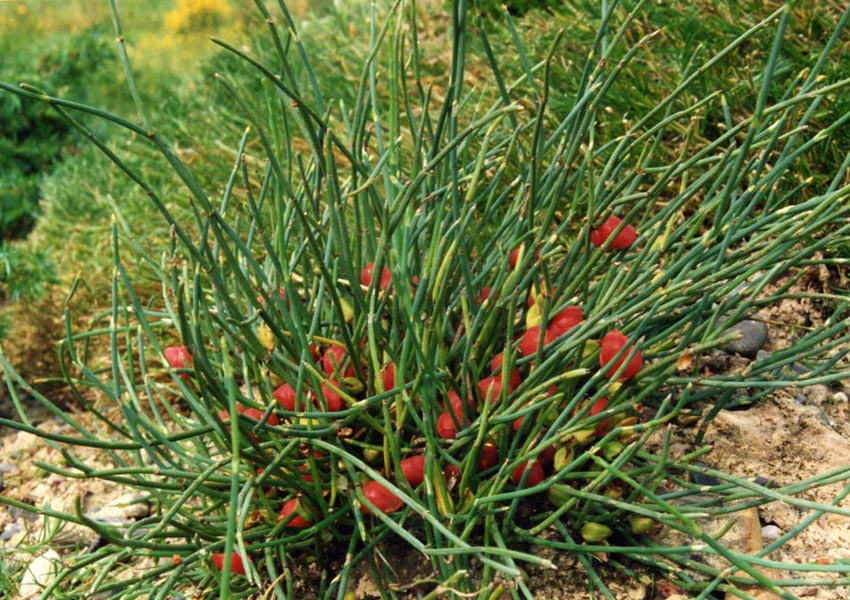
Mormon Tea is a sprawling shrub with erect, sharp-pointed twigs. Its young twigs are light green and become yellowish or greenish gray as they age.[1][2]
Its pointed leaves curl at the nodes and persist on the plant. They can grow up to 1.5 centimeters long, and the shrub can reach approximately 2 metres in height.[3][4][5]
At White Sands National Park, the species is described as a short, spiny, stick-like shrub with thin green stems. Its growth form resembles a miniature bamboo-like plant, and it produces small, pale yellow flowers in spring.[6][7][8]
Habitat
Mormon Tea occurs in desert scrub plant communities. Its documented desert habitats include the Chihuahuan, Sonoran, and Colorado Deserts.[9][10]
The species occurs in the interdunal flats of White Sands National Park.[11]
Its native distribution includes Baja California, Chihuahua, and Sonora in northwestern Mexico, and California, Arizona, New Mexico, and Texas in the southwestern United States.[12][13]
Reproduction and life cycle
Male plants produce pollen cones at the nodes that can reach one centimeter in length. Female plants produce seed cones that are slightly larger than the male pollen cones.[14][15]
Each female seed cone contains one seed enclosed in a papery envelope.[16]
Uses
American Indians used the stems and roots medicinally. Early pioneers brewed a weak medicinal tea from the plant's stems.[17][18]
The plant contains traces of ephedrine. Its ephedrine content is described as having stimulant and decongestant properties relevant to common cold symptoms.[19][20]
The species' twigs have been used to dye wool.[21]
Classification of the Mormon Tea
| Kingdom | Plantae |
|---|---|
| Subkingdom | Pteridobiotina |
| Phylum | Tracheophyta |
| Class | Pinopsida (Conifer) |
| Subclass | Gnetidae |
| Order | Ephedrales |
| Family | Ephedraceae (Jointfir Family) |
| Genus | Ephedra (Ephedras) |
| Species | Ephedra trifurca Torr. ex S.Watson |
Where the Mormon Tea is found
Checklists and occurrence records place Ephedra trifurca in 2 countries. GBIF holds 4,045 georeferenced records of it.
Countries
Regions and cities with the most records
- Arizona, United States 1,127
- New Mexico, United States 832
- California, United States 396
- Texas, United States 340
- Las Cruces, United States 247
- Chihuahua, Mexico 143
- Catalina Foothills, United States 124
- Casas Adobes, United States 121
- Oro Valley, United States 120
- Flowing Wells, United States 118
- Tucson, United States 114
- Tanque Verde, United States 112
- Sonora, Mexico 77
- Sunland Park, United States 77
- El Paso, United States 72
- Baja California, Mexico 53
- Alamogordo, United States 50
- Ciudad Juárez, Mexico 50
- Somerton, United States 49
- Sierra Vista, United States 46
- Drexel Heights, United States 38
- Sahuarita, United States 37
- San Luis, United States 36
- San Luis Río Colorado, Mexico 36
- Coahuila, Mexico 34
- Green Valley, United States 27
- Marana, United States 24
- Nuevo Casas Grandes, Mexico 23
- San Felipe, Mexico 22
- Yuma, United States 21
- Avondale, United States 12
- Brawley, United States 12
- El Mirage, United States 12
- Goodyear, United States 12
- Sun City West, United States 12
- Surprise, United States 12
A number beside a place is its count of GBIF occurrence records. A place without a number comes from a checklist alone. Records show where a species has been observed or collected, which can include escapes and vagrants.
Common names
English
- Mormon Tea
- American Ephedra
- Log-leaf Mormon Tea
- Longleaf Ephedra
- Longleaf Jointfir
- Mexican-tea
- Longleaf Joint-fir
Names in 5 other languages
- Chinese
- 長葉麻黃
- Dutch
- Langbladige Zeedruif
- Russian
- Хвойник трёхвильчатый
- Slovak
- chvojník trojený
- Spanish
- Canutíllo, cola de zorra
Synonyms
2 other scientific names have been used for this species and are now treated as synonyms of Ephedra trifurca.
- Ephedra intermixta H.C.Cutler
- Ephedra trifaria Parl.
Related species
-
 Chinese EphedraEphedra sinica
-
 Green Mormon TeaEphedra viridis
-
 European EphedraEphedra distachya
-
 Nevada EphedraEphedra nevadensis
-
 Joint PineEphedra fragilis
-
 California EphedraEphedra californica
-
 Dwarf Joint FirEphedra monosperma
-
 Death Valley JointfirEphedra funerea
Compare
Questions and answers
What is the scientific name of the Mormon Tea?
The scientific name of the Mormon Tea is Ephedra trifurca. Written with its author, the full name is Ephedra trifurca Torr. ex S.Watson.
Which family does the Mormon Tea belong to?
Ephedra trifurca belongs to the family Ephedraceae, in the order Ephedrales and the class Pinopsida.
Where is the Mormon Tea found?
Checklists and occurrence records place Ephedra trifurca in 2 countries: United States and Mexico.
What is the conservation status of the Mormon Tea?
The IUCN Red List category recorded for Ephedra trifurca is Least Concern (LC).
What other names does the Mormon Tea have?
Ephedra trifurca is also known in English as American Ephedra, Log-leaf Mormon Tea, Longleaf Ephedra, Longleaf Jointfir, Mexican-tea and Longleaf Joint-fir.
What is Mormon tea used for?
American Indians used its stems and roots medicinally, and early pioneers brewed a weak medicinal tea from its stems. Its twigs have also been used to dye wool.[17][18][21]
What does Mormon tea look like?
Mormon Tea is a sprawling shrub with erect, sharp-pointed twigs. Its young twigs are light green and become yellowish or greenish gray as they age, while its pointed leaves curl at the nodes and persist on the plant. It can reach approximately 2 metres in height.[1][2][3][4]
Where does ephedra plant grow?
Mormon Tea is native to Baja California, Chihuahua, and Sonora in northwestern Mexico, and California, Arizona, New Mexico, and Texas in the southwestern United States. It occurs in desert scrub plant communities, including the Chihuahuan, Sonoran, and Colorado Deserts, and in the interdunal flats of White Sands National Park.[12][13][9][10][11]
Sources
Passages the profile rests on
- Ephedra trifurca is a sprawling shrub with erect, sharp-pointed twigs. Source passage: “Ephedra trifurca is a sprawling shrub that can approach 2 metres (6.6 ft) in height.” — English Wikipedia
- Its young twigs are light green and become yellowish or greenish gray as they age. Source passage: “erect, sharp-pointed twigs which are light green when young and age to yellowish or greenish gray.” — English Wikipedia
- Its pointed leaves curl at the nodes and persist on the plant. Source passage: “It has curling, pointed leaves at its nodes which are up to 1.5 centimeters long and persistent.” — English Wikipedia
- The shrub can reach approximately 2 metres in height. Source passage: “can approach 2 metres (6.6 ft) in height.” — English Wikipedia
- Its persistent leaves can grow up to 1.5 centimeters long. Source passage: “leaves at its nodes which are up to 1.5 centimeters long and persistent.” — English Wikipedia
- At White Sands National Park, the species is described as a short, spiny, stick-like shrub with thin green stems. Source passage: “Mormon tea is a short, spiny, stick-like shrub with thin green stems.” — nps.gov
- Its growth form resembles a miniature bamboo-like plant. Source passage: “giving it the appearance of a tiny bamboo-like plant.” — nps.gov
- The species produces small, pale yellow flowers in spring. Source passage: “Small pale yellow flowers appear in the spring.” — nps.gov
- The species occurs in desert scrub plant communities. Source passage: “It is found in desert scrub plant communities” — English Wikipedia
- Its documented desert habitats include the Chihuahuan, Sonoran, and Colorado Deserts. Source passage: “in the Chihuahuan Desert, Sonoran Desert, and Colorado Desert.” — English Wikipedia
- The species occurs in the interdunal flats of White Sands National Park. Source passage: “In the interdunal flats, small shrubs like Mormon tea and rubber rabbitbrush can rise one or two feet above the biological crust of the interdunal flats” — nps.gov
- The species is native to Baja California, Chihuahua, and Sonora in northwestern Mexico. Source passage: “It is native to the states of Baja California, Chihuahua and Sonora in northwestern Mexico” — English Wikipedia
- In the southwestern United States, the species is native to California, Arizona, New Mexico, and Texas. Source passage: “and to California, Arizona, New Mexico, Texas in the Southwestern United States.” — English Wikipedia
- Male plants produce pollen cones at the nodes that can reach one centimeter in length. Source passage: “Male plants produce pollen cones at the nodes, each up to a centimeter long” — English Wikipedia
- Female plants produce seed cones that are slightly larger than the male pollen cones. Source passage: “female plants produce seed cones which are slightly larger” — English Wikipedia
- Each female seed cone contains one seed enclosed in a papery envelope. Source passage: “each contain one seed in a papery envelope.” — English Wikipedia
- American Indians used the stems and roots medicinally. Source passage: “Both the stems and the roots are high in flavonoids and were used as medicines by American Indians.” — nps.gov
- Early pioneers brewed a weak medicinal tea from the plant's stems. Source passage: “Early pioneers used the stems to brew a weak tea for medicinal purposes.” — nps.gov
- The plant contains traces of ephedrine. Source passage: “The plant contains traces of ephedrine” — nps.gov
- The plant's ephedrine content is described as having stimulant and decongestant properties relevant to common cold symptoms. Source passage: “which is a stimulant and decongestant effective in countering symptoms of the common cold.” — nps.gov
- The species' twigs have been used to dye wool. Source passage: “The twigs were also used to dye wool.” — nps.gov
Data
- Catalogue of Life, 2026-10-16 XR cc by
- Global Biodiversity Information Facility CC BY 4.0
- Wikidata CC0
- GeoNames CC BY 4.0
- Wikimedia Commons per image; credit shown with each image
- Within the Catalogue of Life, this name comes from Pinopsida from WFO cc0
References
- Botany [Fortieth Parallel] : 329 (1871) where the name was published
- POWO record for urn:lsid:ipni.org:names:383471-1 Link
This species in other databases
- Catalogue of Life 6FPDC
- Wikidata Q5382150
- iNaturalist 76825
- World Flora Online wfo-0000794495-2026-06
- GRIN 15238
Page built on 26 November 2026. See how the catalog is made and all sources and licences.
Cite this page
ScientificNames.org. (2026). Ephedra trifurca (Mormon Tea). Retrieved November 26, 2026, from https://scientificnames.org/species/ephedra-trifurca
“Ephedra trifurca (Mormon Tea).” ScientificNames.org, 2026, scientificnames.org/species/ephedra-trifurca. Accessed 26 Nov. 2026.
ScientificNames.org. “Ephedra trifurca (Mormon Tea).” Accessed November 26, 2026. https://scientificnames.org/species/ephedra-trifurca.
@misc{scientificnames_ephedra_trifurca_mormon_tea,
  author = {{ScientificNames.org}},
  title = {Ephedra trifurca (Mormon Tea)},
  year = {2026},
  url = {https://scientificnames.org/species/ephedra-trifurca},
  note = {Accessed 2026-11-26}
}