Species · Amphibians
Marbled Poison Frog Epipedobates boulengeri
The scientific name of the Marbled Poison Frog is Epipedobates boulengeri. It is a species of amphibian in the family Dendrobatidae (poison dart frog), order Anura. The name dates from 1909.
- Scientific name
- Epipedobates boulengeri (Barbour, 1909)
- Common name
- Marbled Poison Frog
- Genus
- Epipedobates
- Family
- Dendrobatidae (Poison Dart Frog)
- Order
- Anura
- Class
- Amphibia
- Red List category
- LC Least Concern
- Recorded in
- 2 countries
- Name status
- accepted in the Catalogue of Life

Overview
Epipedobates boulengeri occurs in western Colombia, including Cauca, Nariño and Valle del Cauca Departments and Gorgona Island, as well as northwestern Ecuador. It has variable dark dorsal coloration, black sides and pale lateral and dorsolateral lines.
Written 27 November 2026 from the sources listed below. Each statement was checked against the passage it cites; statements that could not be supported were removed.
Appearance
The dorsal coloration ranges from dark reddish to uniform dark brown, with black sides. The species has a pale yellowish or creamy white lateral line and a cream-coloured dorsolateral line. Its iris is dark coppery black.[1][2][3]
Adult males measure 15–20 mm in snout–vent length, while adult females measure 17–21 mm.[4][5]
Habitat
The Marbled Poison Frog inhabits dense, moist tropical rainforests. It also occurs in modified habitats, including gardens and railway tunnels.[6][7]
It has been recorded at elevations between 10 and 1,500 m above sea level.[8]
Diet
The Marbled Poison Frog feeds on mites, ants, beetles, flies, homopterans and collembolans.[9]
Conservation
The Marbled Poison Frog is classified as Least Concern regarding extinction risk by the IUCN. It is considered tolerant of habitat disturbance.[10][11]
Habitat loss caused by agricultural deforestation and logging is among the threats affecting the species. The introduction of invasive fish is also identified as a potential threat.[12][13]
The fungus Batrachochytrium dendrobatidis has been detected on the species, although no specimens with chytridiomycosis were reported.[14]
Its known range includes Reserva Ecológica Cayapas-Mataje, Parque Nacional Mache Chindul, Reserva Ecológica Cotacachi-Cayapas and Reserva Ecológica Los Illinizas.[15][16][17][18]
Its known range also includes Parque Natural Isla Gorgona, Reserva Natural Biotopo and Reserva Natural Indígena La Nutria.[19][20][21]
The species was most recently assessed for the IUCN Red List in 2018.[22]
Uses
The Marbled Poison Frog has some presence in the international pet trade, but its impact on the species is unknown.[23]
Similar species
The Marbled Poison Frog may represent a species complex comprising at least two species.[24]
Classification of the Marbled Poison Frog
| Kingdom | Animalia |
|---|---|
| Phylum | Chordata |
| Subphylum | Vertebrata |
| Infraphylum | Gnathostomata |
| Parvphylum | Osteichthyes |
| Megaclass | Tetrapoda |
| Class | Amphibia (Amphibians) |
| Order | Anura (Frogs) |
| Superfamily | Dendrobatoidea |
| Family | Dendrobatidae (Poison Dart Frog) |
| Subfamily | Colostethinae |
| Genus | Epipedobates (Phantasmal Poison Frogs) |
| Species | Epipedobates boulengeri (Barbour, 1909) |
Where the Marbled Poison Frog is found
Checklists and occurrence records place Epipedobates boulengeri in 2 countries. GBIF holds 1,661 georeferenced records of it.
Countries
Regions and cities with the most records
- Esmeraldas, Ecuador 512
- Santo Domingo de los Tsáchilas, Ecuador 130
- Valle del Cauca Department, Colombia 117
- Pichincha, Ecuador 112
- Carchi, Ecuador 80
- Imbabura, Ecuador 73
- San Lorenzo de Esmeraldas, Ecuador 42
- Santo Domingo de los Colorados, Ecuador 35
- Los Ríos, Ecuador 28
- Manabí, Ecuador 28
- Nariño, Colombia 27
- Buenaventura, Colombia 19
- Cotopaxi, Ecuador 19
- Buenaventura, Colombia 11
- La Maná, Ecuador 8
- Valencia, Ecuador 6
- Rosa Zarate, Ecuador 5
- Cauca Department, Colombia 3
A number beside a place is its count of GBIF occurrence records. A place without a number comes from a checklist alone. Records show where a species has been observed or collected, which can include escapes and vagrants.
Common names
English
- Marbled Poison Frog
- Marbled Poison-arrow Frog
Names in 4 other languages
- Czech
- pralesnička Boulengerova
- German
- Marmorierter Baumsteiger
- Russian
- Контрастный древолаз
- Spanish
- Rana nodriza de Boulenger
Synonyms
5 other scientific names have been used for this species and are now treated as synonyms of Epipedobates boulengeri.
- Ameerega boulengeri (Barbour, 1909)
- Colostethus boulengeri (Barbour, 1909)
- Dendrobates boulengeri (Barbour, 1909)
- Phyllobates boulengeri (Barbour, 1909)
- Prostherapis boulengeri Barbour, 1909
Related species
-
 Anthony's Poison Arrow FrogEpipedobates anthonyi
-
 Phantasmal Poison FrogEpipedobates tricolor
- Machalilla Poison FrogEpipedobates machalilla
- Darwin Wallace Poison FrogEpipedobates espinosai
- Narino Poison FrogEpipedobates narinensis
- Currulao Nurse FrogEpipedobates currulao
- Confusing Poison FrogEpipedobates maculatus
-
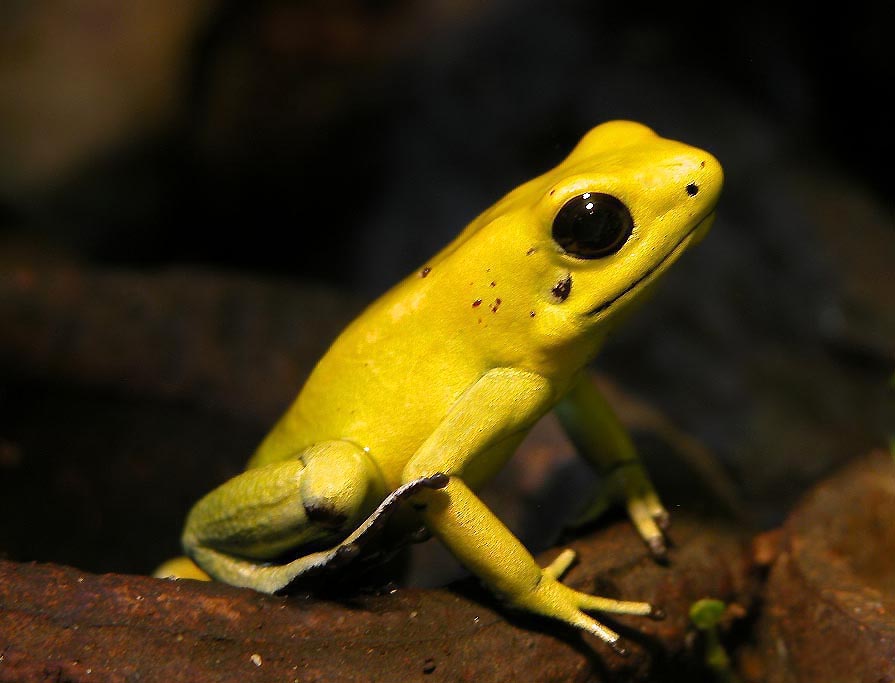 Golden Poison FrogPhyllobates terribilis
Compare
Questions and answers
What is the scientific name of the Marbled Poison Frog?
The scientific name of the Marbled Poison Frog is Epipedobates boulengeri. Written with its author, the full name is Epipedobates boulengeri (Barbour, 1909).
Which family does the Marbled Poison Frog belong to?
Epipedobates boulengeri belongs to the family Dendrobatidae, in the order Anura and the class Amphibia.
Where is the Marbled Poison Frog found?
Checklists and occurrence records place Epipedobates boulengeri in 2 countries: Ecuador and Colombia.
What is the conservation status of the Marbled Poison Frog?
The IUCN Red List category recorded for Epipedobates boulengeri is Least Concern (LC).
What other names does the Marbled Poison Frog have?
Epipedobates boulengeri is also known in English as Marbled Poison-arrow Frog.
Sources
Passages the profile rests on
- The species has a variable dorsal coloration ranging from dark reddish to uniform dark brown, with black sides. Source passage: “Colouration is variable; dorsum is dark reddish to uniform dark brown, sides are black.” — English Wikipedia
- The species has a pale yellowish or creamy white lateral line and a cream-coloured dorsolateral line. Source passage: “There is a pale yellowish or creamy white lateral line and cream-coloured dorsolateral line.” — English Wikipedia
- The iris is dark coppery black. Source passage: “Iris is dark coppery black.” — English Wikipedia
- Adult males measure 15–20 mm in snout–vent length. Source passage: “Males measure 15–20 mm (0.59–0.79 in)” — English Wikipedia
- Adult females measure 17–21 mm in snout–vent length. Source passage: “females 17–21 mm (0.67–0.83 in) in snout–vent length.” — English Wikipedia
- The species inhabits dense, moist tropical rainforests. Source passage: “Its natural habitats are dense moist tropical rainforests” — English Wikipedia
- The species also occurs in modified habitats, including gardens and railway tunnels. Source passage: “as well as altered habitats like gardens and railway tunnels.” — English Wikipedia
- The species has been recorded at elevations between 10 and 1,500 m above sea level. Source passage: “at elevations of 10–1,500 m (33–4,921 ft) asl.” — English Wikipedia
- The species feeds on mites, ants, beetles, flies, homopterans and collembolans. Source passage: “Diet is varied and includes mites, ants, coleopterans, dipterans, homopterans, and colembolas.” — English Wikipedia
- The species is classified as Least Concern regarding extinction risk by the IUCN. Source passage: “The IUCN classifies this frog as least concern of extinction.” — English Wikipedia
- The species is considered tolerant of habitat disturbance. Source passage: “Scientists note that it is tolerant to habitat disturbance.” — English Wikipedia
- Habitat loss caused by agricultural deforestation and logging is among the threats affecting the species. Source passage: “habitat loss from deforestation associated with agriculture, including illegal agriculture, and logging.” — English Wikipedia
- The introduction of invasive fish is also identified as a potential threat to the species. Source passage: “The introduction of invasive fish also poses some threat.” — English Wikipedia
- The fungus Batrachochytrium dendrobatidis has been detected on the species, although no specimens with chytridiomycosis were reported. Source passage: “Scientists noted the presence of the fungus Batrachochytrium dendrobatidis on this frog but they did not note any specimens who were sick with the corresponding fungal disease chytridiomycosis” — English Wikipedia
- The species' known range includes Reserva Ecológica Cayapas-Mataje. Source passage: “Reserva Ecológica Cayapas-Mataje” — English Wikipedia
- The species' known range includes Parque Nacional Mache Chindul. Source passage: “Parque Nacional Mache Chindul” — English Wikipedia
- The species' known range includes Reserva Ecológica Cotacachi-Cayapas. Source passage: “Reserva Ecológica Cotacachi-Cayapas” — English Wikipedia
- The species' known range includes Reserva Ecológica Los Illinizas. Source passage: “Reserva Ecológica Los Illinizas” — English Wikipedia
- The species' known range includes Parque Natural Isla Gorgona. Source passage: “Parque Natural Isla Gorgona” — English Wikipedia
- The species' known range includes Reserva Natural Biotopo. Source passage: “Reserva Natural Biotopo” — English Wikipedia
- The species' known range includes Reserva Natural Indígena La Nutria. Source passage: “Reserva Natural Indígena La Nutria.” — English Wikipedia
- The species was most recently assessed for the IUCN Red List in 2018. Source passage: “has most recently been assessed for The IUCN Red List of Threatened Species in 2018.” — iucnredlist.org
- The species has some presence in the international pet trade, but its impact on the species is unknown. Source passage: “This animal shows some presence on the international pet trade, but scientists do not know if this is a danger to the frog or not.” — English Wikipedia
- The species may represent a species complex comprising at least two species. Source passage: “It likely represents a species complex of at least two species.” — English Wikipedia
Data
- Catalogue of Life, 2026-10-16 XR cc by
- Global Biodiversity Information Facility CC BY 4.0
- Wikidata CC0
- GeoNames CC BY 4.0
- Wikimedia Commons per image; credit shown with each image
- Within the Catalogue of Life, this name comes from The Integrated Taxonomic Information System cc0
This species in other databases
Page built on 29 November 2026. See how the catalog is made and all sources and licences.
Cite this page
ScientificNames.org. (2026). Epipedobates boulengeri (Marbled Poison Frog). Retrieved November 29, 2026, from https://scientificnames.org/species/epipedobates-boulengeri
“Epipedobates boulengeri (Marbled Poison Frog).” ScientificNames.org, 2026, scientificnames.org/species/epipedobates-boulengeri. Accessed 29 Nov. 2026.
ScientificNames.org. “Epipedobates boulengeri (Marbled Poison Frog).” Accessed November 29, 2026. https://scientificnames.org/species/epipedobates-boulengeri.
@misc{scientificnames_epipedobates_boulengeri_marbled_poison_frog,
  author = {{ScientificNames.org}},
  title = {Epipedobates boulengeri (Marbled Poison Frog)},
  year = {2026},
  url = {https://scientificnames.org/species/epipedobates-boulengeri},
  note = {Accessed 2026-11-29}
}