Species · Amphibians
Phantasmal Poison Frog Epipedobates tricolor
The scientific name of the Phantasmal Poison Frog is Epipedobates tricolor. It is a species of amphibian in the family Dendrobatidae (poison dart frog), order Anura. The name dates from 1899.
- Scientific name
- Epipedobates tricolor (Boulenger, 1899)
- Common name
- Phantasmal Poison Frog
- Genus
- Epipedobates
- Family
- Dendrobatidae (Poison Dart Frog)
- Order
- Anura
- Class
- Amphibia
- Red List category
- VU Vulnerable
- Recorded in
- 2 countries
- Name status
- accepted in the Catalogue of Life

Overview
The Phantasmal Poison Frog (Epipedobates tricolor) is an amphibian in the family Dendrobatidae, order Anura, and class Amphibia. It inhabits Chocoan tropical and subtropical rain forests in Ecuador and is restricted to locations on the Andean slopes of Bolívar Province in central Ecuador. It is distinguished by two or three bright longitudinal stripes and green bones.
Written 26 November 2026 from the sources listed below. Each statement was checked against the passage it cites; statements that could not be supported were removed.
Appearance
The Phantasmal Poison Frog has body coloration ranging from dark brown to dark red or black. Individuals have two or three bright longitudinal stripes, which may be orange, yellow, or light green and extend from the head to the rear of the body. The stripes may have straight or flame-like shapes.[1][2][3][4]
The extremities and portions of the dorsal surface have spots or blotches matching the stripe coloration. The hind areas have distinct red or orange spots or markings, while the dorsal surface is usually green or yellow.[5][6][7]
The species has a wide head, a truncated snout, and smooth skin. All fingers are partially webbed, and the first finger is longer than the second. Its bones are green.[8][9][10]
Its approximate snout-to-vent length is 22.6 mm.[11]
Habitat
The Phantasmal Poison Frog inhabits Chocoan tropical and subtropical rain forests in Ecuador. Its natural habitat includes leaf litter on tropical forest floors, particularly near streams, as well as inland wetlands.[12][13][14]
The species has also been found in banana and cacao plantations and in pastures near streams.[15][16]
The species is endemic to Ecuador. Its known distribution is restricted to locations on the Andean slopes of Bolívar Province in central Ecuador, at elevations between 319 and 1,769 metres above sea level.[17][18][19]
Diet
The Phantasmal Poison Frog feeds on insects. Its documented insect prey includes ants, termites, and beetles.[20][21]
Behaviour
The species is active during the day. Males produce most of their calls in the mornings, although they also call at night. They usually call from elevated perches but may also call from the ground.[22][23][24]
Males compete for preferred calling perches through a hierarchical system. They defend their territories aggressively when intruders enter, initially calling at intruders and potentially chasing and fighting them when vocal warnings fail.[25][26][27][28]
Females are not known to exhibit territorial behaviour.[29]
Reproduction and life cycle
Females lay their eggs in leaf litter. Clutches contain approximately 10 eggs, and males guard the eggs during development.[30][31][32]
Males transport tadpoles on their backs to bodies of water. These bodies of water provide a safe environment for tadpole development.[33][34]
Conservation
The Phantasmal Poison Frog is classified as Vulnerable by the IUCN. Its estimated range is less than 5,000 square kilometres, and its population numbers show an apparent decline.[35][36][37]
Habitat destruction is identified as a threat to the species. Overharvesting for medicinal research has also been identified as a potential threat.[38][39]
Uses
The Phantasmal Poison Frog produces epibatidine, a toxin of pharmacological interest. Epibatidine has been studied for its potential medicinal value as a painkiller and opioid blocker.[40][41]
Similar species
The Phantasmal Poison Frog has a habitat similar to that of Dendrobates tinctorius and Dendrobates auratus.[42][43]
Epipedobates tricolor occurs in similar areas to Epipedobates machalilla, although the two species occupy somewhat different environmental niches.[44]
The species has historically been confused with Epipedobates anthonyi because of similarities in coloration and vocal calls. It was formally distinguished from Epipedobates anthonyi in a 2004 study.[45][46]
Classification of the Phantasmal Poison Frog
| Kingdom | Animalia |
|---|---|
| Phylum | Chordata |
| Subphylum | Vertebrata |
| Infraphylum | Gnathostomata |
| Parvphylum | Osteichthyes |
| Megaclass | Tetrapoda |
| Class | Amphibia (Amphibians) |
| Order | Anura (Frogs) |
| Superfamily | Dendrobatoidea |
| Family | Dendrobatidae (Poison Dart Frog) |
| Subfamily | Colostethinae |
| Genus | Epipedobates (Phantasmal Poison Frogs) |
| Species | Epipedobates tricolor (Boulenger, 1899) |
Where the Phantasmal Poison Frog is found
Checklists and occurrence records place Epipedobates tricolor in 2 countries. GBIF holds 1,528 georeferenced records of it.
Countries
Regions and cities with the most records
- Bolívar, Ecuador 471
- Cotopaxi, Ecuador 160
- El Oro, Ecuador 103
- Azuay, Ecuador 91
- Montalvo, Ecuador 69
- Piñas, Ecuador 58
- Santa Rosa, Ecuador 37
- Guabo, Ecuador 36
- Machala, Ecuador 36
- Pasaje, Ecuador 36
- Piura, Peru 9
- Los Ríos, Ecuador 4
- Pichincha, Ecuador 4
- Quito, Ecuador 3
1 more country has a few records outside this range
These countries hold a few records of Epipedobates tricolor but lie outside the range the checklists give for it. Such records are often zoo or garden specimens, museum material or vagrants, so the species is not counted as occurring there.
A number beside a place is its count of GBIF occurrence records. A place without a number comes from a checklist alone. Records show where a species has been observed or collected, which can include escapes and vagrants.
Common names
English
- Phantasmal Poison Frog
- Tricolor Poison Frog
Names in 7 other languages
- Chinese
- 三色箭毒蛙
- Czech
- pralesnička trojbarvá
- Dutch
- Driekleurige pijlgifkikker
- German
- Dreifarbiger Baumsteiger, Dreistreifen-Baumsteiger, Dreistreifen-Blattsteiger
- Norwegian Bokmål
- fantompilgiftfrosk, trefarget dvergfrosk
- Russian
- Трёхполосый листолаз
- Spanish
- Rana Tricolor Ecuatoriana, Rana nodriza tricolor ecuatoriana
Synonyms
6 other scientific names have been used for this species and are now treated as synonyms of Epipedobates tricolor.
- Ameerega tricolor (Boulenger, 1899)
- Colostethus paradoxus Rivero, 1991
- Dendrobates tricolor (Boulenger, 1899)
- Epipedobates bicolor (Boulenger, 1899)
- Phyllobates tricolor (Boulenger, 1899)
- Prostherapis tricolor Boulenger, 1899
Related species
-
 Anthony's Poison Arrow FrogEpipedobates anthonyi
- Ayampe Poison FrogEpipedobates machalilla
- Espinosa Poison FrogEpipedobates espinosai
-
 Marbled Poison FrogEpipedobates boulengeri
- Narino Poison FrogEpipedobates narinensis
- Currulao Nurse FrogEpipedobates currulao
- Confusing Poison FrogEpipedobates maculatus
-
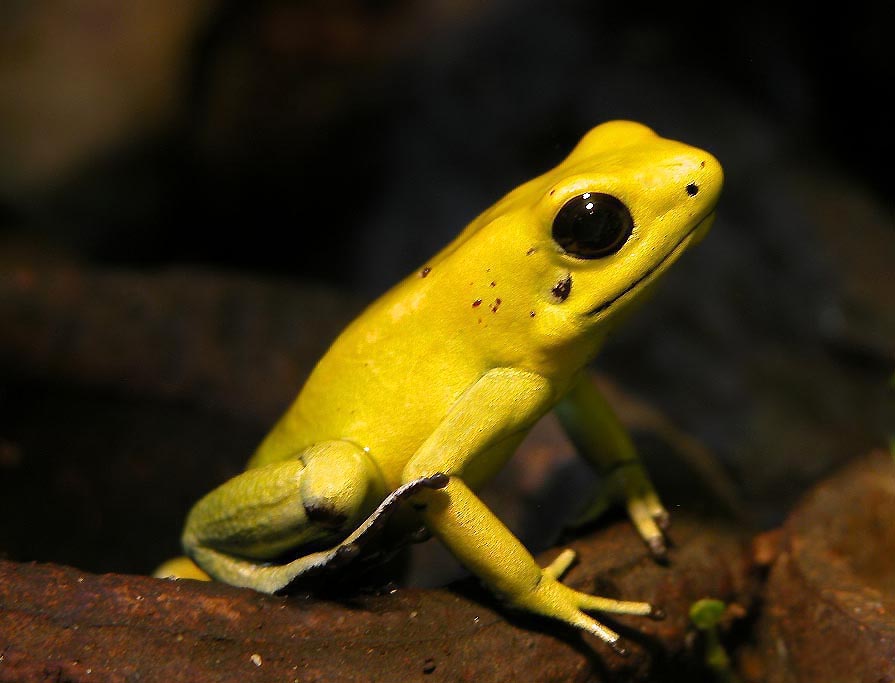 Golden Poison FrogPhyllobates terribilis
Compare
Questions and answers
What is the scientific name of the Phantasmal Poison Frog?
The scientific name of the Phantasmal Poison Frog is Epipedobates tricolor. Written with its author, the full name is Epipedobates tricolor (Boulenger, 1899).
Which family does the Phantasmal Poison Frog belong to?
Epipedobates tricolor belongs to the family Dendrobatidae, in the order Anura and the class Amphibia.
Where is the Phantasmal Poison Frog found?
Checklists and occurrence records place Epipedobates tricolor in 2 countries: Ecuador and Peru.
What is the conservation status of the Phantasmal Poison Frog?
The IUCN Red List category recorded for Epipedobates tricolor is Vulnerable (VU).
What other names does the Phantasmal Poison Frog have?
Epipedobates tricolor is also known in English as Tricolor Poison Frog.
What diet do poison dart frogs eat?
The Phantasmal Poison Frog feeds on insects, including ants, termites, and beetles.[20][21]
What is a poison dart frog's habitat like?
The Phantasmal Poison Frog inhabits Chocoan tropical and subtropical rain forests in Ecuador. Its natural habitat includes leaf litter on tropical forest floors, particularly near streams, and inland wetlands. It also occurs in banana and cacao plantations and pastures near streams.[12][13][14][15][16]
Sources
Passages the profile rests on
- The species has body coloration ranging from dark brown to dark red or black. Source passage: “The Phantasmal Dart Frog varies in body color, ranging from dark brown to dark red or black.” — English Wikipedia
- Individuals have two or three bright longitudinal stripes that may be orange, yellow, or light green. Source passage: “They have two or three bright orange, bright yellow, or even light green longitudinal stripes along their back” — English Wikipedia
- The longitudinal stripes extend from the head to the rear of the body. Source passage: “ranging from their head to their rear.” — English Wikipedia
- The longitudinal stripes may have straight or flame-like shapes. Source passage: “These can be straight or in a flame-like shape.” — English Wikipedia
- The extremities and portions of the dorsal surface have spots or blotches matching the stripe coloration. Source passage: “Their extremities, along with parts of their dorsal surface, have blotches or spots that match the color of their stripes.” — English Wikipedia
- The hind areas have distinct red or orange spots or markings. Source passage: “They also have distinct red or orange spots or markings in their hind areas.” — English Wikipedia
- The dorsal surface is usually green or yellow. Source passage: “The dorsal surface is usually green or yellow” — English Wikipedia
- The species has a wide head, a truncated snout, and smooth skin. Source passage: “They have a wide head, truncated snout, and smooth skin.” — English Wikipedia
- All fingers are partially webbed, and the first finger is longer than the second. Source passage: “All of their fingers are partially webbed, and their first finger is longer than their second.” — English Wikipedia
- The species has green bones. Source passage: “Epipedobates tricolor differs from members of the femoralis group by having green bones” — amphibiaweb.org
- The species has an approximate snout-to-vent length of 22.6 mm. Source passage: “They have a snout-to-vent length of about 22.6 mm (0.9 in)” — English Wikipedia
- The species inhabits Chocoan tropical and subtropical rain forests in Ecuador. Source passage: “The species inhabits the Chocoan tropical and subtropical rain forest in Ecuador.” — English Wikipedia
- Its natural habitat includes leaf litter on tropical forest floors, particularly near streams. Source passage: “Its natural habitat is in the leaf litter on the floor of the tropical forest, especially near streams” — English Wikipedia
- The species also occurs in inland wetlands. Source passage: “and in inland wetlands.” — English Wikipedia
- The species has been found in banana and cacao plantations. Source passage: “They are also found in banana and cacao plantations” — English Wikipedia
- The species occurs in pastures near streams. Source passage: “and pastures near streams.” — English Wikipedia
- The species is endemic to Ecuador. Source passage: “It is endemic to Ecuador” — English Wikipedia
- Its known distribution is restricted to locations on the Andean slopes of Bolívar Province in central Ecuador. Source passage: “The phantasmal poison frog is known only from a number of locations in central Ecuador on the Andean slopes of Bolívar Province” — English Wikipedia
- The species occurs at elevations between 319 and 1,769 metres above sea level. Source passage: “at heights of between 319 and 1,769 m (1,047 and 5,804 ft) above sea level.” — English Wikipedia
- The species feeds on insects. Source passage: “The phantasmal poison frog's diet is based on the consumption of insects.” — English Wikipedia
- Its documented insect prey includes ants, termites, and beetles. Source passage: “their diet consists of insects includes ants, termites, and beetles.” — English Wikipedia
- The species is active during the day. Source passage: “The Phantasmal Dart Frog is diurnal.” — English Wikipedia
- Males produce most of their calls in the mornings, although they also call at night. Source passage: “Males are vocal and make a majority of calls in the mornings, but they are also known to make calls at night.” — English Wikipedia
- Males usually call from elevated perches but may also call from the ground. Source passage: “They mostly make these calls on an elevated perch but can make them on the ground as well.” — English Wikipedia
- Males compete for preferred calling perches through a hierarchical system. Source passage: “Males are also known to compete for "the best" perch in a hierarchal power system.” — English Wikipedia
- Males defend their territories aggressively when intruders enter. Source passage: “The males are also very territorial and are aggressive upon their territory being breached.” — English Wikipedia
- Males initially defend their territories by calling at intruders. Source passage: “They will first use vocalization to defend their territory, sending out calls at the intruders.” — English Wikipedia
- Males may chase and fight intruders when vocal warnings fail. Source passage: “If that doesn't work, they will chase and fight the intruders to defend their territory.” — English Wikipedia
- Females are not known to exhibit territorial behaviour. Source passage: “Unlike the males, females are not known to be territorial.” — English Wikipedia
- Females lay their eggs in leaf litter. Source passage: “The eggs are laid in leaf litter” — English Wikipedia
- Clutches contain approximately 10 eggs. Source passage: “the clutch sizes are around 10 eggs.” — English Wikipedia
- Males guard the eggs during development. Source passage: “The males stand guard for the eggs” — English Wikipedia
- Males transport tadpoles on their backs to bodies of water. Source passage: “and later in their development carry the tadpoles on their back to bodies of water” — English Wikipedia
- Bodies of water provide a safe environment for tadpole development. Source passage: “which provides a safe haven for the tadpoles to develop.” — English Wikipedia
- The species is classified as Vulnerable by the IUCN. Source passage: “The phantasmal poison frog is listed as "vulnerable" by the IUCN.” — English Wikipedia
- Its estimated range is less than 5,000 square kilometres. Source passage: “its limited range, estimated to be less than 5,000 square kilometres (1,900 sq mi)” — English Wikipedia
- The species has an apparent decline in population numbers. Source passage: “and the apparent decline in numbers of this species.” — English Wikipedia
- Habitat destruction is identified as a threat to the species. Source passage: “This species has been classified as vulnerable due to an increase in habitat destruction in the few locations where they are known to live.” — English Wikipedia
- Overharvesting for medicinal research has been identified as a potential threat. Source passage: “The IUCN has noted that over-harvesting of the frog for medicinal research could pose a risk for the species.” — English Wikipedia
- The species produces epibatidine, a toxin of pharmacological interest. Source passage: “The frogs secrete epibatidine, a toxin of high pharmacological interest” — English Wikipedia
- Epibatidine has been studied for its potential medicinal value as a painkiller and opioid blocker. Source passage: “Epibatidine is a toxin of pharmacological interest due to its medicinal value as a painkiller and opioid blocker.” — English Wikipedia
- The species has a habitat similar to that of Dendrobates tinctorius. Source passage: “Its habitat is very similar to other species of the poison dart frog family such as the dyeing dart frog (Dendrobates tinctorius)” — English Wikipedia
- The species has a habitat similar to that of Dendrobates auratus. Source passage: “and the green-and-black dart frog (Dendrobates auratus).” — English Wikipedia
- Epipedobates tricolor occurs in similar areas to Epipedobates machalilla, although the two species occupy somewhat different environmental niches. Source passage: “Phantasmal poison frogs live in similar areas to Epipedobates machalilla, despite the fact that the two to occupy slightly different environmental niches.” — English Wikipedia
- Epipedobates tricolor has historically been confused with Epipedobates anthonyi because of similarities in coloration and vocal calls. Source passage: “They're often confused due to their similar coloring patterns and vocal calls.” — English Wikipedia
- Epipedobates tricolor was formally distinguished from Epipedobates anthonyi in a 2004 study. Source passage: “the two weren't formally distinguished as two different species until a 2004 study concluded so.” — English Wikipedia
Data
- Catalogue of Life, 2026-10-16 XR cc by
- Global Biodiversity Information Facility CC BY 4.0
- Wikidata CC0
- GeoNames CC BY 4.0
- Wikimedia Commons per image; credit shown with each image
- Within the Catalogue of Life, this name comes from The Integrated Taxonomic Information System cc0
This species in other databases
Page built on 26 November 2026. See how the catalog is made and all sources and licences.
Cite this page
ScientificNames.org. (2026). Epipedobates tricolor (Phantasmal Poison Frog). Retrieved November 26, 2026, from https://scientificnames.org/species/epipedobates-tricolor
“Epipedobates tricolor (Phantasmal Poison Frog).” ScientificNames.org, 2026, scientificnames.org/species/epipedobates-tricolor. Accessed 26 Nov. 2026.
ScientificNames.org. “Epipedobates tricolor (Phantasmal Poison Frog).” Accessed November 26, 2026. https://scientificnames.org/species/epipedobates-tricolor.
@misc{scientificnames_epipedobates_tricolor_phantasmal_poison_frog,
  author = {{ScientificNames.org}},
  title = {Epipedobates tricolor (Phantasmal Poison Frog)},
  year = {2026},
  url = {https://scientificnames.org/species/epipedobates-tricolor},
  note = {Accessed 2026-11-26}
}