Species · Amphibians
Darwin Wallace Poison Frog Epipedobates espinosai
The scientific name of the Darwin Wallace Poison Frog is Epipedobates espinosai. It is a species of amphibian in the family Dendrobatidae (poison dart frog), order Anura. The name dates from 1956.
- Scientific name
- Epipedobates espinosai (Funkhouser, 1956)
- Common name
- Darwin Wallace Poison Frog
- Genus
- Epipedobates
- Family
- Dendrobatidae (Poison Dart Frog)
- Order
- Anura
- Class
- Amphibia
- Red List category
- DD Data Deficient
- Recorded in
- 1 country
- Name status
- accepted in the Catalogue of Life
Overview
The Darwin Wallace poison frog is an amphibian in the subfamily Colostethinae. It inhabits lowland forests near streams and is associated with leaf litter. It has a coffee-colored or dark red back with blue and white patterns and black flanks with some turquoise coloration.
Written 27 November 2026 from the sources listed below. Each statement was checked against the passage it cites; statements that could not be supported were removed.
Appearance
The frog has a coffee-colored or dark red back marked with blue and white reticulations or other patterns. Its flanks are black with some turquoise coloration.[1][2]
Habitat
The species inhabits lowland forests near streams and is associated with leaf litter in its forest habitat. It has been observed at elevations between 858 and 1719 meters above sea level.[3][4][5]
Tadpoles have been observed in streams near fast waterfalls.[6]
Behaviour
The species is active during the day.[7]
Reproduction and life cycle
Females are inferred to deposit their eggs on the ground, although egg-laying has not been directly observed.[8]
Male frogs have been observed carrying tadpoles on their backs during October. They are inferred to transport tadpoles to water.[9][10]
Conservation
The IUCN classifies the species as Data Deficient, and its threat level is uncertain.[11][12]
Its habitat is affected by deforestation associated with agriculture, livestock cultivation, and logging.[13]
The species may be involved in the international pet trade, but whether this represents a threat is unknown.[14]
Classification of the Darwin Wallace Poison Frog
| Kingdom | Animalia |
|---|---|
| Phylum | Chordata |
| Subphylum | Vertebrata |
| Infraphylum | Gnathostomata |
| Parvphylum | Osteichthyes |
| Megaclass | Tetrapoda |
| Class | Amphibia (Amphibians) |
| Order | Anura (Frogs) |
| Superfamily | Dendrobatoidea |
| Family | Dendrobatidae (Poison Dart Frog) |
| Subfamily | Colostethinae |
| Genus | Epipedobates (Phantasmal Poison Frogs) |
| Species | Epipedobates espinosai (Funkhouser, 1956) |
Where the Darwin Wallace Poison Frog is found
Checklists and occurrence records place Epipedobates espinosai in 1 country. GBIF holds 882 georeferenced records of it.
Countries
Regions and cities with the most records
- Pichincha, Ecuador 280
- Esmeraldas, Ecuador 155
- Santo Domingo de los Tsáchilas, Ecuador 141
- Los Ríos, Ecuador 75
- Santo Domingo de los Colorados, Ecuador 70
- Cotopaxi, Ecuador 66
- La Maná, Ecuador 21
- Manabí, Ecuador 11
- Rosa Zarate, Ecuador 5
A number beside a place is its count of GBIF occurrence records. A place without a number comes from a checklist alone. Records show where a species has been observed or collected, which can include escapes and vagrants.
Common names
English
- Darwin Wallace Poison Frog
- Darwin Wallace's Poison Frog
- Espinosa Poison Frog
- Espinosa's Poison Frog
- Turquoise-bellied Poison Frog
- Turquoise-bellied Poison-arrow Frog
- Turquoise-bellied Poison Arrow Frog
Names in 3 other languages
- Czech
- pralesnička espinoská
- Russian
- Бирюзовый древолаз
- Spanish
- Rana nodriza de Darwin y Wallace, Rana nodriza de Espinosa
Synonyms
5 other scientific names have been used for this species and are now treated as synonyms of Epipedobates espinosai.
- Ameerega espinosai (Funkhouser, 1956)
- Dendrobates espinosai (Funkhouser, 1956)
- Epipedobates darwinwallacei Cisneros-Heredia & Yánez-Muñoz, 2011
- Epipedobates robnatali van der Horst & Woldhuis, 2006
- Phyllobates espinosai Funkhouser, 1956
Related species
-
 Anthony's Poison Arrow FrogEpipedobates anthonyi
-
 Phantasmal Poison FrogEpipedobates tricolor
- Machalilla Poison FrogEpipedobates machalilla
-
 Marbled Poison FrogEpipedobates boulengeri
- Narino Poison FrogEpipedobates narinensis
- Currulao Nurse FrogEpipedobates currulao
- Confusing Poison FrogEpipedobates maculatus
-
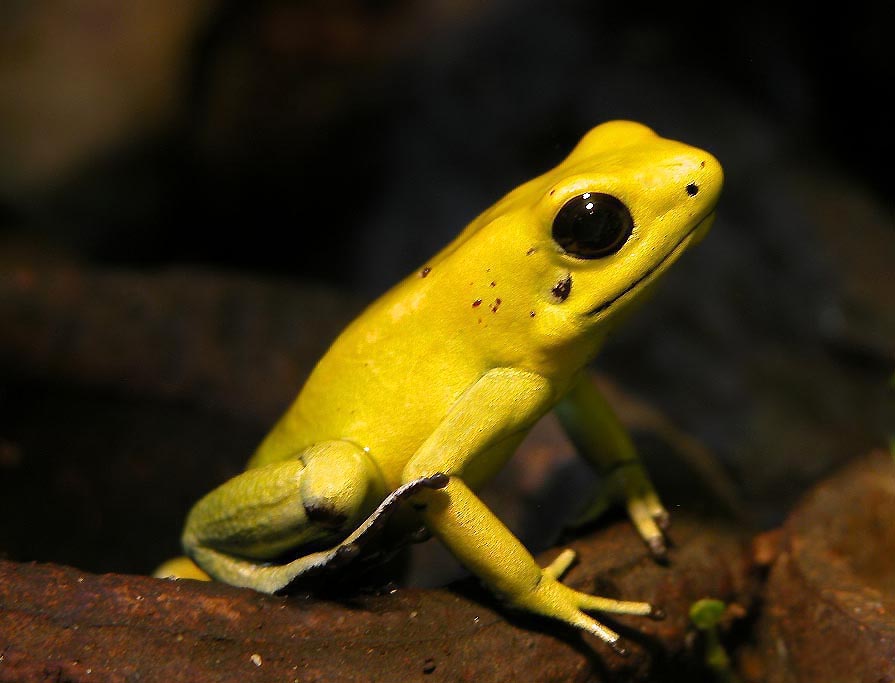 Golden Poison FrogPhyllobates terribilis
Compare
Questions and answers
What is the scientific name of the Darwin Wallace Poison Frog?
The scientific name of the Darwin Wallace Poison Frog is Epipedobates espinosai. Written with its author, the full name is Epipedobates espinosai (Funkhouser, 1956).
Which family does the Darwin Wallace Poison Frog belong to?
Epipedobates espinosai belongs to the family Dendrobatidae, in the order Anura and the class Amphibia.
Where is the Darwin Wallace Poison Frog found?
Checklists and occurrence records place Epipedobates espinosai in 1 country: Ecuador.
What is the conservation status of the Darwin Wallace Poison Frog?
The IUCN Red List category recorded for Epipedobates espinosai is Data Deficient (DD).
What other names does the Darwin Wallace Poison Frog have?
Epipedobates espinosai is also known in English as Darwin Wallace's Poison Frog, Espinosa Poison Frog, Espinosa's Poison Frog, Turquoise-bellied Poison Frog, Turquoise-bellied Poison-arrow Frog and Turquoise-bellied Poison Arrow Frog.
Sources
Passages the profile rests on
- The frog has a coffee-colored or dark red back marked with blue and white reticulations or other patterns. Source passage: “The skin of the frog's back is coffee or dark red in color with blue and white reticulations or other marks.” — English Wikipedia
- The frog has black flanks with some turquoise coloration. Source passage: “The flanks are black in color with some turquoise.” — English Wikipedia
- The species inhabits lowland forests near streams. Source passage: “This diurnal frog lives near streams in lowland forests” — English Wikipedia
- The species is associated with leaf litter in its forest habitat. Source passage: “where it is associated with the leaf litter.” — English Wikipedia
- The species has been observed at elevations between 858 and 1719 meters above sea level. Source passage: “Scientists observed the frog between 858 and 1719 meters above sea level.” — English Wikipedia
- Tadpoles have been observed in streams near fast waterfalls. Source passage: “Scientists have observed the tadpoles in streams near fast waterfalls.” — English Wikipedia
- The species is active during the day. Source passage: “This diurnal frog lives near streams in lowland forests” — English Wikipedia
- Females are inferred to deposit their eggs on the ground, although egg-laying has not been directly observed. Source passage: “Although they have not observed the females laying eggs, they infer that they lay them on the ground, like other frogs in Epipedobates.” — English Wikipedia
- Male frogs have been observed carrying tadpoles on their backs during October. Source passage: “They have observed male frogs carrying tadpoles on their backs, in October” — English Wikipedia
- Male frogs are inferred to transport tadpoles to water. Source passage: “so they infer that the male frogs carry the tadpoles to water.” — English Wikipedia
- The IUCN classifies the species as Data Deficient. Source passage: “The IUCN classifies this frog as data deficient.” — English Wikipedia
- The species' threat level is uncertain. Source passage: “Its threat level is not certain.” — English Wikipedia
- The species' habitat is affected by deforestation associated with agriculture, livestock cultivation, and logging. Source passage: “However, its habitat is subject to deforestation in favor of agriculture, livestock cultivation, and logging.” — English Wikipedia
- The species may be involved in the international pet trade, but whether this represents a threat is unknown. Source passage: “Scientists believe this frog might be part of the international pet trade but do not know if this poses a threat.” — English Wikipedia
Data
- Catalogue of Life, 2026-10-16 XR cc by
- Global Biodiversity Information Facility CC BY 4.0
- Wikidata CC0
- GeoNames CC BY 4.0
- Within the Catalogue of Life, this name comes from The Integrated Taxonomic Information System cc0
This species in other databases
Page built on 28 November 2026. See how the catalog is made and all sources and licences.
Cite this page
ScientificNames.org. (2026). Epipedobates espinosai (Darwin Wallace Poison Frog). Retrieved November 28, 2026, from https://scientificnames.org/species/epipedobates-espinosai
“Epipedobates espinosai (Darwin Wallace Poison Frog).” ScientificNames.org, 2026, scientificnames.org/species/epipedobates-espinosai. Accessed 28 Nov. 2026.
ScientificNames.org. “Epipedobates espinosai (Darwin Wallace Poison Frog).” Accessed November 28, 2026. https://scientificnames.org/species/epipedobates-espinosai.
@misc{scientificnames_epipedobates_espinosai_darwin_wallace_poison_frog,
  author = {{ScientificNames.org}},
  title = {Epipedobates espinosai (Darwin Wallace Poison Frog)},
  year = {2026},
  url = {https://scientificnames.org/species/epipedobates-espinosai},
  note = {Accessed 2026-11-28}
}