Species · Birds
Blue Korhaan Eupodotis caerulescens
The scientific name of the Blue Korhaan is Eupodotis caerulescens. It is a species of bird in the family Otididae (bustard), order Otidiformes. The name dates from 1821.
- Scientific name
- Eupodotis caerulescens (Vieillot, 1821)
- Common name
- Blue Korhaan
- Genus
- Eupodotis
- Family
- Otididae (Bustard)
- Order
- Otidiformes
- Class
- Aves
- Red List category
- NT Near Threatened
- Recorded in
- 2 countries
- Name status
- accepted in the Catalogue of Life

Overview
Eupodotis caerulescens occurs in Lesotho and South Africa. It is distinguished by bluish-grey neck and underparts, a black-and-white face and a dull chestnut back.
Written 26 November 2026 from the sources listed below. Each statement was checked against the passage it cites; statements that could not be supported were removed.
Appearance
The Blue Korhaan has a sturdy body, a large head, a long neck, long legs and short toes. It measures 50–58 cm in total length.[1][2]
It has a black forehead and crown, white sides of the head, and yellow legs and feet. Males have a black-and-white face, brown backs, wings and tails, and bluish-grey necks, throats, breasts and bellies.[3][4][5][6]
Females have duller grey necks and underparts and buff ear coverts compared with males.[7]
The species has striking bluish-gray underparts and neck and a dull chestnut back.[8]
Habitat
The Blue Korhaan inhabits plateau grassland, dry shrubland, arable land and pastureland. It prefers short grassland with flat topography and occurs in grasslands at elevations of 1,500–3,000 metres.[9][10][11]
It favours short grass habitats containing scattered karoo-type dwarf shrubs and termite mounds, with few trees. It usually occurs within one kilometre of water.[12][13]
The species also occupies previously cultivated and fallow land, winter crops and pasture.[14]
The Blue Korhaan occurs in Lesotho and South Africa, with a distribution extending from Pretoria and Mbombela southwards to Bhisho. Its estimated geographic range is approximately 356,000 square kilometres.[15][16][17]
Diet
The Blue Korhaan feeds on insects, lizards, scorpions, seeds, flowers and leaves.[18]
Behaviour
The Blue Korhaan is largely terrestrial and usually occurs in pairs or small family groups. Family groups may remain together for two years.[19][20][21]
When disturbed, the species crouches down. When approached, it tends to walk or run away with its head lowered.[22][23]
When alarmed, the species takes flight and can fly considerable distances. It produces a series of frog-like croaks, usually while flying, and its vocalizations are often heard around dawn.[24][25][26]
Reproduction and life cycle
Breeding mainly occurs in October and November. The species constructs a shallow nest on the ground, often among thick foliage.[27][28]
A Blue Korhaan nest contains between one and three eggs. Incubation lasts approximately 26 days.[29][30]
Conservation
The mature population was estimated at 8,000–10,000 birds in 2017. The Blue Korhaan population appears to be declining in the Eastern Karoo but fairly stable outside the Eastern Karoo.[31][32][33]
The area of suitable habitat is decreasing because grassland is being converted to agricultural use. The International Union for Conservation of Nature classifies the Blue Korhaan as Near Threatened.[34][35]
Classification of the Blue Korhaan
| Kingdom | Animalia |
|---|---|
| Phylum | Chordata |
| Subphylum | Vertebrata |
| Infraphylum | Gnathostomata |
| Parvphylum | Osteichthyes |
| Megaclass | Tetrapoda |
| Class | Aves (Bird) |
| Order | Otidiformes (Bustards) |
| Family | Otididae (Bustard) |
| Genus | Eupodotis (Blue and White-bellied Korhaans) |
| Species | Eupodotis caerulescens (Vieillot, 1821) |
Where the Blue Korhaan is found
Checklists and occurrence records place Eupodotis caerulescens in 2 countries across Africa. GBIF holds 13,333 georeferenced records of it.
Countries
Regions and cities with the most records
- Free State, South Africa 5,939
- Mpumalanga, South Africa 3,897
- Eastern Cape, South Africa 1,546
- Northern Cape, South Africa 981
- Daggakraal, South Africa 693
- Lebohang, South Africa 688
- Leslie, South Africa 687
- Gauteng, South Africa 545
- Harrismith, South Africa 325
- Aliwal North, South Africa 307
- KwaZulu-Natal, South Africa 290
- Cradock, South Africa 218
- eMbalenhle, South Africa 199
- Volksrust, South Africa 161
- Standerton, South Africa 157
- Deneysville, South Africa 156
- Tshiame, South Africa 151
- Hlohlolwane, South Africa 150
- Middelburg, South Africa 144
- Bethal, South Africa 125
- Secunda, South Africa 123
- Bloemfontein, South Africa 122
- Balfour, South Africa 119
- Botshabelo, South Africa 109
- Bronkhorstspruit, South Africa 104
- Heilbron, South Africa 98
- Trichardt, South Africa 93
- Kinross, South Africa 90
- Villiers, South Africa 85
- Breyten, South Africa 84
- Thaba Nchu, South Africa 81
- Vrede, South Africa 64
- Mamafubedu, South Africa 61
- Newcastle, South Africa 59
- Ermelo, South Africa 55
- Hendrina, South Africa 52
Range as the checklists state it
Africa
A number beside a place is its count of GBIF occurrence records. A place without a number comes from a checklist alone. Records show where a species has been observed or collected, which can include escapes and vagrants.
Common names
English
- Blue Korhaan
- BLBU
- Blue Bustard
Names in 27 other languages
- Afrikaans
- Bloukorhaan, Paddakorhaan
- Arabic
- حبارى زرقاء, كورهان أزرق
- Catalan
- sisó blau
- Chinese
- 蓝鸨, 藍鴇
- Croatian
- plavetna droplja
- Czech
- drop modravý
- Danish
- Blåtrappe
- Dutch
- Blauwe Trap
- Esperanto
- blua otido
- Estonian
- sinitrapp
- Finnish
- sinitrappi
- French
- Outarde plombée
- German
- Blautrappe
- Hungarian
- kék túzok
- Italian
- Otarda blu
- Japanese
- アオショウノガン
- Lithuanian
- melsvasis einis
- Polish
- dropik modry
- Portuguese
- abetarda-azul, sisão-azulado
- Russian
- Голубая малая дрофа, Голубой корхан
- Serbian
- Plava droplja
- Slovak
- drop modrý
- Spanish
- Sisón Azul, Sisón azulado
- Swedish
- blåtrapp
- Turkish
- Mavi Toy
- Ukrainian
- корхаан блакитний
- Welsh
- ceiliog gwaun glas
Synonyms
4 other scientific names have been used for this species and are now treated as synonyms of Eupodotis caerulescens.
- Eupodotis caerulesens Vieillot, LJP, 1820
- Eupodotis coerulescens Temminck, CJ, 1807
- Otis caerulescens Vieillot, 1821
- Otis ferox Smith, A, 1831
Related species
-
 White-bellied BustardEupodotis senegalensis
-
 Great Indian BustardArdeotis nigriceps
-
 Kori BustardArdeotis kori
-
 Great BustardOtis tarda
-
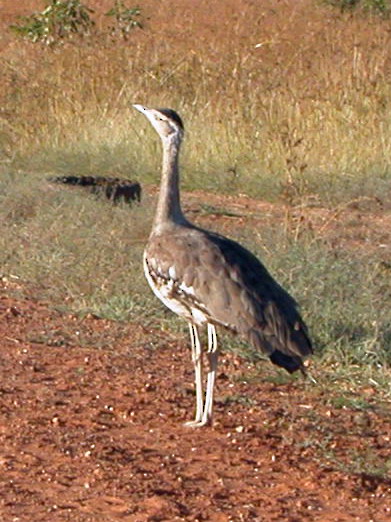 Australian BustardArdeotis australis
-
 Little BustardTetrax tetrax
-
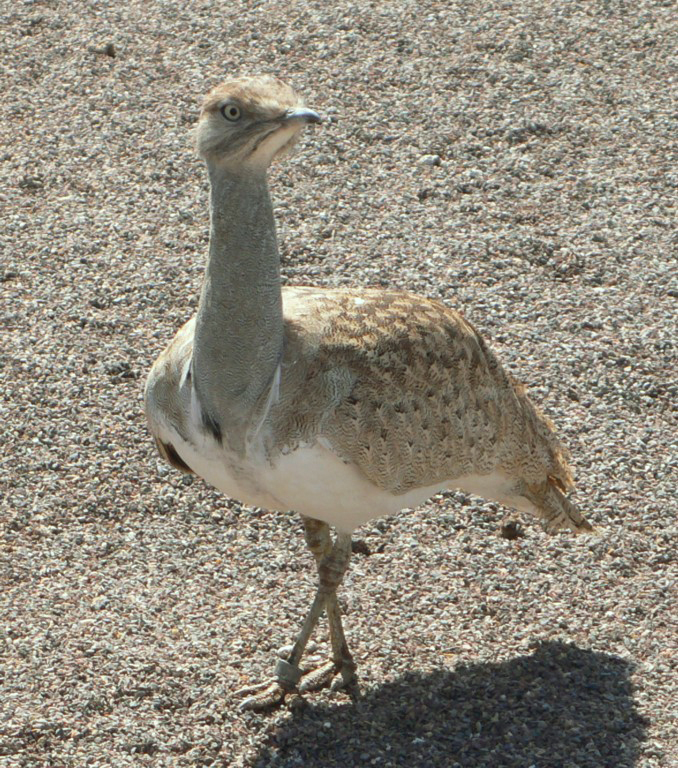 African HoubaraChlamydotis undulata
-
 Bengal FloricanHoubaropsis bengalensis
Compare
Questions and answers
What is the scientific name of the Blue Korhaan?
The scientific name of the Blue Korhaan is Eupodotis caerulescens. Written with its author, the full name is Eupodotis caerulescens (Vieillot, 1821).
Which family does the Blue Korhaan belong to?
Eupodotis caerulescens belongs to the family Otididae, in the order Otidiformes and the class Aves.
Where is the Blue Korhaan found?
Checklists and occurrence records place Eupodotis caerulescens in 2 countries: South Africa and Lesotho.
What is the conservation status of the Blue Korhaan?
The IUCN Red List category recorded for Eupodotis caerulescens is Near Threatened (NT).
What other names does the Blue Korhaan have?
Eupodotis caerulescens is also known in English as BLBU and Blue Bustard.
What bird is blue but not a bluebird?
The Blue Korhaan has bluish-grey neck and underparts, making it a bird with blue colouring that is not named a bluebird.[4][8]
What is the diet of a bird?
The Blue Korhaan feeds on insects, lizards, scorpions, seeds, flowers and leaves.[18]
Sources
Passages the profile rests on
- The Blue Korhaan has a sturdy body, a large head, a long neck, long legs and short toes. Source passage: “Korhaans are ground-dwelling birds with sturdy bodies, large heads and long necks, long legs and short toes.” — English Wikipedia
- The Blue Korhaan measures 50–58 cm in total length. Source passage: “The blue korhaan is a fairly large bird growing to a total length of 50 to 58 cm (20 to 23 in).” — English Wikipedia
- The Blue Korhaan has a black forehead and crown and white sides of the head. Source passage: “The forehead and crown are black, while the sides of the head are white.” — English Wikipedia
- Male Blue Korhaans have brown backs, wings and tails, with bluish-grey necks, throats, breasts and bellies. Source passage: “In males, the back, wings and tail are brown but the neck, throat, breast and belly are bluish-grey.” — English Wikipedia
- The species has yellow legs and feet. Source passage: “The legs and feet are yellow.” — English Wikipedia
- Male Blue Korhaans have a black-and-white face. Source passage: “The male has a black-and-white face” — ebird.org
- Females have duller grey necks and underparts and buff ear coverts compared with males. Source passage: “Females are similar in colouring but the neck and underparts are a duller grey and the ear coverts are buff.” — English Wikipedia
- The Blue Korhaan has striking bluish-gray underparts and neck and a dull chestnut back. Source passage: “A medium-sized bustard with striking bluish-gray underparts and neck, and dull chestnut back.” — ebird.org
- The species inhabits plateau grassland, dry shrubland, arable land and pastureland. Source passage: “Its natural habitat is plateau grassland, dry shrubland, arable land and pastureland.” — English Wikipedia
- The Blue Korhaan prefers short grassland with flat topography. Source passage: “Its preferred habitat is one with short grassland and flat topography.” — English Wikipedia
- The species occurs in grasslands at elevations of 1,500–3,000 metres. Source passage: “It is found on grassland at altitudes of between 1,500 and 3,000 m (5,000 and 10,000 ft).” — English Wikipedia
- The Blue Korhaan favours short grass habitats containing scattered karoo-type dwarf shrubs and termite mounds, with few trees. Source passage: “It favours short grass habitats, with a scattering of karoo-type dwarf shrubs, and with termite mounds but few trees” — English Wikipedia
- The species usually occurs within one kilometre of water. Source passage: “usually within a kilometre of water.” — English Wikipedia
- The Blue Korhaan also occupies previously cultivated and fallow land, winter crops and pasture. Source passage: “It also occurs in previously cultivated and fallow areas, and in winter crops and pasture.” — English Wikipedia
- The species occurs in Lesotho and South Africa. Source passage: “found in Lesotho and South Africa.” — inaturalist.org
- Its distribution extends from Pretoria and Mbombela southwards to Bhisho. Source passage: “Its range extends from Pretoria and Mbombela southwards to Bhisho” — English Wikipedia
- The species has an estimated geographic range of approximately 356,000 square kilometres. Source passage: “amounts to an area of around 356,000 km2 (137,000 mi2).” — English Wikipedia
- The Blue Korhaan feeds on insects, lizards, scorpions, seeds, flowers and leaves. Source passage: “forages for insects, lizards, scorpions, seeds, flowers and leaves.” — English Wikipedia
- The Blue Korhaan is largely terrestrial. Source passage: “This bird is largely terrestrial;” — English Wikipedia
- The Blue Korhaan usually occurs in pairs or small family groups. Source passage: “It usually occurs in pairs or in small family groups” — English Wikipedia
- Blue Korhaan family groups may remain together for two years. Source passage: “the family may stay together for two years.” — English Wikipedia
- When disturbed, the species crouches down. Source passage: “when disturbed it crouches down” — English Wikipedia
- When approached, the Blue Korhaan tends to walk or run away with its head lowered. Source passage: “on being approached tends to walk or run away with head dipped.” — English Wikipedia
- When alarmed, the species takes flight and can fly considerable distances. Source passage: “It will flush when alarmed however, flying for a considerable distance.” — English Wikipedia
- The species produces a series of frog-like croaks, usually while flying. Source passage: “Its call is a series of frog-like croaks, usually uttered in flight.” — English Wikipedia
- Its vocalizations are often heard around dawn. Source passage: “often heard around dawn and uttered during flight.” — English Wikipedia
- Breeding mainly occurs in October and November. Source passage: “Breeding mainly takes place in October and November.” — English Wikipedia
- The species constructs a shallow nest on the ground, often among thick foliage. Source passage: “The nest is a scoop on the ground, often in thick foliage” — English Wikipedia
- A Blue Korhaan nest contains between one and three eggs. Source passage: “where one to three eggs are laid.” — English Wikipedia
- Incubation lasts approximately 26 days. Source passage: “Incubation takes about 26 days” — English Wikipedia
- The mature population was estimated at 8,000–10,000 birds in 2017. Source passage: “The population of this species was estimated to be between 8,000 and 10,000 mature birds in 2017” — English Wikipedia
- The Blue Korhaan population appears to be declining in the Eastern Karoo. Source passage: “In the Eastern Karoo the population seems to be declining” — English Wikipedia
- The population appears fairly stable outside the Eastern Karoo. Source passage: “but elsewhere it seems fairly stable.” — English Wikipedia
- The area of suitable habitat is decreasing because grassland is being converted to agricultural use. Source passage: “the area of suitable habitat is being reduced due to grassland being converted for agricultural use” — English Wikipedia
- The International Union for Conservation of Nature classifies the Blue Korhaan as Near Threatened. Source passage: “the IUCN has assessed the bird's conservation status as being "near threatened".” — English Wikipedia
Data
- Catalogue of Life, 2026-10-16 XR cc by
- Global Biodiversity Information Facility CC BY 4.0
- Wikidata CC0
- GeoNames CC BY 4.0
- Wikimedia Commons per image; credit shown with each image
- Within the Catalogue of Life, this name comes from The Integrated Taxonomic Information System cc0
References
- Gill, Frank, & and Minturn Wright. (2006). Birds of the World: Recommended English Names.
- Dickinson, E. C., and J. V. Remsen Jr., eds. (2013). The Howard and Moore Complete Checklist of the Birds of the World, 4th Edition, Vol. 1 Non-Passerines.
This species in other databases
Page built on 29 November 2026. See how the catalog is made and all sources and licences.
Cite this page
ScientificNames.org. (2026). Eupodotis caerulescens (Blue Korhaan). Retrieved November 29, 2026, from https://scientificnames.org/species/eupodotis-caerulescens
“Eupodotis caerulescens (Blue Korhaan).” ScientificNames.org, 2026, scientificnames.org/species/eupodotis-caerulescens. Accessed 29 Nov. 2026.
ScientificNames.org. “Eupodotis caerulescens (Blue Korhaan).” Accessed November 29, 2026. https://scientificnames.org/species/eupodotis-caerulescens.
@misc{scientificnames_eupodotis_caerulescens_blue_korhaan,
  author = {{ScientificNames.org}},
  title = {Eupodotis caerulescens (Blue Korhaan)},
  year = {2026},
  url = {https://scientificnames.org/species/eupodotis-caerulescens},
  note = {Accessed 2026-11-29}
}