Species · Mammals
Fischer's Guiara Euryzygomatomys spinosus
The scientific name of the Fischer's Guiara is Euryzygomatomys spinosus. It is a species of mammal in the family Echimyidae (coypu), order Rodentia. The name dates from 1814.
- Scientific name
- Euryzygomatomys spinosus (Fischer de Waldheim, 1814)
- Common name
- Fischer's Guiara
- Genus
- Euryzygomatomys
- Family
- Echimyidae (Coypu)
- Order
- Rodentia
- Class
- Mammalia
- Red List category
- LC Least Concern
- Recorded in
- 3 countries
- Name status
- accepted in the Catalogue of Life

Overview
Fischer's Guiara is a spiny rat. The species occurs in Argentina, Brazil, and Paraguay and is native to South America. The species has a diploid chromosome number of 46 and a fundamental number of 88.
Written 27 November 2026 from the sources listed below. Each statement was checked against the passage it cites; statements that could not be supported were removed.
Appearance
Fischer's Guiara is a spiny rat.[1]
Classification of the Fischer's Guiara
| Kingdom | Animalia |
|---|---|
| Phylum | Chordata |
| Subphylum | Vertebrata |
| Infraphylum | Gnathostomata |
| Parvphylum | Osteichthyes |
| Megaclass | Tetrapoda |
| Class | Mammalia (Mammal) |
| Subclass | Theria |
| Infraclass | Eutheria |
| Order | Rodentia (Rodent) |
| Suborder | Hystricomorpha |
| Infraorder | Hystricognathi (Hystricognath Rodents) |
| Family | Echimyidae (Coypu) |
| Subfamily | Euryzygomatomyinae |
| Genus | Euryzygomatomys |
| Species | Euryzygomatomys spinosus (Fischer de Waldheim, 1814) |
Where the Fischer's Guiara is found
Checklists and occurrence records place Euryzygomatomys spinosus in 3 countries across South America. GBIF holds 156 georeferenced records of it.
Countries
Regions and cities with the most records
- São Paulo, Brazil 13
- Registro, Brazil 6
- Juquiá, Brazil 5
- Misiones, Argentina 5
- Rio de Janeiro, Brazil 4
- Santa Catarina, Brazil 4
- Guapimirim, Brazil 3
- Minas Gerais, Brazil 3
- São Pedro, Brazil 3
- Teresópolis, Brazil 3
Range as the checklists state it
South America
A number beside a place is its count of GBIF occurrence records. A place without a number comes from a checklist alone. Records show where a species has been observed or collected, which can include escapes and vagrants.
Common names
English
- Fischer's Guiara
- Brandt's Guiara
- Guiara
Names in 6 other languages
- Japanese
- グイラトゲネズミ
- Norwegian Bokmål
- Guira
- Polish
- gujara kolczasta
- Portuguese
- Guirá
- Russian
- Гиара
- Spanish
- Rata guira
Synonyms
2 other scientific names have been used for this species and are now treated as synonyms of Euryzygomatomys spinosus.
- Euryzygomatomys guiara (Brandt, 1835)
- Rattus spinosus Fischer de Waldheim, 1814
Related species
-
 NutriaMyocastor coypus
-
 Red-crested Tree-ratSantamartamys rufodorsalis
-
 Desmarest's HutiaCapromys pilorides
-
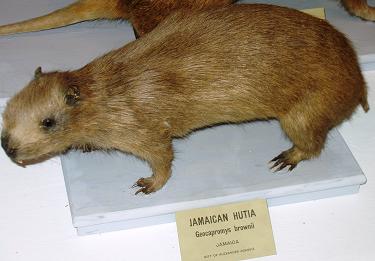 Jamaican ConeyGeocapromys brownii
-
 Hispaniolan HutiaPlagiodontia aedium
-
 Armored RatHoplomys gymnurus
-
 Bahamian HutiaGeocapromys ingrahami
- Garrido's HutiaMysateles garridoi
Compare
Questions and answers
What is the scientific name of the Fischer's Guiara?
The scientific name of the Fischer's Guiara is Euryzygomatomys spinosus. Written with its author, the full name is Euryzygomatomys spinosus (Fischer de Waldheim, 1814).
Which family does the Fischer's Guiara belong to?
Euryzygomatomys spinosus belongs to the family Echimyidae, in the order Rodentia and the class Mammalia.
Where is the Fischer's Guiara found?
Checklists and occurrence records place Euryzygomatomys spinosus in 3 countries: Brazil, Argentina and Paraguay.
What is the conservation status of the Fischer's Guiara?
The IUCN Red List category recorded for Euryzygomatomys spinosus is Least Concern (LC).
What other names does the Fischer's Guiara have?
Euryzygomatomys spinosus is also known in English as Brandt's Guiara and Guiara.
What is the diploid chromosome number of Fischer's Guiara?
The diploid chromosome number is 46.[2]
What is the fundamental number of Fischer's Guiara?
The fundamental number is 88.[2]
Where does Fischer's Guiara occur?
It occurs in Argentina, Brazil, and Paraguay.[3]
Where is Fischer's Guiara native to?
It is native to South America.[4]
Sources
Passages the profile rests on
- The species is a spiny rat. Source passage: “is a spiny rat species” — English Wikipedia
- The species has a diploid chromosome number of 46 and a fundamental number of 88. Source passage: “Its karyotype has 2n=46 and FN=88.” — English Wikipedia
- The species occurs in Argentina, Brazil, and Paraguay. Source passage: “found in Argentina, Brazil and Paraguay.” — English Wikipedia
- The species is native to South America. Source passage: “is a spiny rat species from South America.” — inaturalist.org
Data
- Catalogue of Life, 2026-10-16 XR cc by
- Global Biodiversity Information Facility CC BY 4.0
- Wikidata CC0
- GeoNames CC BY 4.0
- Wikimedia Commons per image; credit shown with each image
- Within the Catalogue of Life, this name comes from The Integrated Taxonomic Information System cc0
References
- Zoognosia vol.3 p.105 where the name was published
- Wilson, Don E., and DeeAnn M. Reeder, eds. (1993). Mammal Species of the World: A Taxonomic and Geographic Reference, 2nd Ed., 3rd Printing.
- Woods, Charles A., and C. William Kilpatrick / Wilson, Don E., and DeeAnn M. Reeder, eds. (2005). Infraorder Hystricognathi Brandt, 1855. Mammal Species of the World: A Taxonomic and Geographic Reference, 3rd Ed., Vol. 2.
- Wilson, Don E., T. E. Lacher Jr., and R. A. Mittermeier, eds. (2016). Handbook of the Mammals of the World. Vol. 6: Lagomorphs and Rodents I.
This species in other databases
Page built on 27 November 2026. See how the catalog is made and all sources and licences.
Cite this page
ScientificNames.org. (2026). Euryzygomatomys spinosus (Fischer's Guiara). Retrieved November 27, 2026, from https://scientificnames.org/species/euryzygomatomys-spinosus
“Euryzygomatomys spinosus (Fischer's Guiara).” ScientificNames.org, 2026, scientificnames.org/species/euryzygomatomys-spinosus. Accessed 27 Nov. 2026.
ScientificNames.org. “Euryzygomatomys spinosus (Fischer's Guiara).” Accessed November 27, 2026. https://scientificnames.org/species/euryzygomatomys-spinosus.
@misc{scientificnames_euryzygomatomys_spinosus_fischers_guiara,
  author = {{ScientificNames.org}},
  title = {Euryzygomatomys spinosus (Fischer's Guiara)},
  year = {2026},
  url = {https://scientificnames.org/species/euryzygomatomys-spinosus},
  note = {Accessed 2026-11-27}
}