Species · Reptiles
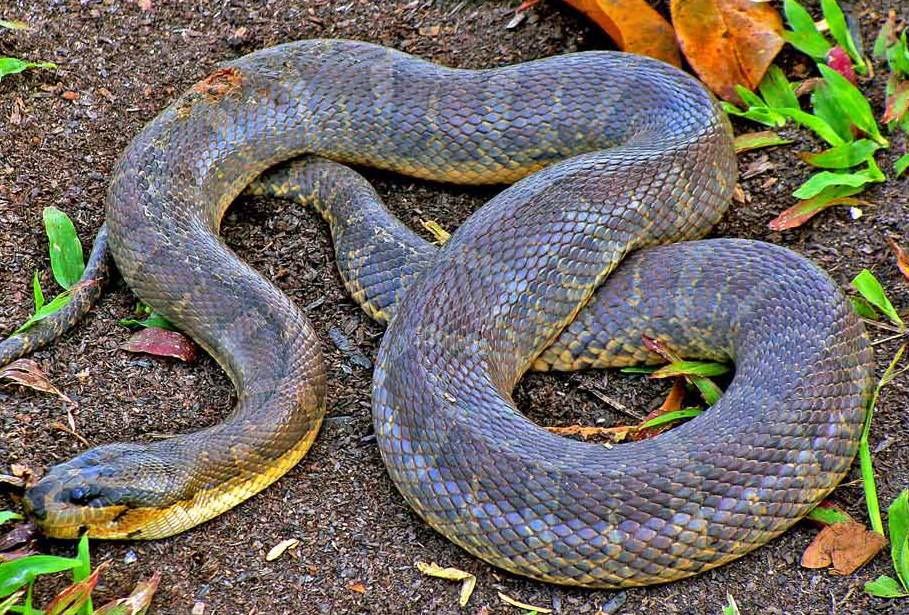
Siebold's Water Snake Ferania sieboldii
The scientific name of the Siebold's Water Snake is Ferania sieboldii. It is a species of reptile in the family Homalopsidae (mud snakes), order Squamata. The name dates from 1837.
- Scientific name
- Ferania sieboldii (Schlegel, 1837)
- Common name
- Siebold's Water Snake
- Genus
- Ferania
- Family
- Homalopsidae (Mud Snakes)
- Order
- Squamata
- Class
- Reptilia
- Red List category
- LC Least Concern
- Recorded in
- 5 countries
- Name status
- accepted in the Catalogue of Life

Overview
Siebold's water snake (Ferania sieboldii), also known commonly as Siebold's mud snake and Siebold's smooth water snake, is a species of mildly venomous, rear-fanged snake in the family Homalopsidae. The species is endemic to Asia.
Classification of the Siebold's Water Snake
| Kingdom | Animalia |
|---|---|
| Phylum | Chordata |
| Subphylum | Vertebrata |
| Infraphylum | Gnathostomata |
| Parvphylum | Osteichthyes |
| Megaclass | Tetrapoda |
| Class | Reptilia (Reptile) |
| Order | Squamata (Snakes) |
| Suborder | Serpentes (Snakes) |
| Infraorder | Alethinophidia |
| Family | Homalopsidae (Mud Snakes) |
| Genus | Ferania |
| Species | Ferania sieboldii (Schlegel, 1837) |
Where the Siebold's Water Snake is found
Checklists and occurrence records place Ferania sieboldii in 5 countries across Asia. GBIF holds 34 georeferenced records of it.
Countries
Regions and cities with the most records
Range as the checklists state it
N/C India (Nagaland, Mizoram, Tripura, Arunachal Pradesh, Assam), Nepal, Bangladesh, Myanmar, West Malaysia
A number beside a place is its count of GBIF occurrence records. A place without a number comes from a checklist alone. Records show where a species has been observed or collected, which can include escapes and vagrants.
Common names
English
- Siebold's Water Snake
- Ferania
- Siebold's Mud Snake
- Siebold's Smooth-water Snake
- Siebold’s Mud Snake
- The Ferania
Synonyms
5 other scientific names have been used for this species and are now treated as synonyms of Ferania sieboldii.
- Enhydris sieboldii (Schlegel, 1837)
- Feranioides jamnaetica Carlleyle, 1869
- Homalopsis sieboldii Schlegel, 1837
- Hypsirhina sieboldii (Schlegel, 1837)
- Trigonurus sieboldii (Schlegel, 1837)
Related species
-
 Tentacled SnakeErpeton tentaculatum
-
 Asian BockadamCerberus rynchops
-
 Masked Water SnakeHomalopsis buccata
-
 Boie’s Mud SnakeHypsiscopus plumbeus
-
 Rainbow Water SnakeEnhydris enhydris
-
 White-bellied Mangrove SnakeFordonia leucobalia
- Kapuas Mud SnakeHomalophis gyii
-
 Glossy Marsh SnakeGerarda prevostiana
Compare
Questions and answers
What is the scientific name of the Siebold's Water Snake?
The scientific name of the Siebold's Water Snake is Ferania sieboldii. Written with its author, the full name is Ferania sieboldii (Schlegel, 1837).
Which family does the Siebold's Water Snake belong to?
Ferania sieboldii belongs to the family Homalopsidae, in the order Squamata and the class Reptilia.
Where is the Siebold's Water Snake found?
Checklists and occurrence records place Ferania sieboldii in 5 countries: India, Nepal, Bangladesh, Malaysia and Myanmar.
What is the conservation status of the Siebold's Water Snake?
The IUCN Red List category recorded for Ferania sieboldii is Least Concern (LC).
What other names does the Siebold's Water Snake have?
Ferania sieboldii is also known in English as Ferania, Siebold's Mud Snake, Siebold's Smooth-water Snake, Siebold’s Mud Snake and The Ferania.
Sources
Data
- Catalogue of Life, 2026-10-16 XR cc by
- Global Biodiversity Information Facility CC BY 4.0
- Wikidata CC0
- English Wikipedia CC BY-SA 4.0
- GeoNames CC BY 4.0
- Wikimedia Commons per image; credit shown with each image
- Within the Catalogue of Life, this name comes from The Reptile Database cc by
References
- Schlegel, H. (1837). Essai sur la physionomie des serpens. Partie Descriptive. La Haye (J. Kips, J. HZ. Et W. P. Van Stockum), 606 S. + Xvi.
- Gray, J. E. (1842). Monographic Synopsis of the Water Snakes, or the Family of Hydridae. Zoological Miscellany 2: 59-68.
- Duméril, A. M. C., Bibron, G. & DUMÉRIL, A. H. A.,. (1854). Erpétologie générale ou histoire naturelle complète des reptiles. Tome septième. Deuxième partie, comprenant l’histoire des serpents venimeux. Paris, Librairie Encyclopédique de Roret: I-Xii + 781-1536.
- Carlleyle, A. C. L. (1869). Descriptions of two new species, belonging to the genera Varanus, and Feranioides respectively, from near Agra. J. Asiat. Soc. Bengal 38: 192-200.
- Anderson, J. (1871). On some Indian reptiles. Proc. Zool. Soc. London 1871: 149-211.
- Boulenger, George A. (1890). The Fauna of British India, Including Ceylon and Burma. Reptilia and Batrachia. Taylor & Francis, London, Xviii, 541 Pp.
- Boulenger, G. A. (1896). Catalogue of the snakes in the British Museum, Vol. 3. London (Taylor & Francis), Xiv + 727 Pp.
- Wall, F. (1907). Notes on Snakes collected in Fyzabad. J. Bombay Nat. Hist. Soc. 18: 101-129.
- Wall, F. (1908). Notes on a gravid female of Siebold’s Water Snake (Hypsirhina Sieboldii.). J. Bombay Nat. Hist. Soc. 18: 920.
- Smith, M. A. (1943). The Fauna of British India, Ceylon and Burma, Including the Whole of the Indo-Chinese Sub-Region. Reptilia and Amphibia. 3 (Serpentes). Taylor and Francis, London. 583 Pp.
- Constable, JOHN D. (1949). Reptiles from the Indian Peninsula in the Museum of Comparative Zoology. Bull. Mus. Comp. Zool. Harvard 103: 59-160.
- Dowling, H.G., & Jenner, J.V. (1988). Snakes of Burma: checklist of reported species and bibliography. Smithsonian Herp. Inf. Serv. (76): 19 Pp.
- Whitaker, & Romulus and Ashok Captain. (2004). Snakes of India. Draco Books, 500 Pp., Reprinted 2007.
- Sharma, R. C. (2004). Handbook Indian Snakes. AKHIL BOOKS, New Delhi, 292 Pp.
- Murphy, John C. (2007). Homalopsid Snakes: Evolution in the Mud. Krieger Publishing, Malabar, Florida, 249 Pp.
- Thakur, & Sanjay and Aparna Watve. (2009). Occurrence of Enhydris sieboldii (Schlegel, 1837) in Bhopal, Madhya Pradesh State of India. Russ. J. Herpetol. 16 (2): 159-160.
- Lalremsanga, H. T., & Saipari Sailo and Chinliansiama. (2011). Diversity of Snakes (Reptilia: Squamata) and Role of Environmental Factors in Their Distribution in Mizoram, Northeast India. Advances in Environmental Chemistry.
- Beolens, B., & Michael Watkins, a. M. G. (2011). The Eponym Dictionary of Reptiles. Johns Hopkins University Press, Baltimore, USA.
- Lenz, & Norbert. (2012). Von Schmetterlingen und Donnerdrachen - Natur und Kultur in Bhutan. Karlsruher Naturhefte 4, Naturkundemuseum Karlsruhe, 124 Pp.
- Kumar, A. Biju; Kate L. Sanders , Sanil George & John C. Murphy. (2012). The status of Eurostus dussumierii and Hypsirhina chinensis (Reptilia, Squamata, Serpentes): with comments on the origin of salt tolerance in homalopsid snakes. Systematics and Biodiversity 10 (4): 479-489.
- Das, I. (2012). A Naturalist’s Guide to the Snakes of South-East Asia: Malaysia, Singapore, Thailand, Myanmar, Borneo, Sumatra, Java and Bali. Oxford J, Ohn Beaufoy Publishing.
- Kästle, W., Rai, K., & Schleich, H. H. (2013). FIELD GUIDE to Amphibians and Reptiles of Nepal. ARCO-Nepal E.V., 625 Pp.
- Murphy, J. C., & Voris, H. K. (2014). A Checklist and Key to the Homalopsid Snakes (Reptilia, Squamata, Serpentes), with the Description of New Genera. Fieldiana: Life and Earth Sciences (8): 1–43.
- Wallach, Van; Kenneth L. Williams, Jeff Boundy. (2014). Snakes of the World: A Catalogue of Living and Extinct Species. [type catalogue]. Taylor and Francis, CRC Press, 1237 Pp.
- Pandey, & Deb Prasad. (2018). New records of snakes from Chitwan National Park and vicinity, Central Nepal. Herpetology Notes 11: 679-696.
This species in other databases
Page built on 25 November 2026. See how the catalog is made and all sources and licences.
Cite this page
ScientificNames.org. (2026). Ferania sieboldii (Siebold's Water Snake). Retrieved November 25, 2026, from https://scientificnames.org/species/ferania-sieboldii
“Ferania sieboldii (Siebold's Water Snake).” ScientificNames.org, 2026, scientificnames.org/species/ferania-sieboldii. Accessed 25 Nov. 2026.
ScientificNames.org. “Ferania sieboldii (Siebold's Water Snake).” Accessed November 25, 2026. https://scientificnames.org/species/ferania-sieboldii.
@misc{scientificnames_ferania_sieboldii_siebolds_water_snake,
  author = {{ScientificNames.org}},
  title = {Ferania sieboldii (Siebold's Water Snake)},
  year = {2026},
  url = {https://scientificnames.org/species/ferania-sieboldii},
  note = {Accessed 2026-11-25}
}