Species · Flowering plants
Fibraurea Fibraurea tinctoria
The scientific name of the Fibraurea is Fibraurea tinctoria. It is a species of flowering plant in the family Menispermaceae (moonseed family), order Ranunculales.
- Scientific name
- Fibraurea tinctoria Lour.
- Common name
- Fibraurea
- Genus
- Fibraurea
- Family
- Menispermaceae (Moonseed Family)
- Order
- Ranunculales
- Class
- Magnoliopsida
- Recorded in
- 12 countries
- Name status
- accepted in the Catalogue of Life
Overview
Fibraurea tinctoria Lour. is a flowering plant in the family Menispermaceae. It grows in wet tropical areas and is native to Assam, Borneo, Cambodia, India, Java, Laos, Malaysia, Myanmar, the Nicobar Islands, the Philippines, Sulawesi, Sumatra, Thailand, and Vietnam. It produces yellow-orange drupes and contains berberine, an isoquinoline alkaloid.
Written 26 November 2026 from the sources listed below. Each statement was checked against the passage it cites; statements that could not be supported were removed.
Appearance
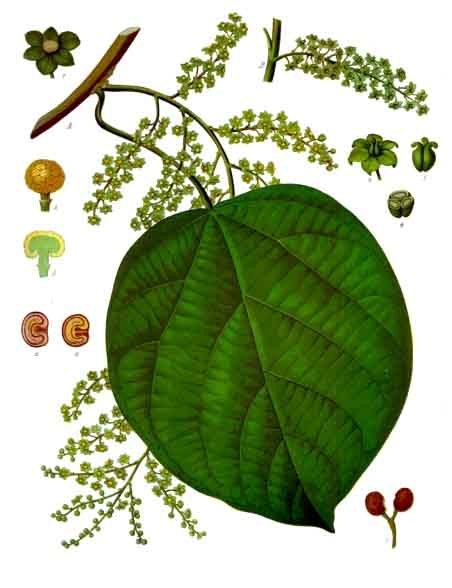
Fibraurea produces yellow-orange drupes.[1]
Habitat
Fibraurea grows in wet tropical areas and primarily in the wet tropical biome.[2][3]
Its native range extends from southwestern India and Assam to Malesia. It is native to Assam, Borneo, Cambodia, India, Java, Laos, Malaysia, Myanmar, the Nicobar Islands, the Philippines, Sulawesi, Sumatra, Thailand, and Vietnam.[4][5]
Behaviour
A wild Sumatran orangutan was observed using fibraurea in an instance of wound treatment.[6]
Reproduction and life cycle
Fibraurea fruits in April and May.[7]
Conservation
Fibraurea is considered locally common.[8]
Uses
Fibraurea is used in Indonesian traditional medicine. Its leaves also have traditional medicinal uses.[9][10]
Its traditional medicinal use is primarily associated with its berberine content. Berberine is an isoquinoline alkaloid whose possible properties are under preliminary research.[11][12]
Classification of the Fibraurea
| Kingdom | Plantae |
|---|---|
| Subkingdom | Pteridobiotina |
| Phylum | Tracheophyta |
| Class | Magnoliopsida |
| Order | Ranunculales |
| Family | Menispermaceae (Moonseed Family) |
| Subfamily | Chasmantheroideae |
| Tribe | Burasaieae |
| Genus | Fibraurea |
| Species | Fibraurea tinctoria Lour. |
Where the Fibraurea is found
Checklists and occurrence records place Fibraurea tinctoria in 12 countries across Asia. GBIF holds 483 georeferenced records of it.
Countries
- Brunei 18
- Cambodia 2
- China 11
- India 2
- Indonesia 145
- Laos 3
- Malaysia 177
- Myanmar 3
- Philippines 3
- Singapore 61
- Thailand 31
- Vietnam 27
Regions and cities with the most records
- Ang Mo Kio New Town, Singapore 50
- Novena, Singapore 50
- Yio Chu Kang, Singapore 50
- Bedok New Town, Singapore 49
- Bukit Timah, Singapore 49
- Eunos, Singapore 49
- Kampong Pasir Ris, Singapore 49
- MacPherson, Singapore 49
- Marine Parade, Singapore 49
- Matilda Estate, Singapore 49
- Sengkang New Town, Singapore 49
- Singapore, Singapore 49
- Sungai Simpang, Singapore 49
- Ulu Bedok, Singapore 49
- Woodlands, Singapore 49
- Yishun New Town, Singapore 49
- Anak Bukit, Singapore 48
- Boon Lay, Singapore 48
- Bukit Panjang New Town, Singapore 48
- Choa Chu Kang New Town, Singapore 48
- Jurong East, Singapore 48
- Jurong Town, Singapore 48
- Jurong West, Singapore 48
- Keat Hong Village, Singapore 48
- Marsiling, Singapore 48
- Queenstown Estate, Singapore 48
- Teck Whye, Singapore 48
- Yew Tee, Singapore 48
- Punggol, Singapore 47
- Sembawang Estate, Singapore 45
- Kampong Loyang, Singapore 42
- Kampung Pasir Gudang Baru, Malaysia 37
- Pasir Gudang, Malaysia 37
- Johor Bahru, Malaysia 36
- Masai, Malaysia 35
- Taman Permas Jaya, Malaysia 33
Range as the checklists state it
S-China; NE-India (Manipur); Andaman Isl. (Little Andaman Isl.); Nicobar Isl. (Central Nicobar Isl., Great Nicobar Isl., Little Nicobar Isl.); Myanmar (Taninthayi); peninsular Thailand; Laos; Cambodia; Vietnam; peninsular Malaysia; Singapore; Sumatera; Borneo; Sulawesi; Philippines (Dinagat); Jawa
A number beside a place is its count of GBIF occurrence records. A place without a number comes from a checklist alone. Records show where a species has been observed or collected, which can include escapes and vagrants.
Common names
English
- Fibraurea
Names in 3 other languages
- Chinese
- 假黄藤
- Slovak
- zlatodrievko farbiarske
- Thai
- ขมิ้นเครือ
Synonyms
7 other scientific names have been used for this species and are now treated as synonyms of Fibraurea tinctoria.
- Cocculus fibraurea DC.
- Fibraurea fasciculata Miers
- Fibraurea laxa Miers
- Fibraurea manipurensis Brace ex Diels
- Fibraurea trotteri Watt ex Diels
- Menispermum tinctorium Spreng.
- Fibraurea chloroleuca Miers ambiguous synonym
Related species
- Fibraurea recisa
- Fibraurea darshanii
-
 Canada MoonseedMenispermum canadense
- Carolina SnailseedNephroia carolina
-
 Chondrodendron tomentosum
-
 FishberryAnamirta cocculus
-
 Cocculus hirsutus
-
 Tiliacora triandra
Compare
Questions and answers
What is the scientific name of the Fibraurea?
The scientific name of the Fibraurea is Fibraurea tinctoria. Written with its author, the full name is Fibraurea tinctoria Lour..
Which family does the Fibraurea belong to?
Fibraurea tinctoria belongs to the family Menispermaceae, in the order Ranunculales and the class Magnoliopsida.
Where is the Fibraurea found?
Checklists and occurrence records place Fibraurea tinctoria in 12 countries, including Malaysia, Indonesia, Singapore, Thailand, Vietnam and Brunei.
Sources
Passages the profile rests on
- The species produces yellow-orange drupes. Source passage: “producing yellow-orange drupes.” — English Wikipedia
- The species grows in wet tropical areas. Source passage: “where it grows in wet tropical areas.” — English Wikipedia
- The species grows primarily in the wet tropical biome. Source passage: “grows primarily in the wet tropical biome.” — powo.science.kew.org
- The species is native to Assam, Borneo, Cambodia, India, Java, Laos, Malaysia, Myanmar, the Nicobar Islands, the Philippines, Sulawesi, Sumatra, Thailand, and Vietnam. Source passage: “It is native to Assam, Borneo, Cambodia, India, Java, Laos, Malaysia, Myanmar, the Nicobar Islands, the Philippines, Sulawesi, Sumatra, Thailand, and Vietnam” — English Wikipedia
- The species' native range extends from southwestern India and Assam to Malesia. Source passage: “The native range of this species is SW. India, Assam to Malesia.” — powo.science.kew.org
- The species was used by a wild Sumatran orangutan in an observed instance of wound treatment. Source passage: “the first documented case of a wild Sumatran orangutan using leaves from a medicinal liana, Fibraurea tinctoria, to actively treat a facial wound.” — pmc.ncbi.nlm.nih.gov
- The species fruits in April and May. Source passage: “It fruits in April and May” — English Wikipedia
- The species is considered locally common. Source passage: “It is considered locally common.” — English Wikipedia
- The species is used in Indonesian traditional medicine. Source passage: “The plant is used in Indonesian traditional medicine” — English Wikipedia
- Leaves of the species have traditional medicinal uses. Source passage: “The leaves of this tree are also known to have traditional medicinal uses” — pmc.ncbi.nlm.nih.gov
- The species is used in traditional medicine primarily because it contains berberine. Source passage: “primarily because it contains berberine” — English Wikipedia
- The species contains berberine, an isoquinoline alkaloid whose possible properties are under preliminary research. Source passage: “berberine, an isoquinoline alkaloid under preliminary research to identify its possible properties.” — English Wikipedia
Data
- Catalogue of Life, 2026-10-16 XR cc by
- Global Biodiversity Information Facility CC BY 4.0
- Wikidata CC0
- GeoNames CC BY 4.0
- Within the Catalogue of Life, this name comes from Synonymic Checklists of the Vascular Plants of the World cc by
References
- Lour. Fl. Cochinch. 626 (1790). where the name was published
This species in other databases
- Catalogue of Life 6HV2X
- Wikidata Q15331296
- iNaturalist 343808
- World Flora Online wfo-0000687146
- GRIN 400056
Page built on 29 November 2026. See how the catalog is made and all sources and licences.
Cite this page
ScientificNames.org. (2026). Fibraurea tinctoria (Fibraurea). Retrieved November 29, 2026, from https://scientificnames.org/species/fibraurea-tinctoria
“Fibraurea tinctoria (Fibraurea).” ScientificNames.org, 2026, scientificnames.org/species/fibraurea-tinctoria. Accessed 29 Nov. 2026.
ScientificNames.org. “Fibraurea tinctoria (Fibraurea).” Accessed November 29, 2026. https://scientificnames.org/species/fibraurea-tinctoria.
@misc{scientificnames_fibraurea_tinctoria_fibraurea,
  author = {{ScientificNames.org}},
  title = {Fibraurea tinctoria (Fibraurea)},
  year = {2026},
  url = {https://scientificnames.org/species/fibraurea-tinctoria},
  note = {Accessed 2026-11-29}
}