Species · Birds
Chestnut-backed Owlet Glaucidium castanotum
The scientific name of the Chestnut-backed Owlet is Glaucidium castanotum. It is a species of bird in the family Strigidae (owls), order Strigiformes. The name dates from 1851.
- Scientific name
- Glaucidium castanotum (Blyth, 1851)
- Common name
- Chestnut-backed Owlet
- Genus
- Glaucidium
- Family
- Strigidae (Owls)
- Order
- Strigiformes
- Class
- Aves
- Red List category
- NT Near Threatened
- Environment
- terrestrial
- Recorded in
- 2 countries
- Name status
- accepted in the Catalogue of Life

Overview
The Chestnut-backed Owlet is a member of the typical owls grouping, Strigidae. The species is endemic to Sri Lanka and occurs in remaining wet-zone forests and adjoining hills at elevations reaching 2,000 m above sea level. It has predominantly chestnut-brown upperparts with darker barring, white underparts with blackish shaft-streaks, a brown facial disc, and a white neckband.
Written 26 November 2026 from the sources listed below. Each statement was checked against the passage it cites; statements that could not be supported were removed.
Similar species
The Chestnut-backed Owlet resembles the Jungle Owlet in shape, size, and appearance. It was formerly classified as a subspecies of the Jungle Owlet.[1][2]
Appearance
The Chestnut-backed Owlet has a small, stocky body and measures approximately 19 cm in length. Its upperparts, scapulars, and wing coverts are predominantly chestnut brown with darker barring.[3][4][5]
The underparts are white with blackish shaft-streaks. The facial disc is predominantly brown, and the species has a white neckband.[6][7][8]
The species has a chestnut mantle, a pale belly, and streaked flanks. Males and females have similar appearances without sexual dimorphism, and the species lacks ear tufts.[9][10][11]
Habitat
The Chestnut-backed Owlet occurs in wet-zone forests in Sri Lanka, including remaining wet-zone forests and adjoining hills at elevations reaching 2,000 m above sea level. It frequents the tops of tall trees, generally on steep hillsides.[12][13][14]
The species is endemic to Sri Lanka and can be observed at Kitulgala and Sinharaja in Sri Lanka.[15][16]
Diet
The Chestnut-backed Owlet feeds mainly on insects. It also captures mice and small birds, particularly when feeding its young.[17][18][19]
Behaviour
The Chestnut-backed Owlet is active during daylight and crepuscular periods. It is frequently observed during the day, particularly in the evening, and occurs either singly or in pairs.[20][21][22][23]
The species has a deeply undulating flight pattern. Small birds often mob it while it is perched in a tree.[24][25]
The species produces a slow kraw-kraw call that carries over long distances.[26]
Reproduction and life cycle
The Chestnut-backed Owlet nests in holes in trees.[27]
Conservation
Historical distribution records included many areas in southern Sri Lanka, particularly the hills and wet-zone lowlands extending to the outskirts of Colombo. The species' geographic range has contracted substantially in recent times.[28][29]
Classification of the Chestnut-backed Owlet
| Kingdom | Animalia |
|---|---|
| Phylum | Chordata |
| Subphylum | Vertebrata |
| Infraphylum | Gnathostomata |
| Parvphylum | Osteichthyes |
| Megaclass | Tetrapoda |
| Class | Aves (Bird) |
| Order | Strigiformes (Owl) |
| Family | Strigidae (Owls) |
| Subfamily | Surniinae |
| Genus | Glaucidium (Pygmy Owl) |
| Species | Glaucidium castanotum (Blyth, 1851) |
Where the Chestnut-backed Owlet is found
Checklists and occurrence records place Glaucidium castanotum in 2 countries across Asia. GBIF holds 2,713 georeferenced records of it.
Countries
Regions and cities with the most records
- Hatton, Sri Lanka 134
- Ratnapura, Sri Lanka 77
- Gampola, Sri Lanka 37
- Kandy, Sri Lanka 37
- Nuwara Eliya, Sri Lanka 28
- Matale, Sri Lanka 23
- Kegalle, Sri Lanka 13
- Hanwella Ihala, Sri Lanka 12
- Ambalangoda, Sri Lanka 11
- Homagama, Sri Lanka 11
Range as the checklists state it
Southern Asia
A number beside a place is its count of GBIF occurrence records. A place without a number comes from a checklist alone. Records show where a species has been observed or collected, which can include escapes and vagrants.
Common names
English
- Chestnut-backed Owlet
Names in 25 other languages
- Catalan
- mussolet de Sri Lanka
- Chinese
- 斯里蘭卡栗背鵂鶹, 栗背鵂鶹, 栗背鸺鹠
- Croatian
- cejlonski ćuk
- Czech
- kulíšek srílanský
- Danish
- Sri Lanka-spurveugle
- Dutch
- Ceylonese Dwerguil
- Esperanto
- kaŝtandorsa strigeto
- Estonian
- tseiloni värbkakk
- Finnish
- srilankanvarpuspöllö
- French
- Chevêchette à dos marron
- German
- Kastanienmantel-Zwergkauz, Kastanienmantelkauz
- Hungarian
- gesztenyebarnahátú törpekuvik
- Italian
- Civetta dorsocastano, Civettina dorsocastano
- Japanese
- クリセスズメフクロウ
- Lithuanian
- rudnugarė žvirblinė pelėda
- Norwegian
- singaleserugle
- Polish
- sóweczka cejlońska
- Portuguese
- mochinho-cingalês, mocho-pigmeu-do-ceilão
- Russian
- Буроспинный воробьиный сыч, Буроспинный сычик, Каштановоспинный сычик
- Sinhala
- පිටතඹල උපබස්සා, මූකලන් බස්සා
- Slovak
- kuvičok hnedochrbtý
- Spanish
- Mochuelo de Ceilán
- Swedish
- ceylonsparvuggla
- Turkish
- Kestane Sırtlı Serçe Baykuşu
- Ukrainian
- сичик-горобець цейлонський
Synonyms
7 other scientific names have been used for this species and are now treated as synonyms of Glaucidium castanotum.
- Athene castanonota Blyth, E, 1851
- Athene castanopterus Blyth, E, 1845
- Athene castanotus Blyth, 1851
- Glaucidium castanonotum (Blyth, 1851)
- Glaucidium cuculoides castanonotum Blyth, E, 1851
- Ieraglaux bubuk Kaup, JJ, 1859
- Taenioglaux castanonota Blyth, E, 1851
Related species
-
 Eurasian Pygmy OwlGlaucidium passerinum
-
 Northern Pygmy OwlGlaucidium gnoma
-
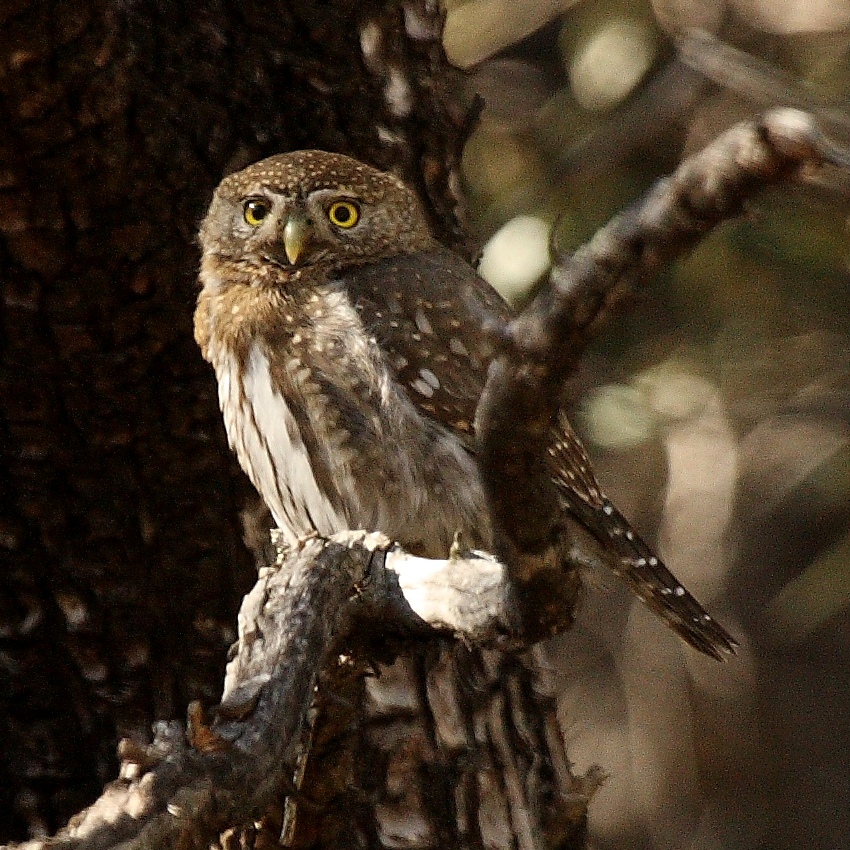 Northern Pygmy OwlGlaucidium californicum
-
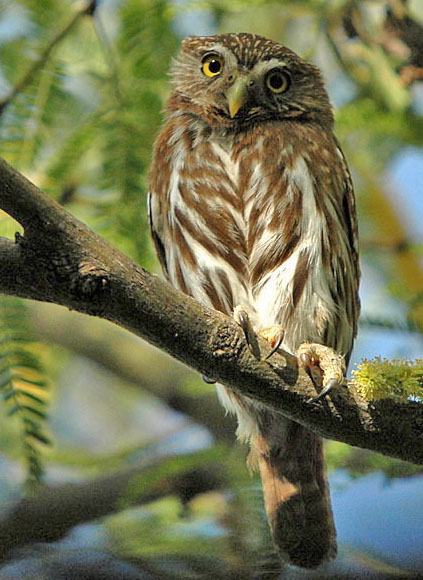 Ferruginous Pygmy OwlGlaucidium brasilianum
-
 Pearl-spotted OwletGlaucidium perlatum
-
 Asian Barred OwletGlaucidium cuculoides
-
 Jungle OwletGlaucidium radiatum
- Pernambuco Pygmy OwlGlaucidium mooreorum
Compare
Questions and answers
What is the scientific name of the Chestnut-backed Owlet?
The scientific name of the Chestnut-backed Owlet is Glaucidium castanotum. Written with its author, the full name is Glaucidium castanotum (Blyth, 1851).
Which family does the Chestnut-backed Owlet belong to?
Glaucidium castanotum belongs to the family Strigidae, in the order Strigiformes and the class Aves.
Where is the Chestnut-backed Owlet found?
Checklists and occurrence records place Glaucidium castanotum in 2 countries: Sri Lanka and Indonesia.
What is the conservation status of the Chestnut-backed Owlet?
The IUCN Red List category recorded for Glaucidium castanotum is Near Threatened (NT).
Sources
Passages the profile rests on
- The Chestnut-backed Owlet resembles the Jungle Owlet in shape, size, and appearance. Source passage: “It resembles the jungle owlet in shape, size and appearance” — English Wikipedia
- The Chestnut-backed Owlet was formerly classified as a subspecies of the Jungle Owlet. Source passage: “This species was formerly considered to be a subspecies of the jungle owlet.” — English Wikipedia
- The Chestnut-backed Owlet has a small, stocky body. Source passage: “The chestnut-backed owlet is small and stocky” — English Wikipedia
- The Chestnut-backed Owlet measures approximately 19 cm in length. Source passage: “measuring 19 cm (7.5 in) in length.” — English Wikipedia
- The upperparts, scapulars, and wing coverts are predominantly chestnut brown with darker barring. Source passage: “the upperparts, scapulars and wing coverts are mainly chestnut brown, with darker barring.” — English Wikipedia
- The underparts are white and marked with blackish shaft-streaks. Source passage: “The underparts are white with blackish shaft-streaks.” — English Wikipedia
- The facial disc is predominantly brown. Source passage: “The facial disc is mainly brown” — English Wikipedia
- The species has a white neckband. Source passage: “There is a white neckband.” — English Wikipedia
- Males and females have similar appearances without sexual dimorphism. Source passage: “Sexes are similar in appearance, with no sexual dimorphism.” — English Wikipedia
- The species lacks ear tufts. Source passage: “Small owl lacking ear tufts” — ebird.org
- The species has a chestnut mantle and a pale belly with streaked flanks. Source passage: “with chestnut mantle and pale belly with streaked flanks.” — ebird.org
- The species occurs in wet-zone forests in Sri Lanka. Source passage: “The chestnut-backed owlet is a common resident bird in the wet zone forests of Sri Lanka” — English Wikipedia
- The species occurs in remaining wet-zone forests and adjoining hills at elevations reaching 2,000 m above sea level. Source passage: “it is now found sparingly in the remaining forests of the wet zone and the adjoining hills at altitudes of up to 6,500 ft (2,000 m) above sea level.” — English Wikipedia
- The species frequents the tops of tall trees, generally on steep hillsides. Source passage: “It frequents tops of tall trees, usually on steep hill-sides” — English Wikipedia
- The Chestnut-backed Owlet is endemic to Sri Lanka. Source passage: “is an owl which is endemic to Sri Lanka.” — English Wikipedia
- The species can be observed at Kitulgala and Sinharaja in Sri Lanka. Source passage: “can be seen easily at sites such as Kitulgala and Sinharaja.” — English Wikipedia
- The Chestnut-backed Owlet feeds mainly on insects. Source passage: “It feeds mainly on insects” — English Wikipedia
- The species also captures mice. Source passage: “but also captures mice” — English Wikipedia
- The species also captures small birds, particularly when feeding its young. Source passage: “and small birds mostly when the young are being fed.” — English Wikipedia
- The Chestnut-backed Owlet is active during daylight hours. Source passage: “This species is diurnal” — English Wikipedia
- The species is frequently observed during the day, particularly in the evening. Source passage: “is frequently seen in the day, especially in the evening.” — English Wikipedia
- The species occurs during crepuscular as well as daylight periods. Source passage: “Crepuscular and diurnal” — ebird.org
- The species occurs either singly or in pairs. Source passage: “occurring singly or in pairs in wet ...” — ebird.org
- The species has a deeply undulating flight pattern. Source passage: “The flight is deeply undulating.” — English Wikipedia
- Small birds often mob the species while it is perched in a tree. Source passage: “It can often be located by the small birds that mob it while it is perched in a tree.” — English Wikipedia
- The species produces a slow kraw-kraw call that carries over long distances. Source passage: “The call is a slow kraw-kraw and carries for a long distance.” — English Wikipedia
- The Chestnut-backed Owlet nests in holes in trees. Source passage: “It nests in a hole in a tree” — English Wikipedia
- Historical distribution records included many areas in southern Sri Lanka, particularly the hills and wet-zone lowlands extending to the outskirts of Colombo. Source passage: “Historical reports of its distribution by Legge include many parts of the southern half of Sri Lanka, especially the hills and the wet-zone low country extending to the outskirts of Colombo.” — English Wikipedia
- The species' geographic range has contracted substantially in recent times. Source passage: “In recent times, its range has shrunk greatly” — English Wikipedia
Data
- Catalogue of Life, 2026-10-16 XR cc by
- Global Biodiversity Information Facility CC BY 4.0
- Wikidata CC0
- GeoNames CC BY 4.0
- Wikimedia Commons per image; credit shown with each image
- Within the Catalogue of Life, this name comes from The Integrated Taxonomic Information System cc0
References
- Dickinson, E. C., and J. V. Remsen Jr., eds. (2013). The Howard and Moore Complete Checklist of the Birds of the World, 4th Edition, Vol. 1 Non-Passerines.
This species in other databases
- Catalogue of Life 3G63R
- Wikidata Q1260299
- iNaturalist 367500
- WoRMS urn:lsid:marinespecies.org:taxname:1657358
- Avibase chbowl1
Page built on 28 November 2026. See how the catalog is made and all sources and licences.
Cite this page
ScientificNames.org. (2026). Glaucidium castanotum (Chestnut-backed Owlet). Retrieved November 28, 2026, from https://scientificnames.org/species/glaucidium-castanotum
“Glaucidium castanotum (Chestnut-backed Owlet).” ScientificNames.org, 2026, scientificnames.org/species/glaucidium-castanotum. Accessed 28 Nov. 2026.
ScientificNames.org. “Glaucidium castanotum (Chestnut-backed Owlet).” Accessed November 28, 2026. https://scientificnames.org/species/glaucidium-castanotum.
@misc{scientificnames_glaucidium_castanotum_chestnut_backed_owlet,
  author = {{ScientificNames.org}},
  title = {Glaucidium castanotum (Chestnut-backed Owlet)},
  year = {2026},
  url = {https://scientificnames.org/species/glaucidium-castanotum},
  note = {Accessed 2026-11-28}
}