Species · Birds
Andean Pygmy Owl Glaucidium jardinii
The scientific name of the Andean Pygmy Owl is Glaucidium jardinii. It is a species of bird in the family Strigidae (owls), order Strigiformes. The name dates from 1855.
- Scientific name
- Glaucidium jardinii (Bonaparte, 1855)
- Common name
- Andean Pygmy Owl
- Genus
- Glaucidium
- Family
- Strigidae (Owls)
- Order
- Strigiformes
- Class
- Aves
- Red List category
- LC Least Concern
- Recorded in
- 6 countries
- Name status
- accepted in the Catalogue of Life

Overview
The Andean Pygmy Owl is a monotypic owl species. It occurs in Colombia, Ecuador, Peru, and Venezuela. It has two color morphs, yellow eyes, white facial markings, and a breast and belly marked with heavy dark streaks.
Written 26 November 2026 from the sources listed below. Each statement was checked against the passage it cites; statements that could not be supported were removed.
Conservation
The Andean Pygmy Owl is classified as Least Concern by the IUCN. It is considered fairly common, but its population size is unknown.[1][2][3]
Its geographical range is large and includes several protected areas. The species is considered probably vulnerable to forest destruction.[4][5]
Appearance
The Andean Pygmy Owl measures 15–16 cm in length. Male individuals weigh between 54.9 and 77.4 g, while female individuals weigh between 54.6 and 75 g.[6][7][8]
The species has two color morphs, one predominantly dull dark brown with white markings and the other dark chestnut with buff markings. Both morphs have small white dots on the crown.[9][10]
The eyes are yellow, with white eyebrow-like markings, white moustache-like markings, and a broad white throat. The nape has a black-and-white pattern resembling a face.[11][12][13]
The back is spotted, and the tail has white or buff bars depending on the color morph. The sides of the breast are dark brown or chestnut with pale markings, while the breast and belly are white with heavy dark brown or chestnut streaks.[14][15][16]
Habitat
The Andean Pygmy Owl inhabits cloudforest, elfin forest, and Polylepis woodland. It sometimes occupies forest edges and pastures with scattered trees.[17][18]
The species occurs from the middle levels of the forest to the canopy. In Colombia, it occurs at elevations of approximately 1,500–3,500 m.[19][20]
The species occurs at somewhat higher elevations in Venezuela, Ecuador, and Peru than in Colombia.[21]
Its distribution extends from far western Venezuela through the central and western Andes of Colombia and Ecuador to central Peru.[22]
Diet
The Andean Pygmy Owl feeds on invertebrates, small birds, and small mammals.[23]
Behaviour
The Andean Pygmy Owl is active during both daytime and nighttime.[24]
Its song consists of a long series of rapidly delivered, evenly spaced notes. The song is sometimes preceded by two whistles.[25][26]
Reproduction and life cycle
The Andean Pygmy Owl nests in tree cavities, including abandoned woodpecker holes. The usual clutch size is three eggs.[27][28]
The breeding phenology of the species is poorly known.[29]
Classification of the Andean Pygmy Owl
| Kingdom | Animalia |
|---|---|
| Phylum | Chordata |
| Subphylum | Vertebrata |
| Infraphylum | Gnathostomata |
| Parvphylum | Osteichthyes |
| Megaclass | Tetrapoda |
| Class | Aves (Bird) |
| Order | Strigiformes (Owl) |
| Family | Strigidae (Owls) |
| Subfamily | Surniinae |
| Genus | Glaucidium (Pygmy Owl) |
| Species | Glaucidium jardinii (Bonaparte, 1855) |
Where the Andean Pygmy Owl is found
Checklists and occurrence records place Glaucidium jardinii in 6 countries across South America. GBIF holds 5,346 georeferenced records of it.
Countries
Regions and cities with the most records
- Pichincha, Ecuador 1,090
- Cundinamarca, Colombia 774
- Pomasqui, Ecuador 621
- Quito, Ecuador 594
- Caldas Department, Colombia 489
- Risaralda Department, Colombia 487
- Villamaría, Colombia 384
- Manizales, Colombia 368
- Antioquia, Colombia 273
- Cesar Department, Colombia 238
- Napo, Ecuador 204
- Tolima Department, Colombia 200
- Loja, Ecuador 199
- Bosconia, Colombia 182
- Chinchiná, Colombia 175
- Sibaté, Colombia 159
- Neira, Colombia 158
- Riosucio, Colombia 156
- Valle del Cauca Department, Colombia 154
- Madrid, Colombia 153
- Anaime, Colombia 152
- Soacha, Colombia 152
- Azuay, Ecuador 150
- Funza, Colombia 150
- Mosquera, Colombia 149
- Andes, Colombia 146
- Supía, Colombia 145
- Santa Rosa de Cabal, Colombia 142
- Nariño, Colombia 135
- Cuenca, Ecuador 99
- Tocancipá, Colombia 82
- Boyacá, Colombia 79
- Zamora Chinchipe, Ecuador 70
- Quindío Department, Colombia 66
- Cajicá, Colombia 60
- Chía, Colombia 56
2 more countries have a few records outside this range
These countries hold a few records of Glaucidium jardinii but lie outside the range the checklists give for it. Such records are often zoo or garden specimens, museum material or vagrants, so the species is not counted as occurring there.
Range as the checklists state it
South America
A number beside a place is its count of GBIF occurrence records. A place without a number comes from a checklist alone. Records show where a species has been observed or collected, which can include escapes and vagrants.
Common names
English
- Andean Pygmy Owl
- Andean Pygmy-Owl
Names in 26 other languages
- Catalan
- mussolet dels Andes
- Chinese
- 安地斯鵂鶹, 安第斯鸺鹠
- Croatian
- andski ćuk
- Czech
- kulíšek andský
- Danish
- Andesspurveugle
- Dutch
- Andesdwerguil
- Esperanto
- anda strigeto
- Estonian
- mägi-värbkakk
- Finnish
- andienvarpuspöllö
- French
- Chevêchette des Andes
- German
- Anden-Kauz, Andenkauz, Andenzwergkauz
- Hungarian
- andoki törpekuvik
- Italian
- Civettina delle Ande
- Japanese
- アンデススズメフクロウ
- Lithuanian
- andinė žvirblinė pelėda
- Norwegian
- oreadeugle
- Polish
- sóweczka andyjska
- Portuguese
- caburé-dos-andes, mocho-pigmeu-andino, mocho-pigmeu-das-andinas
- Russian
- Андский сычик
- Serbian
- Andska mala sova
- Slovak
- kuvičok andský
- Spanish
- Mochuelo andino
- Swedish
- andinsk sparvuggla
- Turkish
- And Serçe Baykuşu
- Ukrainian
- сичик-горобець андійський
- Welsh
- cordylluan yr Andes
Synonyms
3 other scientific names have been used for this species and are now treated as synonyms of Glaucidium jardinii.
- Glaucidium jardinii jardinii Bonaparte, CLJL, 1855
- Palaenopsis jardinii Bonaparte, CLJL, 1855
- Phalaenopsis jardinii Bonaparte, 1855
Related species
-
 Eurasian Pygmy OwlGlaucidium passerinum
-
 Northern Pygmy OwlGlaucidium gnoma
-
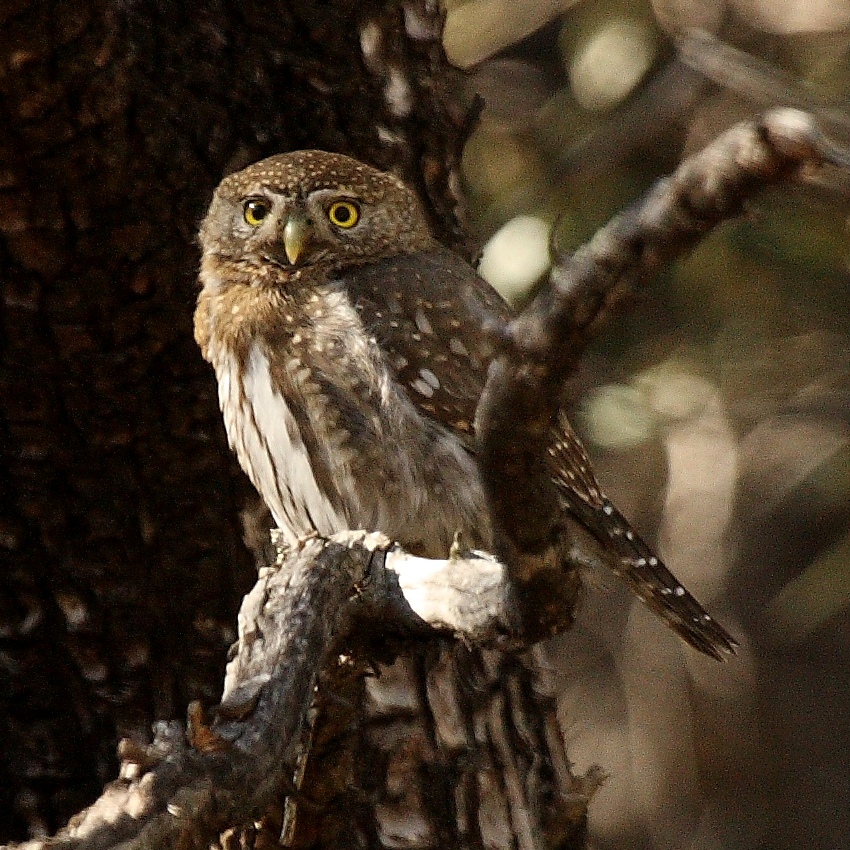 Northern Pygmy OwlGlaucidium californicum
-
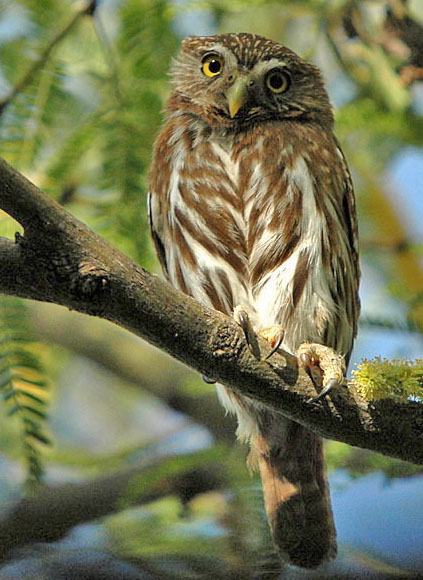 Ferruginous Pygmy OwlGlaucidium brasilianum
-
 Pearl-spotted OwletGlaucidium perlatum
-
 Asian Barred OwletGlaucidium cuculoides
-
 Jungle OwletGlaucidium radiatum
- Pernambuco Pygmy OwlGlaucidium mooreorum
Compare
Questions and answers
What is the scientific name of the Andean Pygmy Owl?
The scientific name of the Andean Pygmy Owl is Glaucidium jardinii. Written with its author, the full name is Glaucidium jardinii (Bonaparte, 1855).
Which family does the Andean Pygmy Owl belong to?
Glaucidium jardinii belongs to the family Strigidae, in the order Strigiformes and the class Aves.
Where is the Andean Pygmy Owl found?
Checklists and occurrence records place Glaucidium jardinii in 6 countries: Colombia, Ecuador, Peru, Venezuela, Bolivia and Argentina.
What is the conservation status of the Andean Pygmy Owl?
The IUCN Red List category recorded for Glaucidium jardinii is Least Concern (LC).
What other names does the Andean Pygmy Owl have?
Glaucidium jardinii is also known in English as Andean Pygmy-Owl.
What do Pygmy-Owls eat?
The Andean Pygmy Owl feeds on invertebrates, small birds, and small mammals.[23]
Sources
Passages the profile rests on
- The Andean pygmy owl is classified as Least Concern by the IUCN. Source passage: “The IUCN has assessed the Andean pygmy owl as being of Least Concern.” — English Wikipedia
- The population size of the species is unknown. Source passage: “Though its population size is not known” — English Wikipedia
- The species is considered fairly common. Source passage: “considered fairly common” — English Wikipedia
- The species has a large geographical range that includes several protected areas. Source passage: “It has a large range that includes several protected areas.” — English Wikipedia
- The species is considered probably vulnerable to forest destruction. Source passage: “probably vulnerable to forest destruction.” — English Wikipedia
- The Andean pygmy owl measures 15–16 cm in length. Source passage: “The Andean pygmy owl is 15 to 16 cm (5.9 to 6.3 in) long.” — English Wikipedia
- Male individuals weigh between 54.9 and 77.4 g. Source passage: “Males weigh 54.9 to 77.4 g (1.9 to 2.7 oz)” — English Wikipedia
- Female individuals weigh between 54.6 and 75 g. Source passage: “females 54.6 to 75 g (1.9 to 2.6 oz).” — English Wikipedia
- The species has two color morphs, one predominantly dull dark brown with white markings and the other dark chestnut with buff markings. Source passage: “It has two distinct color morphs; in one the head, most of the body, wings, and tail are dull dark brown with white markings and in the other the same areas are dark chestnut with buff markings.” — English Wikipedia
- Both color morphs have small white dots on the crown. Source passage: “In both the crown has small white dots.” — English Wikipedia
- The species has yellow eyes with white eyebrow-like markings. Source passage: “They have white "brows" over yellow eyes” — English Wikipedia
- The species has white moustache-like markings and a broad white throat. Source passage: “white "moustaches", and a broad white throat.” — English Wikipedia
- The nape has a black-and-white pattern resembling a face. Source passage: “Their nape has a black and white face-like pattern.” — English Wikipedia
- The back is spotted and the tail has white or buff bars depending on the color morph. Source passage: “Their backs have spots and the tail bars, white or buff respectively.” — English Wikipedia
- The sides of the breast are dark brown or chestnut with pale markings. Source passage: “The sides of the breast are dark brown or chestnut with pale markings” — English Wikipedia
- The breast and belly are white with heavy dark brown or chestnut streaks. Source passage: “the white breast and belly have heavy dark brown or chestnut streaks.” — English Wikipedia
- The species inhabits cloudforest, elfin forest, and Polylepis woodland. Source passage: “It inhabits a variety of mountain landscapes including cloudforest, elfin forest, Polylepis woodland” — English Wikipedia
- The species sometimes occupies forest edges and pastures with scattered trees. Source passage: “sometimes more open landscapes like forest edge and pastures with scattered trees.” — English Wikipedia
- The species occurs from the middle levels of the forest to the canopy. Source passage: “It is found from the middle levels of the forest to the canopy.” — English Wikipedia
- In Colombia, the species occurs at elevations of approximately 1,500–3,500 m. Source passage: “In elevation it ranges from about 1,500 to 3,500 m (4,900 to 11,500 ft) in Colombia” — English Wikipedia
- The species occurs at somewhat higher elevations in Venezuela, Ecuador, and Peru than in Colombia. Source passage: “and somewhat higher in Venezuela, Ecuador, and Peru.” — English Wikipedia
- The species occurs from far western Venezuela through the central and western Andes of Colombia and Ecuador to central Peru. Source passage: “The Andean pygmy owl is found in far western Venezuela and the central and western Andes of Colombia south through Ecuador to central Peru.” — English Wikipedia
- The species feeds on invertebrates, small birds, and small mammals. Source passage: “Its diet is invertebrates, small birds, and small mammals.” — English Wikipedia
- The Andean pygmy owl is active during both daytime and nighttime. Source passage: “The Andean pygmy owl is active both day and night.” — English Wikipedia
- The species produces a song consisting of a long series of rapidly delivered, evenly spaced notes. Source passage: “long series of rapidly delivered, evenly spaced 'poop' notes” — English Wikipedia
- The song is sometimes preceded by two whistles. Source passage: “that is sometimes preceded by two whistles.” — English Wikipedia
- The species nests in tree cavities, including abandoned woodpecker holes. Source passage: “It nests in tree cavities such as old woodpecker holes.” — English Wikipedia
- The usual clutch size is three eggs. Source passage: “The clutch size is usually three.” — English Wikipedia
- The breeding phenology of the species is poorly known. Source passage: “The Andean pygmy owl's breeding phenology is poorly known.” — English Wikipedia
- The Andean pygmy owl occurs in Colombia, Ecuador, Peru, and Venezuela. Source passage: “It is found in Colombia, Ecuador, Peru, and Venezuela.” — English Wikipedia
Data
- Catalogue of Life, 2026-10-16 XR cc by
- Global Biodiversity Information Facility CC BY 4.0
- Wikidata CC0
- GeoNames CC BY 4.0
- Wikimedia Commons per image; credit shown with each image
- Within the Catalogue of Life, this name comes from The Integrated Taxonomic Information System cc0
References
- Gill, Frank, & and Minturn Wright. (2006). Birds of the World: Recommended English Names.
- Dickinson, E. C., and J. V. Remsen Jr., eds. (2013). The Howard and Moore Complete Checklist of the Birds of the World, 4th Edition, Vol. 1 Non-Passerines.
This species in other databases
Page built on 29 November 2026. See how the catalog is made and all sources and licences.
Cite this page
ScientificNames.org. (2026). Glaucidium jardinii (Andean Pygmy Owl). Retrieved November 29, 2026, from https://scientificnames.org/species/glaucidium-jardinii
“Glaucidium jardinii (Andean Pygmy Owl).” ScientificNames.org, 2026, scientificnames.org/species/glaucidium-jardinii. Accessed 29 Nov. 2026.
ScientificNames.org. “Glaucidium jardinii (Andean Pygmy Owl).” Accessed November 29, 2026. https://scientificnames.org/species/glaucidium-jardinii.
@misc{scientificnames_glaucidium_jardinii_andean_pygmy_owl,
  author = {{ScientificNames.org}},
  title = {Glaucidium jardinii (Andean Pygmy Owl)},
  year = {2026},
  url = {https://scientificnames.org/species/glaucidium-jardinii},
  note = {Accessed 2026-11-29}
}