Species · Birds
East Brazilian Pygmy Owl Glaucidium minutissimum
The scientific name of the East Brazilian Pygmy Owl is Glaucidium minutissimum. It is a species of bird in the family Strigidae (owls), order Strigiformes. The name dates from 1830.
- Scientific name
- Glaucidium minutissimum (Wied-Neuwied, 1830)
- Common name
- East Brazilian Pygmy Owl
- Genus
- Glaucidium
- Family
- Strigidae (Owls)
- Order
- Strigiformes
- Class
- Aves
- Red List category
- LC Least Concern
- Recorded in
- 6 countries
- Name status
- accepted in the Catalogue of Life
Overview
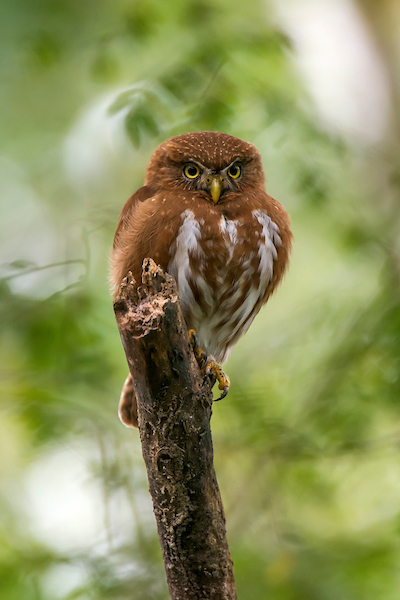
The East Brazilian Pygmy Owl is described as one of the smallest owls in South America. The species occurs in southeastern Brazil and easternmost Paraguay. It has a rounded head without ear tufts, yellow eyes, and relatively dark rufous-brown upperparts with small white spots.
Written 26 November 2026 from the sources listed below. Each statement was checked against the passage it cites; statements that could not be supported were removed.
Appearance
The East Brazilian Pygmy Owl has a rounded head without ear tufts. Its facial disk is pale greyish-brown, indistinct, and marked with rufous concentric lines. It has yellow eyes and whitish eyebrows.[1][2][3]
The upperparts are relatively dark rufous-brown with small white spots. The wings are relatively short and dark brown, while the dark brown tail has five pale bars.[4][5][6]
The underparts are light gray or white with reddish-brown stripes, and the throat has a rounded whitish patch. The legs are feathered and have bristled, yellowish toes, while the claws are horn-colored with dark tips and the beak is yellow-green.[7][8][9][10][11]
The species averages approximately 55 g in weight and 15 cm in height. Its wing length reaches 85–91 mm, and its tail reaches 49–54 mm.[12][13][14]
Habitat
The East Brazilian Pygmy Owl occurs in southeastern Brazil and easternmost Paraguay. It inhabits tropical and subtropical moist evergreen forests and their edges, as well as open bush canopy.[15][16]
Diet
The species feeds mainly on small insects. It sometimes captures small vertebrates.[17][18]
Behaviour
The species is active at dawn and dusk, although it occasionally hunts during daylight.[19][20]
The male's song consists of two to four long notes separated by short pauses.[21]
Similar species
The species has been proposed to require the scientific name Glaucidium sicki because the name Glaucidium minutissimum may belong to the Pernambuco pygmy owl. The proposed change has not achieved widespread recognition.[22][23]
The species formerly included the Colima, Tamaulipas, Central American, subtropical, and Baja pygmy owls as subspecies.[24]
Classification of the East Brazilian Pygmy Owl
| Kingdom | Animalia |
|---|---|
| Phylum | Chordata |
| Subphylum | Vertebrata |
| Infraphylum | Gnathostomata |
| Parvphylum | Osteichthyes |
| Megaclass | Tetrapoda |
| Class | Aves (Bird) |
| Order | Strigiformes (Owl) |
| Family | Strigidae (Owls) |
| Subfamily | Surniinae |
| Genus | Glaucidium (Pygmy Owl) |
| Species | Glaucidium minutissimum (Wied-Neuwied, 1830) |
Where the East Brazilian Pygmy Owl is found
Checklists and occurrence records place Glaucidium minutissimum in 6 countries across South America. GBIF holds 4,208 georeferenced records of it.
Countries
Regions and cities with the most records
- Bahia, Brazil 1,503
- São Paulo, Brazil 1,147
- Espírito Santo, Brazil 383
- Rio de Janeiro, Brazil 346
- Camacan, Brazil 322
- Santa Catarina, Brazil 272
- Sooretama, Brazil 267
- Porto Seguro, Brazil 263
- Guapiara, Brazil 261
- Santa Cruz Cabrália, Brazil 259
- Uruçuca, Brazil 214
- São Pedro, Brazil 143
- Teresópolis, Brazil 141
- Itacaré, Brazil 138
- Ilhéus, Brazil 136
- Minas Gerais, Brazil 120
- Cachoeiras de Macacu, Brazil 115
- Guapimirim, Brazil 112
- Itabuna, Brazil 108
- Timóteo, Brazil 99
- Coronel Fabriciano, Brazil 97
- Magé, Brazil 91
- Maraú, Brazil 91
- Apiaí, Brazil 84
- Petrópolis, Brazil 75
- Guabiruba, Brazil 65
- Paraty, Brazil 58
- Goiás, Brazil 57
- Gaspar, Brazil 55
- Brusque, Brazil 54
- Paraná, Brazil 53
- Ubatuba, Brazil 51
- Santa Teresa, Brazil 50
- Jaguaré, Brazil 49
- Fundão, Brazil 48
- Iguaí, Brazil 48
Range as the checklists state it
South America
A number beside a place is its count of GBIF occurrence records. A place without a number comes from a checklist alone. Records show where a species has been observed or collected, which can include escapes and vagrants.
Common names
English
- East Brazilian Pygmy Owl
- Brazilian Pygmy-Owl
- Least Pygmy Owl
- Least Pygmy-Owl
Names in 26 other languages
- Catalan
- mussolet pigmeu
- Chinese
- 小鵂鶹, 巴西鸺鹠
- Croatian
- crnorepi ćuk
- Czech
- kulíšek zakrslý
- Danish
- Brasiliansk Spurveugle, Dværgspurveugle
- Dutch
- Kleinste Dwerguil
- Esperanto
- nana strigeto
- Estonian
- pisi-värbkakk
- Finnish
- pikkuvarpuspöllö
- French
- Chevêchette cabouré
- German
- Kleinstzwergkauz, Zwergkauz, Zwergsperlingskauz
- Hungarian
- parányi törpekuvik
- Italian
- Civettina del Brasile, Civettina minuta
- Japanese
- コスズメフクロウ, ブラジルコスズメフクロウ
- Lithuanian
- žvirblinė pelėda mažylė
- Norwegian
- knøttugle
- Polish
- sóweczka karłowata
- Portuguese
- caburezinho, caburé-do-sol, caburé-ferrugem, caburé-miudinho, corujinha, mocho-pigmeu-mínimo
- Russian
- Крошечный воробьиный сыч, Крошечный сычик
- Serbian
- Najmanja mala sova
- Slovak
- kuvičok trpasličí
- Spanish
- Mochuelo mínimo
- Swedish
- dvärgsparvuggla
- Turkish
- Brezilya Serçe Baykuşu
- Ukrainian
- сичик-горобець крихітний
- Welsh
- cordylluan fechan
Synonyms
5 other scientific names have been used for this species and are now treated as synonyms of Glaucidium minutissimum.
- Glaucidium minutissimum minutissimum Wied-Neuwied, M, 1830
- Glaucidium sicki König, C; Weick, F, 2005
- Phalaenopsis minutissima Wied-Neuwied, M, 1830
- Strix minutissima Wied-Neuwied, 1830
- Strix pumila Temminck, CJ, 1821
Related species
-
 Eurasian Pygmy OwlGlaucidium passerinum
-
 Northern Pygmy OwlGlaucidium gnoma
-
 Northern Pygmy OwlGlaucidium californicum
-
 Ferruginous Pygmy OwlGlaucidium brasilianum
-
 Pearl-spotted OwletGlaucidium perlatum
-
 Asian Barred OwletGlaucidium cuculoides
-
 Jungle OwletGlaucidium radiatum
- Pernambuco Pygmy OwlGlaucidium mooreorum
Compare
Questions and answers
What is the scientific name of the East Brazilian Pygmy Owl?
The scientific name of the East Brazilian Pygmy Owl is Glaucidium minutissimum. Written with its author, the full name is Glaucidium minutissimum (Wied-Neuwied, 1830).
Which family does the East Brazilian Pygmy Owl belong to?
Glaucidium minutissimum belongs to the family Strigidae, in the order Strigiformes and the class Aves.
Where is the East Brazilian Pygmy Owl found?
Checklists and occurrence records place Glaucidium minutissimum in 6 countries: Brazil, Mexico, Panama, Colombia, Guatemala and Guyana.
What is the conservation status of the East Brazilian Pygmy Owl?
The IUCN Red List category recorded for Glaucidium minutissimum is Least Concern (LC).
What other names does the East Brazilian Pygmy Owl have?
Glaucidium minutissimum is also known in English as Brazilian Pygmy-Owl, Least Pygmy Owl and Least Pygmy-Owl.
Sources
Passages the profile rests on
- The species has a rounded head without ear tufts. Source passage: “The head is rounded, with no ear tufts.” — English Wikipedia
- The facial disk is pale greyish-brown, indistinct, and marked with rufous concentric lines. Source passage: “The pale greyish-brown facial disk is not pronounced and shows some rufous concentric lines.” — English Wikipedia
- The species has yellow eyes and whitish eyebrows. Source passage: “The eyes are yellow, with whitish eyebrows.” — English Wikipedia
- The upperparts are relatively dark rufous-brown and bear small white spots. Source passage: “The upper part of the body is relatively dark, rufous-brown with small white spots.” — English Wikipedia
- The wings are relatively short and dark brown. Source passage: “Wings are dark brown and relatively short.” — English Wikipedia
- The dark brown tail has five pale bars. Source passage: “The tail is dark brown with five pale bars.” — English Wikipedia
- The underparts are light gray or white with reddish-brown stripes. Source passage: “The lower part of the body is light gray or white, with reddish-brown stripes.” — English Wikipedia
- The throat has a rounded whitish patch. Source passage: “The throat shows a rounded whitish area.” — English Wikipedia
- The legs are feathered and have bristled, yellowish toes. Source passage: “The legs are feathered, with bristled and yellowish toes.” — English Wikipedia
- The claws are horn-colored with dark tips. Source passage: “Claws are horn-colored with dark tips.” — English Wikipedia
- The beak is yellow-green. Source passage: “The beak is yellow-green.” — English Wikipedia
- The species averages approximately 55 g in weight and 15 cm in height. Source passage: “averaging at 55 g (1.9 oz) and 15 cm (5.9 in) tall.” — English Wikipedia
- The species has a wing length reaching 85–91 mm. Source passage: “Wing length can reach 85–91 mm (3.3–3.6 in)” — English Wikipedia
- The species has a tail reaching 49–54 mm in length. Source passage: “the tail can reach a length of 49–54 mm (1.9–2.1 in).” — English Wikipedia
- The species occurs in southeastern Brazil and easternmost Paraguay. Source passage: “It can be found in southeastern Brazil and easternmost Paraguay.” — English Wikipedia
- The species inhabits tropical and subtropical moist evergreen forests and their edges, as well as open bush canopy. Source passage: “It inhabits tropical and subtropical moist evergreen forests and edges as well as open bush canopy.” — English Wikipedia
- The species feeds mainly on small insects. Source passage: “The East Brazilian pygmy owl mainly feeds on small insects” — English Wikipedia
- The species sometimes captures small vertebrates. Source passage: “sometimes catches small vertebrates.” — English Wikipedia
- The species is active at dawn and dusk. Source passage: “It is active at dusk and dawn” — English Wikipedia
- The species occasionally hunts during daylight. Source passage: “but occasionally hunts during the day.” — English Wikipedia
- The male's song consists of two to four long notes separated by short pauses. Source passage: “The song of the male is two to four long notes separated by short pauses.” — English Wikipedia
- The species has been proposed to require the scientific name Glaucidium sicki because the name Glaucidium minutissimum may belong to the Pernambuco pygmy owl. Source passage: “It has been argued that the scientific name used here actually belongs to the Pernambuco pygmy owl, in which case the East Brazilian pygmy owl should be referred to as G. sicki” — English Wikipedia
- The proposed scientific-name change to Glaucidium sicki has not achieved widespread recognition. Source passage: “This has not gained widespread recognition.” — English Wikipedia
- The species formerly included the Colima, Tamaulipas, Central American, subtropical, and Baja pygmy owls as subspecies. Source passage: “Formerly, this species included the Colima pygmy owl, Tamaulipas pygmy owl, Central American pygmy owl, subtropical pygmy owl, and Baja pygmy owl as subspecies.” — English Wikipedia
Data
- Catalogue of Life, 2026-10-16 XR cc by
- Global Biodiversity Information Facility CC BY 4.0
- Wikidata CC0
- GeoNames CC BY 4.0
- Wikimedia Commons per image; credit shown with each image
- Within the Catalogue of Life, this name comes from The Integrated Taxonomic Information System cc0
References
- Gill, Frank, & and Minturn Wright. (2006). Birds of the World: Recommended English Names.
- Dickinson, E. C., and J. V. Remsen Jr., eds. (2013). The Howard and Moore Complete Checklist of the Birds of the World, 4th Edition, Vol. 1 Non-Passerines.
This species in other databases
Page built on 28 November 2026. See how the catalog is made and all sources and licences.
Cite this page
ScientificNames.org. (2026). Glaucidium minutissimum (East Brazilian Pygmy Owl). Retrieved November 28, 2026, from https://scientificnames.org/species/glaucidium-minutissimum
“Glaucidium minutissimum (East Brazilian Pygmy Owl).” ScientificNames.org, 2026, scientificnames.org/species/glaucidium-minutissimum. Accessed 28 Nov. 2026.
ScientificNames.org. “Glaucidium minutissimum (East Brazilian Pygmy Owl).” Accessed November 28, 2026. https://scientificnames.org/species/glaucidium-minutissimum.
@misc{scientificnames_glaucidium_minutissimum_east_brazilian_pygmy_owl,
  author = {{ScientificNames.org}},
  title = {Glaucidium minutissimum (East Brazilian Pygmy Owl)},
  year = {2026},
  url = {https://scientificnames.org/species/glaucidium-minutissimum},
  note = {Accessed 2026-11-28}
}