Species · Birds
Austral Pygmy Owl Glaucidium nana
The scientific name of the Austral Pygmy Owl is Glaucidium nana. It is a species of bird in the family Strigidae (owls), order Strigiformes. The name dates from 1827.
- Scientific name
- Glaucidium nana (P. P. King, 1827)
- Common name
- Austral Pygmy Owl
- Genus
- Glaucidium
- Family
- Strigidae (Owls)
- Order
- Strigiformes
- Class
- Aves
- Red List category
- LC Least Concern
- Recorded in
- 2 countries
- Name status
- accepted in the Catalogue of Life

Overview
Glaucidium nana occurs mainly in central and southern Chile and parts of southern Argentina, from approximately Valparaíso Province and Neuquén Province south to Tierra del Fuego. It has brown to rusty plumage, with gray-brown and red morphs and intermediate forms.
Written 26 November 2026 from the sources listed below. Each statement was checked against the passage it cites; statements that could not be supported were removed.
Similar species
The Austral Pygmy Owl has sometimes been classified as a subspecies of the ferruginous pygmy owl (Glaucidium brasilianum). No other pygmy owl occurs within its geographic range.[1][2]
Appearance
Adults have a pale grayish-brown face with dark flecks, whitish eyebrows, pale yellow eyes, and black false eyes on the nape. Its overall plumage coloration ranges from brown to rusty, with gray-brown individuals occurring rarely.[3][4]
The species occurs in gray-brown and red plumage morphs, with intermediate forms between them. The gray-brown morph has dark grayish-brown upperparts marked with whitish dots of varying sizes and shapes, and a dark grayish-brown tail with narrow buffy bars.[5][6][7]
The gray-brown morph has a white throat, dark grayish-brown sides of the upper breast, and off-white underparts with dark streaks. In the red morph, reddish-brown coloration replaces the dark grayish-brown coloration of the gray-brown morph.[8][9]
The species measures 17–21 cm in length. Males weigh between 56 and 75 g, while females weigh between 70 and 100 g.[10][11][12]
Habitat
The Austral Pygmy Owl inhabits city parks and farmland containing scattered trees. Its habitats also include deciduous forests, thickets, and evergreen shrublands.[13][14][15]
It inhabits temperate and southern beech forests of the genus Nothofagus, as well as Patagonian scrub and steppe.[16][17]
Diet
Its prey includes insects, birds, mammals, and reptiles. Insects account for approximately 50% of recorded food items by number, while small mammals disproportionately influence food biomass.[18][19][20]
The species has been documented capturing birds weighing almost twice as much as itself.[21]
Behaviour
The Austral Pygmy Owl is primarily active during daylight but also hunts at night. It hunts alone, launching from perches to capture prey.[22][23]
Pairs maintain contact through a whistle consisting of six to seven notes per second. Its territorial vocalization is a sharp trill.[24][25]
Nestlings produce soft metallic chirping vocalizations. Both sexes produce a courtship whistle and an additional vocalization.[26][27]
Reproduction and life cycle
The species usually nests in cavities in trees and has also been recorded nesting in holes in earthen banks. Clutches contain three to five eggs.[28][29][30]
Egg laying occurs between September and November. The female alone incubates the eggs.[31][32]
Conservation
The Austral Pygmy Owl is classified as Least Concern by the IUCN. Its population has not been quantified, and it has been reported as the most abundant owl in Chile.[33][34][35]
The species is persecuted in agricultural areas because its nocturnal calls are interpreted as an ill omen. It was most recently assessed for the IUCN Red List in 2024.[36][37]
Classification of the Austral Pygmy Owl
| Kingdom | Animalia |
|---|---|
| Phylum | Chordata |
| Subphylum | Vertebrata |
| Infraphylum | Gnathostomata |
| Parvphylum | Osteichthyes |
| Megaclass | Tetrapoda |
| Class | Aves (Bird) |
| Order | Strigiformes (Owl) |
| Family | Strigidae (Owls) |
| Subfamily | Surniinae |
| Genus | Glaucidium (Pygmy Owl) |
| Species | Glaucidium nana (P. P. King, 1827) |
Where the Austral Pygmy Owl is found
Checklists and occurrence records place Glaucidium nana in 2 countries across South America. GBIF holds 20,022 georeferenced records of it.
Countries
Regions and cities with the most records
- Los Lagos Region, Chile 3,649
- Santiago Metropolitan, Chile 2,732
- Valparaiso, Chile 2,583
- Peñalolén, Chile 1,435
- Osorno, Chile 1,432
- Santiago, Chile 1,378
- Los Ríos Region, Chile 1,359
- Renca, Chile 1,085
- Quilpué, Chile 1,084
- Viña del Mar, Chile 1,045
- Valdivia, Chile 1,005
- Maule Region, Chile 1,002
- Concón, Chile 965
- La Pintana, Chile 889
- Araucania, Chile 843
- Lo Prado, Chile 822
- Biobio, Chile 819
- Neuquen, Argentina 808
- Quilicura, Chile 807
- Coquimbo Region, Chile 783
- Limache, Chile 732
- Valparaíso, Chile 720
- Santa Cruz, Argentina 719
- Villa Alemana, Chile 717
- Puente Alto, Chile 690
- Rio Negro, Argentina 682
- San Bernardo, Chile 625
- Maipú, Chile 622
- Tierra del Fuego, Argentina 601
- Puerto Varas, Chile 589
- Ushuaia, Argentina 561
- Aysén, Chile 539
- Concepción, Chile 534
- San Pedro de la Paz, Chile 531
- Hualpén, Chile 530
- Puerto Montt, Chile 496
Range as the checklists state it
South America
A number beside a place is its count of GBIF occurrence records. A place without a number comes from a checklist alone. Records show where a species has been observed or collected, which can include escapes and vagrants.
Common names
English
- Austral Pygmy Owl
- Austral Pygmy-Owl
Names in 26 other languages
- Catalan
- mussolet de la Patagònia
- Chinese
- 南鸺鹠, 長簇鵂鶹
- Croatian
- patagonski ćuk
- Czech
- kulíšek patagonský
- Danish
- Patagonsk Spurveugle
- Dutch
- Magelhaendwerguil
- Esperanto
- patagonia strigeto
- Finnish
- pampavarpuspöllö
- French
- Chevêchette australe
- German
- Araukanerkauz, Australzwergkauz, Patagonien-Sperlingskauz
- Hungarian
- Araukán törpekuvik
- Italian
- Civetta nana australe, Civettina australe
- Japanese
- ミナミスズメフクロウ
- Lithuanian
- australinė žvirblinė pelėda
- Norwegian
- skjellgranugle
- Polish
- sóweczka magellańska
- Portuguese
- caburé-austral, mocho-pigmeu-austral, mocho-pigmeu-australiano
- Russian
- Южный сычик
- Serbian
- Južna mala sova
- Slovak
- kuvičok patagónsky
- Spanish
- Cabure austral, Caburé grande, Chuncho, Mochuelo patagón
- Swedish
- magellansparvuggla
- Turkish
- Güneyli Serçe Baykuşu
- Ukrainian
- сичик-горобець магеланський
- Welsh
- cordylluan Patagonia
- arn
- kil-kil
Synonyms
5 other scientific names have been used for this species and are now treated as synonyms of Glaucidium nana.
- Glaucidium brasilianum nanum King, PP, 1827
- Glaucidium nanum (P. P. King, 1827)
- Glaucidium nanum vafrum Wetmore, A, 1922
- Phalaenopsis nana King, PP, 1827
- Strix nana P. P. King, 1827
Related species
-
 Eurasian Pygmy OwlGlaucidium passerinum
-
 Northern Pygmy OwlGlaucidium gnoma
-
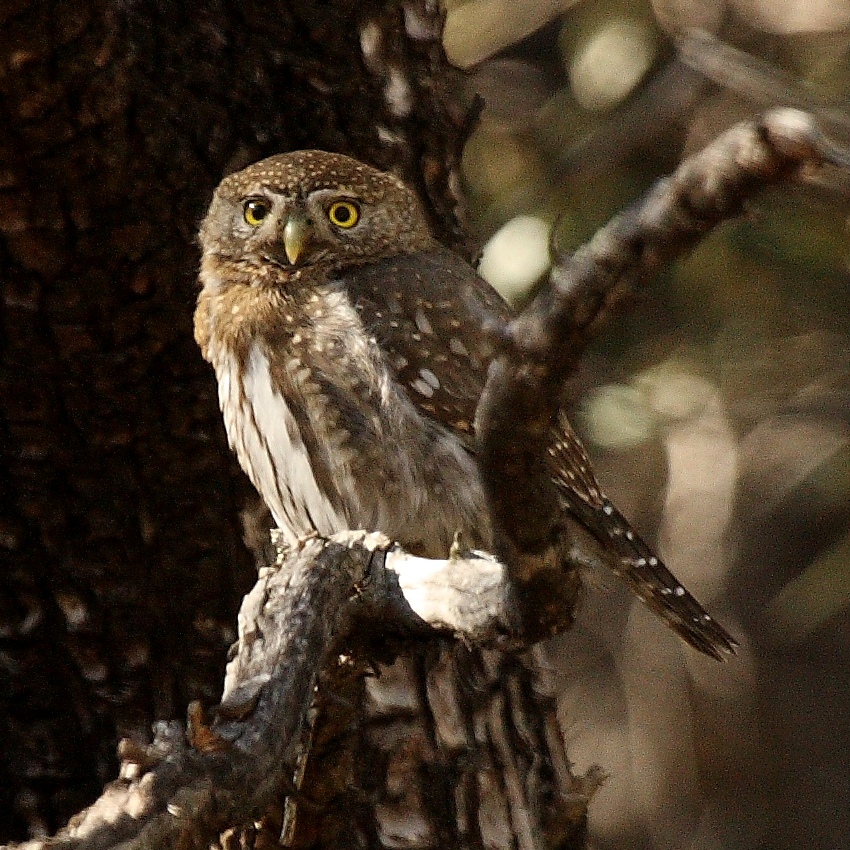 Northern Pygmy OwlGlaucidium californicum
-
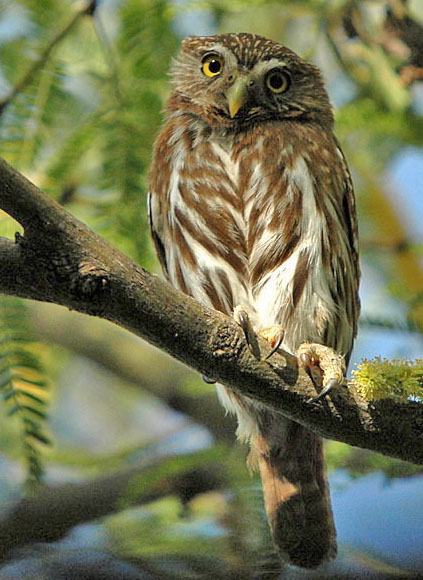 Ferruginous Pygmy OwlGlaucidium brasilianum
-
 Pearl-spotted OwletGlaucidium perlatum
-
 Asian Barred OwletGlaucidium cuculoides
-
 Jungle OwletGlaucidium radiatum
- Pernambuco Pygmy OwlGlaucidium mooreorum
Compare
Questions and answers
What is the scientific name of the Austral Pygmy Owl?
The scientific name of the Austral Pygmy Owl is Glaucidium nana. Written with its author, the full name is Glaucidium nana (P. P. King, 1827).
Which family does the Austral Pygmy Owl belong to?
Glaucidium nana belongs to the family Strigidae, in the order Strigiformes and the class Aves.
Where is the Austral Pygmy Owl found?
Checklists and occurrence records place Glaucidium nana in 2 countries: Chile and Argentina.
What is the conservation status of the Austral Pygmy Owl?
The IUCN Red List category recorded for Glaucidium nana is Least Concern (LC).
What other names does the Austral Pygmy Owl have?
Glaucidium nana is also known in English as Austral Pygmy-Owl.
Sources
Passages the profile rests on
- The species has sometimes been classified as a subspecies of the ferruginous pygmy owl (Glaucidium brasilianum). Source passage: “The austral pygmy owl has sometimes been treated as a subspecies of ferruginous pygmy owl (Glaucidium brasilianum)” — English Wikipedia
- No other pygmy owl occurs within its geographic range. Source passage: “no other pygmy-owl in its range.” — ebird.org
- Adults have a pale grayish-brown face with dark flecks, whitish eyebrows, pale yellow eyes, and black false eyes on the nape. Source passage: “Adults of both morphs have a pale grayish brown face with dark flecks, whitish "brows" over pale yellow eyes, and black "false eyes" on the nape.” — English Wikipedia
- Its overall plumage coloration ranges from brown to rusty, with gray-brown individuals occurring rarely. Source passage: “Overall plumage tones vary from brown to rusty, rarely gray-brown.” — ebird.org
- The species occurs in gray-brown and red plumage morphs, with intermediate forms between them. Source passage: “It has gray-brown and red morphs and intergrades between them.” — English Wikipedia
- The gray-brown morph has dark grayish-brown upperparts marked with whitish dots of varying sizes and shapes. Source passage: “The gray-brown morph's upperparts are dark grayish brown with whitish dots of variable size and shape.” — English Wikipedia
- The gray-brown morph has a dark grayish-brown tail with narrow buffy bars. Source passage: “The tail is also dark grayish brown with narrow buffy bars.” — English Wikipedia
- The gray-brown morph has a white throat, dark grayish-brown sides of the upper breast, and off-white underparts with dark streaks. Source passage: “The throat is white, the sides of the upper breast dark grayish brown, and the underparts off-white with dark grayish brown streaks.” — English Wikipedia
- In the red morph, reddish-brown coloration replaces the dark grayish-brown coloration of the gray-brown morph. Source passage: “The red morph has a similar pattern but reddish brown replaces the dark grayish brown.” — English Wikipedia
- The species measures 17–21 cm in length. Source passage: “The austral pygmy owl is 17 to 21 cm (6.7 to 8.3 in) long.” — English Wikipedia
- Males weigh between 56 and 75 g. Source passage: “Males weigh 56 to 75 g (2.0 to 2.6 oz)” — English Wikipedia
- Females weigh between 70 and 100 g. Source passage: “females 70 to 100 g (2.5 to 3.5 oz).” — English Wikipedia
- The species inhabits city parks and farmland containing scattered trees. Source passage: “city parks and farmland with scattered trees” — English Wikipedia
- Its habitats include deciduous forests and thickets. Source passage: “deciduous forests and thickets” — English Wikipedia
- It inhabits evergreen shrublands. Source passage: “evergreen shrublands” — English Wikipedia
- Its habitats include temperate and southern beech forests of the genus Nothofagus. Source passage: “temperate and southern beech (Nothofagus) forests” — English Wikipedia
- It also inhabits Patagonian scrub and steppe. Source passage: “Patagonian scrub/steppe.” — English Wikipedia
- Insects account for approximately 50% of the recorded food items by number. Source passage: “insects (50% by number)” — academia.edu
- Its food biomass contribution is disproportionately influenced by small mammals. Source passage: “The biomass contribution, however, is strongly skewed toward small mammals” — academia.edu
- Its prey includes insects, birds, mammals, and reptiles. Source passage: “to capture insects, birds, mammals, and reptiles.” — English Wikipedia
- It has been documented capturing birds weighing almost twice as much as itself. Source passage: “It has been documented taking birds almost double its own weight.” — English Wikipedia
- The species is primarily active during daylight but also hunts at night. Source passage: “The austral pygmy owl is primarily diurnal but is also active at night.” — English Wikipedia
- It hunts alone, launching from perches to capture prey. Source passage: “It is a solitary hunter that sallies from perches” — English Wikipedia
- Pairs maintain contact through a whistle consisting of six to seven notes per second. Source passage: “Pairs maintain contact with "a whistle with 6 to 7 notes/sec described as huj-huj-huj-huj-huj-huj".” — English Wikipedia
- Its territorial vocalization is a sharp trill. Source passage: “Their territorial call is "a sharp trill described as truie-truie-yi-yi".” — English Wikipedia
- Nestlings produce soft metallic chirping vocalizations. Source passage: “Nestlings make "soft metallic chirps trigigigirrr or trigigick".” — English Wikipedia
- Both sexes produce a courtship whistle and an additional vocalization. Source passage: “Both sexes make a courtship call, "a whistle...described as tiririi-tiririi, and an undefined call rendered as diud or diuh".” — English Wikipedia
- The species usually nests in cavities in trees. Source passage: “The austral pygmy owl usually nests in a tree cavity” — English Wikipedia
- It has also been recorded nesting in holes in earthen banks. Source passage: “but has also been documented using holes in earthen banks.” — English Wikipedia
- The species lays clutches containing three to five eggs. Source passage: “They lay a clutch of three to five eggs” — English Wikipedia
- Egg laying occurs between September and November. Source passage: “between September and November” — English Wikipedia
- The female alone incubates the eggs. Source passage: “and the female alone incubates them.” — English Wikipedia
- The species is classified as Least Concern by the IUCN. Source passage: “The IUCN has assessed the austral pygmy owl as being of Least Concern.” — English Wikipedia
- Its population has not been quantified. Source passage: “Though its population has not been quantified,” — English Wikipedia
- It has been reported as the most abundant owl in Chile. Source passage: “reported to be the most abundant owl in Chile” — English Wikipedia
- The species is persecuted in agricultural areas because its nocturnal calls are interpreted as an ill omen. Source passage: “In agricultural areas it is persecuted because its nocturnal calls are interpreted as an ill omen.” — English Wikipedia
- The species was most recently assessed for the IUCN Red List in 2024. Source passage: “Austral Pygmy-owl Glaucidium nana has most recently been assessed for The IUCN Red List of Threatened Species in 2024.” — iucnredlist.org
- The species occurs mainly in central and southern Chile and in parts of southern Argentina. Source passage: “It is found mainly in central and southern Chile, but also in some parts of southern Argentina.” — English Wikipedia
- Its range extends from approximately Valparaíso Province in Chile and Neuquén Province in western Argentina south to Tierra del Fuego. Source passage: “The austral pygmy owl is found from approximately Valparaíso Province in Chile and Neuquén Province in western Argentina south to the tip of Tierra del Fuego.” — English Wikipedia
Data
- Catalogue of Life, 2026-10-16 XR cc by
- Global Biodiversity Information Facility CC BY 4.0
- Wikidata CC0
- GeoNames CC BY 4.0
- Wikimedia Commons per image; credit shown with each image
- Within the Catalogue of Life, this name comes from The Integrated Taxonomic Information System cc0
References
- Gill, Frank, & and Minturn Wright. (2006). Birds of the World: Recommended English Names.
- Dickinson, E. C., and J. V. Remsen Jr., eds. (2013). The Howard and Moore Complete Checklist of the Birds of the World, 4th Edition, Vol. 1 Non-Passerines.
This species in other databases
Page built on 27 November 2026. See how the catalog is made and all sources and licences.
Cite this page
ScientificNames.org. (2026). Glaucidium nana (Austral Pygmy Owl). Retrieved November 27, 2026, from https://scientificnames.org/species/glaucidium-nana
“Glaucidium nana (Austral Pygmy Owl).” ScientificNames.org, 2026, scientificnames.org/species/glaucidium-nana. Accessed 27 Nov. 2026.
ScientificNames.org. “Glaucidium nana (Austral Pygmy Owl).” Accessed November 27, 2026. https://scientificnames.org/species/glaucidium-nana.
@misc{scientificnames_glaucidium_nana_austral_pygmy_owl,
  author = {{ScientificNames.org}},
  title = {Glaucidium nana (Austral Pygmy Owl)},
  year = {2026},
  url = {https://scientificnames.org/species/glaucidium-nana},
  note = {Accessed 2026-11-27}
}