Species · Birds
Sjöstedt's Barred Owlet Glaucidium sjostedti
The scientific name of the Sjöstedt's Barred Owlet is Glaucidium sjostedti. It is a species of bird in the family Strigidae (owls), order Strigiformes. The name dates from 1893.
- Scientific name
- Glaucidium sjostedti Reichenow, 1893
- Common name
- Sjöstedt's Barred Owlet
- Genus
- Glaucidium
- Family
- Strigidae (Owls)
- Order
- Strigiformes
- Class
- Aves
- Red List category
- LC Least Concern
- Recorded in
- 5 countries
- Name status
- accepted in the Catalogue of Life

Overview
Sjöstedt's Barred Owlet is a small owl in the family Strigidae, order Strigiformes and class Aves. It occurs in western Central Africa, from southeastern Nigeria through Cameroon to the Central African Republic, and south to Equatorial Guinea, Gabon, northern Congo and northwestern and central Democratic Republic of Congo. It is marked by intricate white and dark brown barring, deep reddish-brown upperparts, prominent white eyebrows and bright yellow eyes.
Written 26 November 2026 from the sources listed below. Each statement was checked against the passage it cites; statements that could not be supported were removed.
Appearance
The barring becomes less distinct towards the lower belly and vent. The species has prominent white eyebrows above bright yellow eyes, with intricate barring across most of its body and buff-and-black underparts.[1][2][3][4]
Juveniles are generally paler than adults, with yellow-brown underparts and faint upper-breast barring. They develop chestnut coloration around the throat.[5][6]
Habitat
The species is generally restricted to lowland primary forest and inhabits lowland and foothill forest interiors. It avoids particularly damp regions and forest edges.[7][8][9]
It occurs at high altitude on Mount Cameroon.[10]
Diet
The species eats insects, including grasshoppers, and also feeds on spiders, crabs, mice, small snakes and nestling birds.[11][12]
Behaviour
The species is nocturnal and hunts at night in the forest understorey. It commonly gives its distinctive call around dawn and dusk.[13][14][15]
Males defend territories and call loudly to attract females and warn rival males. Disturbing an individual at its daytime roost often triggers mobbing by small birds such as passerines.[16][17]
Reproduction and life cycle
The breeding season is poorly known. Eggs are laid in July in Gabon, while young individuals have been found in nests in Cameroon throughout much of the year.[18][19][20]
The species nests in cavities or natural hollows in trees. The female lays a clutch containing at least two eggs, and incubation lasts approximately one month.[21][22][23]
Classification of the Sjöstedt's Barred Owlet
| Kingdom | Animalia |
|---|---|
| Phylum | Chordata |
| Subphylum | Vertebrata |
| Infraphylum | Gnathostomata |
| Parvphylum | Osteichthyes |
| Megaclass | Tetrapoda |
| Class | Aves (Bird) |
| Order | Strigiformes (Owl) |
| Family | Strigidae (Owls) |
| Subfamily | Surniinae |
| Genus | Glaucidium (Pygmy Owl) |
| Species | Glaucidium sjostedti Reichenow, 1893 |
Where the Sjöstedt's Barred Owlet is found
Checklists and occurrence records place Glaucidium sjostedti in 5 countries across Africa. GBIF holds 558 georeferenced records of it.
Countries
Regions and cities with the most records
- Mai-Ndombe, Democratic Republic of the Congo 343
- South-West, Cameroon 93
- Wele-Nzas, Equatorial Guinea 28
- Ciudad de la Paz, Equatorial Guinea 23
- Ogooué-Ivindo, Gabon 22
- Tshuapa, Democratic Republic of the Congo 19
- Manjo, Cameroon 14
- Loum, Cameroon 12
- Makokou, Gabon 12
- Tombel, Cameroon 12
- Aconibe, Equatorial Guinea 9
- Ogooué-Maritime, Gabon 8
- Penja, Cameroon 6
- Centro Sur, Equatorial Guinea 5
- East, Cameroon 5
- South, Cameroon 5
- Cross River State, Nigeria 4
- Littoral, Cameroon 3
Range as the checklists state it
Africa
A number beside a place is its count of GBIF occurrence records. A place without a number comes from a checklist alone. Records show where a species has been observed or collected, which can include escapes and vagrants.
Common names
English
- Sjöstedt's Barred Owlet
- SJOW
- Sjostedt's Barred Owlet
- Sjostedt's Owlet
- Sjöstedt's Owlet
- Sjöstedt's Owlet
Names in 25 other languages
- Catalan
- mussolet de Sjostedt
- Chinese
- 中非鸺鹠, 栗背鵂鶹
- Croatian
- kestenjastoleđi ćuk
- Czech
- kulíšek Sjoestedtův, kulíšek vlnkovaný
- Danish
- Rødrygget Spurveugle
- Dutch
- Kameroendwerguil
- Esperanto
- strivosta strigeto
- Estonian
- ruskselg-värbkakk
- Finnish
- kameruninvarpuspöllö
- French
- Chevêchette à queue barrée
- German
- Prachtkauz, Prachtsperlingskauz, Prachtzwergkauz
- Hungarian
- pompás törpekuvik
- Italian
- Civettina di Sjostedt
- Japanese
- セアカスズメフクロウ
- Lithuanian
- Sjostedo žvirblinė pelėda
- Norwegian
- skarabidugle
- Polish
- sóweczka białobroda
- Portuguese
- mochinho-congolês, mocho-pigmeu-de-dorso-ruivo
- Russian
- Каштановоспинный воробьиный сыч, Каштановый сычик
- Slovak
- kuvičok hnedastý
- Spanish
- Mochuelo del Congo
- Swedish
- Sjöstedts sparvuggla, kongosparvuggla, sjöstedtsparvuggla
- Turkish
- Kamerun Serçe Baykuşu
- Ukrainian
- сичик-горобець білогорлий
- Welsh
- cordylluan gefnwinau
Synonyms
One other scientific name has been used for this species and is now treated as a synonym of Glaucidium sjostedti.
- Taenioglaux sjoestedti Reichenow, A, 1893
Related species
-
 Eurasian Pygmy OwlGlaucidium passerinum
-
 Northern Pygmy OwlGlaucidium gnoma
-
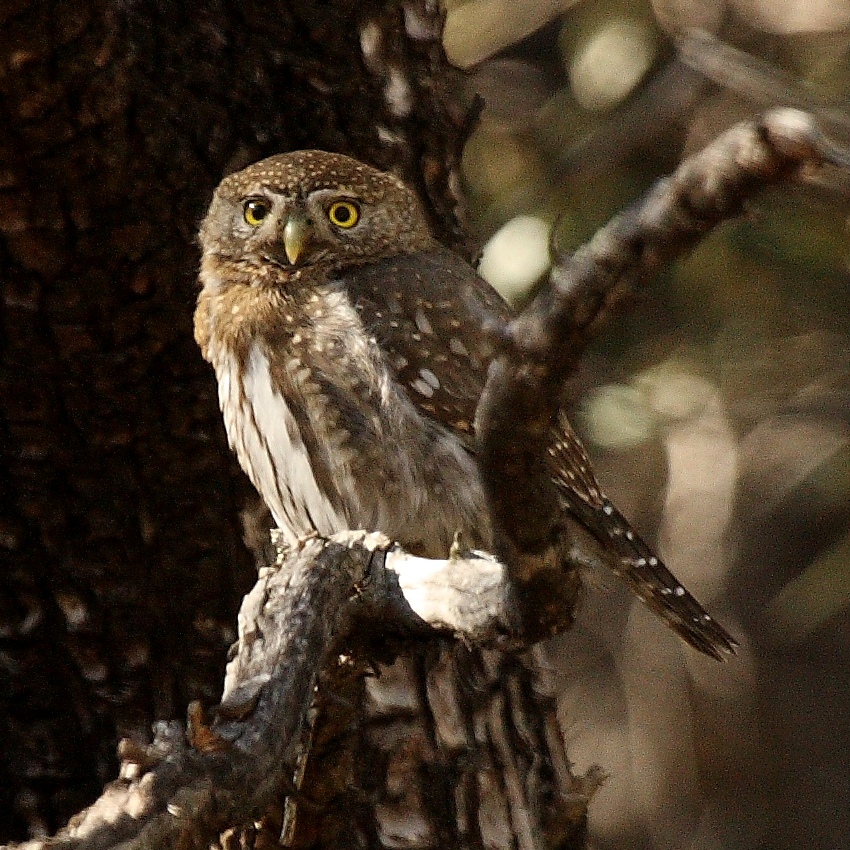 Northern Pygmy OwlGlaucidium californicum
-
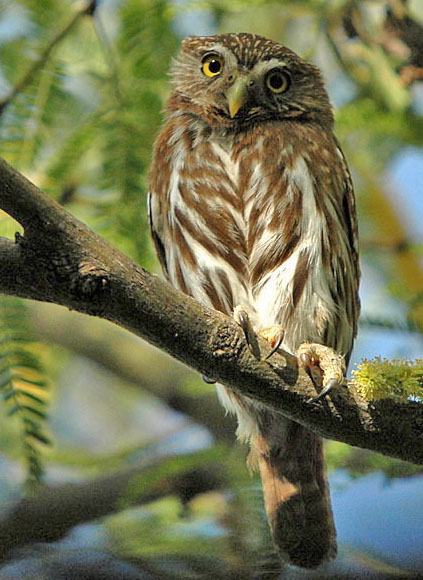 Ferruginous Pygmy OwlGlaucidium brasilianum
-
 Pearl-spotted OwletGlaucidium perlatum
-
 Asian Barred OwletGlaucidium cuculoides
-
 Jungle OwletGlaucidium radiatum
- Pernambuco Pygmy OwlGlaucidium mooreorum
Compare
Questions and answers
What is the scientific name of the Sjöstedt's Barred Owlet?
The scientific name of the Sjöstedt's Barred Owlet is Glaucidium sjostedti. Written with its author, the full name is Glaucidium sjostedti Reichenow, 1893.
Which family does the Sjöstedt's Barred Owlet belong to?
Glaucidium sjostedti belongs to the family Strigidae, in the order Strigiformes and the class Aves.
Where is the Sjöstedt's Barred Owlet found?
Checklists and occurrence records place Glaucidium sjostedti in 5 countries: Democratic Republic of the Congo, Cameroon, Gabon, Equatorial Guinea and Nigeria.
What is the conservation status of the Sjöstedt's Barred Owlet?
The IUCN Red List category recorded for Glaucidium sjostedti is Least Concern (LC).
What other names does the Sjöstedt's Barred Owlet have?
Glaucidium sjostedti is also known in English as SJOW, Sjostedt's Barred Owlet, Sjostedt's Owlet, Sjöstedt's Owlet and Sjöstedt's Owlet.
Sources
Passages the profile rests on
- The barring becomes less distinct towards the lower belly and vent. Source passage: “the barring becomes more diffuse towards the lower belly and vent.” — English Wikipedia
- The species has prominent white eyebrows above bright yellow eyes. Source passage: “bold, white eyebrows above bright yellow eyes.” — English Wikipedia
- The species has intricate barring patterns across most of its body. Source passage: “with intricate barring patterns over most of its body” — ebird.org
- Its underparts have buff-and-black coloration. Source passage: “including the buff-and-black underparts” — ebird.org
- Juveniles are generally paler than adults, with yellow-brown underparts and faint upper-breast barring. Source passage: “generally paler, with a yellow-brown cast to the underparts and faint barring on the upper breast” — English Wikipedia
- Juveniles develop chestnut coloration around the throat. Source passage: “darkening to become chestnut around the throat.” — English Wikipedia
- The species is generally restricted to lowland primary forest. Source passage: “generally restricted to lowland primary forest” — English Wikipedia
- The species avoids particularly damp regions and forest edges. Source passage: “it avoids regions that are particularly damp, and the forest edges.” — English Wikipedia
- The species inhabits lowland and foothill forest interiors. Source passage: “A small owlet of lowland and foothill forest interior” — ebird.org
- The species occurs at high altitude on Mount Cameroon. Source passage: “It occurs at high altitude on Mount Cameroon.” — English Wikipedia
- The species eats insects, including grasshoppers. Source passage: “insects such as grasshoppers” — English Wikipedia
- The species also feeds on spiders, crabs, mice, small snakes and nestling birds. Source passage: “spiders, crabs, mice, small snakes and nestling birds.” — English Wikipedia
- The species is nocturnal. Source passage: “Sjöstedt's barred owlet is a nocturnal species” — English Wikipedia
- The species hunts at night in the forest understorey. Source passage: “hunting during the night in the forest understorey.” — English Wikipedia
- The species commonly gives its distinctive call around dawn and dusk. Source passage: “which is most often made around dawn and dusk.” — English Wikipedia
- Disturbing an individual at its daytime roost often triggers mobbing by small birds such as passerines. Source passage: “it often results in mobbing behaviour by small birds, e.g. passerines.” — English Wikipedia
- Males defend territories and call loudly to attract females and warn rival males. Source passage: “The males are territorial, calling loudly in order to attract females and to warn off potentially rival males.” — English Wikipedia
- The breeding season of the species is poorly known. Source passage: “The breeding season of Sjöstedt's barred owlet is little known” — English Wikipedia
- The species lays eggs in July in Gabon. Source passage: “it lays in July in Gabon” — English Wikipedia
- Young individuals have been found in nests in Cameroon throughout much of the year. Source passage: “young have been found in nests throughout much of the year in Cameroon.” — English Wikipedia
- The species nests in cavities or natural hollows in trees. Source passage: “The nest is in a cavity or natural tree hollow” — English Wikipedia
- The female lays a clutch containing at least two eggs. Source passage: “the female lays a clutch of at least two eggs” — English Wikipedia
- The incubation period lasts approximately one month. Source passage: “with an incubation period of around one month.” — English Wikipedia
Data
- Catalogue of Life, 2026-10-16 XR cc by
- Global Biodiversity Information Facility CC BY 4.0
- Wikidata CC0
- GeoNames CC BY 4.0
- Wikimedia Commons per image; credit shown with each image
- Within the Catalogue of Life, this name comes from The Integrated Taxonomic Information System cc0
References
- Gill, Frank, & and Minturn Wright. (2006). Birds of the World: Recommended English Names.
- Dickinson, E. C., and J. V. Remsen Jr., eds. (2013). The Howard and Moore Complete Checklist of the Birds of the World, 4th Edition, Vol. 1 Non-Passerines.
This species in other databases
Page built on 27 November 2026. See how the catalog is made and all sources and licences.
Cite this page
ScientificNames.org. (2026). Glaucidium sjostedti (Sjöstedt's Barred Owlet). Retrieved November 27, 2026, from https://scientificnames.org/species/glaucidium-sjostedti
“Glaucidium sjostedti (Sjöstedt's Barred Owlet).” ScientificNames.org, 2026, scientificnames.org/species/glaucidium-sjostedti. Accessed 27 Nov. 2026.
ScientificNames.org. “Glaucidium sjostedti (Sjöstedt's Barred Owlet).” Accessed November 27, 2026. https://scientificnames.org/species/glaucidium-sjostedti.
@misc{scientificnames_glaucidium_sjostedti_sjostedts_barred_owlet,
  author = {{ScientificNames.org}},
  title = {Glaucidium sjostedti (Sjöstedt's Barred Owlet)},
  year = {2026},
  url = {https://scientificnames.org/species/glaucidium-sjostedti},
  note = {Accessed 2026-11-27}
}