Species · Mammals · Extinct
Insular Cave Rat Heteropsomys insulans
The scientific name of the Insular Cave Rat is Heteropsomys insulans. It is an extinct species of mammal in the family Echimyidae (coypu), order Rodentia. The name dates from 1916.
- Scientific name
- Heteropsomys insulans Anthony, 1916
- Common name
- Insular Cave Rat
- Genus
- Heteropsomys
- Family
- Echimyidae (Coypu)
- Order
- Rodentia
- Class
- Mammalia
- Red List category
- EX Extinct
- Name status
- accepted in the Catalogue of Life
Overview
The Insular Cave Rat (Heteropsomys insulans Anthony, 1916) was a spiny rat belonging to the genus Heteropsomys. It was native to Puerto Rico and restricted to regions with abundant water. It is extinct and is known only from recent fossil deposits.
Written 26 November 2026 from the sources listed below. Each statement was checked against the passage it cites; statements that could not be supported were removed.
Appearance
The Insular Cave Rat was a spiny rat.[1]
Habitat
The species was restricted to regions with abundant water.[2]
Diet
The Insular Cave Rat was almost exclusively herbivorous. Its diet most likely included fruits, nuts, grass, and sugar cane.[3][4]
Conservation
The Insular Cave Rat is extinct and is known only from recent fossil deposits. It most likely persisted until European colonization of Puerto Rico began.[5][6][7]
Classification of the Insular Cave Rat
| Kingdom | Animalia |
|---|---|
| Phylum | Chordata |
| Subphylum | Vertebrata |
| Infraphylum | Gnathostomata |
| Parvphylum | Osteichthyes |
| Megaclass | Tetrapoda |
| Class | Mammalia (Mammal) |
| Subclass | Theria |
| Infraclass | Eutheria |
| Order | Rodentia (Rodent) |
| Suborder | Hystricomorpha |
| Infraorder | Hystricognathi (Hystricognath Rodents) |
| Family | Echimyidae (Coypu) |
| Subfamily | Heteropsomyinae |
| Genus | Heteropsomys |
| Species | Heteropsomys insulans Anthony, 1916 |
Where the Insular Cave Rat is found
Checklists place Heteropsomys insulans in North America.
Range as the checklists state it
Caribbean
A number beside a place is its count of GBIF occurrence records. A place without a number comes from a checklist alone. Records show where a species has been observed or collected, which can include escapes and vagrants.
Common names
English
- Insular Cave Rat
- Puerto Rican Cave Rat
Names in 4 other languages
- Czech
- koro ostrovní
- Finnish
- puertoriconluolarotta
- Japanese
- プエルトリコホラアナネズミ
- Polish
- pieczarowiec portorykański
Related species
- Antillean Cave RatHeteropsomys antillensis
-
 NutriaMyocastor coypus
-
 Red-crested Tree-ratSantamartamys rufodorsalis
-
 Desmarest's HutiaCapromys pilorides
-
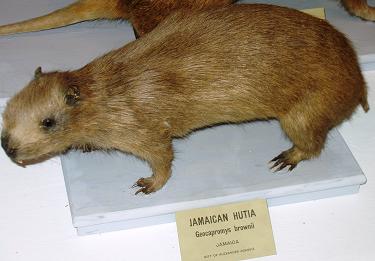 Jamaican ConeyGeocapromys brownii
-
 Hispaniolan HutiaPlagiodontia aedium
-
 Armored RatHoplomys gymnurus
-
 Bahamian HutiaGeocapromys ingrahami
Compare
Questions and answers
What is the scientific name of the Insular Cave Rat?
The scientific name of the Insular Cave Rat is Heteropsomys insulans. Written with its author, the full name is Heteropsomys insulans Anthony, 1916.
Which family does the Insular Cave Rat belong to?
Heteropsomys insulans belongs to the family Echimyidae, in the order Rodentia and the class Mammalia.
What is the conservation status of the Insular Cave Rat?
The IUCN Red List category recorded for Heteropsomys insulans is Extinct (EX).
What other names does the Insular Cave Rat have?
Heteropsomys insulans is also known in English as Puerto Rican Cave Rat.
Sources
Passages the profile rests on
- The species was a spiny rat. Source passage: “The insular cave rat (Heteropsomys insulans) is an extinct species of spiny rat that was native to Puerto Rico.” — English Wikipedia
- The species was restricted to regions with abundant water. Source passage: “This species most likely did not do well in conditions of high heat and aridity and are restricted to regions with an abundant source of water.” — English Wikipedia
- The species was almost exclusively herbivorous. Source passage: “These rats were almost exclusively herbivorous.” — English Wikipedia
- Its diet most likely included fruits, nuts, grass, and sugar cane. Source passage: “Their diet most likely included fruits, nuts, grass, and sugar cane.” — English Wikipedia
- The species is extinct. Source passage: “The insular cave rat (Heteropsomys insulans) is an extinct species of spiny rat that was native to Puerto Rico.” — English Wikipedia
- The species is known only from recent fossil deposits. Source passage: “Known only from recent fossil deposits, it most likely persisted until European colonization of Puerto Rico began.” — English Wikipedia
- The species most likely persisted until European colonization of Puerto Rico began. Source passage: “Known only from recent fossil deposits, it most likely persisted until European colonization of Puerto Rico began.” — English Wikipedia
Data
- Catalogue of Life, 2026-10-16 XR cc by
- Wikidata CC0
- Within the Catalogue of Life, this name comes from The Integrated Taxonomic Information System cc0
References
- Ann New York Acad. Sci. vol.27 p.202 where the name was published
- Wilson, Don E., and DeeAnn M. Reeder, eds. (1993). Mammal Species of the World: A Taxonomic and Geographic Reference, 2nd Ed., 3rd Printing.
- Woods, Charles A., and C. William Kilpatrick / Wilson, Don E., and DeeAnn M. Reeder, eds. (2005). Infraorder Hystricognathi Brandt, 1855. Mammal Species of the World: A Taxonomic and Geographic Reference, 3rd Ed., Vol. 2.
- Upham, Nathan S. (2017). Past and present of insular Caribbean mammals: understanding Holocene extinctions to inform modern biodiversity conservation. Journal of Mammalogy, Vol. 98, No. 4.
This species in other databases
Page built on 29 November 2026. See how the catalog is made and all sources and licences.
Cite this page
ScientificNames.org. (2026). Heteropsomys insulans (Insular Cave Rat). Retrieved November 29, 2026, from https://scientificnames.org/species/heteropsomys-insulans
“Heteropsomys insulans (Insular Cave Rat).” ScientificNames.org, 2026, scientificnames.org/species/heteropsomys-insulans. Accessed 29 Nov. 2026.
ScientificNames.org. “Heteropsomys insulans (Insular Cave Rat).” Accessed November 29, 2026. https://scientificnames.org/species/heteropsomys-insulans.
@misc{scientificnames_heteropsomys_insulans_insular_cave_rat,
  author = {{ScientificNames.org}},
  title = {Heteropsomys insulans (Insular Cave Rat)},
  year = {2026},
  url = {https://scientificnames.org/species/heteropsomys-insulans},
  note = {Accessed 2026-11-29}
}