Species · Birds
Ayres's Hawk-eagle Hieraaetus ayresii
The scientific name of the Ayres's Hawk-eagle is Hieraaetus ayresii. It is a species of bird in the family Accipitridae (hawks), order Accipitriformes. The name dates from 1862.
- Scientific name
- Hieraaetus ayresii (J. H. Gurney Sr, 1862)
- Common name
- Ayres's Hawk-eagle
- Genus
- Hieraaetus
- Family
- Accipitridae (Hawks)
- Order
- Accipitriformes
- Class
- Aves
- Red List category
- LC Least Concern
- Recorded in
- 29 countries
- Name status
- accepted in the Catalogue of Life

Overview
Hieraaetus ayresii occurs in southern Democratic Republic of the Congo, southern Uganda, Kenya, Tanzania, Zambia, Mozambique, Angola, northeastern Namibia, northern Botswana and northern Zimbabwe. It is a fast and agile aerial hunter that primarily preys on birds, including doves and pigeons.
Written 26 November 2026 from the sources listed below. Each statement was checked against the passage it cites; statements that could not be supported were removed.
Appearance
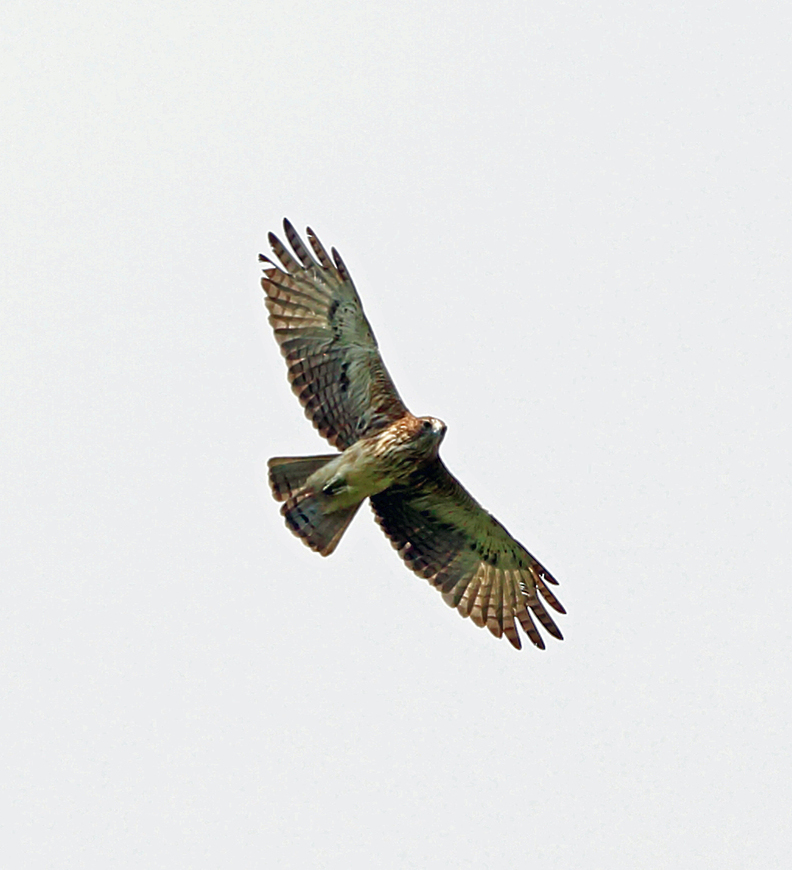
The species has yellow to orange eyes, yellow feet and cere, and a bluish horn-coloured bill with a black tip. Some individuals have predominantly black melanistic plumage with white markings.[1][2]
Juveniles have dark brown upperparts and largely white underparts with sparse dark brown markings.[3]
Adults measure 44–57 cm in total length and have a wingspan of 106–137 cm. Male body mass ranges from 615 to 714 g, while female body mass ranges from 879 to 1,150 g.[4][5]
Adult males have wing chords of 326–345 mm, compared with 360–420 mm in females. Females are substantially larger than males, with no overlap between the sexes in standard measurements.[6][7]
Habitat
Ayres's Hawk-eagle primarily inhabits mature woodland, particularly in irregular and rocky terrain. Brachystegia and Baikiaea woodlands are characteristic habitats in its south-central African core range.[8][9]
It occasionally inhabits Acacia plantations and riparian zones. It is uncommon in extremely arid and treeless environments.[10][11]
Diet
The species primarily hunts birds, particularly doves and pigeons. Laughing doves and red-eyed doves are preferred prey in some regions.[12][13]
Recorded mammalian prey includes bush squirrels and fruit bats. Typical small avian prey weighs approximately 40–200 g.[14][15]
Other recorded prey includes rock pigeons and African grey hornbills. The species sometimes captures birds exceeding twice its own size, including white-faced whistling ducks, francolins and guineafowls.[16][17]
Behaviour
Ayres's Hawk-eagle searches for prey while soaring high above the ground. It captures flying birds by stooping and intercepting them in mid-air.[18][19]
The species is particularly agile and fast in flight and can overtake many other birds.[20]
It is monogamous, territorial and solitary when nesting. During the rainy season, it moves from denser deciduous woodland into more open wooded savanna.[21][22]
Reproduction and life cycle
The nest is a large platform of twigs and sticks lined with green leaves. It is generally concealed in the fork of a large, leafy tree, approximately 9–32 m above the ground, and measures approximately 60–132 cm across.[23][24][25]
Egg laying occurs from April to September, with a peak in April and May. The female lays a single egg measuring approximately 61.2 by 49.8 mm.[26][27]
The female performs almost all incubation, which lasts approximately 43 days. The male provides food to the incubating female every two to three days.[28][29]
Chicks are fed almost daily and fledge at approximately 73 days old. Young birds become fully independent approximately three months after fledging.[30][31]
Conservation
Ayres's Hawk-eagle is classified as Least Concern on the IUCN Red List. Its estimated global population is approximately 1,000–10,000 individuals.[32][33]
Cutting of woodland is identified as the principal threat to the species. It is sometimes persecuted because it hunts domestic pigeons.[34][35]
Uses
The English name Ayres's Hawk-eagle honours South African ornithologist Thomas Ayres.[36]
Classification of the Ayres's Hawk-eagle
| Kingdom | Animalia |
|---|---|
| Phylum | Chordata |
| Subphylum | Vertebrata |
| Infraphylum | Gnathostomata |
| Parvphylum | Osteichthyes |
| Megaclass | Tetrapoda |
| Class | Aves (Bird) |
| Order | Accipitriformes (Hawks) |
| Family | Accipitridae (Hawks) |
| Genus | Hieraaetus (Hawk-eagles) |
| Species | Hieraaetus ayresii (J. H. Gurney Sr, 1862) |
Where the Ayres's Hawk-eagle is found
Checklists and occurrence records place Hieraaetus ayresii in 29 countries across Africa. GBIF holds 3,779 georeferenced records of it.
Countries
- Angola 48
- Benin 22
- Botswana 81
- Burundi 5
- Cameroon 84
- Central African Republic 4
- Chad 3
- Democratic Republic of the Congo 32
- Ethiopia 261
- Gabon 38
- Gambia 10
- Ghana 334
- Guinea 19
- Ivory Coast 24
- Kenya 783
- Liberia 57
- Malawi 59
- Mozambique 103
- Namibia 66
- Nigeria 19
- Republic of the Congo 25
- Rwanda 27
- Senegal 3
- Sierra Leone 25
- South Africa 309
- Tanzania 362
- Uganda 471
- Zambia 238
- Zimbabwe 267
Regions and cities with the most records
- Nairobi, Kenya 301
- Imara Daima Estate, Kenya 295
- Ongata Rongai, Kenya 284
- Nairobi County, Kenya 282
- Ngong, Kenya 239
- Kikuyu, Kenya 206
- Karuri, Kenya 199
- Arusha, Tanzania 197
- Kiambu, Kenya 181
- Kiserian, Kenya 175
- Oromiya, Ethiopia 152
- Githunguri, Kenya 143
- Mlolongo, Kenya 127
- Manicaland, Zimbabwe 118
- Central, Ghana 117
- KwaZulu-Natal, South Africa 115
- Arusha, Tanzania 112
- Kanungu, Uganda 93
- Gauteng, South Africa 90
- Eastern, Ghana 82
- Ruiru, Kenya 82
- Bundibugyo, Uganda 79
- Anyinam, Ghana 77
- Matabeleland North, Zimbabwe 76
- Livingstone, Zambia 75
- Victoria Falls, Zimbabwe 74
- Pretoria, South Africa 73
- Nyeri County, Kenya 66
- Kiambu County, Kenya 59
- Kilifi County, Kenya 58
- Rwiimi, Uganda 58
- Rubanda, Uganda 57
- Centurion, South Africa 56
- Sofala, Mozambique 54
- Ntungamo, Uganda 53
- Usa River, Tanzania 52
Range as the checklists state it
Africa
A number beside a place is its count of GBIF occurrence records. A place without a number comes from a checklist alone. Records show where a species has been observed or collected, which can include escapes and vagrants.
Common names
English
- Ayres's Hawk-Eagle
- AHEA
- Ayres's Eagle
- Ayres's Hawk Eagle
Names in 27 other languages
- Afrikaans
- Kleinjagarend
- Catalan
- àguila d'Ayres
- Chinese
- 艾氏隼雕, 艾氏鵰
- Croatian
- orao golubaš
- Czech
- orel skvrnitý
- Danish
- Brun Dværgørn, Brun Høgeørn
- Dutch
- Ayres' Havikarend, Ayres-havikarend
- Esperanto
- makula aglo
- Estonian
- aafrika kääbuskotkas
- Finnish
- afrikanpikkukotka
- French
- Aigle d'Ayres, Aigle d’Ayres
- German
- Fleckenadler
- Hungarian
- foltos törpesas
- Italian
- Aquila minore di Ayres, Aquilastore di Ayres
- Japanese
- シロハラクマタカ
- Korean
- 흰배뿔매
- Lithuanian
- afrikinis sakalinis erelis
- Norwegian
- flekkørn
- Polish
- orzełek plamisty
- Portuguese
- águia-de-ayres, águia-manchada
- Russian
- Африканский ястребиный орёл, Пятнистый орёл-карлик
- Serbian
- Ejresov jastrebasti orao
- Slovak
- orol holubiar
- Spanish
- Águila Azor de Ayres, Águila de Ayres
- Swedish
- fläckörn
- Turkish
- Ayres Küçük Kartalı
- Ukrainian
- орел-карлик Айреса
Synonyms
6 other scientific names have been used for this species and are now treated as synonyms of Hieraaetus ayresii.
- Anomalaetus ayresi
- Aquila ayresii Gurney, JH Sr, 1862
- Hieraaetus ayersii Gurney, JH Sr, 1862
- Hieraaetus fasciatus minor Erlanger, C, 1904
- Hieraaetus lucani Bouvier, A; Sharpe, RB, 1877
- Spizaetus ayresii J. H. Gurney Sr, 1862
Related species
-
 Booted EagleHieraaetus pennatus
-
 Little EagleHieraaetus morphnoides
-
 Wahlberg's EagleHieraaetus wahlbergi
-
 Pygmy EagleHieraaetus weiskei
-
 Bald EagleHaliaeetus leucocephalus
-
 Golden EagleAquila chrysaetos
-
 Haast's EagleHarpagornis moorei
-
 Harpy EagleHarpia harpyja
Compare
Questions and answers
What is the scientific name of the Ayres's Hawk-eagle?
The scientific name of the Ayres's Hawk-eagle is Hieraaetus ayresii. Written with its author, the full name is Hieraaetus ayresii (J. H. Gurney Sr, 1862).
Which family does the Ayres's Hawk-eagle belong to?
Hieraaetus ayresii belongs to the family Accipitridae, in the order Accipitriformes and the class Aves.
Where is the Ayres's Hawk-eagle found?
Checklists and occurrence records place Hieraaetus ayresii in 29 countries, including Kenya, Uganda, Tanzania, Ghana, South Africa and Zimbabwe.
What is the conservation status of the Ayres's Hawk-eagle?
The IUCN Red List category recorded for Hieraaetus ayresii is Least Concern (LC).
What other names does the Ayres's Hawk-eagle have?
Hieraaetus ayresii is also known in English as AHEA, Ayres's Eagle and Ayres's Hawk Eagle.
Sources
Passages the profile rests on
- The species has yellow to orange eyes, yellow feet and cere, and a bluish horn-coloured bill with a black tip. Source passage: “The eyes are yellow to orange, the cere and feet yellow, and the bill is bluish horn coloured becoming paler towards the base, with a black tip.” — English Wikipedia
- Some individuals exhibit a predominantly black melanistic plumage with white markings. Source passage: “There are two phases, the normal as described above and a melanistic phase, which is mostly black with white markings.” — English Wikipedia
- Juveniles have dark brown upperparts and largely white underparts with sparse dark brown markings. Source passage: “The juvenile Ayres's hawk-eagle is dark brown on the back and coverts, similarly dark on the crown, slightly paler necked, largely white below from the throat to the crissum and legs with sparse dark brown markings variably along the chest, belly, and flanks.” — English Wikipedia
- Adults measure 44–57 cm in total length and have a wingspan of 106–137 cm. Source passage: “with a total length of 44 to 57 cm (17 to 22 in) and has a wingspan of 106 to 137 cm (3 ft 6 in to 4 ft 6 in).” — English Wikipedia
- Male body mass ranges from 615 to 714 g, while female body mass ranges from 879 to 1,150 g. Source passage: “A small sample of males have been known to weigh from 615 to 714 g (1.356 to 1.574 lb) and females weigh from 879 to 1,150 g (1.938 to 2.535 lb).” — English Wikipedia
- Adult males have wing chords of 326–345 mm, whereas females have wing chords of 360–420 mm. Source passage: “The wing chord is 326 to 345 mm (12.8 to 13.6 in) and from 360 to 420 mm (14 to 17 in) in males and females, respectively.” — English Wikipedia
- Females are substantially larger than males, with no overlap between the sexes in standard measurements. Source passage: “The species thus manifests quite strong sexual dimorphism in favor of the female, which does not overlap in standard measurements with the smaller male.” — English Wikipedia
- The species primarily inhabits mature woodland, particularly in irregular and rocky terrain. Source passage: “It is not typically a forest dwelling species and prefers mature woodland among often irregular, rocky terrain.” — English Wikipedia
- Brachystegia and Baikiaea woodlands are characteristic habitats in its south-central African core range. Source passage: “It tends to occur around woodlands of Brachystegia and Baikiaea in the core south-central African part of their distribution.” — English Wikipedia
- The species occasionally inhabits Acacia plantations and riparian zones. Source passage: “Occasionally but not regularly they may habituate to Acacia plantations and riparian zones.” — English Wikipedia
- It is uncommon in extremely arid and treeless environments. Source passage: “Ayres's hawk-eagles tend to be rare in hyper arid and, of course, treeless areas.” — English Wikipedia
- The species primarily hunts birds, particularly doves and pigeons. Source passage: “Ayres's hawk-eagle is a bird hunter, almost to the exclusion of any other type of prey, especially doves and pigeons” — English Wikipedia
- Laughing doves and red-eyed doves are preferred prey in some regions. Source passage: “Favoured in diet in some areas are laughing doves and red-eyed doves.” — English Wikipedia
- Recorded mammalian prey includes bush squirrels and fruit bats. Source passage: “Other than birds it has been recorded as catching a few mammals including bush squirrels, and fruit bats.” — English Wikipedia
- Its typical small avian prey weighs approximately 40–200 g. Source passage: “The Ayres's hawk-eagle predominantly hunt quite small birds, typically weighing from 40 to 200 g (1.4 to 7.1 oz)” — English Wikipedia
- Its prey can include rock pigeons and African grey hornbills. Source passage: “including rock pigeons and African grey hornbills.” — English Wikipedia
- The species sometimes captures birds exceeding twice its own size, including white-faced whistling ducks, francolins and guineafowls. Source passage: “Sometimes they will overtake birds up to over twice their size including white-faced whistling ducks, assorted francolins and guineafowls” — English Wikipedia
- The eagle searches for prey while soaring high above the ground. Source passage: “it soars high above the ground to search for prey.” — English Wikipedia
- It captures flying birds by stooping and intercepting them in mid-air. Source passage: “Once a bird has been singled out, the eagle stoops to intercept it in mid air.” — English Wikipedia
- The species is particularly agile and fast in flight and can overtake many other birds. Source passage: “They are an exceptional agile and fast eagle and can overtake many birds in flight.” — English Wikipedia
- The species is monogamous, territorial and solitary when nesting. Source passage: “Ayres's hawk-eagle is a monogamous, territorial solitary nester.” — English Wikipedia
- The species moves from denser deciduous woodland into more open wooded savanna during the rainy season. Source passage: “In the rainy season moves out of denser and taller deciduous woodlands of central Africa into more open albeit treed savanna habitat further south” — English Wikipedia
- The nest is a large platform of twigs and sticks lined with green leaves. Source passage: “The nest consists of a large platform of a twigs and sticks, lined with green leaves” — English Wikipedia
- Nests are generally concealed in the fork of a large, leafy tree, approximately 9–32 m above the ground. Source passage: “typically concealed in the fork within a well-leafed, large tree, usually from 9 to 32 m (30 to 105 ft) above the ground.” — English Wikipedia
- Nest platforms measure approximately 60–132 cm across. Source passage: “The nest can be from 60 to 132 cm (24 to 52 in) across.” — English Wikipedia
- Egg laying occurs from April to September, with a peak in April and May. Source passage: “Eggs are laid from April to September, peaking in April and May.” — English Wikipedia
- The female lays a single egg measuring approximately 61.2 by 49.8 mm. Source passage: “A single egg is laid, measuring on average 61.2 by 49.8 mm (2.41 by 1.96 in).” — English Wikipedia
- The female performs almost all incubation, which lasts approximately 43 days. Source passage: “The female is almost solely responsible for incubation which takes about 43 days” — English Wikipedia
- The male provides food to the incubating female every two to three days. Source passage: “the male brings her food every two to three days.” — English Wikipedia
- Chicks are fed almost daily and fledge at approximately 73 days old. Source passage: “The chick is fed almost daily, fledging at about 73 days old” — English Wikipedia
- Young birds become fully independent approximately three months after fledging. Source passage: “becoming fully independent from its parents approximately three months after fledging.” — English Wikipedia
- The species is classified as Least Concern on the IUCN Red List. Source passage: “it is classified as Least Concern (LC) by the IUCN” — English Wikipedia
- Its estimated global population is approximately 1,000–10,000 individuals. Source passage: “The estimated global population is only 1000 to 10,000 individuals.” — English Wikipedia
- Cutting of woodland is identified as the principal threat to the species. Source passage: “The main threat faced by the species is cutting of woodland.” — English Wikipedia
- The species is sometimes persecuted because it hunts domestic pigeons. Source passage: “Furthermore, it is persecuted at times for hunting down domestic pigeons.” — English Wikipedia
- The species' English name honours South African ornithologist Thomas Ayres. Source passage: “Its name honours South African ornithologist Thomas Ayres.” — English Wikipedia
Data
- Catalogue of Life, 2026-10-16 XR cc by
- Global Biodiversity Information Facility CC BY 4.0
- Wikidata CC0
- GeoNames CC BY 4.0
- Wikimedia Commons per image; credit shown with each image
- Within the Catalogue of Life, this name comes from The Integrated Taxonomic Information System cc0
References
- Gill, Frank, & and Minturn Wright. (2006). Birds of the World: Recommended English Names.
This species in other databases
Page built on 28 November 2026. See how the catalog is made and all sources and licences.
Cite this page
ScientificNames.org. (2026). Hieraaetus ayresii (Ayres's Hawk-eagle). Retrieved November 28, 2026, from https://scientificnames.org/species/hieraaetus-ayresii
“Hieraaetus ayresii (Ayres's Hawk-eagle).” ScientificNames.org, 2026, scientificnames.org/species/hieraaetus-ayresii. Accessed 28 Nov. 2026.
ScientificNames.org. “Hieraaetus ayresii (Ayres's Hawk-eagle).” Accessed November 28, 2026. https://scientificnames.org/species/hieraaetus-ayresii.
@misc{scientificnames_hieraaetus_ayresii_ayress_hawk_eagle,
  author = {{ScientificNames.org}},
  title = {Hieraaetus ayresii (Ayres's Hawk-eagle)},
  year = {2026},
  url = {https://scientificnames.org/species/hieraaetus-ayresii},
  note = {Accessed 2026-11-28}
}