Species · Birds
Wahlberg's Eagle Hieraaetus wahlbergi
The scientific name of the Wahlberg's Eagle is Hieraaetus wahlbergi. It is a species of bird in the family Accipitridae (hawks), order Accipitriformes. The name dates from 1850.
- Scientific name
- Hieraaetus wahlbergi (Sundevall, 1850)
- Common name
- Wahlberg's Eagle
- Genus
- Hieraaetus
- Family
- Accipitridae (Hawks)
- Order
- Accipitriformes
- Class
- Aves
- Red List category
- LC Least Concern
- Recorded in
- 37 countries
- Name status
- accepted in the Catalogue of Life

Overview
Wahlberg's Eagle is a medium-sized bird of prey belonging to the family Accipitridae. It inhabits woodlands and savannas in sub-Saharan Africa, occurring from central Chad to the northeastern coast of South Africa. It has a small crest, yellow legs and variable plumage that occurs in light and dark phases.
Written 26 November 2026 from the sources listed below. Each statement was checked against the passage it cites; statements that could not be supported were removed.
Appearance
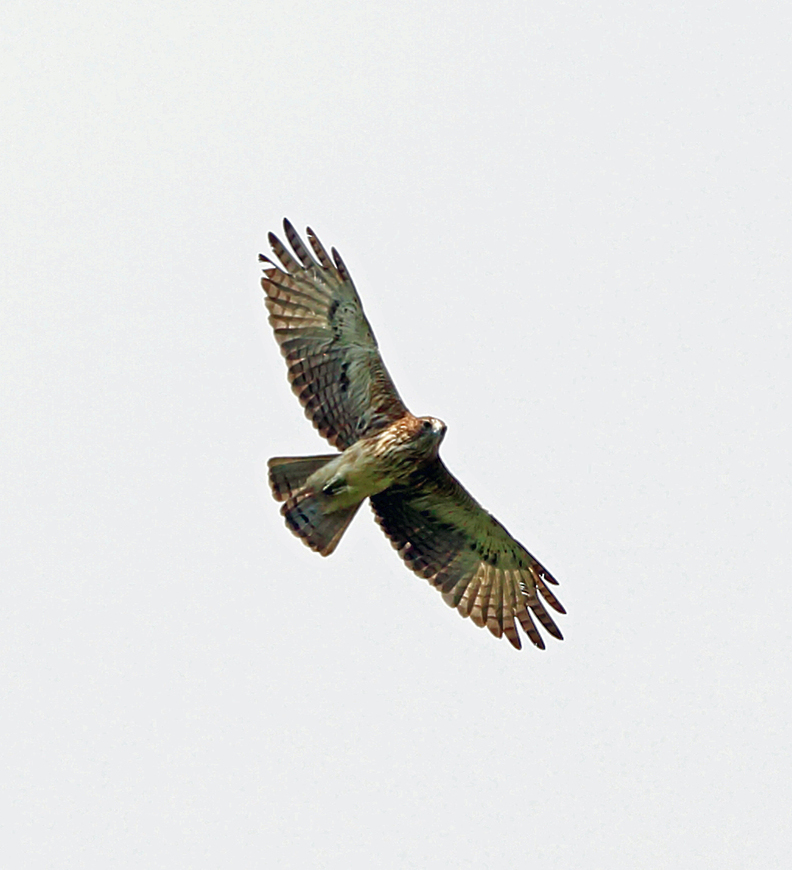
Wahlberg's Eagle has a small crest on its head and yellow legs. Its plumage is variable and commonly dark brown, with dark-streaked grey undersides to its flight feathers and a barred grey undertail.[1][2]
The species occurs in light and dark plumage phases. The less common pale variant has lighter brown coloration and whitish undersides to its undertail and flight feathers.[3][4][5]
Adult Wahlberg's Eagles measure approximately 53–61 cm in length and have a wingspan of approximately 130–146 cm. Males have an average body mass of 437–845 g, while females have an average body mass of 670–1,400 g.[6][7][8][9]
Male and female Wahlberg's Eagles have similar external appearances.[10]
Habitat
Wahlberg's Eagle inhabits woodlands and savannas in sub-Saharan Africa. It generally occurs at elevations between sea level and 1,800 m.[11][12]
The species has also been recorded at an elevation of 2,800 m in Ethiopia.[13]
Its range extends from central Chad to the northeastern coast of South Africa. Cameroon is considered the western boundary of its range, and the species occurs more commonly in the eastern part of its continental range.[14][15][16]
Diet
Birds constitute the main prey of Wahlberg's Eagle. Recorded prey includes Gabar goshawks and Barn owls.[17][18]
The species also consumes reptiles, including lizards and snakes. It occasionally eats small mammals, including tree squirrels, mongooses and hares.[19][20]
Wahlberg's Eagle has also been recorded eating termites, grasshoppers and beetles.[21]
Behaviour
Wahlberg's Eagle is a seasonal migrant within its African range and can travel considerable distances over short periods. A tracked female travelled more than 8,800 km during nine months between northern Namibia and Chad and back.[22][23][24]
Wahlberg's Eagles are territorial and nest solitarily. They form long-term pair bonds and perform complex aerial courtship displays.[25][26][27]
Reproduction and life cycle
Wahlberg's Eagle breeds mainly in southern Africa between October and February. The breeding season coincides with the wet season in northern South Africa.[28][29]
The species constructs its nest from sticks in tree forks or palm crowns. Pairs may reuse the same nest over multiple years.[30][31]
Female Wahlberg's Eagles feed their chicks using food supplied by the male.[32]
Breeding success in Wahlberg's Eagles was reported to depend strongly on population density.[33]
Conservation
Reductions in reproductive output were observed in Wahlberg's Eagles during the 1990s. Increased population density was proposed as a possible explanation for these reductions.[34][35]
The IUCN Red List assessment of Wahlberg's Eagle was most recently conducted in 2021.[36]
Classification of the Wahlberg's Eagle
| Kingdom | Animalia |
|---|---|
| Phylum | Chordata |
| Subphylum | Vertebrata |
| Infraphylum | Gnathostomata |
| Parvphylum | Osteichthyes |
| Megaclass | Tetrapoda |
| Class | Aves (Bird) |
| Order | Accipitriformes (Hawks) |
| Family | Accipitridae (Hawks) |
| Genus | Hieraaetus (Hawk-eagles) |
| Species | Hieraaetus wahlbergi (Sundevall, 1850) |
Where the Wahlberg's Eagle is found
Checklists and occurrence records place Hieraaetus wahlbergi in 37 countries across Africa. GBIF holds 60,161 georeferenced records of it.
Countries
- Angola 77
- Benin 146
- Botswana 1,492
- Burkina Faso 9
- Burundi 3
- Cameroon 94
- Central African Republic 17
- Chad 40
- Democratic Republic of the Congo 158
- Eritrea 4
- Eswatini 504
- Ethiopia 476
- Gambia 1,613
- Ghana 200
- Guinea 7
- Guinea-Bissau 26
- Ivory Coast 8
- Kenya 4,407
- Liberia 8
- Malawi 353
- Mali 5
- Mauritania 4
- Mozambique 584
- Namibia 1,257
- Niger 6
- Nigeria 506
- Rwanda 409
- Senegal 454
- Sierra Leone 10
- Somalia 4
- South Africa 37,606
- South Sudan 4
- Sudan 5
- Tanzania 1,944
- Uganda 3,923
- Zambia 1,567
- Zimbabwe 2,231
Regions and cities with the most records
- Mpumalanga, South Africa 14,607
- Limpopo, South Africa 13,572
- KwaZulu-Natal, South Africa 6,791
- North West, South Africa 1,618
- Matsulu, South Africa 1,145
- Taita Taveta, Kenya 1,018
- North-West, Botswana 861
- Komatipoort, South Africa 698
- Western, Gambia 691
- Narok County, Kenya 666
- Gauteng, South Africa 645
- Katabi, Uganda 624
- Mkhuhlu, South Africa 618
- Entebbe, Uganda 609
- Kasanje, Uganda 604
- Calcutta, South Africa 594
- Arusha, Tanzania 546
- Matabeleland North, Zimbabwe 529
- Ressano Garcia, Mozambique 477
- Central River, Gambia 439
- Kajansi, Uganda 435
- Brikama, Gambia 429
- Acornhoek, South Africa 419
- Masvingo Province, Zimbabwe 416
- Phalaborwa, South Africa 412
- Busumbala, Gambia 389
- Lubombo Region, Eswatini 382
- Kilifi County, Kenya 368
- Nakivale Refugee Camp, Uganda 359
- Harare, Zimbabwe 349
- Manyara, Tanzania 342
- Central Province, Zambia 340
- Pietermaritzburg, South Africa 340
- Mbombela, South Africa 335
- Harare, Zimbabwe 328
- Sinchu Alagi, Gambia 328
Range as the checklists state it
Africa
A number beside a place is its count of GBIF occurrence records. A place without a number comes from a checklist alone. Records show where a species has been observed or collected, which can include escapes and vagrants.
Common names
English
- Wahlberg's Eagle
- WAEA
- Wahlberg’s Eagle
Names in 32 other languages
- Afrikaans
- Bruinarend, Bruinarend (Wahlbergarend)
- Bulgarian
- Орел на Уолбърг
- Catalan
- àguila de Wahlberg
- Chinese
- 細嘴鵰, 细嘴雕
- Croatian
- smeđi orao
- Czech
- orel Wahlbergův
- Danish
- Savanneørn
- Dutch
- Wahlbergs Arend
- Esperanto
- arĝenta aglo
- Estonian
- väikekotkas
- Finnish
- sirokotka
- French
- Aigle de Wahlberg
- German
- Silberadler
- Hebrew
- עיט בינוני
- Hungarian
- Wahlberg-sas
- Irish
- Iolar airgid
- Italian
- Aquila di Wahlberg
- Japanese
- ヒメイヌワシ
- Korean
- 왈버그수리
- Lithuanian
- sidabrinis erelis
- Norwegian
- bantuørn
- Polish
- Orzeł afrykański, orzełek afrykański
- Portuguese
- águia-da-savana, águia-de-wahlberg
- Russian
- Серебристый орёл, Серебристый орёл-карлик
- Serbian
- Valbergov orao
- Slovak
- orol savanový
- Spanish
- Águila de Wahlberg
- Swedish
- Wahlbergs örn, ödleörn
- Tswana
- nTsu
- Turkish
- Wahlberg Küçük Kartalı, Wahlberg kartalı
- Ukrainian
- орел білоголовий, орел-карлик білоголовий
- Welsh
- gwalcheryr Wahlberg
Synonyms
3 other scientific names have been used for this species and are now treated as synonyms of Hieraaetus wahlbergi.
- Afraetus wahlbergi
- Aquila wahlbergi Sundevall, 1850
- Micraetus wahlbergi
Related species
-
 Booted EagleHieraaetus pennatus
-
 Little EagleHieraaetus morphnoides
-
 Pygmy EagleHieraaetus weiskei
-
 Ayres's Hawk-eagleHieraaetus ayresii
-
 Bald EagleHaliaeetus leucocephalus
-
 Golden EagleAquila chrysaetos
-
 Haast's EagleHarpagornis moorei
-
 Harpy EagleHarpia harpyja
Compare
Questions and answers
What is the scientific name of the Wahlberg's Eagle?
The scientific name of the Wahlberg's Eagle is Hieraaetus wahlbergi. Written with its author, the full name is Hieraaetus wahlbergi (Sundevall, 1850).
Which family does the Wahlberg's Eagle belong to?
Hieraaetus wahlbergi belongs to the family Accipitridae, in the order Accipitriformes and the class Aves.
Where is the Wahlberg's Eagle found?
Checklists and occurrence records place Hieraaetus wahlbergi in 37 countries, including South Africa, Kenya, Uganda, Zimbabwe, Tanzania and Gambia.
What is the conservation status of the Wahlberg's Eagle?
The IUCN Red List category recorded for Hieraaetus wahlbergi is Least Concern (LC).
What other names does the Wahlberg's Eagle have?
Hieraaetus wahlbergi is also known in English as WAEA and Wahlberg’s Eagle.
Sources
Passages the profile rests on
- Wahlberg's eagle has a small crest on its head and yellow legs. Source passage: “The head has a small crest, and the legs are yellow.” — English Wikipedia
- Wahlberg's eagle has variable plumage that is commonly dark brown, with dark-streaked grey undersides to its flight feathers and a barred grey undertail. Source passage: “The plumage tone is variable but may be dark brown except for dark-streaked grey undersides to the flight feathers, and a barred grey undertail.” — English Wikipedia
- Wahlberg's eagle occurs in both light and dark plumage phases. Source passage: “Light and dark plumage phases occur.” — English Wikipedia
- The pale plumage variant has lighter brown coloration and whitish undersides to its undertail and flight feathers. Source passage: “A pale variant may be much lighter brown with whitish, rather than grey undertail and flight feather undersides.” — English Wikipedia
- The pale plumage variant is less common than the darker variant. Source passage: “The pale variant is much less common than the darker variant.” — English Wikipedia
- Adult Wahlberg's eagles measure approximately 53–61 cm in length. Source passage: “It is about 53–61 cm (21–24 in) in length” — English Wikipedia
- Wahlberg's eagle has a wingspan of approximately 130–146 cm. Source passage: “with a wingspan of 130–146 cm (51–57 in)” — English Wikipedia
- Male Wahlberg's eagles have an average body mass of 437–845 g. Source passage: “a body mass of 437–845 g (15.4–29.8 oz) for males” — English Wikipedia
- Female Wahlberg's eagles have an average body mass of 670–1,400 g. Source passage: “and 670–1,400 g (24–49 oz) for females on average.” — English Wikipedia
- Male and female Wahlberg's eagles have similar external appearances. Source passage: “the sexes are similar.” — English Wikipedia
- Wahlberg's eagle inhabits woodlands and savannas in sub-Saharan Africa. Source passage: “where it is a seasonal migrant in the woodlands and savannas.” — English Wikipedia
- Wahlberg's eagle generally occurs at elevations between sea level and 1,800 m. Source passage: “it usually remains between sea-level and 1,800 m (5,900 ft)” — English Wikipedia
- Wahlberg's eagle has been recorded at an elevation of 2,800 m in Ethiopia. Source passage: “but has also been documented at an altitude of 2,800 m (9,200 ft) in Ethiopia.” — English Wikipedia
- Wahlberg's eagle occurs from central Chad to the northeastern coast of South Africa. Source passage: “Wahlberg's eagle is distributed from central Chad to the north-east coast of South Africa.” — English Wikipedia
- Cameroon is considered the western boundary of Wahlberg's eagle's range. Source passage: “Its western boundary is thought to be Cameroon” — English Wikipedia
- Wahlberg's eagle occurs more commonly in the eastern part of its continental range. Source passage: “although it most commonly occurs further east across the continent.” — English Wikipedia
- Birds constitute the main prey of Wahlberg's eagle. Source passage: “Wahlberg's eagle mainly hunts birds” — English Wikipedia
- Wahlberg's eagle has been recorded preying on Gabar goshawks and Barn owls. Source passage: “including other raptors such as the Gabar goshawk and Barn owl” — English Wikipedia
- Wahlberg's eagle also consumes reptiles, including lizards and snakes. Source passage: “although it also feeds on reptiles (various lizards and snakes)” — English Wikipedia
- Wahlberg's eagle occasionally eats small mammals, including tree squirrels, mongooses and hares. Source passage: “and a few small mammals (Tree squirrels, Mongooses, Hares).” — English Wikipedia
- Wahlberg's eagle has also been recorded eating termites, grasshoppers and beetles. Source passage: “It has also been recorded eating various Invertebrates such as termites, grasshoppers and beetles.” — English Wikipedia
- Wahlberg's eagle is a seasonal migrant within its African range. Source passage: “where it is a seasonal migrant in the woodlands and savannas.” — English Wikipedia
- Wahlberg's eagles can travel considerable distances over short periods. Source passage: “Wahlberg's eagles cover large distances in short periods.” — English Wikipedia
- A tracked female travelled more than 8,800 km during nine months between northern Namibia and Chad and back. Source passage: “it covered over 8,800 km (5,500 mi) from northern Namibia to Chad and back” — English Wikipedia
- Wahlberg's eagles are territorial and nest solitarily. Source passage: “They are very territorial and solitary nesters.” — English Wikipedia
- Wahlberg's eagles form long-term pair bonds. Source passage: “Wahlberg's eagles are monogamous and form long-term pair bonds.” — English Wikipedia
- Wahlberg's eagles perform complex aerial courtship displays. Source passage: “They are well known for complex and spectacular aerial courtship displays.” — English Wikipedia
- Wahlberg's eagle breeds mainly in southern Africa between October and February. Source passage: “Wahlberg's eagle breeds mainly in southern Africa during the October to February period.” — English Wikipedia
- The breeding season coincides with the wet season in northern South Africa. Source passage: “Their breeding season occurs during the wet season of northern South Africa from October to February” — English Wikipedia
- Wahlberg's eagle constructs its nest from sticks in tree forks or palm crowns. Source passage: “It builds a stick nest in the fork of a tree or the crown of a palm tree.” — English Wikipedia
- Wahlberg's eagle pairs may reuse the same nest over multiple years. Source passage: “The nest is often reused by the same pair through multiple years.” — English Wikipedia
- Female Wahlberg's eagles feed their chicks using food supplied by the male. Source passage: “The female feeds the chicks with food provided by the male eagle.” — English Wikipedia
- Breeding success in Wahlberg's eagles was reported to depend strongly on population density. Source passage: “breeding success was highly density dependant” — English Wikipedia
- Reductions in reproductive output were observed in Wahlberg's eagles during the 1990s. Source passage: “Reductions in reproductive output were observed in the 1990s” — English Wikipedia
- Increased population density was proposed as a possible explanation for reduced reproductive output in Wahlberg's eagles. Source passage: “which were thought to be related to increased population density in Wahlberg's eagles” — English Wikipedia
- The IUCN Red List assessment of Wahlberg's eagle was most recently conducted in 2021. Source passage: “Wahlberg's Eagle Hieraaetus wahlbergi has most recently been assessed for The IUCN Red List of Threatened Species in 2021.” — iucnredlist.org
Data
- Catalogue of Life, 2026-10-16 XR cc by
- Global Biodiversity Information Facility CC BY 4.0
- Wikidata CC0
- GeoNames CC BY 4.0
- Wikimedia Commons per image; credit shown with each image
- Within the Catalogue of Life, this name comes from The Integrated Taxonomic Information System cc0
This species in other databases
Page built on 29 November 2026. See how the catalog is made and all sources and licences.
Cite this page
ScientificNames.org. (2026). Hieraaetus wahlbergi (Wahlberg's Eagle). Retrieved November 29, 2026, from https://scientificnames.org/species/hieraaetus-wahlbergi
“Hieraaetus wahlbergi (Wahlberg's Eagle).” ScientificNames.org, 2026, scientificnames.org/species/hieraaetus-wahlbergi. Accessed 29 Nov. 2026.
ScientificNames.org. “Hieraaetus wahlbergi (Wahlberg's Eagle).” Accessed November 29, 2026. https://scientificnames.org/species/hieraaetus-wahlbergi.
@misc{scientificnames_hieraaetus_wahlbergi_wahlbergs_eagle,
  author = {{ScientificNames.org}},
  title = {Hieraaetus wahlbergi (Wahlberg's Eagle)},
  year = {2026},
  url = {https://scientificnames.org/species/hieraaetus-wahlbergi},
  note = {Accessed 2026-11-29}
}