Species · Birds
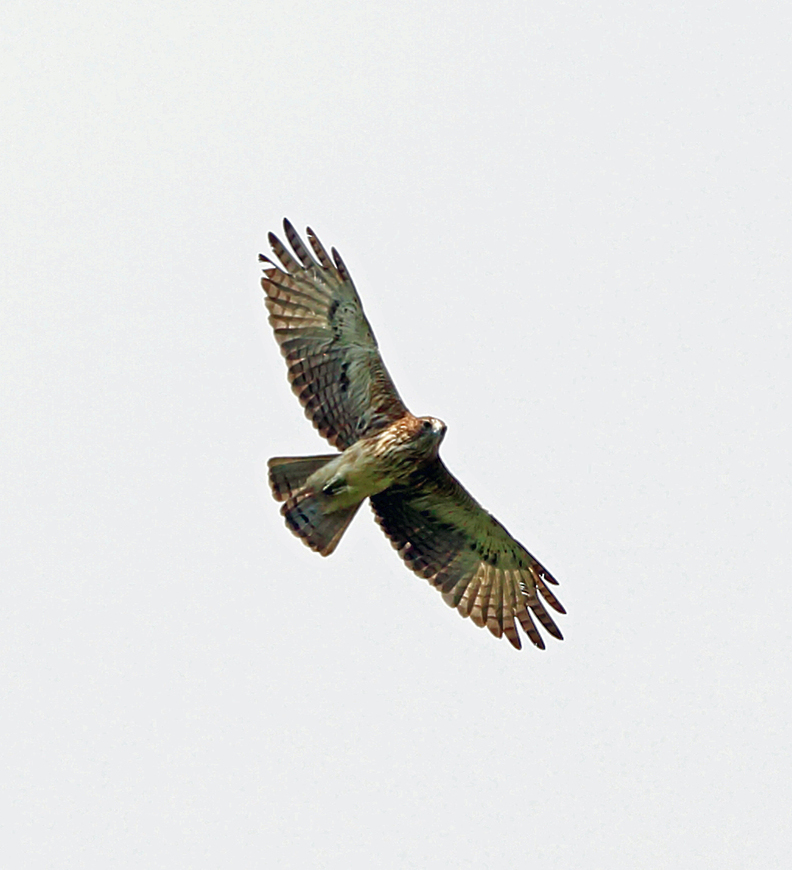
Booted Eagle Hieraaetus pennatus
The scientific name of the Booted Eagle is Hieraaetus pennatus. It is a species of bird in the family Accipitridae (hawks), order Accipitriformes. The name dates from 1788.
- Scientific name
- Hieraaetus pennatus (J. F. Gmelin, 1788)
- Common name
- Booted Eagle
- Genus
- Hieraaetus
- Family
- Accipitridae (Hawks)
- Order
- Accipitriformes
- Class
- Aves
- Red List category
- LC Least Concern
- Environment
- terrestrial
- Recorded in
- 116 countries
- Name status
- accepted in the Catalogue of Life

Overview
Hieraaetus pennatus breeds in southern Europe, North Africa, across Asia, western South Africa and Namibia. It has two distinct plumage forms, one predominantly light grey and the other mid-brown.
Written 26 November 2026 from the sources listed below. Each statement was checked against the passage it cites; statements that could not be supported were removed.
Appearance
The Booted Eagle has two distinct plumage forms: a predominantly light grey form and a mid-brown form. The pale form is dominant over the dark form through Mendelian inheritance.[1][2]
Dark-morph individuals constitute approximately 20% of the population in South Africa.[3]
The species has a body length of approximately 40 cm and a wingspan ranging from 110 to 132 cm. Male individuals weigh approximately 510–770 g, while female individuals weigh approximately 840–1,025 g.[4][5][6][7]
Habitat
The Booted Eagle inhabits wooded, often hilly countryside containing some open areas. It breeds in rocky, broken terrain.[8][9]
Palearctic breeding populations commonly nest in coniferous or deciduous woodlands. Migrating individuals use almost any habitat except dense forest.[10][11]
In South Africa, the species commonly inhabits the Fynbos and Karoo low-stature shrublands and their ecotone. South African breeding individuals typically nest on rocky cliffs in ravines and gorges, and have also been recorded nesting in trees of the genus Euphorbia.[12][13][14]
Behaviour
The Booted Eagle is typically observed alone or in pairs and typically flies at relatively low heights.[15][16]
Its vocalisation is a shrill call described as kli-kli-kli.[17]
Northern populations migrate to Sub-Saharan Africa and South Asia between November and February. Southern African populations are sedentary.[18][19]
The species typically hunts while flying. During hunting, it stoops rapidly with its wings folded inward and feet extended.[20][21]
Diet
The Booted Eagle hunts small mammals, reptiles and birds. Birds are the most commonly recorded prey of the species in Southern Africa.[22][23]
Studies in southwestern South Africa recorded birds, lizards and rodents in its diet. More than 90% of captured prey weighed between 27 and 243 g.[24][25]
Reproduction and life cycle
The Booted Eagle is monogamous and performs courtship displays involving sophisticated flight demonstrations. It typically lays one or two eggs per clutch.[26][27]
Nests are constructed from sticks and lined with green leaves. The species nests in trees or on crags and may occupy abandoned nests belonging to other large birds.[28][29]
Female individuals incubate eggs for approximately 45 days, while the male supplies food to the incubating female. After hatching, the female guards the nest and young while the male supplies all the food.[30][31][32]
Chicks generally fledge after 70–75 days.[33]
In South African breeding populations, nests are located on cliff ledges at an average height of approximately 60 m. South African breeding pairs generally successfully raise two chicks.[34][35][36]
In an Algerian study, incubation lasted between 33 and 38 days. In the same study, 67.6% of clutches contained two eggs.[37][38]
Conservation
Research on this migratory species remains limited.[39]
The species has no currently recognised subspecies.[40]
Classification of the Booted Eagle
| Kingdom | Animalia |
|---|---|
| Phylum | Chordata |
| Subphylum | Vertebrata |
| Infraphylum | Gnathostomata |
| Parvphylum | Osteichthyes |
| Megaclass | Tetrapoda |
| Class | Aves (Bird) |
| Order | Accipitriformes (Hawks) |
| Family | Accipitridae (Hawks) |
| Genus | Hieraaetus (Hawk-eagles) |
| Species | Hieraaetus pennatus (J. F. Gmelin, 1788) |
Where the Booted Eagle is found
Checklists and occurrence records place Hieraaetus pennatus in 116 countries across Africa and Asia. GBIF holds 501,867 georeferenced records of it.
Countries
- Afghanistan 22
- Albania 19
- Algeria 831
- Andorra 58
- Angola 100
- Armenia 1,223
- Austria 36
- Azerbaijan 264
- Bangladesh 270
- Belarus 14
- Belgium 250
- Benin 149
- Bhutan 64
- Botswana 264
- Bulgaria 3,097
- Burkina Faso 54
- Cabo Verde 6
- Cambodia 27
- Cameroon 52
- Chad 29
- China 1,102
- Croatia 21
- Cyprus 132
- Czechia 8
- Democratic Republic of the Congo 9
- Denmark 422
- Djibouti 51
- Egypt 819
- Eritrea 11
- Estonia 9
- Eswatini 19
- Ethiopia 555
- Finland 14
- France 35,693
- Gambia 242
- Georgia 53,226
- Germany 60
- Ghana 147
- Gibraltar 637
- Greece 1,826
- Guinea 7
- Hungary 65
- India 44,945
- Indonesia 5
- Iran 458
- Iraq 41
- Israel 14,809
- Italy 5,044
- Ivory Coast 3
- Jordan 226
- Kazakhstan 738
- Kenya 1,195
- Kuwait 321
- Kyrgyzstan 365
- Latvia 3
- Lebanon 202
- Lesotho 12
- Liberia 5
- Malawi 35
- Malaysia 135
- Mali 32
- Malta 7
- Mauritania 52
- Moldova 164
- Mongolia 896
- Montenegro 15
- Morocco 3,551
- Mozambique 67
- Myanmar 67
- Namibia 1,027
- Nepal 2,630
- Niger 21
- Nigeria 118
- North Macedonia 64
- Oman 985
- Pakistan 338
- Palestinian Territory 705
- Poland 156
- Portugal 52,008
- Romania 950
- Russia 2,852
- Rwanda 50
- San Marino 11
- Saudi Arabia 209
- Senegal 204
- Serbia 24
- Singapore 210
- Slovakia 14
- Somalia 9
- South Africa 17,885
- South Sudan 3
- Spain 232,949
- Sri Lanka 954
- Sudan 22
- Sweden 897
- Switzerland 38
- Syria 30
- Taiwan 12
- Tajikistan 78
- Tanzania 438
- Thailand 1,894
- The Netherlands 338
- Togo 3
- Tunisia 337
- Turkey 4,916
- Turkmenistan 21
- Uganda 192
- Ukraine 1,629
- United Arab Emirates 510
- United Kingdom 261
- Uzbekistan 288
- Vietnam 4
- Western Sahara 25
- Yemen 34
- Zambia 72
- Zimbabwe 155
Regions and cities with the most records
- Batumi, Georgia 52,201
- Kobuleti, Georgia 51,975
- Algeciras, Spain 33,444
- Tarifa, Spain 33,033
- Los Barrios, Spain 31,162
- Extremadura, Spain 23,511
- Occitanie, France 19,430
- Gibraltar, Gibraltar 17,216
- San Roque, Spain 17,162
- La Línea de la Concepción, Spain 17,132
- Valencia, Spain 13,953
- Madrid, Spain 13,952
- Faro, Portugal 12,636
- Aragon, Spain 12,572
- Balearic Islands, Spain 10,787
- Karnataka, India 10,757
- Western Cape, South Africa 10,015
- Cártama, Spain 7,117
- Catalonia, Spain 6,788
- Benalmádena, Spain 6,627
- Alhaurín de la Torre, Spain 6,499
- Arroyo de la Miel, Spain 6,407
- Torremolinos, Spain 6,124
- Kerala, India 6,083
- Málaga, Spain 5,988
- Provence-Alpes-Côte d'Azur, France 5,949
- Lavradio, Portugal 5,901
- Mijas, Spain 5,899
- Basque Country, Spain 5,747
- Northern District, Israel 5,682
- Setúbal, Portugal 5,578
- Barreiro, Portugal 5,488
- Rincón de la Victoria, Spain 5,386
- Santarém, Portugal 5,309
- Bengaluru, India 5,173
- Olivais, Portugal 5,155
1 more country has a few records outside this range
These countries hold a few records of Hieraaetus pennatus but lie outside the range the checklists give for it. Such records are often zoo or garden specimens, museum material or vagrants, so the species is not counted as occurring there.
Range as the checklists state it
Europe & Northern Asia (excluding China)
Southern Asia
Africa
A number beside a place is its count of GBIF occurrence records. A place without a number comes from a checklist alone. Records show where a species has been observed or collected, which can include escapes and vagrants.
Common names
English
- Booted Eagle
- BOEA
Names in 65 other languages
- Albanian
- Shqiponja e vogel
- Arabic
- السّبَر, عقاب المسيرة, عقاب المنتعلة, عقاب مسيرة, عقاب مسيرة صغرى
- Armenian
- Արծիվ գաճաճ, Գաճաճ արծիվ
- Asturian
- Aigla de les Biesques, águila pinta
- Azerbaijani
- Cırtdan qartal
- Belarusian
- Арол-карлiк, Арол-карлік
- Breton
- Erer korr
- Bulgarian
- Малък орел
- Catalan
- Esparver, Àguila calçada, àguila calçada comuna
- Chinese
- 靴隼雕, 靴隼鵰, 靴雕, 靴鵰, 靴鷹
- Czech
- orel nejmenší
- Danish
- Dværgørn
- Dutch
- Dwergarend
- Esperanto
- botaglo
- Estonian
- kääbuskotkas
- Faroese
- velbrún ørn
- Finnish
- pikkukotka
- French
- Aigle botté
- Galician
- Aguia calzada
- Georgian
- ჩია არწივი
- German
- Zwergadler
- Greek
- Γερακαετός, Σταυραετός
- Hebrew
- עיט גמד, עיט גמדי
- Hungarian
- törpesas
- Icelandic
- Skálmörn
- Indonesian
- Elang setiwel
- Irish
- Iolar brógach
- Italian
- Aquila minore, Aquila minore eurasiatica
- Japanese
- ヒメクマタカ
- Kazakh
- Бақалтақ бүркіт, Бақалтақ қыран
- Korean
- 털발뿔매, 흰점어깨수리
- Latvian
- pundurērglis
- Lithuanian
- Nykštukinis erelis, nykštukinis sakalinis erelis
- Luxembourgish
- Heckesproochmates
- Macedonian
- Џуџест (Мал) орел, мал орел
- Malay
- Burung Lang Junam
- Malayalam
- വെള്ളക്കറുപ്പൻ പരുന്ത്
- Maltese
- Ajkla tal-Kalzetti
- Marathi
- सरडामार
- Mongolian
- Бахим бүргэд
- Northern Sami
- Uhcagoaskin
- Norwegian
- dvergørn
- Persian
- عقاب پرپا
- Polish
- Orzełek, Orzełek włochaty, orzełek (włochaty)
- Portuguese
- Águia-pequena, águia-calçada
- Romanian
- Acvilă mică
- Russian
- Орёл-карлик
- Serbian
- Patuljasti orao, Patuljasti orao - Патулјасти орао
- Slovak
- Orol myšiakovitý, orol malý
- Slovenian
- mali orel
- Spanish
- Aguililla Calzada, Águila calzada
- Swahili
- Tai Mabuti
- Swedish
- dvärgörn
- Tamil
- Punjai Parundhu, பூஞ்சைப் பருந்து
- Thai
- นกอินทรีเล็ก
- Turkish
- Küçük Kartal
- Ukrainian
- Орел-карлик, орел-карлик малий
- Welsh
- gwalcheryr bacsiog
- arg
- Alica chicota
- chv
- Пӗчӗк ӑмӑрткайӑк
- glv
- Urley braagagh
- kwn
- Ekangakodi
- ori
- ଗୁଣ୍ଡୁଚିଖିଆ ଚିଲ
- roh
- Evla pitschna
- tyv
- Бичии эзир
Synonyms
12 other scientific names have been used for this species and are now treated as synonyms of Hieraaetus pennatus.
- Aquila gymnopus Heuglin, MT, 1856
- Aquila minuta Brehm, CL, 1831
- Aquila pennatus Gmelin, JF, 1788
- Butaetes lessonii Smith, A, 1834
- Falco bonelli Temminck, CJ, 1824
- Falco pennatus J. F. Gmelin, 1788
- Hieraaetus dubius (Smith, 1830)
- Hieraaetus pennatus harterti Stegmann
- Hieraaetus pennatus pennatus Gmelin, JF, 1788
- Morphinus albescens Smith, A, 1830
- Morphinus dubius Smith, A, 1830
- Spizaetus milvoides Jerdon.1839
Related species
-
 Little EagleHieraaetus morphnoides
-
 Wahlberg's EagleHieraaetus wahlbergi
-
 Pygmy EagleHieraaetus weiskei
-
 Ayres's Hawk-eagleHieraaetus ayresii
-
 Bald EagleHaliaeetus leucocephalus
-
 Golden EagleAquila chrysaetos
-
 Haast's EagleHarpagornis moorei
-
 Harpy EagleHarpia harpyja
Compare
Questions and answers
What is the scientific name of the Booted Eagle?
The scientific name of the Booted Eagle is Hieraaetus pennatus. Written with its author, the full name is Hieraaetus pennatus (J. F. Gmelin, 1788).
Which family does the Booted Eagle belong to?
Hieraaetus pennatus belongs to the family Accipitridae, in the order Accipitriformes and the class Aves.
Where is the Booted Eagle found?
Checklists and occurrence records place Hieraaetus pennatus in 116 countries, including Spain, Georgia, Portugal, India, France and South Africa.
What is the conservation status of the Booted Eagle?
The IUCN Red List category recorded for Hieraaetus pennatus is Least Concern (LC).
What other names does the Booted Eagle have?
Hieraaetus pennatus is also known in English as BOEA.
What are booted eagles?
The Booted Eagle (Hieraaetus pennatus) is a bird in the family Accipitridae. It has two distinct plumage forms, one predominantly light grey and the other mid-brown.[1]
Sources
Passages the profile rests on
- The Booted Eagle has two distinct plumage forms, one predominantly light grey and the other mid-brown. Source passage: “There are two relatively distinct plumage forms; pale individuals are mainly light grey with a darker head and flight feathers. The other form has mid-brown plumage with dark grey flight feathers.” — English Wikipedia
- The pale plumage form is dominant over the dark form through Mendelian inheritance. Source passage: “These discrete colour morphs follow a Mendelian inheritance pattern, where the paler allele is dominant.” — English Wikipedia
- Dark-morph individuals constitute approximately 20% of the population in South Africa. Source passage: “The dark colour morph represents 20% of the population in South Africa” — English Wikipedia
- The species has a body length of approximately 40 cm. Source passage: “The booted eagle is a small eagle with a length of 40 cm (16 in)” — English Wikipedia
- Its wingspan ranges from 110 to 132 cm. Source passage: “a wingspan of 110–132 cm (43–52 in)” — English Wikipedia
- Male individuals weigh approximately 510–770 g. Source passage: “males weigh about 510–770 g (18–27 oz)” — English Wikipedia
- Female individuals weigh approximately 840–1,025 g. Source passage: “females about 840–1,025 g (29.6–36.2 oz)” — English Wikipedia
- The species inhabits wooded, often hilly countryside containing some open areas. Source passage: “This is a species of wooded, often hilly countryside with some open areas.” — English Wikipedia
- The species breeds in rocky, broken terrain. Source passage: “It breeds in rocky, broken terrain” — English Wikipedia
- Migrating individuals use almost any habitat except dense forest. Source passage: “migrants will use almost any type of habitat other than dense forest.” — English Wikipedia
- Palearctic breeding populations commonly nest in coniferous or deciduous woodlands. Source passage: “The birds of the Palearctic breeding population tend to nest in coniferous or deciduous woodlands and often in trees.” — English Wikipedia
- In South Africa, the species commonly inhabits the Fynbos and Karoo low-stature shrublands and their ecotone. Source passage: “This bird is most common in the low stature shrublands of the Fynbos and Karoo, and more specifically the ecotone between the two biomes.” — English Wikipedia
- South African breeding individuals typically nest on rocky cliffs in ravines and gorges. Source passage: “typically breed strictly on rocky cliffs in ravines and gorges.” — English Wikipedia
- South African individuals have also been recorded nesting in trees of the genus Euphorbia. Source passage: “evidence has been found in South Africa of birds nesting in trees such as Euphorbias.” — English Wikipedia
- The species is typically observed alone or in pairs. Source passage: “Booted eagles are typically seen in pairs or as solitary individuals.” — English Wikipedia
- The species typically flies at relatively low heights. Source passage: “The booted eagle typically flies at relatively low heights, making it conspicuous.” — English Wikipedia
- Its vocalisation is a shrill call described as kli-kli-kli. Source passage: “The call is a shrill kli-kli-kli.” — English Wikipedia
- Northern populations migrate to Sub-Saharan Africa and South Asia between November and February. Source passage: “The northern populations are migratory spending November to February in Sub-Saharan Africa and South Asia” — English Wikipedia
- Southern African populations are sedentary. Source passage: “while the small southern African populations is sedentary.” — English Wikipedia
- The species typically hunts while flying. Source passage: “The booted eagle typically hunts on the wing” — English Wikipedia
- During hunting, the species stoops rapidly with its wings folded inward and feet extended. Source passage: “stooping quickly with wings folded in and feet extended.” — English Wikipedia
- The species hunts small mammals, reptiles and birds. Source passage: “It hunts small mammals, reptiles and birds.” — English Wikipedia
- Birds are the most commonly recorded prey of the species in Southern Africa. Source passage: “In Southern Africa, it has been noted that birds are the most common prey.” — English Wikipedia
- Studies in southwestern South Africa recorded birds, lizards and rodents in its diet. Source passage: “Studies conducted in south-western South Africa observed that they ate birds, lizards, and rodents.” — English Wikipedia
- More than 90% of captured prey weighed between 27 and 243 g. Source passage: “Over 90% of the prey captured weighed between 27 and 243 g.” — digitalcommons.usf.edu
- The species is monogamous and performs courtship displays involving sophisticated flight demonstrations. Source passage: “Booted eagles are monogamous and perform courtship rituals of sophisticated flight demonstrations.” — English Wikipedia
- The species typically lays one or two eggs per clutch. Source passage: “This eagle lays 1–2 eggs” — English Wikipedia
- Nests are constructed from sticks and lined with green leaves. Source passage: “in a nest built from sticks and lined with green leaves” — English Wikipedia
- The species nests in trees or on crags and may occupy abandoned nests belonging to other large birds. Source passage: “in a tree or on a crag, or it takes over the disused nest of another large bird such as a black kite or grey heron.” — English Wikipedia
- Female individuals incubate eggs for approximately 45 days. Source passage: “The female incubates the egg for around 45 days” — English Wikipedia
- The male supplies food to the incubating female. Source passage: “and is fed by the male” — English Wikipedia
- After hatching, the female guards the nest and young while the male supplies all the food. Source passage: “after hatching she guards the nest and the young while the male provides all the food.” — English Wikipedia
- Chicks generally fledge after 70–75 days. Source passage: “The chick fledges after 70–75 days.” — English Wikipedia
- In South African breeding populations, nests are located on cliff ledges. Source passage: “The breeding pairs nest on cliff ledges” — English Wikipedia
- South African nests have been recorded at an average height of approximately 60 m. Source passage: “booted eagles nested on cliffs at an average height of 60m.” — English Wikipedia
- South African breeding pairs generally successfully raise two chicks. Source passage: “pairs generally successfully raising two chicks according to existing evidence.” — English Wikipedia
- In an Algerian study, incubation lasted between 33 and 38 days. Source passage: “A study conducted in Algeria determined that these birds typically incubate their eggs for a period of 33 to 38 days.” — English Wikipedia
- In the Algerian study, 67.6% of clutches contained two eggs. Source passage: “most likely for clutches to consist of two eggs (67.6%).” — English Wikipedia
- Research on this migratory species remains limited. Source passage: “There is a great lack of research about this migratory species.” — English Wikipedia
- The species has no currently recognised subspecies. Source passage: “The booted eagle has no recognised subspecies.” — English Wikipedia
Data
- Catalogue of Life, 2026-10-16 XR cc by
- Global Biodiversity Information Facility CC BY 4.0
- Wikidata CC0
- GeoNames CC BY 4.0
- Wikimedia Commons per image; credit shown with each image
- Within the Catalogue of Life, this name comes from The Integrated Taxonomic Information System cc0
References
- Helbig, Andreas J., Annett Kocum, Ingrid Seibold, and Michael J. Braun. (2005). A multi-gene phylogeny of aquiline eagles (Aves: Accipitriformes) reveals extensive paraphyly at the genus level. Molecular Phylogenetics and Evolution, Vol. 35, No. 1.
- Gill, Frank, & and Minturn Wright. (2006). Birds of the World: Recommended English Names.
This species in other databases
- Catalogue of Life 3LKLR
- Wikidata Q182971
- iNaturalist 5154
- WoRMS urn:lsid:marinespecies.org:taxname:1484453
- Avibase booeag1
Page built on 28 November 2026. See how the catalog is made and all sources and licences.
Cite this page
ScientificNames.org. (2026). Hieraaetus pennatus (Booted Eagle). Retrieved November 28, 2026, from https://scientificnames.org/species/hieraaetus-pennatus
“Hieraaetus pennatus (Booted Eagle).” ScientificNames.org, 2026, scientificnames.org/species/hieraaetus-pennatus. Accessed 28 Nov. 2026.
ScientificNames.org. “Hieraaetus pennatus (Booted Eagle).” Accessed November 28, 2026. https://scientificnames.org/species/hieraaetus-pennatus.
@misc{scientificnames_hieraaetus_pennatus_booted_eagle,
  author = {{ScientificNames.org}},
  title = {Hieraaetus pennatus (Booted Eagle)},
  year = {2026},
  url = {https://scientificnames.org/species/hieraaetus-pennatus},
  note = {Accessed 2026-11-28}
}