Species · Flowering plants
Sackflower Holubia saccata
The scientific name of the Sackflower is Holubia saccata. It is a species of flowering plant in the family Pedaliaceae (pedalium family or sesame family), order Lamiales.
- Scientific name
- Holubia saccata Oliv.
- Common name
- Sackflower
- Genus
- Holubia
- Family
- Pedaliaceae (Pedalium Family Or Sesame Family)
- Order
- Lamiales
- Class
- Magnoliopsida
- Recorded in
- 4 countries
- Name status
- accepted in the Catalogue of Life

Overview
Sackflower is the only species in the monotypic genus Holubia. It is native to Botswana, Zimbabwe, and the Northern Provinces of South Africa. Its flowers have a foxglove-like corolla tube and a flattened, sack-shaped spur at the base.
Written 27 November 2026 from the sources listed below. Each statement was checked against the passage it cites; statements that could not be supported were removed.
Appearance
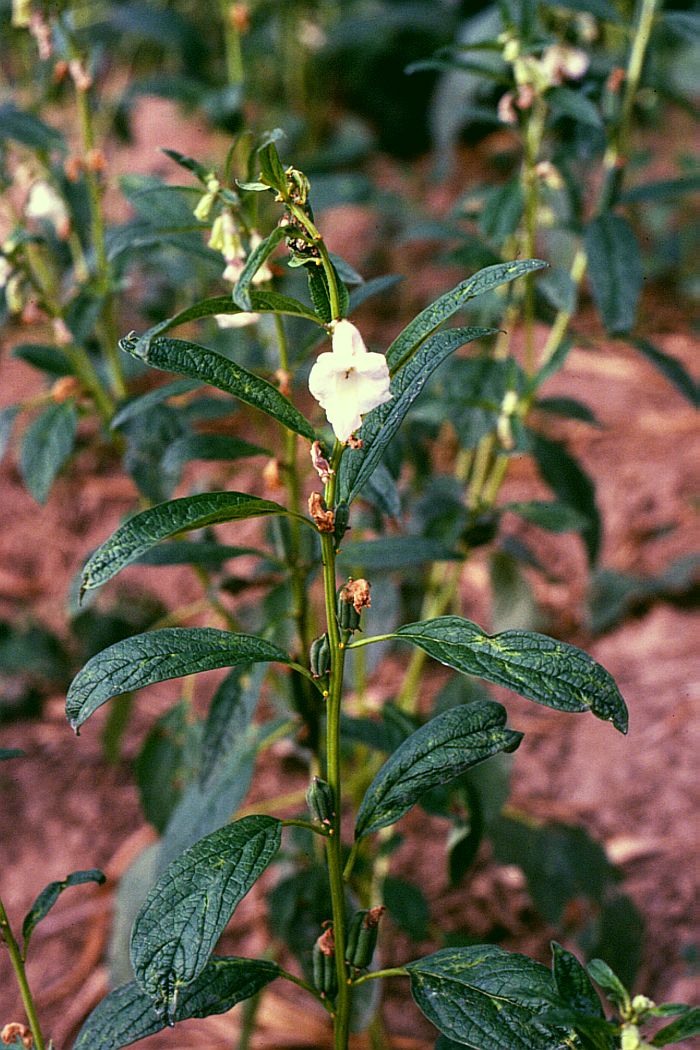
Sackflower has a slightly fleshy, square stem with spreading branches. Its opposite leaves are fleshy, spinach-green, and circular to ovate in shape.[1][2][3]
Its solitary flowers range from yellow-green and yellow to cream or white and have an unpleasant smell. They have a foxglove-like corolla tube and a flattened, sack-shaped spur at the base.[4][5][6]
Its fruit is a large, angled or rounded capsule, often tinged with purple. The seeds are dark brown or black, obovate, and covered by a leathery seed coat.[7][8]
The plant grows to 30–75 cm in height, and its leaves can reach 7 cm in length. The leaf petioles measure 2.5–7 cm long.[9][10][11]
The corolla tube measures 30–40 mm long, while the flower spur is approximately 30 mm long and 20 mm wide. The fruit capsule can reach 5–6 cm in length and 5 cm in width, and the seeds measure approximately 6 mm long and 4 mm wide.[12][13][14][15]
Habitat
Sackflower commonly grows in disturbed sandy soils along riverbanks.[16]
Behaviour
Sackflower can grow as an upright annual, biennial, or perennial plant.[17]
Reproduction and life cycle
Sackflower flowers from summer through autumn and produces fruit capsules after flowering.[18][19]
The plant can be propagated from seeds at any time of year. Recommended preparation involves removing the seed coat, chipping the blunt end, and briefly soaking the seed in water.[20][21][22]
Uses
Sackflower can be propagated for cultivation using seeds. Its fruit capsules can cause problems in sheep's wool.[22][23]
Similar species
Sackflower is similar in form to Harpagophytum procumbens.[24]
Conservation
Sackflower was reported as unchecked by the Royal Horticultural Society as of August 2021.[25]
Classification of the Sackflower
| Kingdom | Plantae |
|---|---|
| Subkingdom | Pteridobiotina |
| Phylum | Tracheophyta |
| Class | Magnoliopsida |
| Order | Lamiales |
| Family | Pedaliaceae (Pedalium Family Or Sesame Family) |
| Tribe | Pedalieae |
| Genus | Holubia (Sack Flowers) |
| Species | Holubia saccata Oliv. |
Where the Sackflower is found
Checklists and occurrence records place Holubia saccata in 4 countries across Africa. GBIF holds 199 georeferenced records of it.
Countries
Regions and cities with the most records
- Limpopo, South Africa 77
- Central, Botswana 21
- Mpumalanga, South Africa 15
- Serowe, Botswana 13
- Praktiseer, South Africa 6
- Musina, South Africa 5
- Tlokweng, Botswana 5
- Gaborone, Botswana 4
- Mmopone, Botswana 4
- Mogoditshane, Botswana 4
- Gabane, Botswana 3
- Louis Trichardt, South Africa 3
- South-East, Botswana 3
Range as the checklists state it
Zimbabwe; Mozambique; Botswana; South Africa (Limpopo, North-West Prov., Mpulamanga)
A number beside a place is its count of GBIF occurrence records. A place without a number comes from a checklist alone. Records show where a species has been observed or collected, which can include escapes and vagrants.
Common names
English
- Sackflower
Names in 1 other language
- Tswana
- makgabeathutlwa
Related species
-
 SesameSesamum indicum
-
 Wingseed SesameSesamum alatum
-
 Mousetrap TreeUncarina grandidieri
-
 Transvaal Sesame BushSesamothamnus lugardii
-
 Kunene SesameSesamum marlothii
-
 White DjirrieRogeria longiflora
- Devil's-clawHarpagophytum procumbens
-
 Large CaltropsPedalium murex
Compare
Questions and answers
What is the scientific name of the Sackflower?
The scientific name of the Sackflower is Holubia saccata. Written with its author, the full name is Holubia saccata Oliv..
Which family does the Sackflower belong to?
Holubia saccata belongs to the family Pedaliaceae, in the order Lamiales and the class Magnoliopsida.
Where is the Sackflower found?
Checklists and occurrence records place Holubia saccata in 4 countries: South Africa, Botswana, Zimbabwe and Mozambique.
Sources
Passages the profile rests on
- Holubia saccata has a slightly fleshy, square stem with spreading branches. Source passage: “with slightly fleshy, square stem and spreading branches.” — English Wikipedia
- Its leaves are opposite, fleshy, and circular to ovate in shape. Source passage: “It has opposite leaves, which are also fleshy, circular to ovate shaped.” — English Wikipedia
- Its leaves are spinach-green. Source passage: “and spinach-green in colour.” — English Wikipedia
- Its flowers are solitary and occur in yellow-green, yellow, cream, or white shades. Source passage: “with large, solitary flowers in shades of yellow-green, yellow, cream or white.” — English Wikipedia
- Its flowers have an unpleasant smell. Source passage: “They have an unpleasant smell.” — English Wikipedia
- Its flowers have a foxglove-like corolla tube and a flattened, sack-shaped spur at the base. Source passage: “They have a 30–40 mm long, corolla tube that is fox-glove like, and it has a saccate spur, or a flattened sack at the base” — English Wikipedia
- Its fruit is a large, angled or rounded capsule that is often tinged with purple. Source passage: “that is often tinged with purple, large and angled, or rotund to circular in shape” — English Wikipedia
- Its seeds are dark brown or black, obovate, and covered by a leathery seed coat. Source passage: “dark brown, or black seeds, which are obovate shaped, 6 mm long and 4 mm wide. They have a leathery seed coat.” — English Wikipedia
- Holubia saccata grows to a height of 30–75 cm. Source passage: “It grows up to 30–75 cm (12–30 in) tall” — English Wikipedia
- Its leaves can reach 7 cm in length. Source passage: “They can be up to 7 cm (2.8 in) long” — English Wikipedia
- Its leaf petioles measure 2.5–7 cm long. Source passage: “with the petiole reaching 2.5–7 cm (0.98–2.76 in) long.” — English Wikipedia
- Its corolla tube measures 30–40 mm in length. Source passage: “They have a 30–40 mm long, corolla tube” — English Wikipedia
- Its flower spur measures approximately 30 mm long and 20 mm wide. Source passage: “which is 30 mm long and 20 mm wide.” — English Wikipedia
- Its fruit capsule can reach 5–6 cm in length and 5 cm in width. Source passage: “up to 5–6 cm (2.0–2.4 in) long, and 5 cm (2.0 in) wide.” — English Wikipedia
- Its seeds measure approximately 6 mm long and 4 mm wide. Source passage: “6 mm long and 4 mm wide.” — English Wikipedia
- Holubia saccata commonly grows in disturbed sandy soils along riverbanks. Source passage: “commonly found in disturbed sandy soils along riverbanks” — English Wikipedia
- Holubia saccata can grow as an upright annual, biennial, or perennial plant. Source passage: “An upright, annual, biennial, or perennial” — English Wikipedia
- Holubia saccata flowers from summer through autumn. Source passage: “It blooms from summer to autumn” — English Wikipedia
- Holubia saccata produces fruit capsules after flowering. Source passage: “After flowering, it produces a fruit or seed capsule” — English Wikipedia
- Holubia saccata can be propagated by growing seeds at any time of year. Source passage: “Holubia saccata can be propagated by seed growing, which take place at any time of the year.” — English Wikipedia
- Seed propagation recommendations include removing the seed coat, chipping the blunt end, and soaking the seed briefly in water. Source passage: “the seed coat should be removed, the blunt end of the seed is then chipped and left in water for a short period of time.” — English Wikipedia
- Holubia saccata can be propagated for cultivation using seeds. Source passage: “Holubia saccata can be propagated by seed growing” — English Wikipedia
- The fruit capsules can cause problems in sheep's wool. Source passage: “the seed capsules (fruit) can cause a problem in sheep's wool.” — English Wikipedia
- Holubia saccata is similar in form to Harpagophytum procumbens. Source passage: “It is similar in form to Harpagophytum procumbens, another plant in the family of Pedaliaceae.” — English Wikipedia
- The species was reported as unchecked by the Royal Horticultural Society as of August 2021. Source passage: “As of August 2021, the species was unchecked by the Royal Horticultural Society” — English Wikipedia
Data
- Catalogue of Life, 2026-10-16 XR cc by
- Global Biodiversity Information Facility CC BY 4.0
- Wikidata CC0
- GeoNames CC BY 4.0
- Wikimedia Commons per image; credit shown with each image
- Within the Catalogue of Life, this name comes from Synonymic Checklists of the Vascular Plants of the World cc by
References
- Oliv. (1884). Hooker’s Icon. Pl. 15: t. 1475 (1884). where the name was published
This species in other databases
Page built on 28 November 2026. See how the catalog is made and all sources and licences.
Cite this page
ScientificNames.org. (2026). Holubia saccata (Sackflower). Retrieved November 28, 2026, from https://scientificnames.org/species/holubia-saccata
“Holubia saccata (Sackflower).” ScientificNames.org, 2026, scientificnames.org/species/holubia-saccata. Accessed 28 Nov. 2026.
ScientificNames.org. “Holubia saccata (Sackflower).” Accessed November 28, 2026. https://scientificnames.org/species/holubia-saccata.
@misc{scientificnames_holubia_saccata_sackflower,
  author = {{ScientificNames.org}},
  title = {Holubia saccata (Sackflower)},
  year = {2026},
  url = {https://scientificnames.org/species/holubia-saccata},
  note = {Accessed 2026-11-28}
}