Species · Flowering plants
Large Caltrops Pedalium murex
The scientific name of the Large Caltrops is Pedalium murex. It is a species of flowering plant in the family Pedaliaceae (pedalium family or sesame family), order Lamiales.
- Scientific name
- Pedalium murex L.
- Common name
- Large Caltrops
- Genus
- Pedalium
- Family
- Pedaliaceae (Pedalium Family Or Sesame Family)
- Order
- Lamiales
- Class
- Magnoliopsida
- Recorded in
- 22 countries
- Name status
- accepted in the Catalogue of Life

Overview
Large Caltrops (Pedalium murex L.) is a flowering plant in the family Pedaliaceae, order Lamiales and class Magnoliopsida, described as a shrub. The species occurs in the Deccan region and in parts of Ceylon and Gujarat. It bears brownish fruits with four angular, spiny projections.
Written 28 November 2026 from the sources listed below. Each statement was checked against the passage it cites; statements that could not be supported were removed.
Appearance
Large Caltrops is described as a shrub. It grows to a height of approximately 15–40 cm.[1][2]
The plant bears brownish fruits with four angular, spiny projections.[3]
Habitat
The species occurs in the Deccan region and in parts of Ceylon and Gujarat. It is distributed across India, Sri Lanka and Tropical Africa.[4][5]
The species has been collected from locations in and around Erode, Tamil Nadu, India.[6]
Uses
Large Caltrops has been evaluated for analgesic and antipyretic activities. An aqueous extract of the whole plant has demonstrated analgesic and anti-inflammatory properties.[7][8]
The petroleum ether extract has shown effectiveness against the Japanese encephalitis mosquito vector Culex quinquefasciatus. Methanolic leaf extracts have demonstrated larvicidal and pupicidal effects against Anopheles culicifacies.[9][10]
The plant's flavonoid constituent has been reported to possess antioxidant activity. The plant has also been investigated for anti-hyperlipidemic activity, with reported reductions in LDL and triglycerides in rats.[11][12]
The fruits contain polyphenolic compounds, including flavonoids and phenolics. They also contain the glycoside sapogenin, including diosgenin at a reported concentration of 0.06%, and soluble proteins at a concentration of 20.14 mg/g.[13][14][15]
Pedalitin and Pedalin have been identified as major flavonoids in the plant. Other identified flavonoids include Diosmetin, Dinatin, Dinatin-7-glucoronide, Quercetin, Quercimeritin and Quercetin-7-glucorhamnoside.[16][17]
Classification of the Large Caltrops
| Kingdom | Plantae |
|---|---|
| Subkingdom | Pteridobiotina |
| Phylum | Tracheophyta |
| Class | Magnoliopsida |
| Order | Lamiales |
| Family | Pedaliaceae (Pedalium Family Or Sesame Family) |
| Tribe | Pedalieae |
| Genus | Pedalium |
| Species | Pedalium murex L. |
Where the Large Caltrops is found
Checklists and occurrence records place Pedalium murex in 22 countries across Africa and Asia. GBIF holds 838 georeferenced records of it.
Countries
- Benin 46
- Egypt
- Ethiopia 3
- Ghana 47
- India 393
- Ivory Coast 7
- Kenya 39
- Madagascar 32
- Mayotte 4
- Mozambique 29
- Myanmar
- Nigeria 6
- Pakistan 2
- Saudi Arabia 3
- Somalia 38
- Sri Lanka 100
- Sudan 1
- Tanzania 42
- Thailand 6
- Togo 20
- Vietnam
- Yemen 20
Regions and cities with the most records
- Tamil Nadu, India 166
- Rajasthan, India 36
- Gujarat, India 35
- Injambakkam, India 35
- Jalladiampet, India 35
- Meddappakkam, India 34
- Sholinganallur, India 33
- Kullattūr, India 32
- Madipakkam, India 32
- Neelankarai, India 32
- Pallikaranai, India 32
- Rajakilpakkam, India 31
- Pallāvaram, India 30
- Meenambakkam, India 29
- Polichalur, India 29
- Kallamchavadi, India 28
- Saint Thomas Mount, India 28
- Tambaram, India 28
- Mugalivakkam, India 27
- Ramapuram, India 27
- Andhra Pradesh, India 26
- Kaikalapettai, India 26
- Karnataka, India 26
- Porur, India 26
- Maduraivayal, India 25
- Nerkunram, India 25
- Ambattur, India 24
- Maduravoyal, India 24
- Nalambūr, India 24
- Poonamalle, India 24
- Madhavaram, India 23
- Chennai, India 22
- Abomey-Calavi, Benin 17
- Ariyānkuppam, India 17
- Godomè, Benin 17
- Kerala, India 17
Range as the checklists state it
Egypt (SE-Egypt); Ghana; Togo; Benin; Nigeria; Sudan; Ethiopia; Somalia; Soqotra; Kenya; Tanzania; Zanzibar; Mozambique; Madagascar; Comores (Mayotte, etc.); Yemen (W-Yemen: Tihama); Pakistan (Sind); India (Andhra Pradesh, Bihar, Delhi, Gujarat, Haryana, Jharkhand, Karnataka, Kerala, Madhya Pradesh, Maharashtra, Odisha, Pondicherry, Punjab, Rajasthan, Tamil Nadu, Telangana, Uttar Pradesh, West Bengal); Sri Lanka; Myanmar (Magway, Mandalay); Vietnam
A number beside a place is its count of GBIF occurrence records. A place without a number comes from a checklist alone. Records show where a species has been observed or collected, which can include escapes and vagrants.
Common names
English
- Large Caltrops
Names in 3 other languages
- Russian
- Педалиум колючий
- Slovak
- pedálium ostrankovité
- Tamil
- யானை நெருஞ்சில்
Synonyms
4 other scientific names have been used for this species and are now treated as synonyms of Pedalium murex.
- Murex burmannii Kuntze
- Pedalium microcarpum (Klotzsch) Decne.
- Pedalium muricatum Salisb.
- Rogeria microcarpa Klotzsch
Related species
-
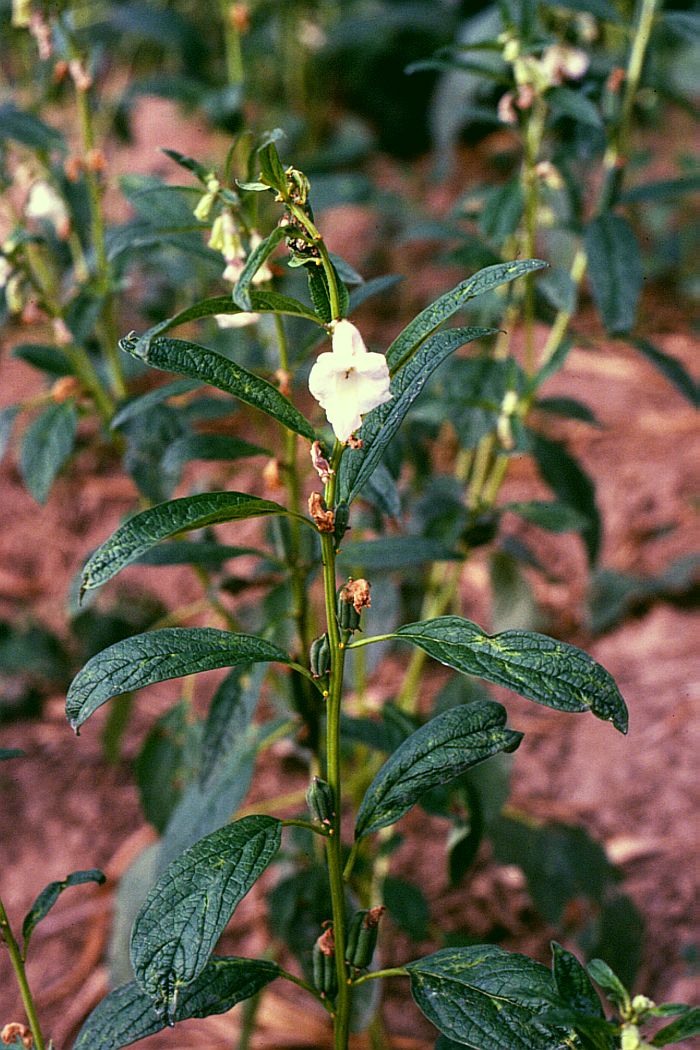 SesameSesamum indicum
-
 Wingseed SesameSesamum alatum
-
 Mousetrap TreeUncarina grandidieri
-
 Transvaal Sesame BushSesamothamnus lugardii
-
 Kunene SesameSesamum marlothii
-
 White DjirrieRogeria longiflora
-
 SackflowerHolubia saccata
- Devil's-clawHarpagophytum procumbens
Compare
Questions and answers
What is the scientific name of the Large Caltrops?
The scientific name of the Large Caltrops is Pedalium murex. Written with its author, the full name is Pedalium murex L..
Which family does the Large Caltrops belong to?
Pedalium murex belongs to the family Pedaliaceae, in the order Lamiales and the class Magnoliopsida.
Where is the Large Caltrops found?
Checklists and occurrence records place Pedalium murex in 22 countries, including India, Sri Lanka, Ghana, Benin, Tanzania and Kenya.
What are the medicinal uses of Pedalium murex?
Pedalium murex has been evaluated for analgesic and antipyretic activities. Its aqueous whole-plant extract has demonstrated analgesic and anti-inflammatory properties, and its flavonoid constituent has been reported to possess antioxidant activity. It has also been investigated for anti-hyperlipidemic activity, with reported reductions in LDL and triglycerides in rats.[7][8][11][12]
Sources
Passages the profile rests on
- The species is described as a shrub. Source passage: “is a shrub found in the Southern part, Deccan region of” — pubmed.ncbi.nlm.nih.gov
- The plant grows to a height of approximately 15–40 cm. Source passage: “It is about 15 to 40 cm in height” — pmc.ncbi.nlm.nih.gov
- The plant bears brownish fruits with four angular, spiny projections. Source passage: “having four angled spiny brownish colour fruits.” — pmc.ncbi.nlm.nih.gov
- The species occurs in the Deccan region and in parts of Ceylon and Gujarat. Source passage: “It is commonly found in Deccan and in some parts of Ceylon and Gujarat.” — pmc.ncbi.nlm.nih.gov
- The species is distributed across India, Sri Lanka and Tropical Africa. Source passage: “It is distributed in India, Sri Lanka and Tropical Africa.” — inaturalist.org
- The species was collected from locations in and around Erode, Tamil Nadu, India. Source passage: “Leaves of P. murex (Pedaliaceae) were collected from in and around Erode (11° 20′ N and 77° 43′ E), Tamilnadu, India.” — pmc.ncbi.nlm.nih.gov
- The plant has been evaluated for analgesic and antipyretic activities. Source passage: “It has also been evaluated for its analgesic and antipyretic activities.” — pmc.ncbi.nlm.nih.gov
- An aqueous extract of the whole plant has demonstrated analgesic and anti-inflammatory properties. Source passage: “The aqueous extract of the whole plant has been found to possess analgesic and anti-inflammatory properties” — pmc.ncbi.nlm.nih.gov
- The petroleum ether extract of the plant has shown effectiveness against the Japanese encephalitis mosquito vector Culex quinquefasciatus. Source passage: “The petroleum ether extract of P. murex is effective against Japanese encephalitis vector Culex quinquefasciatus” — pmc.ncbi.nlm.nih.gov
- Methanolic leaf extracts of the plant have demonstrated larvicidal and pupicidal effects against Anopheles culicifacies. Source passage: “Laboratory studies on larvicidal and pupicidal effects of methanolic extract of P. murex tested against the rural malarial vector, An. culicifacies were significant.” — pmc.ncbi.nlm.nih.gov
- The plant's flavonoid constituent has been reported to possess antioxidant activity. Source passage: “Flavanoid, an important constituent of P. murex, has been reported for its antioxidant activities.” — pmc.ncbi.nlm.nih.gov
- The plant has been investigated for anti-hyperlipidemic activity, with reported reductions in LDL and triglycerides in rats. Source passage: “Pedalium murex exhibits significant anti-hyperlipidemic effects, reducing LDL and triglycerides in rats.” — academia.edu
- The fruits contain polyphenolic compounds, including flavonoids and phenolics. Source passage: “The fruits are rich in polyphenolics (flavonoids and phenolics)” — pmc.ncbi.nlm.nih.gov
- The fruits contain the glycoside sapogenin, including diosgenin at a reported concentration of 0.06%. Source passage: “glycosides like sapogenin (diosgenin 0.06%)” — pmc.ncbi.nlm.nih.gov
- The fruits contain soluble proteins at a concentration of 20.14 mg/g. Source passage: “soluble proteins (20.14 mg/g)” — pmc.ncbi.nlm.nih.gov
- Phytochemical investigations identified Pedalitin and Pedalin as major flavonoids in the plant. Source passage: “Pedalitin and Pedalin (major flavanoids)” — pmc.ncbi.nlm.nih.gov
- Other flavonoids identified in the plant include Diosmetin, Dinatin, Dinatin-7-glucoronide, Quercetin, Quercimeritin and Quercetin-7-glucorhamnoside. Source passage: “Diosmetin, Dinatin, Dinatin-7-glucoronide, Quercetin, Quercimeritin, and Quercetin-7-glucorhamnoside” — pmc.ncbi.nlm.nih.gov
- Gokhru is another recorded common name for the species in India. Source passage: “commonly known as Large Caltrops and Gokhru (India)” — pubmed.ncbi.nlm.nih.gov
Data
- Catalogue of Life, 2026-10-16 XR cc by
- Global Biodiversity Information Facility CC BY 4.0
- Wikidata CC0
- GeoNames CC BY 4.0
- Wikimedia Commons per image; credit shown with each image
- Within the Catalogue of Life, this name comes from Synonymic Checklists of the Vascular Plants of the World cc by
References
- L. (1759). Syst. Nat., ed. 10, 2: 1123 (1759). where the name was published
This species in other databases
- Catalogue of Life 75XBF
- Wikidata Q13114589
- iNaturalist 355383
- World Flora Online wfo-0000482113
- GRIN 431293
Page built on 29 November 2026. See how the catalog is made and all sources and licences.
Cite this page
ScientificNames.org. (2026). Pedalium murex (Large Caltrops). Retrieved November 29, 2026, from https://scientificnames.org/species/pedalium-murex
“Pedalium murex (Large Caltrops).” ScientificNames.org, 2026, scientificnames.org/species/pedalium-murex. Accessed 29 Nov. 2026.
ScientificNames.org. “Pedalium murex (Large Caltrops).” Accessed November 29, 2026. https://scientificnames.org/species/pedalium-murex.
@misc{scientificnames_pedalium_murex_large_caltrops,
  author = {{ScientificNames.org}},
  title = {Pedalium murex (Large Caltrops)},
  year = {2026},
  url = {https://scientificnames.org/species/pedalium-murex},
  note = {Accessed 2026-11-29}
}