Species · Amphibians
Abu Salamander Hynobius abuensis
The scientific name of the Abu Salamander is Hynobius abuensis. It is a species of amphibian in the family Hynobiidae (asiatic salamander), order Caudata. The name dates from 2019.
- Scientific name
- Hynobius abuensis Matsui, Okawa, Nishikawa & Tominaga, 2019
- Common name
- Abu Salamander
- Genus
- Hynobius
- Family
- Hynobiidae (Asiatic Salamander)
- Order
- Caudata
- Class
- Amphibia
- Red List category
- EN Endangered
- Recorded in
- 1 country
- Name status
- accepted in the Catalogue of Life

Overview
Hynobius abuensis occurs in Shimane and Yamaguchi prefectures in the Chūgoku region of Honshu, Japan.
Written 27 November 2026 from the sources listed below. Each statement was checked against the passage it cites; statements that could not be supported were removed.
Appearance
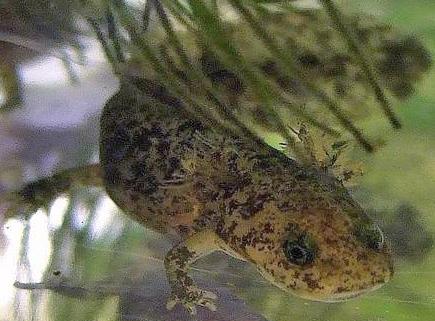
The posterior portion of the Abu Salamander is olive-colored. Its underbelly is lighter-colored and covered with silvery-white spots.[1][2]
The Abu Salamander has vomerine teeth, long legs, and clawless fingers. Its tail is slightly shorter than the combined length of its head and body.[3][4]
The Abu Salamander possesses lungs. It typically measures approximately 10–12 centimeters from head to tail.[5][6]
Habitat
The Abu Salamander inhabits temperate forests near still-water habitats such as puddles and marshes.[7]
Reproduction and life cycle
The Abu Salamander breeds in bodies of still water, usually between February and March.[8][9]
Its larvae normally complete metamorphosis during the year in which they hatch. Some larvae overwinter and undergo metamorphosis the following spring.[10][11]
Classification of the Abu Salamander
| Kingdom | Animalia |
|---|---|
| Phylum | Chordata |
| Subphylum | Vertebrata |
| Infraphylum | Gnathostomata |
| Parvphylum | Osteichthyes |
| Megaclass | Tetrapoda |
| Class | Amphibia (Amphibians) |
| Order | Caudata (Salamanders) |
| Family | Hynobiidae (Asiatic Salamander) |
| Subfamily | Hynobiinae |
| Genus | Hynobius (Asian Salamanders) |
| Species | Hynobius abuensis Matsui, Okawa, Nishikawa & Tominaga, 2019 |
Where the Abu Salamander is found
Checklists and occurrence records place Hynobius abuensis in 1 country. GBIF holds 12 georeferenced records of it.
Countries
A number beside a place is its count of GBIF occurrence records. A place without a number comes from a checklist alone. Records show where a species has been observed or collected, which can include escapes and vagrants.
Common names
English
- Abu Salamander
Names in 3 other languages
- Arabic
- سمندل ابو
- Japanese
- Abu-sansyou-uwo, アブサンショウウオ
- Korean
- 아부도롱뇽
Related species
-
 Ezo SalamanderHynobius retardatus
-
 Hida SalamanderHynobius kimurae
-
 Japanese Rift SalamanderHynobius fossigenus
- Korean SalamanderHynobius leechii
-
 Japanese Black SalamanderHynobius nigrescens
-
 Taiwan SalamanderHynobius formosanus
-
 Alishan SalamanderHynobius arisanensis
-
 Abe's SalamanderHynobius abei
Compare
Questions and answers
What is the scientific name of the Abu Salamander?
The scientific name of the Abu Salamander is Hynobius abuensis. Written with its author, the full name is Hynobius abuensis Matsui, Okawa, Nishikawa & Tominaga, 2019.
Which family does the Abu Salamander belong to?
Hynobius abuensis belongs to the family Hynobiidae, in the order Caudata and the class Amphibia.
Where is the Abu Salamander found?
Checklists and occurrence records place Hynobius abuensis in 1 country: Japan.
What is the conservation status of the Abu Salamander?
The IUCN Red List category recorded for Hynobius abuensis is Endangered (EN).
What kind of habitat do salamanders need?
The Abu Salamander inhabits temperate forests near still-water habitats such as puddles and marshes.[7]
Sources
Passages the profile rests on
- The posterior portion of the Abu salamander is olive-colored. Source passage: “It has an olive-colored posterior, and a lighter underbelly.” — English Wikipedia
- The Abu salamander has a lighter-colored underbelly covered with silvery-white spots. Source passage: “The underbelly is dotted with silvery-white spots.” — English Wikipedia
- The Abu salamander has vomerine teeth, long legs, and clawless fingers. Source passage: “Like all species in the genus Hynobius, Hynobius abuensis has vomerine teeth, long legs, clawless fingers” — English Wikipedia
- The Abu salamander's tail is slightly shorter than the combined length of its head and body. Source passage: “and a tail a little shorter than its head and body combined.” — English Wikipedia
- The Abu salamander possesses lungs. Source passage: “It also has lungs, in contrast to its lungless cousins of the genus Onychodactylus.” — English Wikipedia
- The Abu salamander typically measures approximately 10–12 centimeters from head to tail. Source passage: “It is usually around 10 to 12 centimeters from head to tail.” — English Wikipedia
- The Abu salamander inhabits temperate forests near still-water habitats such as puddles and marshes. Source passage: “Hynobius abuensis is found in temperate forests, near still water bodies such as puddles and marshes.” — English Wikipedia
- The Abu salamander breeds in bodies of still water. Source passage: “Hynobius abuensis breeds in still water bodies.” — English Wikipedia
- Breeding in the Abu salamander usually takes place between February and March. Source passage: “Breeding usually occurs from February to March.” — English Wikipedia
- Abu salamander larvae normally complete metamorphosis during the year in which they hatch. Source passage: “H. abuensis larvae normally metamorphosize within the year of their birth.” — English Wikipedia
- Some Abu salamander larvae overwinter and undergo metamorphosis the following spring. Source passage: “However, the larvae sometimes overwinter, and go through metamorphosis the next spring.” — English Wikipedia
Data
- Catalogue of Life, 2026-10-16 XR cc by
- Global Biodiversity Information Facility CC BY 4.0
- Wikidata CC0
- GeoNames CC BY 4.0
- Wikimedia Commons per image; credit shown with each image
- Within the Catalogue of Life, this name comes from The Integrated Taxonomic Information System cc0
References
- Matsui, Masafumi, Hiroshi Okawa, Kanto Nishikawa, Gen Aoki, Koshiro Eto, Natsuhiko Yoshikawa, Shingo Tanabe, Yasuchika Misawa & Atsushi Tominaga. 2019. Systematics of the widely distributed Japanese clouded salamander, Hynobius nebulosus (Amphibia: Caudata: Hynobiidae), and its closest relatives. Current Herpetology 38(1): 32–90. Link where the name was published
This species in other databases
Page built on 27 November 2026. See how the catalog is made and all sources and licences.
Cite this page
ScientificNames.org. (2026). Hynobius abuensis (Abu Salamander). Retrieved November 27, 2026, from https://scientificnames.org/species/hynobius-abuensis
“Hynobius abuensis (Abu Salamander).” ScientificNames.org, 2026, scientificnames.org/species/hynobius-abuensis. Accessed 27 Nov. 2026.
ScientificNames.org. “Hynobius abuensis (Abu Salamander).” Accessed November 27, 2026. https://scientificnames.org/species/hynobius-abuensis.
@misc{scientificnames_hynobius_abuensis_abu_salamander,
  author = {{ScientificNames.org}},
  title = {Hynobius abuensis (Abu Salamander)},
  year = {2026},
  url = {https://scientificnames.org/species/hynobius-abuensis},
  note = {Accessed 2026-11-27}
}