Species · Amphibians
Aki Salamander Hynobius akiensis
The scientific name of the Aki Salamander is Hynobius akiensis. It is a species of amphibian in the family Hynobiidae (asiatic salamander), order Caudata. The name dates from 2019.
- Scientific name
- Hynobius akiensis Matsui, Okawa & Nishikawa, 2019
- Common name
- Aki Salamander
- Genus
- Hynobius
- Family
- Hynobiidae (Asiatic Salamander)
- Order
- Caudata
- Class
- Amphibia
- Red List category
- EN Endangered
- Recorded in
- 1 country
- Name status
- accepted in the Catalogue of Life
Overview
Hynobius akiensis occurs in southern central Chugoku, southwestern Honshu, and northwestern Shikoku in Japan. Adults have a chocolate-brown back and a grayish-brown underside marked with silvery-white dots.
Written 27 November 2026 from the sources listed below. Each statement was checked against the passage it cites; statements that could not be supported were removed.
Appearance
Adults measure approximately 4–6 centimeters from the tip of the snout to the cloaca. Their tails are slightly shorter than the remainder of their bodies.[1][2]
The species has longer and wider vomerine teeth than its close relative Hynobius abuensis.[3][4]
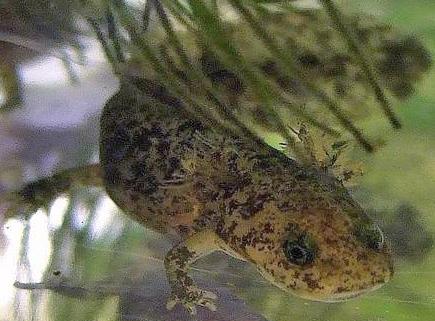
Larvae possess external gills, a caudal fin, dorsal and ventral fins, and a tail fin. They have broad, rounded heads, slightly protruding eyes, and lack claws on their fingers and toes.[5][6][7]
Larvae have yellow-brown backs with dark brown markings and off-white, semi-transparent undersides. Their tails have large black spots, and their tail fins have golden dots.[8][9]
Similar species
Hynobius abuensis is a close relative of the Aki Salamander. The Aki Salamander has longer and wider vomerine teeth than Hynobius abuensis.[3][4]
Habitat
The Aki Salamander inhabits slow-moving or stagnant bodies of water.[10]
Reproduction and life cycle
Breeding periods vary among populations, although most occur between December and January. The egg sacs are string-like, wrinkled, and coiled.[11][12]
Average clutch-size estimates vary geographically from 50 to 124 eggs. Some individual clutches contain more than 200 eggs.[13][14]
Conservation
The Aki Salamander is described as endangered.[15]
Classification of the Aki Salamander
| Kingdom | Animalia |
|---|---|
| Phylum | Chordata |
| Subphylum | Vertebrata |
| Infraphylum | Gnathostomata |
| Parvphylum | Osteichthyes |
| Megaclass | Tetrapoda |
| Class | Amphibia (Amphibians) |
| Order | Caudata (Salamanders) |
| Family | Hynobiidae (Asiatic Salamander) |
| Subfamily | Hynobiinae |
| Genus | Hynobius (Asian Salamanders) |
| Species | Hynobius akiensis Matsui, Okawa & Nishikawa, 2019 |
Where the Aki Salamander is found
Checklists and occurrence records place Hynobius akiensis in 1 country. GBIF holds 17 georeferenced records of it.
Countries
A number beside a place is its count of GBIF occurrence records. A place without a number comes from a checklist alone. Records show where a species has been observed or collected, which can include escapes and vagrants.
Common names
English
- Aki Salamander
Names in 3 other languages
- Arabic
- سمندل اكي
- Japanese
- Aki-sansyou-uwo, アキサンショウウオ
- Korean
- 아키도롱뇽
Related species
-
 Ezo SalamanderHynobius retardatus
-
 Hida SalamanderHynobius kimurae
-
 Japanese Rift SalamanderHynobius fossigenus
- Korean SalamanderHynobius leechii
-
 Japanese Black SalamanderHynobius nigrescens
-
 Taiwan SalamanderHynobius formosanus
-
 Alishan SalamanderHynobius arisanensis
-
 Abe's SalamanderHynobius abei
Compare
Questions and answers
What is the scientific name of the Aki Salamander?
The scientific name of the Aki Salamander is Hynobius akiensis. Written with its author, the full name is Hynobius akiensis Matsui, Okawa & Nishikawa, 2019.
Which family does the Aki Salamander belong to?
Hynobius akiensis belongs to the family Hynobiidae, in the order Caudata and the class Amphibia.
Where is the Aki Salamander found?
Checklists and occurrence records place Hynobius akiensis in 1 country: Japan.
What is the conservation status of the Aki Salamander?
The IUCN Red List category recorded for Hynobius akiensis is Endangered (EN).
Sources
Passages the profile rests on
- Adults measure approximately 4–6 centimeters from the tip of the snout to the cloaca. Source passage: “about 4 to 6 centimeters from the tip of the snout to the cloaca.” — English Wikipedia
- The adult tail is slightly shorter than the remainder of the body. Source passage: “H. akiensis has a tail that is slightly shorter than the rest of its body.” — English Wikipedia
- This species has longer and wider vomerine teeth than its close relative Hynobius abuensis. Source passage: “This species also has longer and wider vomerine teeth compared to its close cousin, Hynobius abuensis.” — English Wikipedia
- Hynobius abuensis is identified as a close relative of Hynobius akiensis. Source passage: “compared to its close cousin, Hynobius abuensis.” — English Wikipedia
- Larvae possess external gills, a caudal fin, dorsal and ventral fins, and a tail fin. Source passage: “Larvae have external gills, a caudal fin, a dorsal fin, a ventral fin, and a tail fin.” — English Wikipedia
- Larvae have broad, rounded heads and slightly protruding eyes. Source passage: “Their head is broad and round, with slightly protruding eyes.” — English Wikipedia
- Larvae lack claws on their fingers and toes. Source passage: “They lack claws on their fingers and toes.” — English Wikipedia
- Larvae have yellow-brown backs with dark brown markings and off-white, semi-transparent undersides. Source passage: “Their back is yellow-brown with dark brown markings, and their underbelly is off-white and semi-transparent.” — English Wikipedia
- Larvae have large black spots on their tails and golden dots on their tail fins. Source passage: “They have large black spots on their tail, and golden dots on their tail fin.” — English Wikipedia
- The species inhabits slow-moving or stagnant bodies of water. Source passage: “Hynobius akiensis lives in slow moving or stagnant bodies of water.” — English Wikipedia
- Breeding periods vary among populations, although most occur between December and January. Source passage: “Different populations of H. akiensis breed at different times of the year, but most breeding periods fall between December and January.” — English Wikipedia
- The egg sacs are string-like, wrinkled, and coiled. Source passage: “Egg sacs are string-like and wrinkly, in a coiling shape.” — English Wikipedia
- Average clutch-size estimates vary geographically from 50 to 124 eggs. Source passage: “Depending on the location of the population, estimates of the average clutch size range from 50 to 124” — English Wikipedia
- Some individual clutches contain more than 200 eggs. Source passage: “in some cases, a single clutch can have over 200 eggs.” — English Wikipedia
- The species is described as endangered. Source passage: “It is considered an endangered species.” — English Wikipedia
Data
- Catalogue of Life, 2026-10-16 XR cc by
- Global Biodiversity Information Facility CC BY 4.0
- Wikidata CC0
- GeoNames CC BY 4.0
- Within the Catalogue of Life, this name comes from The Integrated Taxonomic Information System cc0
References
- Matsui, Masafumi, Hiroshi Okawa, Kanto Nishikawa, Gen Aoki, Koshiro Eto, Natsuhiko Yoshikawa, Shingo Tanabe, Yasuchika Misawa & Atsushi Tominaga. 2019. Systematics of the widely distributed Japanese clouded salamander, Hynobius nebulosus (Amphibia: Caudata: Hynobiidae), and its closest relatives. Current Herpetology 38(1): 32–90. Link where the name was published
This species in other databases
Page built on 27 November 2026. See how the catalog is made and all sources and licences.
Cite this page
ScientificNames.org. (2026). Hynobius akiensis (Aki Salamander). Retrieved November 27, 2026, from https://scientificnames.org/species/hynobius-akiensis
“Hynobius akiensis (Aki Salamander).” ScientificNames.org, 2026, scientificnames.org/species/hynobius-akiensis. Accessed 27 Nov. 2026.
ScientificNames.org. “Hynobius akiensis (Aki Salamander).” Accessed November 27, 2026. https://scientificnames.org/species/hynobius-akiensis.
@misc{scientificnames_hynobius_akiensis_aki_salamander,
  author = {{ScientificNames.org}},
  title = {Hynobius akiensis (Aki Salamander)},
  year = {2026},
  url = {https://scientificnames.org/species/hynobius-akiensis},
  note = {Accessed 2026-11-27}
}