Species · Amphibians
Oita Salamander Hynobius dunni
The scientific name of the Oita Salamander is Hynobius dunni. It is a species of amphibian in the family Hynobiidae (asiatic salamander), order Caudata. The name dates from 1931.
- Scientific name
- Hynobius dunni Tago, 1931
- Common name
- Oita Salamander
- Genus
- Hynobius
- Family
- Hynobiidae (Asiatic Salamander)
- Order
- Caudata
- Class
- Amphibia
- Red List category
- VU Vulnerable
- Recorded in
- 2 countries
- Name status
- accepted in the Catalogue of Life

Overview
Hynobius dunni occurs exclusively on the Japanese islands of Shikoku and Kyushu. It has 11 costal grooves and generally greenish-grey or brown coloration, with young individuals displaying blue iridescent highlights.
Written 27 November 2026 from the sources listed below. Each statement was checked against the passage it cites; statements that could not be supported were removed.
Appearance
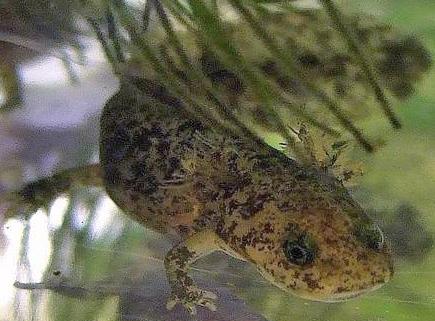
The Oita Salamander is generally greenish-grey or brown. Its dorsal surface may have black dots, although many individuals lack them, and the dots fade as spotted individuals reach adulthood.[1][2][3]
The ventral surface is generally bluish-grey and becomes lighter toward the throat. Young individuals have blue iridescent highlights that fade with adulthood, and this coloration is more pronounced in individuals from wetter environments than in those from drier locations.[4][5][6]
The species has 11 costal grooves. Its snout-to-vent length is reported as 6–8 cm, with a maximum range of 10–16 cm also given.[7][8]
Habitat
The Oita Salamander is endemic to Japan and occurs exclusively on the Japanese islands of Shikoku and Kyushu. Its natural habitats include temperate forests, rivers, intermittent rivers, freshwater marshes, intermittent freshwater marshes, and irrigated land in western Japan.[9][10][11]
The species inhabits secondary forests and bamboo woods. Outside the mating season, individuals can be found beneath stones and leaves.[12][13]
Diet
The Oita Salamander consumes earthworms, miniature mealworms, fly maggots, spiders, mosquito larvae, woodlice, and millipedes. It does not eat slugs.[14][15]
Behaviour
Individuals consume substantial amounts of food during winter while using little energy.[16]
During the climbing phase, males climb branches that can support several salamanders. They may stiffen their bodies while grasping a twig.[17][18]
During the attraction phase, males fan or swing their tails and enlarge their throats. Tail swinging is reported as a behaviour not found in other species.[19][20]
During the marking phase, males rub their cloacas against the area where they fan their tails to mark their territories.[21]
Reproduction and life cycle
The mating season extends from December through May. During this period, males develop broader heads, lighter-colored throats, and taller tail fins, while females develop yellow tails and gain weight because of ovulation and water absorption by their egg sacs.[22][23][24]
Males enter the water before females during the breeding period and remain there until April or May during the aquatic phase. Preferred breeding habitats contain scattered twigs and branches, with individuals showing greater attraction to thicker branches because these can support more salamanders.[25][26][27][28]
Males search for breeding grounds and follow females approaching those grounds. Males bite and poke one another when females begin swimming.[29][30]
Multiple males may compete to fertilize an egg sac, forming a mating ball.[31]
Conservation
The Oita Salamander is classified as Vulnerable on the IUCN Red List and has a declining population.[32][33]
The species is threatened by habitat loss associated with increasing home construction within its habitat. Habitat destruction is identified as a threat requiring conservation efforts.[34][35]
Similar species
Genetic differences among Japanese populations vary according to geographic location. DNA diversity is particularly apparent in comparisons between northern and southern populations in Japan.[36][37]
Classification of the Oita Salamander
| Kingdom | Animalia |
|---|---|
| Phylum | Chordata |
| Subphylum | Vertebrata |
| Infraphylum | Gnathostomata |
| Parvphylum | Osteichthyes |
| Megaclass | Tetrapoda |
| Class | Amphibia (Amphibians) |
| Order | Caudata (Salamanders) |
| Family | Hynobiidae (Asiatic Salamander) |
| Subfamily | Hynobiinae |
| Genus | Hynobius (Asian Salamanders) |
| Species | Hynobius dunni Tago, 1931 |
Where the Oita Salamander is found
Checklists and occurrence records place Hynobius dunni in 2 countries. GBIF holds 135 georeferenced records of it.
Countries
Regions and cities with the most records
- Oita, Japan 25
- Mie, Japan 14
- Beppu, Japan 12
- Hiji, Japan 12
- Tsurusaki, Japan 11
- Ōita, Japan 10
- Yufu, Japan 8
- Kitsuki, Japan 5
A number beside a place is its count of GBIF occurrence records. A place without a number comes from a checklist alone. Records show where a species has been observed or collected, which can include escapes and vagrants.
Common names
English
- Oita Salamander
- Dunn's Oriental Salamander
Names in 8 other languages
- Arabic
- سمندل أويتا
- Chinese
- 鄧氏小鯢
- Czech
- pamlok Dunnův
- French
- Hynobie d'Oita, Salamandre d'Oita
- German
- Dunns Winkelzahnmolch
- Japanese
- Oita Sanshouo, オオイタサンショウウオ
- Korean
- 오이타도롱뇽
- Russian
- Светло-бурый углозуб
Synonyms
One other scientific name has been used for this species and is now treated as a synonym of Hynobius dunni.
- Hynobius dunnus Tago, 1929
Related species
-
 Ezo SalamanderHynobius retardatus
-
 Hida SalamanderHynobius kimurae
-
 Japanese Rift SalamanderHynobius fossigenus
- Korean SalamanderHynobius leechii
-
 Japanese Black SalamanderHynobius nigrescens
-
 Taiwan SalamanderHynobius formosanus
-
 Alishan SalamanderHynobius arisanensis
-
 Abe's SalamanderHynobius abei
Compare
Questions and answers
What is the scientific name of the Oita Salamander?
The scientific name of the Oita Salamander is Hynobius dunni. Written with its author, the full name is Hynobius dunni Tago, 1931.
Which family does the Oita Salamander belong to?
Hynobius dunni belongs to the family Hynobiidae, in the order Caudata and the class Amphibia.
Where is the Oita Salamander found?
Checklists and occurrence records place Hynobius dunni in 2 countries: Japan and China.
What is the conservation status of the Oita Salamander?
The IUCN Red List category recorded for Hynobius dunni is Vulnerable (VU).
What other names does the Oita Salamander have?
Hynobius dunni is also known in English as Dunn's Oriental Salamander.
Sources
Passages the profile rests on
- The salamander is generally greenish-grey or brown in coloration. Source passage: “The Oita salamander tends to be greenish-grey in color, some even being brown.” — English Wikipedia
- Its dorsal surface may have black dots, although many individuals lack them. Source passage: “On their dorsal, they typically have black dots with a lot of the salamanders lacking dots.” — English Wikipedia
- The black dorsal dots of spotted individuals fade as they reach adulthood. Source passage: “Those with dots will fade as they enter adulthood.” — English Wikipedia
- The ventral surface is generally bluish-grey and becomes lighter toward the throat. Source passage: “the ventricle surface tends to be a blueish-grey that becomes lighter at the salamander's throat.” — English Wikipedia
- Young individuals have blue iridescent highlights that fade with adulthood. Source passage: “Young Oita salamanders have a blue iridescent highlight to them, until they eventually fade with adulthood.” — English Wikipedia
- The blue iridescent coloration is more pronounced in individuals from wetter environments than in those from drier locations. Source passage: “In wetter environments the blue iridescent color is more pronounced than those in dryer locations.” — English Wikipedia
- The species has 11 costal grooves. Source passage: “This salamander unlike most animals have only 11 coastal grooves, compared to the normal 12.” — English Wikipedia
- Its snout-to-vent length is reported as 6–8 cm, with a maximum range of 10–16 cm also given in the source. Source passage: “Their (SVL) snout to vent length 6–8 cm with a maximum of 10–16 cm” — English Wikipedia
- Hynobius dunni is endemic to Japan. Source passage: “The Oita salamander (Hynobius dunni) is a species of salamander in the family Hynobiidae endemic to Japan.” — English Wikipedia
- The species occurs exclusively on the Japanese islands of Shikoku and Kyushu. Source passage: “This species can be found exclusively in the Japanese Island groups of Shikoku and Kyushu.” — English Wikipedia
- Its natural habitats include temperate forests, rivers, intermittent rivers, freshwater marshes, intermittent freshwater marshes, and irrigated land in western Japan. Source passage: “its natural habitats are temperate forests, rivers, intermittent rivers, freshwater marshes, intermittent freshwater marshes, and irrigated land in western Japan.” — English Wikipedia
- The species inhabits secondary forests and bamboo woods. Source passage: “The live in secondary forests and bamboo woods.” — English Wikipedia
- Outside the mating season, individuals can be found beneath stones and leaves. Source passage: “Outside of the mating season, they can be found under stones and leaves.” — English Wikipedia
- The species consumes earthworms, miniature mealworms, fly maggots, spiders, mosquito larvae, woodlice, and millipedes. Source passage: “i.e., earthworms, miniature mealworms, fly maggots, spiders, mosquito larvae, woodlice, millipedes, etc.” — English Wikipedia
- The species does not eat slugs. Source passage: “However, this salamander does not eat slugs” — English Wikipedia
- Individuals consume substantial amounts of food during winter while using little energy. Source passage: “They eat quite a lot during the winter, and don't use much energy.” — English Wikipedia
- During the climbing phase, males climb branches that can support several salamanders. Source passage: “after they have found an adequate branch, the males board (climb) them.” — English Wikipedia
- Males may stiffen their bodies while grasping a twig during the climbing phase. Source passage: “Sometimes, the salamander—while grasping the twig—will stiffen their body” — English Wikipedia
- During the attraction phase, males fan or swing their tails and enlarge their throats. Source passage: “tail fanning/swinging begins and their throats enlarge.” — English Wikipedia
- Tail swinging is reported as a behaviour not found in other species. Source passage: “Tail swinging isn't found in any other species besides the Oita salamanders.” — English Wikipedia
- During the marking phase, males rub their cloacas against the area where they fan their tails to mark their territories. Source passage: “The male marks their territory but rubbing their cloaca in the area they are tail fanning.” — English Wikipedia
- The mating season extends from December through May. Source passage: “during the mating season (December – May).” — English Wikipedia
- Males develop broader heads, lighter-colored throats, and taller tail fins during the mating season. Source passage: “Male Oita salamanders heads grow much broader, their throats become lighter in color, and their tail fin grows taller.” — English Wikipedia
- During the mating season, females develop yellow tails and gain weight because of ovulation and water absorption by their egg sacs. Source passage: “The female salamanders tails become yellow, and their weight increases due to ovulation and their egg sacs absorbing water.” — English Wikipedia
- Males enter the water before females during the breeding period. Source passage: “During this period males will be the first to enter the water” — English Wikipedia
- Males remain in the water until April or May during the aquatic phase. Source passage: “they will stay in the water until either April or May (this is called the aquatic phase).” — English Wikipedia
- Preferred breeding habitats contain scattered twigs and branches. Source passage: “The preferable breeding habitat is strewn about with twigs and branches.” — English Wikipedia
- Individuals are more attracted to thicker branches because these can support more salamanders. Source passage: “The salamanders tend to be more attracted to thicker branches since it can hold more of them.” — English Wikipedia
- Males search for breeding grounds, and females approaching those grounds are followed by males. Source passage: “Males will go out and find grounds for breeding, females who approach those breeding grounds are followed by males.” — English Wikipedia
- Males bite and poke one another when females begin swimming. Source passage: “When the females start to swim, males will bite and poke at each other.” — English Wikipedia
- Multiple males may compete to fertilize an egg sac, forming a mating ball. Source passage: “more males will hope onto the sac, trying to fertilize it, inevitably creating a mating ball.” — English Wikipedia
- The Oita salamander is classified as Vulnerable on the IUCN Red List. Source passage: “The Oita salamander is considered to be vulnerable by the (IUCN) Red List of Threatened Species” — English Wikipedia
- The species has a declining population. Source passage: “with a declining population.” — English Wikipedia
- The species is threatened by habitat loss associated with increasing home construction within its habitat. Source passage: “It is threatened by habitat loss, due to the increasing construction of homes within its habitat.” — English Wikipedia
- Habitat destruction is identified as a threat requiring conservation efforts for the species. Source passage: “Hynobius dunni is vulnerable due to habitat destruction; conservation efforts are essential.” — academia.edu
- Genetic differences among Japanese populations vary according to geographic location. Source passage: “Across Japan, the Oita salamander genetically differs based on their location.” — English Wikipedia
- DNA diversity is particularly apparent in comparisons between northern and southern populations in Japan. Source passage: “The DNA diversity was most apparent when comparing both the Northern and Southern species across Japan.” — English Wikipedia
Data
- Catalogue of Life, 2026-10-16 XR cc by
- Global Biodiversity Information Facility CC BY 4.0
- Wikidata CC0
- GeoNames CC BY 4.0
- Wikimedia Commons per image; credit shown with each image
- Within the Catalogue of Life, this name comes from The Integrated Taxonomic Information System cc0
This species in other databases
Page built on 27 November 2026. See how the catalog is made and all sources and licences.
Cite this page
ScientificNames.org. (2026). Hynobius dunni (Oita Salamander). Retrieved November 27, 2026, from https://scientificnames.org/species/hynobius-dunni
“Hynobius dunni (Oita Salamander).” ScientificNames.org, 2026, scientificnames.org/species/hynobius-dunni. Accessed 27 Nov. 2026.
ScientificNames.org. “Hynobius dunni (Oita Salamander).” Accessed November 27, 2026. https://scientificnames.org/species/hynobius-dunni.
@misc{scientificnames_hynobius_dunni_oita_salamander,
  author = {{ScientificNames.org}},
  title = {Hynobius dunni (Oita Salamander)},
  year = {2026},
  url = {https://scientificnames.org/species/hynobius-dunni},
  note = {Accessed 2026-11-27}
}