Species · Amphibians
Amber-colored Salamander Hynobius stejnegeri
The scientific name of the Amber-colored Salamander is Hynobius stejnegeri. It is a species of amphibian in the family Hynobiidae (asiatic salamander), order Caudata. The name dates from 1923.
- Scientific name
- Hynobius stejnegeri Dunn, 1923
- Common name
- Amber-colored Salamander
- Genus
- Hynobius
- Family
- Hynobiidae (Asiatic Salamander)
- Order
- Caudata
- Class
- Amphibia
- Red List category
- NT Near Threatened
- Recorded in
- 1 country
- Name status
- accepted in the Catalogue of Life
Overview
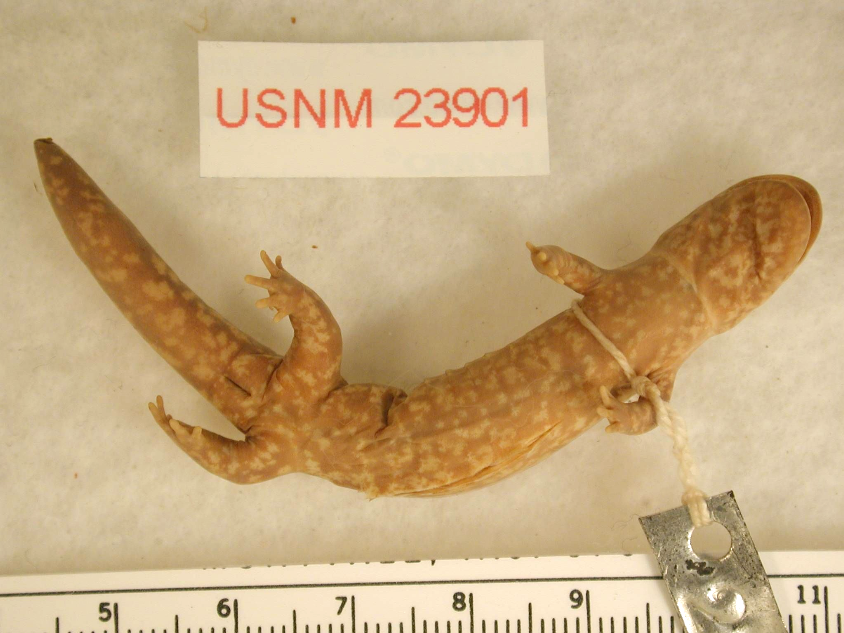
Hynobius stejnegeri occurs exclusively on the island of Kyushu in Japan. It has a semitransparent blackish-brown body marked with bright amber blotches.
Written 27 November 2026 from the sources listed below. Each statement was checked against the passage it cites; statements that could not be supported were removed.
Appearance
The salamander has a semitransparent blackish-brown body with bright amber blotches. Its ventral surface is lighter in color and lacks blotches.[1][2]
Its head is oval-shaped when viewed from above, with prominent eyes and a gular fold. The body is robust and cylindrical, with 13 to 14 costal grooves.[3][4][5][6]
The larvae are yellowish and have black claws on their fingers and toes.[7]
The snout-to-vent length ranges from 76 to 85 mm. Total length generally ranges from 137 to 155 mm, although some individuals have been reported to reach nearly 200 mm.[8][9][10]
Habitat
The salamander inhabits temperate forests and rivers. Its terrestrial habitats include mountainous broad-leaved evergreen forests and mixed forests.[11][12]
Its freshwater habitats include wetlands associated with permanent rivers, streams, creeks, and waterfalls. It occurs in mountainous stream habitats at elevations between 500 and 1500 m.[13][14]
The species is associated with flowing-water breeding habitats in western Japan.[15]
Its recorded distribution includes mountainous areas of Kumamoto, Miyazaki, and northern Kagoshima prefectures. Regional populations are separated by geographic barriers including the Gokase River, Aso Volcano, Kirishima Volcano, and Yatsushiro Sea.[16][17][18]
Diet
The salamander feeds on insects, spiders, worms, aquatic insect larvae, and crustaceans. It has also been observed engaging in cannibalism.[19][20]
Behaviour
The species returns to upstream areas for breeding and larval development. Female salamanders remain near their egg clutches until hatching.[21][22]
Larvae undergo metamorphosis while living in streams.[23]
Reproduction and life cycle
The male-produced egg sacs measure between 17 and 30 cm in length, and each clutch contains between 21 and 57 eggs. The egg sacs lack the prominent whip-like structure at their free ends that occurs in Hynobius boulengeri.[24][25][26]
Larvae generally emerge in September or October of the year in which the eggs are laid. Some remain in streams through winter and emerge during the following spring or summer.[27][28]
Similar species
Hynobius kimurae resembles the Amber-colored Salamander in coloration. The Amber-colored Salamander differs by having four toes, a longer vomerine tooth series, and a longer body.[29][30]
Hynobius yatsui has been treated as a subjective junior synonym of Hynobius stejnegeri. A Kyushu population formerly classified as Hynobius stejnegeri has been proposed for recognition as Hynobius ikioi.[31][32]
Conservation
Habitat loss threatens the species. Hunting, trapping, logging, and wood harvesting negatively affect it, as do road construction, deforestation, erosion, and pollution.[33][34][35]
Its extent of occurrence is smaller than 20,000 km². Its distribution is fragmented, and its habitat extent and quality are continuing to decline.[36][37]
Japan's Environment Agency classified the species as Near Threatened in 2000. The IUCN determined it to be Near Threatened in 2021.[38][39]
Kumamoto Prefecture designates the species as a natural monument.[40]
Uses
The species is used for medicinal purposes and as food. It is also used in comparative hepatology research.[41][42]
Classification of the Amber-colored Salamander
| Kingdom | Animalia |
|---|---|
| Phylum | Chordata |
| Subphylum | Vertebrata |
| Infraphylum | Gnathostomata |
| Parvphylum | Osteichthyes |
| Megaclass | Tetrapoda |
| Class | Amphibia (Amphibians) |
| Order | Caudata (Salamanders) |
| Family | Hynobiidae (Asiatic Salamander) |
| Subfamily | Hynobiinae |
| Genus | Hynobius (Asian Salamanders) |
| Species | Hynobius stejnegeri Dunn, 1923 |
Where the Amber-colored Salamander is found
Checklists and occurrence records place Hynobius stejnegeri in 1 country. GBIF holds 74 georeferenced records of it.
Countries
Regions and cities with the most records
A number beside a place is its count of GBIF occurrence records. A place without a number comes from a checklist alone. Records show where a species has been observed or collected, which can include escapes and vagrants.
Common names
English
- Amber-colored Salamander
- Amber Salamander
- Amber-coloured Salamander
- Smaller Blotched Salamander
- Tortoiseshell Salamander
Names in 7 other languages
- Arabic
- سمندل صدفة السلحفاة
- Chinese
- 琥珀小鯢
- Czech
- pamlok Stejnegerův
- French
- Hynobie du Mont Aso, Petit hynobie tacheté
- Japanese
- Kogota Buchi Sanshouwo, コガタブチサンショウウオ, ベッコウサンショウウオ
- Korean
- 코가타부치도롱뇽
- Russian
- Янтарный углозуб
Synonyms
5 other scientific names have been used for this species and are now treated as synonyms of Hynobius stejnegeri.
- Hynobius naevius stejnegeri Dunn, 1923
- Hynobius naevius yatsui Oyama, 1947
- Hynobius yatsui Oyama, 1947
- Pseudosalamandra stejnegeri (Dunn, 1923)
- Seudosalamandra stejnegeri (Dunn, 1923)
Related species
-
 Ezo SalamanderHynobius retardatus
-
 Hida SalamanderHynobius kimurae
-
 Japanese Rift SalamanderHynobius fossigenus
- Korean SalamanderHynobius leechii
-
 Japanese Black SalamanderHynobius nigrescens
-
 Taiwan SalamanderHynobius formosanus
-
 Alishan SalamanderHynobius arisanensis
-
 Abe's SalamanderHynobius abei
Compare
Questions and answers
What is the scientific name of the Amber-colored Salamander?
The scientific name of the Amber-colored Salamander is Hynobius stejnegeri. Written with its author, the full name is Hynobius stejnegeri Dunn, 1923.
Which family does the Amber-colored Salamander belong to?
Hynobius stejnegeri belongs to the family Hynobiidae, in the order Caudata and the class Amphibia.
Where is the Amber-colored Salamander found?
Checklists and occurrence records place Hynobius stejnegeri in 1 country: Japan.
What is the conservation status of the Amber-colored Salamander?
The IUCN Red List category recorded for Hynobius stejnegeri is Near Threatened (NT).
What other names does the Amber-colored Salamander have?
Hynobius stejnegeri is also known in English as Amber Salamander, Amber-coloured Salamander, Smaller Blotched Salamander and Tortoiseshell Salamander.
What kind of salamander is orange?
The Amber-colored Salamander has a semitransparent blackish-brown body marked with bright amber blotches.[1]
What are some examples of colorful salamanders?
The Amber-colored Salamander is marked with bright amber blotches against a semitransparent blackish-brown body.[1]
What is a black and yellow salamander called?
The Amber-colored Salamander has a semitransparent blackish-brown body with bright amber blotches.[1]
Sources
Passages the profile rests on
- The salamander has a semitransparent blackish-brown body marked with bright amber blotches. Source passage: “the external appearance is that of semitransparent blackish brown ground color, blotched with bright amber.” — English Wikipedia
- The ventral surface is lighter in color and lacks blotches. Source passage: “Its ventral surface is lighter and without blotches.” — English Wikipedia
- The salamander has an oval-shaped head when viewed from above and prominent eyes. Source passage: “The head appears to be oval when viewed from above and the eyes are prominent” — English Wikipedia
- The salamander possesses a gular fold. Source passage: “a gular fold is present.” — English Wikipedia
- The salamander has a robust, cylindrical body. Source passage: “It has a robust and cylindrical body” — English Wikipedia
- The salamander has 13 to 14 costal grooves. Source passage: “with 13 to 14 costal grooves.” — English Wikipedia
- The larvae are yellowish and have black claws on their fingers and toes. Source passage: “The hatched larvae are a yellowish color and the fingers and toes sport black claws.” — English Wikipedia
- The salamander's snout-to-vent length ranges from 76 to 85 mm. Source passage: “The amber salamander has a snout-to-vent length of 76–85 mm” — English Wikipedia
- The salamander's total length generally ranges from 137 to 155 mm. Source passage: “a total length of 137–155 mm.” — English Wikipedia
- Some individuals have been reported to reach nearly 200 mm in length. Source passage: “individuals have been reported to have been nearly 200 mm in length.” — English Wikipedia
- The salamander inhabits temperate forests and rivers. Source passage: “Its natural habitats are temperate forests and rivers.” — English Wikipedia
- Its terrestrial habitat includes mountainous broad-leaved evergreen forests and mixed forests. Source passage: “temperate forests which consist of mountainous areas of broad-leaved, evergreen forests, as well as mixed forests.” — English Wikipedia
- Its freshwater habitats include wetlands associated with permanent rivers, streams, creeks, and waterfalls. Source passage: “wetlands of permanent rivers, streams, and creeks, including waterfalls.” — English Wikipedia
- The species occurs in mountainous stream habitats at elevations between 500 and 1500 m. Source passage: “mountainous streams at altitudes ranging from 500 to 1500 m.” — English Wikipedia
- The species is associated with flowing-water breeding habitats in western Japan. Source passage: “a lotic breeding salamander from western Japan” — amphibiaweb.org
- The species occurs exclusively on the island of Kyushu in Japan. Source passage: “This species of salamander is found only in Kyushu, Japan” — English Wikipedia
- Its recorded distribution includes mountainous areas of Kumamoto, Miyazaki, and northern Kagoshima prefectures. Source passage: “the mountainous areas of the prefectures of Kumamoto, Miyazaki, and Northern Kagoshima.” — English Wikipedia
- Geographic barriers separating regional populations include the Gokase River, Aso Volcano, Kirishima Volcano, and Yatsushiro Sea. Source passage: “including the Gokase River and the Aso Volcano, the Kirishima Volcano, and the Yatsushiro Sea.” — English Wikipedia
- The salamander feeds on insects, spiders, worms, aquatic insect larvae, and crustaceans. Source passage: “Their diets are made up of insects, spiders, worms, aquatic insect larvae, and crustaceans” — English Wikipedia
- The species has been observed engaging in cannibalism. Source passage: “they have been known to resort to cannibalism.” — English Wikipedia
- The species returns to upstream areas for breeding and larval development. Source passage: “They return to upstream areas to breed, and this is also where the larvae develop.” — English Wikipedia
- Female salamanders remain near their egg clutches until hatching. Source passage: “the female remains close to her clutch until the eggs have hatched.” — English Wikipedia
- Larvae undergo metamorphosis while living in streams. Source passage: “These larvae undergo a metamorphosis while living in the stream” — English Wikipedia
- The male-produced egg sacs measure between 17 and 30 cm in length. Source passage: “The egg sacs produced by the males are quite long, ranging from 17 to 30 cm” — English Wikipedia
- Each clutch contains between 21 and 57 eggs. Source passage: “Each clutch ranges from 21 to 57 eggs” — English Wikipedia
- The egg sacs lack the prominent whip-like structure at their free ends that occurs in Hynobius boulengeri. Source passage: “not having the prominent whip-like formation on the free end.” — English Wikipedia
- Larvae generally emerge in September or October of the year in which the eggs are laid. Source passage: “emerge in September and October of the same year they are laid” — English Wikipedia
- Some larvae remain in streams through winter and emerge during the following spring or summer. Source passage: “many wintering larvae remain in the stream until spring or summer of the following year when they emerge.” — English Wikipedia
- Hynobius kimurae resembles this species in coloration. Source passage: “It is similar to Hynobius kimurae in color” — English Wikipedia
- The species differs from Hynobius kimurae by having four toes, a longer vomerine tooth series, and a longer body. Source passage: “but has only four toes, a longer series of vomerine teeth, and a longer body.” — English Wikipedia
- Hynobius yatsui has been treated as a subjective junior synonym of Hynobius stejnegeri. Source passage: “The name H. yatsui is therefore relegated to a subjective junior synonym of H. stejnegeri.” — English Wikipedia
- A Kyushu population formerly classified as Hynobius stejnegeri has been proposed for recognition as Hynobius ikioi. Source passage: “a population of Hynobius stejnegeri from Kyushu should be treated as a new species Hynobius ikioi.” — English Wikipedia
- Habitat loss threatens the species. Source passage: “It is threatened by habitat loss.” — English Wikipedia
- Hunting, trapping, logging, and wood harvesting negatively affect the species. Source passage: “The amber salamander is harmed by hunting and trapping, logging, and wood harvesting.” — English Wikipedia
- Road construction, deforestation, erosion, and pollution are additional threats to the species. Source passage: “Major threats also include the construction of roads, deforestation, erosion, and pollution.” — English Wikipedia
- The species has an extent of occurrence smaller than 20,000 km². Source passage: “The extent of occurrence is less than 20,000 km2” — English Wikipedia
- The species has a fragmented distribution and its habitat extent and quality are continuing to decline. Source passage: “the species are fragmented in distribution, regionally only in Japan, with a continuing decline in the extent and quality of their habitat.” — English Wikipedia
- The species was classified as Near Threatened by Japan's Environment Agency in 2000. Source passage: “The amber salamander was considered near threatened by the Environment Agency of Japan in 2000.” — English Wikipedia
- The IUCN determined the species to be Near Threatened in 2021. Source passage: “It was determined near threatened by the International Union for Conservation of Nature (IUCN) in 2021.” — English Wikipedia
- Kumamoto Prefecture designates the species as a natural monument. Source passage: “It is designated a natural monument by Kumamoto Prefecture.” — English Wikipedia
- The species is used for medicinal purposes and as food. Source passage: “The amber salamander is also used for medicine and food.” — English Wikipedia
- The species is used in comparative hepatology research. Source passage: “H. stejnegeri is also used in the medical field of comparative hepatology.” — English Wikipedia
Data
- Catalogue of Life, 2026-10-16 XR cc by
- Global Biodiversity Information Facility CC BY 4.0
- Wikidata CC0
- GeoNames CC BY 4.0
- Wikimedia Commons per image; credit shown with each image
- Within the Catalogue of Life, this name comes from The Integrated Taxonomic Information System cc0
References
- Dunn, Emmet R. 1923. New species of Hynobius from Japan. Proceedings of the California Academy of Sciences, Series 4 12(2): 27–29. where the name was published
This species in other databases
Page built on 27 November 2026. See how the catalog is made and all sources and licences.
Cite this page
ScientificNames.org. (2026). Hynobius stejnegeri (Amber-colored Salamander). Retrieved November 27, 2026, from https://scientificnames.org/species/hynobius-stejnegeri
“Hynobius stejnegeri (Amber-colored Salamander).” ScientificNames.org, 2026, scientificnames.org/species/hynobius-stejnegeri. Accessed 27 Nov. 2026.
ScientificNames.org. “Hynobius stejnegeri (Amber-colored Salamander).” Accessed November 27, 2026. https://scientificnames.org/species/hynobius-stejnegeri.
@misc{scientificnames_hynobius_stejnegeri_amber_colored_salamander,
  author = {{ScientificNames.org}},
  title = {Hynobius stejnegeri (Amber-colored Salamander)},
  year = {2026},
  url = {https://scientificnames.org/species/hynobius-stejnegeri},
  note = {Accessed 2026-11-27}
}