Species · Reptiles
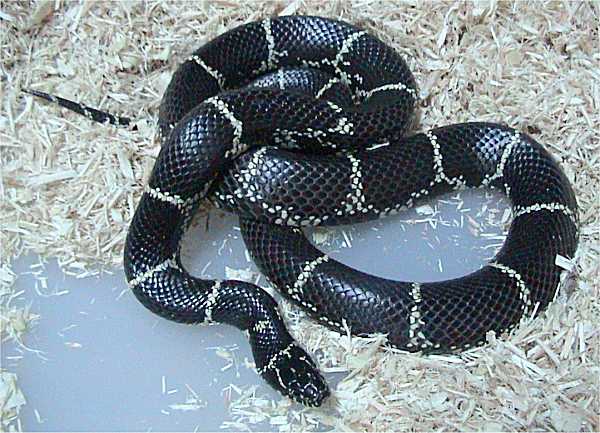
Gray-banded Kingsnake Lampropeltis alterna
The scientific name of the Gray-banded Kingsnake is Lampropeltis alterna. It is a species of reptile in the family Colubridae (colubrid), order Squamata. The name dates from 1901.
- Scientific name
- Lampropeltis alterna (Brown, 1901)
- Common name
- Gray-banded Kingsnake
- Genus
- Lampropeltis
- Family
- Colubridae (Colubrid)
- Order
- Squamata
- Class
- Reptilia
- Red List category
- LC Least Concern
- Recorded in
- 2 countries
- Name status
- accepted in the Catalogue of Life
Overview
Lampropeltis alterna inhabits dry, rocky desert environments in the Chihuahuan Desert.
Written 26 November 2026 from the sources listed below. Each statement was checked against the passage it cites; statements that could not be supported were removed.
Habitat
The Gray-banded Kingsnake inhabits dry, rocky desert environments in the Chihuahuan Desert. It is closely associated with limestone and volcanic substrates, steep slopes, and desert scrub.[1][2]
Its distribution includes the Trans-Pecos and Chihuahuan Desert regions of southwestern Texas, southern New Mexico, and northern Mexico. It occurs from southeastern New Mexico through southwestern Texas into central Mexico.[3][4]
Diet
Lizards constitute the primary food source of the Gray-banded Kingsnake. It occasionally eats small rodents, frogs, and eggs of ground-nesting birds, lizards, and other snakes.[5][6]
Behaviour
The Gray-banded Kingsnake is nocturnal, active at night, and secretive. It generally has a calm disposition and rarely responds defensively by biting.[7][8][9]
The species is nonvenomous and has immunity to rattlesnake venom.[10]
Reproduction and life cycle
The Gray-banded Kingsnake is oviparous. Females lay clutches of 3–13 eggs in early summer, and the eggs hatch after approximately nine weeks.[11][12][13]
Conservation
The Gray-banded Kingsnake is regionally protected in New Mexico and Mexico. Texas does not provide regional protections for the species.[14][15]
The extreme southern portion of its Mexican range is considered severely degraded because of high human habitation. In the New Mexico assessment, the species is classified as Less Vulnerable to climate change under both RCP 4.5 and RCP 8.5 scenarios.[16][17]
Classification of the Gray-banded Kingsnake
| Kingdom | Animalia |
|---|---|
| Phylum | Chordata |
| Subphylum | Vertebrata |
| Infraphylum | Gnathostomata |
| Parvphylum | Osteichthyes |
| Megaclass | Tetrapoda |
| Class | Reptilia (Reptile) |
| Order | Squamata (Snakes) |
| Suborder | Serpentes (Snakes) |
| Infraorder | Alethinophidia |
| Family | Colubridae (Colubrid) |
| Subfamily | Colubrinae |
| Genus | Lampropeltis (Kingsnakes) |
| Species | Lampropeltis alterna (Brown, 1901) |
Where the Gray-banded Kingsnake is found
Checklists and occurrence records place Lampropeltis alterna in 2 countries across North America. GBIF holds 703 georeferenced records of it.
Countries
Regions and cities with the most records
- Texas, United States 431
- Coahuila, Mexico 38
- Nuevo León, Mexico 10
- Ramos Arizpe, Mexico 9
- New Mexico, United States 7
- Saltillo, Mexico 7
- Chihuahua, Mexico 6
- García, Mexico 6
- Parque Industrial Ciudad Mitras, Mexico 5
- Durango, Mexico 4
Range as the checklists state it
Mexico (Transpecos, Durango, Coahuila, Chihuahua),
A number beside a place is its count of GBIF occurrence records. A place without a number comes from a checklist alone. Records show where a species has been observed or collected, which can include escapes and vagrants.
Common names
English
- Gray-banded Kingsnake
- Grey-banded Kingsnake
Names in 5 other languages
- Czech
- korálovka šedá
- German
- Graugebänderte Königsnatter
- Polish
- lancetogłów szaropasy
- Russian
- Горная королевская змея
- Spanish
- Culebra Real Gris, Culebra real bandas grises, Culebra real rayada de gris, Culebra-real bandas grises, Falsa coralillo real de bandas grises
Synonyms
2 other scientific names have been used for this species and are now treated as synonyms of Lampropeltis alterna.
- Lampropeltis blairi Flury, 1950
- Ophibolus alternus Brown, 1901
Related species
-
 Milk SnakeLampropeltis triangulum
-
 California KingsnakeLampropeltis californiae
-
 Scarlet KingsnakeLampropeltis elapsoides
-
 Common KingsnakeLampropeltis getula
-
 Speckled KingsnakeLampropeltis holbrooki
-
 California Mountain KingsnakeLampropeltis zonata
-
 Black KingsnakeLampropeltis nigra
-
 Prairie KingsnakeLampropeltis calligaster
Compare
Questions and answers
What is the scientific name of the Gray-banded Kingsnake?
The scientific name of the Gray-banded Kingsnake is Lampropeltis alterna. Written with its author, the full name is Lampropeltis alterna (Brown, 1901).
Which family does the Gray-banded Kingsnake belong to?
Lampropeltis alterna belongs to the family Colubridae, in the order Squamata and the class Reptilia.
Where is the Gray-banded Kingsnake found?
Checklists and occurrence records place Lampropeltis alterna in 2 countries: United States and Mexico.
What is the conservation status of the Gray-banded Kingsnake?
The IUCN Red List category recorded for Lampropeltis alterna is Least Concern (LC).
What other names does the Gray-banded Kingsnake have?
Lampropeltis alterna is also known in English as Grey-banded Kingsnake.
How big do gray-banded kingsnakes get?
The average total length is approximately 91 cm. Individuals can reach approximately 120 cm in total length, including the tail, while hatchlings measure approximately 25 cm.[18][19][20]
What is the diet of a king snake?
Lizards constitute the primary food source of the Gray-banded Kingsnake. It occasionally eats small rodents, frogs, and eggs of ground-nesting birds, lizards, and other snakes.[5][6]
Sources
Passages the profile rests on
- The gray-banded kingsnake inhabits dry, rocky desert environments in the Chihuahuan Desert. Source passage: “found in dry, rocky, desert habitats of the Chihuahuan Desert.” — swap.dgf.nm.gov
- The species is closely associated with limestone and volcanic substrates, steep slopes, and desert scrub. Source passage: “The species is closely associated with limestone and volcanic substrates, with steep slopes and standard desert scrub.” — English Wikipedia
- The gray-banded kingsnake occurs in the Trans-Pecos and Chihuahuan Desert regions of southwestern Texas, southern New Mexico, and northern Mexico. Source passage: “Lampropeltis alterna is found in the Trans-Pecos/Chihuahuan Desert region of southwestern Texas, southern New Mexico, and northern Mexico.” — English Wikipedia
- The species occurs from southeastern New Mexico through southwestern Texas into central Mexico. Source passage: “It is found from southeastern New Mexico to southwestern Texas and into central Mexico.” — swap.dgf.nm.gov
- Lizards constitute the primary food source of the gray-banded kingsnake. Source passage: “The gray-banded kingsnake feeds primarily on lizards.” — English Wikipedia
- The species occasionally eats small rodents, frogs, and eggs of ground-nesting birds, lizards, and other snakes. Source passage: “It will occasionally feed on small rodents, frogs, and the eggs of ground nesting birds, lizards, and other snakes.” — English Wikipedia
- The gray-banded kingsnake is nocturnal and secretive. Source passage: “It is a common species, but nocturnal and quite secretive.” — English Wikipedia
- The species is active at night. Source passage: “It is active at night” — swap.dgf.nm.gov
- The gray-banded kingsnake generally has a calm disposition and rarely responds defensively by biting. Source passage: “L. alterna generally has a calm disposition and is not prone to defensive reactions, like biting.” — English Wikipedia
- The species is nonvenomous and has immunity to rattlesnake venom. Source passage: “They are non venomous and have an immunity to rattlesnake venom.” — English Wikipedia
- The gray-banded kingsnake is oviparous. Source passage: “L. alterna is oviparous” — English Wikipedia
- Females lay clutches of 3–13 eggs in early summer. Source passage: “laying clutches of 3–13 eggs in early summer” — English Wikipedia
- The eggs hatch after approximately nine weeks. Source passage: “which hatch in approximately 9 weeks.” — English Wikipedia
- The gray-banded kingsnake is regionally protected in New Mexico and Mexico. Source passage: “L. alterna is regionally protected in New Mexico and Mexico.” — English Wikipedia
- Texas does not provide regional protections for the species. Source passage: “Texas does not have any regional protections, due to the number of reports in the area.” — English Wikipedia
- The extreme southern portion of the species' Mexican range is considered severely degraded because of high human habitation. Source passage: “the extreme Southern portion of the range has seen high levels of human habitation and is considered to be extremely degraded.” — English Wikipedia
- The species is classified as Less Vulnerable to climate change under both RCP 4.5 and RCP 8.5 scenarios in the New Mexico assessment. Source passage: “ranking of Less Vulnerable under both Representative Concentration Pathway (RCP) 4.5 and RCP 8.5 Scenarios.” — swap.dgf.nm.gov
- The average total length of the gray-banded kingsnake is approximately 91 cm. Source passage: “with the average total length being 3 ft (91 cm).” — English Wikipedia
- The species can reach approximately 120 cm in total length, including its tail. Source passage: “can grow up to 4 ft (120 cm) in total length (including tail)” — English Wikipedia
- Hatchlings measure approximately 25 cm in total length. Source passage: “Each hatchling is around 10 in (25 cm) in total length.” — English Wikipedia
Data
- Catalogue of Life, 2026-10-16 XR cc by
- Global Biodiversity Information Facility CC BY 4.0
- Wikidata CC0
- GeoNames CC BY 4.0
- Within the Catalogue of Life, this name comes from The Reptile Database cc by
References
- Brown, A. E. (1901). A new species of Ophiobolus from Western Texas. Proc. Acad. Nat. Sci. Philad. 53 (3): 612-613.
- Stejneger, L.H., and T. Barbour. (1917). A Check List of North American Amphibians and Reptiles. Harvard University Press, Cambridge. 4: I-Iv, 1-125.
- Blanchard, Frank N. (1920). A synopsis of the king snakes: Genus Lampropeltis Fitzinger. Occasional Papers of the Museum of Zoology, University of Michigan (87): 1-7.
- Blanchard, Frank N. (1921). A revision of the king snakes: genus Lampropeltis. Bull. US Natl. Mus. (114): 1-260.
- Smith, H. M. (1941). Lampropeltis alterna from Mexico. Copeia 1941 (2): 112.
- Jameson, David H.;Flury, Alvin G. (1949). The reptiles and amphibians of the Sierra Vieja Range of southwestern Texas. Texas Journal of Science 1 (2): 54-77.
- Mecham, J.S. & W.W. Milstead. (1949). Lampropeltis alterna from Pecos County, Texas. Herpetologica 5 (6): 140.
- Flury, A. (1950). A new kingsnake from Trans-Pecos Texas. Copeia 1950 (3): 215-217.
- Axtell, Ralph W. (1951). An additional specimen of Lampropeltis blairi from Texas. Copeia 1951 (4): 313 + 1 Plate.
- Gehlbach, Frederick R. (1967). Lampropeltis mexicana. Catalogue of American Amphibians and Reptiles (55): 1-2.
- Tanzer, E. C. (1970). Polymorphism in the mexicana complex of kingsnakes, with notes on their natural history. Herpetologica 26 (4): 419-428.
- Worthington, Richard D.;Arvizo, Edward R. (1974). Western records of the Davis Mountains kingsnake, Lampropeltis mexicana alterna. Southwestern Naturalist 19 (3): 329-340.
- Garstka, W. R. (1982). Systematics of the mexicana species group of the colubrid genus Lampropeltis, with an hypothesis [of] mimicry. Breviora (466): 1-35.
- Mehrtens, J. M. (1987). Living snakes of the world in color. Sterling Publ. Co., Hic., New York, NY: 480 Pp.
- Conant, R., & Collins, J. T. (1991). A Field Guide to Reptiles and Amphibians of Eastern/Central North America, 3rd ed. Houghton Mifflin (Boston/New York), Xx + 450 P.
- Degenhardt, William G.; C. W. Painter, and A. H. Price. (1996). Amphibians and reptiles of New Mexico. Univ. New Mexico Press, 431 Pp.
- Hilken, G., & Schlepper, R. (1998). Der Lampropeltis mexicana-Komplex (Serpentes: Colubridae): Naturgeschichte und Terrarienhaltung. Salamandra 34 (2): 97-124.
- Trutnau, L. (1999). Bemerkungen zur Biologie, Pflege und Nachzucht der Trans-Pecos-Königsnatter Lampropeltis alterna (Brown, 1902). Herpetofauna 21 (118): 11-18.
- Dixon, James R. (2000). Amphibians and reptiles of Texas, second edition. Texas A&M University Press, 421 Pp.
- Werler, John E. & James R. Dixon. (2000). Texas Snakes. University of Texas Press, 544 Pages.
- Tennant, A., & Bartlett, R. D. (2000). Snakes of North America - Eastern and Central Regions. Gulf Publishing, Houston, TX, 588 Pp.
- Thissen, R., & Hansen, H. (2001). Königsnattern - Lampropeltis. Natur Und Tier Verlag (Münster), 172 Pp.
- Tennant, A. (2003). Snakes of North America - Eastern and Central Regions, revised edition. Lone Star Books, 605 Pp.
- Hibbits, T.D.; Salmon, G.T. & Bryson Jr., R.W. (2003). New distributional records for the Gray-banded Kingsnake (Lampropeltis alterna) in Texas. Herpetological Review 34 (4): 393.
- Axelsson, J. (2004). Lampropeltis alterna. Captive care and reproduction of the Grey-banded Kingsnake. Reptilia (GB) (36): 61-65.
This species in other databases
Page built on 28 November 2026. See how the catalog is made and all sources and licences.
Cite this page
ScientificNames.org. (2026). Lampropeltis alterna (Gray-banded Kingsnake). Retrieved November 28, 2026, from https://scientificnames.org/species/lampropeltis-alterna
“Lampropeltis alterna (Gray-banded Kingsnake).” ScientificNames.org, 2026, scientificnames.org/species/lampropeltis-alterna. Accessed 28 Nov. 2026.
ScientificNames.org. “Lampropeltis alterna (Gray-banded Kingsnake).” Accessed November 28, 2026. https://scientificnames.org/species/lampropeltis-alterna.
@misc{scientificnames_lampropeltis_alterna_gray_banded_kingsnake,
  author = {{ScientificNames.org}},
  title = {Lampropeltis alterna (Gray-banded Kingsnake)},
  year = {2026},
  url = {https://scientificnames.org/species/lampropeltis-alterna},
  note = {Accessed 2026-11-28}
}