Species · Reptiles
Speckled Kingsnake Lampropeltis holbrooki
The scientific name of the Speckled Kingsnake is Lampropeltis holbrooki. It is a species of reptile in the family Colubridae (colubrid), order Squamata. The name dates from 1902.
- Scientific name
- Lampropeltis holbrooki Stejneger, 1902
- Common name
- Speckled Kingsnake
- Genus
- Lampropeltis
- Family
- Colubridae (Colubrid)
- Order
- Squamata
- Class
- Reptilia
- Red List category
- LC Least Concern
- Recorded in
- 1 country
- Name status
- accepted in the Catalogue of Life

Overview
Lampropeltis holbrooki is endemic to the United States and occurs in the central and southern United States, from southern Iowa to the Gulf of Mexico. It has a black body marked with small yellow-white specks, with one speck in the center of almost every dorsal scale.
Written 26 November 2026 from the sources listed below. Each statement was checked against the passage it cites; statements that could not be supported were removed.
Appearance
The Speckled Kingsnake has a black body marked with small yellow-white specks. One speck occurs in the center of almost every dorsal scale.[1]
Habitat
The Speckled Kingsnake prefers wetter habitats than other kingsnakes, including swamps and rivers. It also ventures into woodlands and grassy fields.[2][3]
Behaviour
The Speckled Kingsnake kills its prey by constriction. When threatened, it shakes its tail to deter predators and frequently expels musk and feces or bites.[4][5][6]
The Speckled Kingsnake is usually docile and often strikes only once or twice after capture.[7]
Male Speckled Kingsnakes commonly fight to establish dominance and discourage other males from approaching their territory. These fights can involve thrashing, biting, and intertwining.[8][9][10]
Reproduction and life cycle
Courtship in Speckled Kingsnakes includes tactile chasing, tactile alignment, and intromission phases. Both males and females contribute motor patterns during the initiation of courtship phases.[11][12]
Mating behavior includes writhing, mounting, grasping with the mouth, and biting. The species is commonly bred in captivity.[13][14]
Uses
The Speckled Kingsnake is frequently kept as a pet.[15]
Similar species
The geographic range of the Speckled Kingsnake overlaps with that of the desert kingsnake (Lampropeltis splendida). The two species are known to intergrade.[16][17]
Classification of the Speckled Kingsnake
| Kingdom | Animalia |
|---|---|
| Phylum | Chordata |
| Subphylum | Vertebrata |
| Infraphylum | Gnathostomata |
| Parvphylum | Osteichthyes |
| Megaclass | Tetrapoda |
| Class | Reptilia (Reptile) |
| Order | Squamata (Snakes) |
| Suborder | Serpentes (Snakes) |
| Infraorder | Alethinophidia |
| Family | Colubridae (Colubrid) |
| Subfamily | Colubrinae |
| Genus | Lampropeltis (Kingsnakes) |
| Species | Lampropeltis holbrooki Stejneger, 1902 |
Where the Speckled Kingsnake is found
Checklists and occurrence records place Lampropeltis holbrooki in 1 country across North America. GBIF holds 5,127 georeferenced records of it.
Countries
Regions and cities with the most records
- Texas, United States 1,184
- Arkansas, United States 875
- Louisiana, United States 649
- Oklahoma, United States 536
- Kansas, United States 446
- Missouri, United States 373
- Mississippi, United States 252
- Fayetteville, United States 153
- Springdale, United States 124
- Shenandoah, United States 121
- Central, United States 95
- Maumelle, United States 95
- Baton Rouge, United States 93
- Little Rock, United States 75
- Prairieville, United States 74
- College Station, United States 72
- North Little Rock, United States 69
- Bryan, United States 68
- Sherwood, United States 55
- Rogers, United States 49
- Bryant, United States 41
- Chalmette, United States 41
- Frisco, United States 40
- Fort Worth, United States 39
- Van Buren, United States 37
- Bentonville, United States 36
- Conway, United States 36
- Highland Village, United States 36
- Lewisville, United States 36
- New Orleans, United States 36
- Fort Smith, United States 35
- Grand Prairie, United States 35
- Gretna, United States 35
- Harvey, United States 35
- Terrytown, United States 35
- The Colony, United States 35
Range as the checklists state it
USA (S Iowa, Missouri, Arkansas, Louisiana, Mississippi, Alabama, Oklahoma; isolated record in NW Kentucky. Intergrades with splendida from Nebraska to Texas)
A number beside a place is its count of GBIF occurrence records. A place without a number comes from a checklist alone. Records show where a species has been observed or collected, which can include escapes and vagrants.
Common names
English
- Speckled Kingsnake
Names in 7 other languages
- Czech
- korálovka pruhovaná skvrnitá
- Danish
- Spættet Kongesnog
- German
- Gefleckte Kettennatter, Holbrooks Königsnatter
- Italian
- Serpente reale maculato
- Portuguese
- Cobra-rei-pintada
- Spanish
- Culebra real moteada, Falsa coralillo real moteada
- Ukrainian
- Королівська змія крапчаста
Synonyms
One other scientific name has been used for this species and is now treated as a synonym of Lampropeltis holbrooki.
- Lampropeltis getula holbrooki Stejneger, 1902
Related species
-
 Milk SnakeLampropeltis triangulum
-
 California KingsnakeLampropeltis californiae
-
 Scarlet KingsnakeLampropeltis elapsoides
-
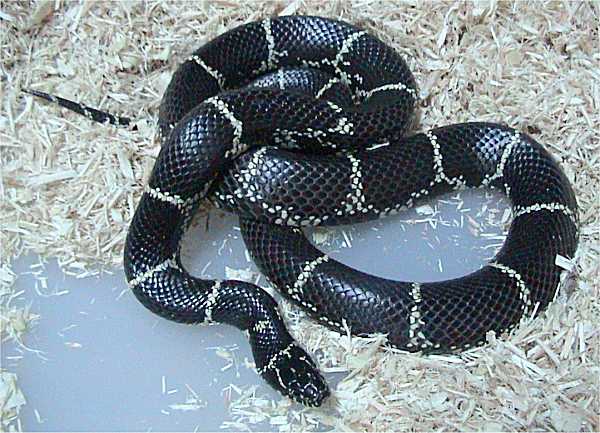 Common KingsnakeLampropeltis getula
-
 California Mountain KingsnakeLampropeltis zonata
-
 Black KingsnakeLampropeltis nigra
-
 Prairie KingsnakeLampropeltis calligaster
-
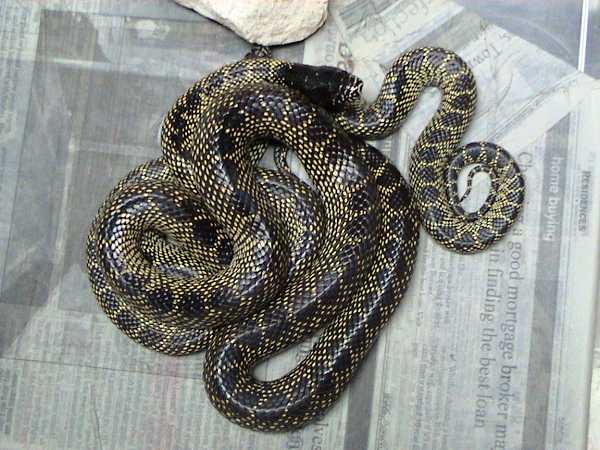 Desert KingsnakeLampropeltis splendida
Compare
Questions and answers
What is the scientific name of the Speckled Kingsnake?
The scientific name of the Speckled Kingsnake is Lampropeltis holbrooki. Written with its author, the full name is Lampropeltis holbrooki Stejneger, 1902.
Which family does the Speckled Kingsnake belong to?
Lampropeltis holbrooki belongs to the family Colubridae, in the order Squamata and the class Reptilia.
Where is the Speckled Kingsnake found?
Checklists and occurrence records place Lampropeltis holbrooki in 1 country: United States.
What is the conservation status of the Speckled Kingsnake?
The IUCN Red List category recorded for Lampropeltis holbrooki is Least Concern (LC).
Are speckled kingsnakes aggressive?
The Speckled Kingsnake is usually docile and often strikes only once or twice after capture. When threatened, it may shake its tail, expel musk and feces, or bite.[5][6][7]
How big can speckled kingsnakes get?
The recorded maximum total length is 72 inches (180 cm), including the tail. The species usually reaches a total length of up to 48 inches (120 cm).[18][19]
Sources
Passages the profile rests on
- The speckled kingsnake has a black body marked with small yellow-white specks, with one speck in the center of almost every dorsal scale. Source passage: “The common name is derived from its pattern, which is black, with small yellow-white specks, one speck in the center of almost every dorsal scale.” — English Wikipedia
- The speckled kingsnake prefers wetter habitats than other kingsnakes, including swamps and rivers. Source passage: “The speckled kingsnake prefers wetter habitats than other kingsnakes, such as swamps and rivers” — English Wikipedia
- The speckled kingsnake also ventures into woodlands and grassy fields. Source passage: “but it does commonly venture to dry areas such as woodlands and grassy fields.” — English Wikipedia
- The speckled kingsnake kills its prey by constriction. Source passage: “It kills by constriction.” — English Wikipedia
- When threatened, the speckled kingsnake shakes its tail to deter predators. Source passage: “When threatened, the speckled kingsnake shakes its tail like a rattlesnake to deter predators.” — English Wikipedia
- When threatened, the speckled kingsnake frequently expels musk and feces or bites. Source passage: “It frequently expels musk and feces or bites when threatened.” — English Wikipedia
- The speckled kingsnake is usually docile and often strikes only once or twice after capture. Source passage: “It is usually docile, often striking only one or two times after capture” — English Wikipedia
- Male speckled kingsnakes commonly fight to establish dominance. Source passage: “A fight between two male speckled kingsnakes is very common to assert dominance.” — English Wikipedia
- Dominance fights between male speckled kingsnakes can involve thrashing, biting, and intertwining. Source passage: “This can include thrashing, biting, and intertwining.” — English Wikipedia
- Male speckled kingsnakes fight to establish territorial dominance and discourage other males from approaching their territory. Source passage: “The main reason for doing this is to assert one's territory, so the other male will not come close to their land.” — English Wikipedia
- Courtship in speckled kingsnakes includes tactile chasing, tactile alignment, and intromission phases. Source passage: “There are also multiple phases of courtship, including tactile chase, tactile alignment, and intromission.” — English Wikipedia
- Both male and female speckled kingsnakes contribute motor patterns during the initiation of courtship phases. Source passage: “Each phase is initiated by a share of motor patterns from both the male and female.” — English Wikipedia
- Mating behavior in speckled kingsnakes includes writhing, mounting, grasping with the mouth, and biting. Source passage: “These include writhing, mounting, grasping (with mouth), and biting.” — English Wikipedia
- The speckled kingsnake is commonly bred in captivity. Source passage: “It is commonly captive bred.” — English Wikipedia
- The speckled kingsnake is frequently kept as a pet. Source passage: “and is frequently kept as a pet.” — English Wikipedia
- The speckled kingsnake's geographic range overlaps with that of the desert kingsnake (Lampropeltis splendida). Source passage: “Its range overlaps that of the desert kingsnake, Lampropeltis splendida” — English Wikipedia
- The speckled kingsnake is known to intergrade with the desert kingsnake (Lampropeltis splendida). Source passage: “and it is known to intergrade with that species.” — English Wikipedia
- The speckled kingsnake usually reaches a total length of up to 48 inches (120 cm), including its tail. Source passage: “The speckled kingsnake usually grows up to 48 in (120 cm) in total length (including tail)” — English Wikipedia
- The recorded maximum total length of the speckled kingsnake is 72 inches (180 cm). Source passage: “but the record total length is 72 in (180 cm).” — English Wikipedia
- The speckled kingsnake is endemic to the United States. Source passage: “The species is endemic to the United States.” — English Wikipedia
- The speckled kingsnake occurs in the central and southern United States, from southern Iowa to the Gulf of Mexico. Source passage: “The speckled kingsnake is found in the central and southern United States from southern Iowa to the Gulf of Mexico.” — English Wikipedia
Data
- Catalogue of Life, 2026-10-16 XR cc by
- Global Biodiversity Information Facility CC BY 4.0
- Wikidata CC0
- GeoNames CC BY 4.0
- Wikimedia Commons per image; credit shown with each image
- Within the Catalogue of Life, this name comes from The Reptile Database cc by
References
- The Reptiles of the Huachuca Mountains, Arizona. (1902). Proceedings United States Museum, xxv, 149–158. https://doi.org/10.5479/si.00963801.1282.149 Link where the name was published
- Holbrook, John E. (1842). North American Herpetology; or, A description of the reptiles inhabiting the United States. Vol III (2nd ed.). J. Dobson, Philadelphia, 128 Pp.
- Stejneger, L. (1902). The reptiles of the Huachuca Mountains, Arizona. Proc. US Natl. Mus. 25 [1902]: 149-158.
- Blanchard, Frank N. (1921). A revision of the king snakes: genus Lampropeltis. Bull. US Natl. Mus. (114): 1-260.
- Wright, A.A. & A.H. Wright. (1931). Some Stejneger Species. Photographs from Life. Copeia 1931 (3): 84-85.
- Allen, Morrow J. (1932). A survey of the Amphibians and reptiles of Harrison County, Mississippi. American Museum Novitates (542): 1-20.
- Burt, Charles E. (1935). Further records of the ecology and distribution of amphibians and reptiles in the middle west. American Midland Naturalist 16 (3): 311-336.
- Blaney, Richard M. (1977). Systematics of the common kingsnake, Lampropeltis getulus (Linnaeus). Tulane Studies in Zoology and Botany 19 (3-4): 47-103.
- Dixon, James R. (2000). Amphibians and reptiles of Texas, second edition. Texas A&M University Press, 421 Pp.
- Crother, B. I. (2000). Scientific and standard English names of amphibians and reptiles of North America north of Mexico, with comments regarding confidence in our understanding. Herpetological Circular 29: 1-82.
- Werler, John E. & James R. Dixon. (2000). Texas Snakes. University of Texas Press, 544 Pages.
- Tennant, A., & Bartlett, R. D. (2000). Snakes of North America - Eastern and Central Regions. Gulf Publishing, Houston, TX, 588 Pp.
- Pyron, R. Alexander; Frank T. Burbrink. (2009). LINEAGE DIVERSIFICATION IN A WIDESPREAD SPECIES: ROLES FOR NICHE DIVERGENCE AND CONSERVATISM IN THE COMMON KINGSNAKE, LAMPROPELTIS GETULA. Molecular Ecology 18: 3443–3457.
- Pyron, R. Alexander; Frank T. Burbrink. (2009). Systematics of the Common Kingsnake (Lampropeltis getula; Serpentes: Colubridae) and the burden of heritage in taxonomy. Zootaxa 2241: 22-32.
- Crother, B. I. (ed.). (2012). Standard Common and Current Scientific Names for North American Amphibians, Turtles, Reptiles, and Crocodilians, Seventh Edition. Herpetological Circular 39: 1-92.
- Laita, & Mark. (2013). Serpentine. Abrams and PQ Blackwell, Auckland, New Zealand, 200 Unnumbered Pages.
- Renner, D. (2013). Die Gesprenkelte Kettennatter, Lampropeltis getula holbrooki – Eine unterschätzte Schönheit. Reptilia (Münster) 18 (103): 60-64.
- Wallach, Van; Kenneth L. Williams, Jeff Boundy. (2014). Snakes of the World: A Catalogue of Living and Extinct Species. [type catalogue]. Taylor and Francis, CRC Press, 1237 Pp.
- Cohen, Henry. (2014). Lampropeltis holbrooki (speckled kingsnake) longevity. Herpetological Review 45 (1): 61.
- Konvalina, John D., Stanley E. Trauth, Christopher S. Thigpen and Samuel A. Schratz. (2015). Lampropeltis holbrooki (spreckled kingsnake) diet. Herpetological Review 46 (4): 645.
- Martin, Daniel J., Cameron L. Aldridge, Celina Bycenski, Beth A. Wittmann, Devin L. Jacobs, Jake R. Milford and Larissa L. Bailey. (2015). Geographic Distribution: Lampropeltis holbrooki (speckled kingsnake). Herpetological Review 46 (1): 62.
- McAllister, C. T. (2016). Lampropeltis holbrooki (Specked Kingsnake) diet / ophiophagy. Herpetological Review 47(3): 479-480.
- Williams, Avery A. (2016). Geographic Distribution: Lampropeltis holbrooki (Speckled Kingsnake). Herpetological Review 47 (2): 262.
- Krysko, Kenneth L.; Leroy P. Nuñez, Catherine E. Newman, Brian W. Bowen. (2017). Phylogenetics of Kingsnakes, Lampropeltis getula Complex (Serpentes: Colubridae), in Eastern North America. J Hered.: Esw086. Doi: 10.1093/Jhered/Esw086.
- Guyer, Craig; Mark A. Bailey, and Robert H. Mount. (2018). Lizards and snakes of Alabama. University of Alabama Press, 397 Pp.
This species in other databases
Page built on 28 November 2026. See how the catalog is made and all sources and licences.
Cite this page
ScientificNames.org. (2026). Lampropeltis holbrooki (Speckled Kingsnake). Retrieved November 28, 2026, from https://scientificnames.org/species/lampropeltis-holbrooki
“Lampropeltis holbrooki (Speckled Kingsnake).” ScientificNames.org, 2026, scientificnames.org/species/lampropeltis-holbrooki. Accessed 28 Nov. 2026.
ScientificNames.org. “Lampropeltis holbrooki (Speckled Kingsnake).” Accessed November 28, 2026. https://scientificnames.org/species/lampropeltis-holbrooki.
@misc{scientificnames_lampropeltis_holbrooki_speckled_kingsnake,
  author = {{ScientificNames.org}},
  title = {Lampropeltis holbrooki (Speckled Kingsnake)},
  year = {2026},
  url = {https://scientificnames.org/species/lampropeltis-holbrooki},
  note = {Accessed 2026-11-28}
}