Species · Reptiles
California Mountain Kingsnake Lampropeltis zonata
The scientific name of the California Mountain Kingsnake is Lampropeltis zonata. It is a species of reptile in the family Colubridae (colubrid), order Squamata. The name dates from 1835.
- Scientific name
- Lampropeltis zonata (Lockington, 1835)
- Common name
- California Mountain Kingsnake
- Genus
- Lampropeltis
- Family
- Colubridae (Colubrid)
- Order
- Squamata
- Class
- Reptilia
- Red List category
- LC Least Concern
- Recorded in
- 2 countries
- Name status
- accepted in the Catalogue of Life

Overview
Lampropeltis zonata ranges from south-central Washington and northern Oregon through California to northern Baja California, Mexico. It has a slender, cylindrical body with red, black, and white or occasionally yellow bands, with each red band bordered by black on both sides.
Written 26 November 2026 from the sources listed below. Each statement was checked against the passage it cites; statements that could not be supported were removed.
Appearance
The California Mountain Kingsnake has a slender, cylindrical body with red, black, and white or occasionally yellow bands. Each red body band is bordered by black bands on both sides, and the first band immediately behind the head is white.[1][2][3]
The dorsal surface of the head is black, while the chin and throat are often white. Some individuals have reduced red pigmentation, and others may lack red bands entirely; individuals from Isla Todos Santos have exclusively black and white bands.[4][5][6]
The species has smooth, unkeeled scales, with 21 to 23 dorsal scale rows at mid-body and an undivided anal plate. Each maxilla has 11 to 13 teeth.[7][8][9][10]
Total body length can reach 122.5 cm, although most individuals are shorter than 100 cm. Adults are usually approximately 30 inches long but can reach 40 inches.[11][12]
Males have 45 to 62 subcaudal scales, while females have 46 to 56. Male tail length averages 18.2% of total body length, compared with 17.5% in females.[13][14]
Habitat
The California Mountain Kingsnake commonly inhabits moist woodlands, including coniferous forests, oak woodlands, chaparral, and coastal sage scrub. It also occurs in riparian areas containing rocks and rotting logs exposed to sunlight and on south-facing rocky slopes of stream canyons.[15][16][17]
Diet
The California Mountain Kingsnake commonly preys on Gilbert skinks, western skinks, sagebrush lizards, and western fence lizards. Its recorded prey categories include reptiles, birds, and small mammals.[18][19]
Behaviour
The species is generally secretive and spends much of its time underground, beneath surface objects, or in rock crevices. It is also a capable climber, with an individual recorded more than 1.5 m above ground in a decaying oak-tree cavity.[20][21]
In California, the species is active annually from late March through early November. During winter, individuals shelter in deep rock crevices or mammal burrows.[22][23]
The species uses sight to locate moving prey and smell to locate concealed prey and eggs. Large, struggling prey are constricted before being swallowed.[24][25]
Reproduction and life cycle
The California Mountain Kingsnake is oviparous, and breeding typically occurs from April through early June. Females may reproduce only every second year.[26][27][28]
Egg laying generally takes place from late May through July. Clutches average approximately seven eggs and range from two to ten.[29][30]
Eggs average 42.2 mm long and 17.2 mm wide. Egg incubation averages 62 days, with incubation periods ranging from 47 to 87 days at temperatures of 23 to 29 degrees Celsius.[31][32][33]
Hatchlings measure 20.0 to 27.2 cm and weigh approximately 5.7 to 7.7 g. In Washington, mating probably occurs in May, with three to nine eggs laid in June or July.[34][35]
Similar species
The California Mountain Kingsnake resembles venomous coral snakes in its red, black, and pale banding pattern but is harmless. The Isla Todos Santos population resembles the California kingsnake in appearance.[36][37][38]
Conservation
Habitat destruction associated with urbanization is a major threat to the California Mountain Kingsnake. Removing rock slabs from outcrops damages its habitat.[39][40]
Collection for the pet trade has reduced populations. Illegal collection and habitat alteration are identified as major causes of mortality, and the species may experience substantial road mortality.[41][42][43]
Classification of the California Mountain Kingsnake
| Kingdom | Animalia |
|---|---|
| Phylum | Chordata |
| Subphylum | Vertebrata |
| Infraphylum | Gnathostomata |
| Parvphylum | Osteichthyes |
| Megaclass | Tetrapoda |
| Class | Reptilia (Reptile) |
| Order | Squamata (Snakes) |
| Suborder | Serpentes (Snakes) |
| Infraorder | Alethinophidia |
| Family | Colubridae (Colubrid) |
| Subfamily | Colubrinae |
| Genus | Lampropeltis (Kingsnakes) |
| Species | Lampropeltis zonata (Lockington, 1835) |
Where the California Mountain Kingsnake is found
Checklists and occurrence records place Lampropeltis zonata in 2 countries across North America. GBIF holds 2,303 georeferenced records of it.
Countries
Regions and cities with the most records
- California, United States 1,822
- Altadena, United States 159
- La Cañada Flintridge, United States 149
- Monrovia, United States 146
- Arcadia, United States 145
- Pasadena, United States 143
- Los Gatos, United States 141
- La Crescenta-Montrose, United States 138
- Duarte, United States 135
- Saratoga, United States 128
- South Pasadena, United States 123
- Temple City, United States 120
- San Gabriel, United States 112
- Santa Cruz, United States 112
- Glendale, United States 110
- Alhambra, United States 107
- Burbank, United States 106
- Live Oak, United States 105
- Rosemead, United States 100
- Santa Monica, United States 99
- Azusa, United States 96
- El Monte, United States 92
- Campbell, United States 89
- Oregon, United States 87
- Glendora, United States 86
- Monterey Park, United States 85
- Cupertino, United States 83
- Baldwin Park, United States 82
- Vincent, United States 79
- Agoura, United States 70
- South El Monte, United States 68
- Los Altos, United States 64
- Covina, United States 62
- Sunnyvale, United States 61
- West Covina, United States 61
- Mountain View, United States 60
Range as the checklists state it
USA (Oregon, Washington, California),
A number beside a place is its count of GBIF occurrence records. A place without a number comes from a checklist alone. Records show where a species has been observed or collected, which can include escapes and vagrants.
Common names
English
- California Mountain Kingsnake
Names in 5 other languages
- Chinese
- 加州山王蛇
- Czech
- korálovka horská
- German
- Bergkönigsnatter, Kalifornische Königsnatter, Korallen-Königsnatter
- Russian
- Калифорнийская королевская змея
- Spanish
- Culebra real de California, Falsa coralillo real de California
Synonyms
12 other scientific names have been used for this species and are now treated as synonyms of Lampropeltis zonata.
- Bellophis zonatus Lockington ex Blainville, 1876
- Coluber (Zacholus) zonatus Lockington ex Blainville, 1835
- Coronella multifasciata Bocourt, 1886
- Lampropeltis agalma Van Denburgh & Slevin, 1923
- Lampropeltis herrerae Van Denburgh & Slevin, 1923
- Lampropeltis multifasciata (Bocourt, 1886)
- Lampropeltis zonata multicincta (Yarrow, 1882)
- Lampropeltis zonata multifasciata (Bocourt, 1886)
- Lampropeltis zonata parvirubra Zweifel, 1952
- Lampropeltis zonata pulchra Zweifel, 1952
- Lampropeltis zonata zonata (Lockington ex Blainville, 1876)
- Ophibolus getulus multicinctus Yarrow, 1882
Related species
-
 Milk SnakeLampropeltis triangulum
-
 California KingsnakeLampropeltis californiae
-
 Scarlet KingsnakeLampropeltis elapsoides
-
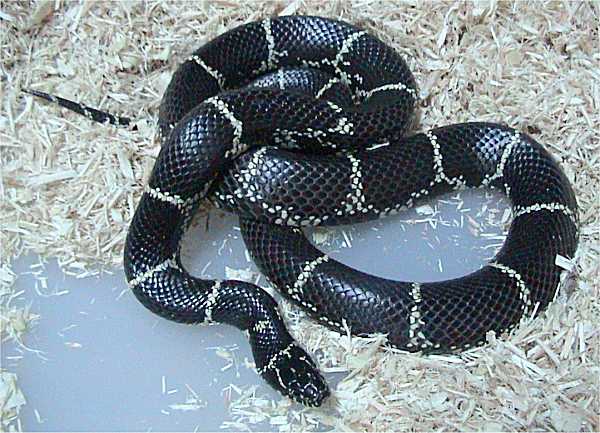 Common KingsnakeLampropeltis getula
-
 Speckled KingsnakeLampropeltis holbrooki
-
 Black KingsnakeLampropeltis nigra
-
 Prairie KingsnakeLampropeltis calligaster
-
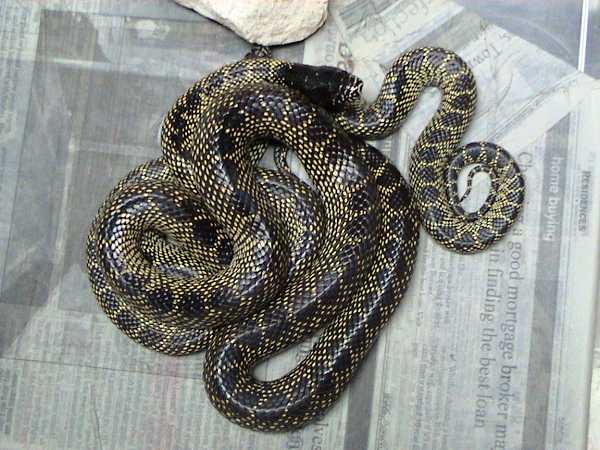 Desert KingsnakeLampropeltis splendida
Compare
Questions and answers
What is the scientific name of the California Mountain Kingsnake?
The scientific name of the California Mountain Kingsnake is Lampropeltis zonata. Written with its author, the full name is Lampropeltis zonata (Lockington, 1835).
Which family does the California Mountain Kingsnake belong to?
Lampropeltis zonata belongs to the family Colubridae, in the order Squamata and the class Reptilia.
Where is the California Mountain Kingsnake found?
Checklists and occurrence records place Lampropeltis zonata in 2 countries: United States and Mexico.
What is the conservation status of the California Mountain Kingsnake?
The IUCN Red List category recorded for Lampropeltis zonata is Least Concern (LC).
Are mountain kingsnakes poisonous?
The California Mountain Kingsnake is harmless despite its superficial resemblance to venomous coral snakes.[36][37]
How big do CA king snakes get?
Adults are usually approximately 30 inches long but can reach 40 inches. Total body length can reach 122.5 cm, although most individuals are shorter than 100 cm.[11][12]
What kills kingsnakes?
Major causes of mortality include illegal collection and habitat alteration. The species may also experience substantial road mortality.[42][43]
What do California kingsnakes eat?
The California Mountain Kingsnake commonly preys on Gilbert skinks, western skinks, sagebrush lizards, and western fence lizards. Its recorded prey categories also include birds and small mammals.[18][19]
What is a California kingsnakes natural habitat?
The California Mountain Kingsnake commonly inhabits moist woodlands, including coniferous forests, oak woodlands, chaparral, and coastal sage scrub. It also occupies riparian areas with rocks and rotting logs exposed to sunlight and south-facing rocky slopes of stream canyons.[15][16][17]
Sources
Passages the profile rests on
- The species has a slender, cylindrical body with red, black, and white or occasionally yellow bands. Source passage: “The slender, cylindrical body of this snake is patterned with black, white (or occasionally yellow), and red bands” — animaldiversity.org
- Each red body band is bordered by black bands on both sides. Source passage: “each red crossband being surrounded by two black crossbands” — English Wikipedia
- The first body band immediately behind the head is white. Source passage: “The first band after the black head is white.” — animaldiversity.org
- The dorsal surface of the head is black, while the chin and throat are often white. Source passage: “The dorsal side of the head is black, but the chin and throat are often white.” — animaldiversity.org
- Some individuals have reduced red pigmentation, and others may lack red bands entirely. Source passage: “Some individuals may have reduced amounts of red pigment, and rare individuals may have virtually no red bands at all.” — English Wikipedia
- Individuals from Isla Todos Santos have exclusively black and white bands. Source passage: “One population from Isla Todos Santos always lacks the red crossbands and is instead uniformly banded with black and white” — English Wikipedia
- The species has smooth, unkeeled scales. Source passage: “The scales are smooth and unkeeled.” — animaldiversity.org
- The species has 21 to 23 dorsal scale rows at mid-body. Source passage: “There are 21 to 23 dorsal body scale rows at mid-body.” — animaldiversity.org
- The species has an undivided anal plate. Source passage: “and an undivided anal plate.” — animaldiversity.org
- The species has 11 to 13 teeth on each maxilla. Source passage: “Each maxilla on this snake has 11 to 13 teeth.” — animaldiversity.org
- Total body length can reach 122.5 cm, although most individuals are shorter than 100 cm. Source passage: “can reach a total body length of 122.5 cm, although most are shorter than 100 cm long.” — animaldiversity.org
- Adults are usually approximately 30 inches long but can reach 40 inches. Source passage: “Adults are usually 30 inches in length but may reach 40 inches.” — swap.oregon.gov
- Males have 45 to 62 subcaudal scales, while females have 46 to 56. Source passage: “Males have 45 to 62 subcaudals and tail lengths that average 18.2% of total body length, while females have 46 to 56 subcaudals” — animaldiversity.org
- Male tail length averages 18.2% of total body length, compared with 17.5% in females. Source passage: “tail lengths that average 18.2% of total body length, while females have 46 to 56 subcaudals and tail lengths averaging 17.5% of total body length.” — animaldiversity.org
- The species commonly inhabits moist woodlands, including coniferous forests, oak woodlands, chaparral, and coastal sage scrub. Source passage: “Most often though, it is associated with moist woodlands such as coniferous forests, oak woodlands, chaparral, or coastal sage scrub.” — animaldiversity.org
- Individuals commonly occupy riparian areas containing rocks and rotting logs exposed to sunlight. Source passage: “it is commonly located within riparian zones with ample rocks and rotting logs where the sun reaches” — animaldiversity.org
- The species also occurs on south-facing rocky slopes of stream canyons. Source passage: “or on the south-facing, rocky, slopes of stream canyons.” — animaldiversity.org
- The species commonly preys on Gilbert skinks, western skinks, sagebrush lizards, and western fence lizards. Source passage: “Lizards including Gilbert skinks ( Eumeces gilberti ), western skinks ( E. skiltonianus ), sagebrush lizards ( Sceloporus graciosus ) and western fence lizards ( S. occidentalis ) are common prey.” — animaldiversity.org
- Its recorded prey categories include reptiles, birds, and small mammals. Source passage: “Prey consists of reptiles, birds, and small mammals.” — swap.oregon.gov
- The species is generally secretive and spends much of its time underground, beneath surface objects, or in rock crevices. Source passage: “This snake generally has secretive habits, spending most of its time underground, under surface objects, or inside rock crevices.” — animaldiversity.org
- The species is a capable climber, with an individual recorded more than 1.5 m above ground in a decaying oak-tree cavity. Source passage: “One individual was found over 1.5 meters above ground coiled in a decaying cavity of an oak tree.” — animaldiversity.org
- In California, the species is active annually from late March through early November. Source passage: “Lampropeltis zonata is active from late March through early November annually in California.” — animaldiversity.org
- During winter, individuals shelter in deep rock crevices or mammal burrows. Source passage: “Winters are spent deep in rock crevices or within mammal burrows” — animaldiversity.org
- The species uses sight to locate moving prey and smell to locate concealed prey and eggs. Source passage: “uses sight to locate moving prey, and smell (olfaction and the vomero-nasal system) to find hidden prey and eggs.” — animaldiversity.org
- Large, struggling prey are constricted before being swallowed. Source passage: “but large, struggling prey must be constricted before ingestion.” — animaldiversity.org
- The species is oviparous. Source passage: “Lampropeltis zonata is an oviparous species” — animaldiversity.org
- Breeding typically occurs from April through early June. Source passage: “Lampropeltis zonata typically breeds from April through early June” — animaldiversity.org
- Females may reproduce only every second year. Source passage: “Females may breed only every second year.” — animaldiversity.org
- Egg laying generally takes place from late May through July. Source passage: “Oviposition occurs in late May to July.” — animaldiversity.org
- Clutches average approximately seven eggs and range from two to ten. Source passage: “Clutches average about 7 eggs, but range from 2 to 10.” — animaldiversity.org
- Eggs average 42.2 mm long and 17.2 mm wide. Source passage: “averaging 42.2 (40.0 to 45.0) mm in length, and 17.2 (15.8 to 18.0) mm in width” — animaldiversity.org
- Egg incubation averages 62 days. Source passage: “eggs incubate for an average 62 days.” — animaldiversity.org
- Incubation periods range from 47 to 87 days at temperatures of 23 to 29 degrees Celsius. Source passage: “range from 47 to 87 days at temperatures of 23 to 29 degrees Celsius.” — animaldiversity.org
- Hatchlings measure 20.0 to 27.2 cm and weigh approximately 5.7 to 7.7 g. Source passage: “young measure 20.0 to 27.2 cm in length, and weigh about 5.7 to 7.7 g.” — animaldiversity.org
- In Washington, mating probably occurs in May, with three to nine eggs laid in June or July. Source passage: “Mating probably takes place in May with three to nine eggs laid in June or July.” — wdfw.wa.gov
- The species resembles venomous coral snakes in its red, black, and pale banding pattern. Source passage: “It is a coral snake mimic, having a similar pattern consisting of red, black, and yellow on its body” — English Wikipedia
- The species is harmless despite its superficial resemblance to venomous coral snakes. Source passage: “This species superficially resembles the venomous coral snake, but it is harmless.” — wdfw.wa.gov
- The Isla Todos Santos population resembles the California kingsnake in appearance. Source passage: “similar in appearance to the related California kingsnake.” — English Wikipedia
- Habitat destruction associated with urbanization is a major threat to the species. Source passage: “A major threat to Lampropeltis zonata is habitat destruction. This is usually associated with urbanization” — animaldiversity.org
- Removing rock slabs from outcrops damages the species' habitat. Source passage: “slabs from rock outcrops are also torn off by people searching for this species or other reptiles.” — animaldiversity.org
- Collection for the pet trade has reduced populations. Source passage: “collection for the pet trade has diminished populations, as well.” — animaldiversity.org
- Illegal collection and habitat alteration are identified as major causes of mortality. Source passage: “The main causes of mortality in populations of California mountain kingsnake include illegal collection and habitat alteration” — swap.oregon.gov
- The species may experience substantial road mortality. Source passage: “Like other snakes, this species may experience high rates of road mortality.” — swap.oregon.gov
Data
- Catalogue of Life, 2026-10-16 XR cc by
- Global Biodiversity Information Facility CC BY 4.0
- Wikidata CC0
- GeoNames CC BY 4.0
- Wikimedia Commons per image; credit shown with each image
- Within the Catalogue of Life, this name comes from The Reptile Database cc by
References
- Blainville, & Henri Marie Ducrotay de. (1835). Description de quelques espèces de reptiles de la Californie précédée de l’analyse d’un système général d’erpétologie et d’amphibiologie. Nouv. Ann. Mus. Hist. Nat. Paris 4: 233-296.
- Yarrow, H. C. (1882). Description of new species of reptiles and amphibians in the US National Museum. Proc. US Natl. Mus. 5: 438-443. Link
- Bocourt, M. F. (1886). In A. Duméril, M. F. Bocourt, and F. Mocquard, (1870-1909), Etudes sur les reptiles, p. i-xiv, 1-1012. In Recherches Zoologiques pour servir a l’Histoire de Ia Faune de l’Amérique Centrale et du Mexique. Mission Scientifique au Mexique et dans l’Amérique Centrale, Recherches zoologiques. Part 2, sect. 1. Imprimerie Impériale, Paris, Vol. 3.
- Blanchard, Frank N. (1920). A synopsis of the king snakes: Genus Lampropeltis Fitzinger. Occasional Papers of the Museum of Zoology, University of Michigan (87): 1-7.
- Blanchard, Frank N. (1921). A revision of the king snakes: genus Lampropeltis. Bull. US Natl. Mus. (114): 1-260.
- Van Denburgh, J., & Slevin, J. R. (1923). Preliminary diagnoses of four new snakes from Lower California, Mexico. Proc. Cal. Acad. Sci. (4) 13 (1): 1-2.
- Burt, Charles E. (1936). The nomenclature of western coral king snakes, Lampropeltis zonata versus L. multicincta. Copeia 1936 (2): 94-98.
- Fitch, H. S. (1936). Amphibians and reptiles of the Rouge River Basin, Oregon. American Midland Naturalist 17: 634-652.
- Lewis, Thomas H. (1942). Additional records for Washington snakes. Copeia 1942 (2): 129.
- Zweifel, R. G. (1952). Pattern variation and evolution of the mountain kingsnake, Lampropeltis zonata. Copeia 1952 (3): 152-168.
- Zweifel, Richard G. (1975). Lampropeltis zonata. Catalogue of American Amphibians and Reptiles (174): 1-4.
- Coote, Jon’. (1982). Literature: The Californian mountain kingsnake (Lampropeltis zonata) and the Coral snake mimic problem. Litteratura Serpentium 2 (6): 308.
- TRYON, B. W., & MURPHY, J. B. (1982). Miscellaneous Notes on the Reproductive Biology of Reptiles. 5. Thirteen Varieties of the Genus Lampropeltis, species mexicana, triangulum and zonata. Trans. Kansas Acad. Sci. 85 (2): 96-119.
- Nussbaum, R.A., Brodie, E.D., Jr., & Storm, R.M. (1983). Amphibians and reptiles of the Pacific Northwest. Univ. Press of Idaho, Moscow 332 Pp.
- Stebbins, R. C. (1985). A Field Guide to Western Reptiles and Amphibians, 2nd ed. Houghton Mifflin, Boston.
- Mehrtens, J. M. (1987). Living snakes of the world in color. Sterling Publ. Co., Hic., New York, NY: 480 Pp.
- Collins J T. (1991). Viewpoint: a new taxonomic arrangement for some North American amphibians and reptiles. Herpetological Review 22 (2): 42-43.
- Keogh, & Scott, J. (1996). Evolution of the colubrid snake tribe Lampropeltini: a morphological perspective. Herpetologica 52 (3): 406-416.
- McKeown, S., & Morgan, M. (1996). Two size records for California snakes. Bull. Chicago Herp. Soc. 31 (12): 217-218.
- Rodríguez-Robles, Javier A.; Denardo, D.F. & Staub, R.E. (1999). Phylogeography of the California mountain kingsnake, Lampropeltis zonata (Colubridae). Molecular Ecology 8: 1923–1934.
- Crother, B. I. (2000). Scientific and standard English names of amphibians and reptiles of North America north of Mexico, with comments regarding confidence in our understanding. Herpetological Circular 29: 1-82.
- Thissen, R., & Hansen, H. (2001). Königsnattern - Lampropeltis. Natur Und Tier Verlag (Münster), 172 Pp.
- Grismer, L. L. (2001). Bull. Southern Calif. Acad. Sci. 100(1):12-23.
- Rodríguez-Robles, Javier A., Good, David A., Wake, David B. (2003). Brief History of Herpetology in the Museum of Vertebrate Zoology, University of California, Berkeley, with a List of Type Specimens of Recent Amphibians and Reptiles. UC Publications in Zoology, 119 Pp.
- Greene, H.W. & J.A. Rodríguez-Robles. (2003). Feeding ecology of the California mountain kingsnake, Lampropeltis zonata (Colubridae). Copeia 2003 (2): 308-314.
This species in other databases
Page built on 28 November 2026. See how the catalog is made and all sources and licences.
Cite this page
ScientificNames.org. (2026). Lampropeltis zonata (California Mountain Kingsnake). Retrieved November 28, 2026, from https://scientificnames.org/species/lampropeltis-zonata
“Lampropeltis zonata (California Mountain Kingsnake).” ScientificNames.org, 2026, scientificnames.org/species/lampropeltis-zonata. Accessed 28 Nov. 2026.
ScientificNames.org. “Lampropeltis zonata (California Mountain Kingsnake).” Accessed November 28, 2026. https://scientificnames.org/species/lampropeltis-zonata.
@misc{scientificnames_lampropeltis_zonata_california_mountain_kingsnake,
  author = {{ScientificNames.org}},
  title = {Lampropeltis zonata (California Mountain Kingsnake)},
  year = {2026},
  url = {https://scientificnames.org/species/lampropeltis-zonata},
  note = {Accessed 2026-11-28}
}