Species · Reptiles
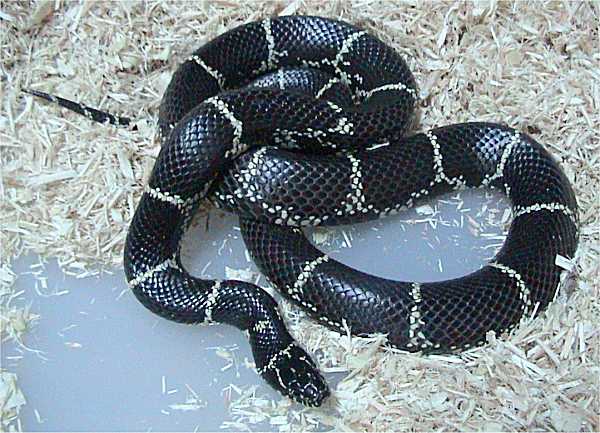
Atlantic Central American Milksnake Lampropeltis polyzona
The scientific name of the Atlantic Central American Milksnake is Lampropeltis polyzona. It is a species of reptile in the family Colubridae (colubrid), order Squamata. The name dates from 1860.
- Scientific name
- Lampropeltis polyzona Cope, 1860
- Common name
- Atlantic Central American Milksnake
- Genus
- Lampropeltis
- Family
- Colubridae (Colubrid)
- Order
- Squamata
- Class
- Reptilia
- Red List category
- LC Least Concern
- Recorded in
- 7 countries
- Name status
- accepted in the Catalogue of Life

Overview
The Atlantic Central American Milksnake is a reptile in the family Colubridae, order Squamata, and class Reptilia. It is a nonvenomous snake.
Written 26 November 2026 from the sources listed below. Each statement was checked against the passage it cites; statements that could not be supported were removed.
Appearance
The Atlantic Central American Milksnake is nonvenomous.[1]
Classification of the Atlantic Central American Milksnake
| Kingdom | Animalia |
|---|---|
| Phylum | Chordata |
| Subphylum | Vertebrata |
| Infraphylum | Gnathostomata |
| Parvphylum | Osteichthyes |
| Megaclass | Tetrapoda |
| Class | Reptilia (Reptile) |
| Order | Squamata (Snakes) |
| Suborder | Serpentes (Snakes) |
| Infraorder | Alethinophidia |
| Family | Colubridae (Colubrid) |
| Subfamily | Colubrinae |
| Genus | Lampropeltis (Kingsnakes) |
| Species | Lampropeltis polyzona Cope, 1860 |
Where the Atlantic Central American Milksnake is found
Checklists and occurrence records place Lampropeltis polyzona in 7 countries across North America. GBIF holds 1,520 georeferenced records of it.
Countries
Regions and cities with the most records
- Veracruz, Mexico 192
- Jalisco, Mexico 147
- Puebla, Mexico 143
- Sinaloa, Mexico 143
- Oaxaca, Mexico 93
- Nayarit, Mexico 76
- Catemaco, Mexico 60
- Michoacán, Mexico 59
- Guanajuato, Mexico 55
- Mazatlán, Mexico 46
- Guerrero, Mexico 41
- Coatepec, Mexico 33
- Fortín de las Flores, Mexico 33
- Xalapa de Enríquez, Mexico 33
- Xico, Mexico 32
- Banderilla, Mexico 30
- Córdoba, Mexico 29
- Ixtaczoquitlán, Mexico 27
- Nuevo México, Mexico 25
- San Andrés Tuxtla, Mexico 25
- Atlántida Department, Honduras 24
- México, Mexico 24
- Orizaba, Mexico 24
- Colima, Mexico 23
- Huauchinango, Mexico 23
- Acámbaro, Mexico 22
- Hidalgo, Mexico 22
- Xicotepec de Juárez, Mexico 22
- Zapopan, Mexico 22
- Río Blanco, Mexico 20
- Nogales, Mexico 19
- Chilpancingo, Mexico 17
- Ciudad Mendoza, Mexico 17
- Tela, Honduras 17
- Tixtla de Guerrero, Mexico 17
- Tala, Mexico 16
1 more country has a few records outside this range
These countries hold a few records of Lampropeltis polyzona but lie outside the range the checklists give for it. Such records are often zoo or garden specimens, museum material or vagrants, so the species is not counted as occurring there.
Range as the checklists state it
Mexico (Colima, Guerrero, Hidalgo, Jalisco, Puebla, Michoacán, Oaxaca, Sinaloa, Sonora, Veracruz; possibly in Guanajuato, Morelos, and Nayarit, W San Luis Potosí, Aguascalientes, Zacatecas)
A number beside a place is its count of GBIF occurrence records. A place without a number comes from a checklist alone. Records show where a species has been observed or collected, which can include escapes and vagrants.
Common names
English
- Atlantic Central American Milksnake
- West Mexican Milksnake
Names in 5 other languages
- Czech
- korálovka sedlatá Nelsonova, korálovka sedlatá sinalojská
- Danish
- Centralmexicansk Mælkesnog
- German
- Nelsons Dreiecksnatter, Nelsons Dreiecksnatter [nelsoni]
- Spanish
- Culebra Real Escarlata, Falsa coralillo, Falsa coralillo real occidental
- Ukrainian
- Королівська змія західномексиканська
Synonyms
9 other scientific names have been used for this species and are now treated as synonyms of Lampropeltis polyzona.
- Coronella micropholis var. arcifera Werner, 1903
- Lampropeltis triangulum arcifera (Werner, 1903)
- Lampropeltis triangulum campbelli Quinn, 1983
- Lampropeltis triangulum conanti Williams, 1978
- Lampropeltis triangulum nelsoni Blanchard, 1920
- Lampropeltis triangulum polyzona Cope, 1860
- Lampropeltis triangulum schmidti Stuart, 1935
- Lampropeltis triangulum sinaloae Williams, 1978
- Lampropeltis triangulum smithi Williams, 1978
Related species
-
 Milk SnakeLampropeltis triangulum
-
 California KingsnakeLampropeltis californiae
-
 Scarlet KingsnakeLampropeltis elapsoides
-
 Common KingsnakeLampropeltis getula
-
 Speckled KingsnakeLampropeltis holbrooki
-
 California Mountain KingsnakeLampropeltis zonata
-
 Black KingsnakeLampropeltis nigra
-
 Prairie KingsnakeLampropeltis calligaster
Compare
Questions and answers
What is the scientific name of the Atlantic Central American Milksnake?
The scientific name of the Atlantic Central American Milksnake is Lampropeltis polyzona. Written with its author, the full name is Lampropeltis polyzona Cope, 1860.
Which family does the Atlantic Central American Milksnake belong to?
Lampropeltis polyzona belongs to the family Colubridae, in the order Squamata and the class Reptilia.
Where is the Atlantic Central American Milksnake found?
Checklists and occurrence records place Lampropeltis polyzona in 7 countries, including Mexico, Honduras, Guatemala, Nicaragua, United States and Costa Rica.
What is the conservation status of the Atlantic Central American Milksnake?
The IUCN Red List category recorded for Lampropeltis polyzona is Least Concern (LC).
What other names does the Atlantic Central American Milksnake have?
Lampropeltis polyzona is also known in English as West Mexican Milksnake.
How venomous are milk snakes?
The Atlantic Central American Milksnake is nonvenomous.[1]
How venomous is a milk snake?
The Atlantic Central American Milksnake is nonvenomous.[1]
Sources
Passages the profile rests on
- Lampropeltis polyzona is a nonvenomous snake. Source passage: “Lampropeltis polyzona, commonly known as the Atlantic Central American milksnake, is a species of nonvenomous snake in the family Colubridae.” — inaturalist.org
Data
- Catalogue of Life, 2026-10-16 XR cc by
- Global Biodiversity Information Facility CC BY 4.0
- Wikidata CC0
- GeoNames CC BY 4.0
- Wikimedia Commons per image; credit shown with each image
- Within the Catalogue of Life, this name comes from The Reptile Database cc by
References
- Cope, E. D. (1860). Catalogue of the Colubridae in the Museum of the Academy of Natural Sciences of Philadelphia, with notes and descriptions of new species. Part II. Proc. Acad. Nat. Sci. Philadelphia 12: 241-266.
- Cope, E. D. (1900). The crocodilians, lizards and snakes of North America. Ann. Rep. U.S. Natl. Mus. 1898: 153-1270.
- Werner, F. (1903). Neue Reptilien und Batrachier aus dem naturhistorischen Museum in Brüssel. Zool. Anz. 26: 246-253.
- Blanchard, Frank N. (1920). Three new snakes of the genus Lampropeltis. Occasional Papers of the Museum of Zoology, University of Michigan (81): 1-10.
- Blanchard, Frank N. (1920). A synopsis of the king snakes: Genus Lampropeltis Fitzinger. Occasional Papers of the Museum of Zoology, University of Michigan (87): 1-7.
- Blanchard, Frank N. (1921). A revision of the king snakes: genus Lampropeltis. Bull. US Natl. Mus. (114): 1-260.
- Stuart, L. C. (1935). Studies on neotropical colubrinae. V. A new snake of the genus Lampropeltis from Yucatan. Occasional Papers of the Museum of Zoology, University of Michigan (309): 1-6.
- Stuart, L. C. (1935). A contribution to a knowledge of the herpetology of a portion of the savanna region of Central Peten, Guatemala. University of Michigan Museum of Zoology Miscellaneous Publications 29: 1-56.
- Taylor, Edward H. (1939). Some Mexican serpents. Univ. Kansas Sci. Bull. 26 (13): 445-487.
- Smith, Hobart M. (1942). Remarks on the Mexican king snakes of the triangulum group. Proc. Rochester Academy of Science 8 (4): 196-207.
- Klauber, Lawrence M. (1948). Some misapplications of the Linnaean names applied to American snakes. Copeia 1948 (1): 1-14.
- Laurent, R. (1949). Note sur quelques reptiles appartenant à la collection de l’Institut Royal des Sciences Naturelles de Belgique. III. Formes americaines. Bull. Inst. Roy. Sci. Nat. Belgique, Bruxelles, 25 (9): 1-20 [4].
- Taylor, E. H. (1949). A preliminary account of the herpetology of the state of San Luis Potosi, Mexico. Univ. Kansas Sci. Bull. 33 (2): 169-215. Link
- Taylor, E. H. (1950). Second contribution to the herpetology of San Luis Potosi. Univ. Kansas Sci. Bull. 33 (11): 441-457.
- Mertens, R. (1952). Die Amphibien und Reptilien von El Salvador. Abh. Senckenb. Naturf. Ges. (Frankfurt) (No. 487): 120 Pp.
- Davis, William B.; Smith, Hobart M. (1953). Snakes of the Mexican state of Morelos. Herpetologica 8: 133-149.
- Zweifel,R.G. and Norris,K.S. (1955). Contributions to the herpetology of Sonora, Mexico:Descriptions of new subspecies of snakes (Micruroides euryxanthus and Lampropeltis getulus) and miscellaneous collecting notes. American Midland Naturalist 54: 230-249.
- Mertens, R. (1956). Das Problem der Mimikry bei Korallenschlangen. Zool. Jahrb., Abt Syst. Ökol. Geogr. Tiere 84: 541-576 + Plates 6-14.
- Mertens, R. (1956). Das Problem der Mimikry bei Korallenschlangen. English Translation by Andrew Durso. Smithsonian Herpetological Information Service 160 (2023).
- Fugler, Charles M.;Dixon, James R. (1961). Notes on the herpetofauna of the El Dorado Area of Sinaloa, Mexico. Publications of the Museum, Michigan State University, Biological Series 2 (1): 1-24.
- Hardy, L.M., & McDiarmid, R.W. (1969). The amphibians and reptiles of Sinaloa, Mexico. Univ. Kansas Publ. Mus. Nat. Hist. 18 (3): 39-252.
- Peters, James A.; Donoso-Barros, Roberto & Orejas-Miranda, Braulio. (1970). Catalogue of the Neotropical Squamata: Part I Snakes. Bull. US Natl. Mus. 297: 347 Pp.
- Williams, K. L. (1978). Systematics and natural history of the American milk snake Lampropeltis triangulum. Milwaukee Publ. Mus. Contrib. Biol. Geol. No. 2, 258 Pp.
- Engelmann, W.-E. and F. J. Obst. (1981). Snake biology, behavior and relationship to man. Exeter Books, New York.
- Quinn, H. R. (1983). Two new subspecies of Lampropeltis triangulum from México. Trans. Kansas Acad. Sci. 86: 113-135. Link
This species in other databases
Page built on 28 November 2026. See how the catalog is made and all sources and licences.
Cite this page
ScientificNames.org. (2026). Lampropeltis polyzona (Atlantic Central American Milksnake). Retrieved November 28, 2026, from https://scientificnames.org/species/lampropeltis-polyzona
“Lampropeltis polyzona (Atlantic Central American Milksnake).” ScientificNames.org, 2026, scientificnames.org/species/lampropeltis-polyzona. Accessed 28 Nov. 2026.
ScientificNames.org. “Lampropeltis polyzona (Atlantic Central American Milksnake).” Accessed November 28, 2026. https://scientificnames.org/species/lampropeltis-polyzona.
@misc{scientificnames_lampropeltis_polyzona_atlantic_central_american_milksnake,
  author = {{ScientificNames.org}},
  title = {Lampropeltis polyzona (Atlantic Central American Milksnake)},
  year = {2026},
  url = {https://scientificnames.org/species/lampropeltis-polyzona},
  note = {Accessed 2026-11-28}
}