Species · Reptiles
Webb's Kingsnake Lampropeltis webbi
The scientific name of the Webb's Kingsnake is Lampropeltis webbi. It is a species of reptile in the family Colubridae (colubrid), order Squamata. The name dates from 2005.
- Scientific name
- Lampropeltis webbi Bryson, Dixon & Lazcano, 2005
- Common name
- Webb's Kingsnake
- Genus
- Lampropeltis
- Family
- Colubridae (Colubrid)
- Order
- Squamata
- Class
- Reptilia
- Red List category
- DD Data Deficient
- Recorded in
- 1 country
- Name status
- accepted in the Catalogue of Life
Overview
Webb's Kingsnake is an egg-laying snake. It occurs in the Sierra Madre Occidental near the boundary between Durango and Sinaloa, Mexico. Known specimens have grey coloration with broad red saddles outlined by black stripes.
Written 27 November 2026 from the sources listed below. Each statement was checked against the passage it cites; statements that could not be supported were removed.
Appearance
Known specimens have grey coloration with broad red saddles outlined by black stripes. The head is slightly differentiated from the neck, and the eyes are slightly protruding and brown.[1][2][3]
Specimens have between 216 and 221 ventral scales. The largest known specimen measures 75 cm in length.[4][5]
Habitat
The species has been recorded in rugged montane pine–oak forest.[6]
Reproduction and life cycle
Webb's Kingsnake is an egg-laying species.[7]
Conservation
Only five specimens are currently known, including one living specimen. Known records are restricted to a short section of a single highway in the species' documented region.[8][9]
Most recorded specimens were discovered dead on the road.[10]
Classification of the Webb's Kingsnake
| Kingdom | Animalia |
|---|---|
| Phylum | Chordata |
| Subphylum | Vertebrata |
| Infraphylum | Gnathostomata |
| Parvphylum | Osteichthyes |
| Megaclass | Tetrapoda |
| Class | Reptilia (Reptile) |
| Order | Squamata (Snakes) |
| Suborder | Serpentes (Snakes) |
| Infraorder | Alethinophidia |
| Family | Colubridae (Colubrid) |
| Subfamily | Colubrinae |
| Genus | Lampropeltis (Kingsnakes) |
| Species | Lampropeltis webbi Bryson, Dixon & Lazcano, 2005 |
Where the Webb's Kingsnake is found
Checklists and occurrence records place Lampropeltis webbi in 1 country across North America. GBIF holds 5 georeferenced records of it.
Countries
Regions and cities with the most records
Range as the checklists state it
Mexico (Pacific versant of the Sierra Madre Occidental in Mixed Boreal-Tropical habitat near the Durango/Sinaloa state border)
A number beside a place is its count of GBIF occurrence records. A place without a number comes from a checklist alone. Records show where a species has been observed or collected, which can include escapes and vagrants.
Common names
English
- Webb's Kingsnake
- Webb’s Kingsnake
Names in 3 other languages
- Czech
- korálovka Webbova
- German
- Webbs Königsnatter
- Spanish
- Culebra real de la Sierra Madre Oriental, Falsa coralillo real de Webb
Related species
-
 Milk SnakeLampropeltis triangulum
-
 California KingsnakeLampropeltis californiae
-
 Scarlet KingsnakeLampropeltis elapsoides
-
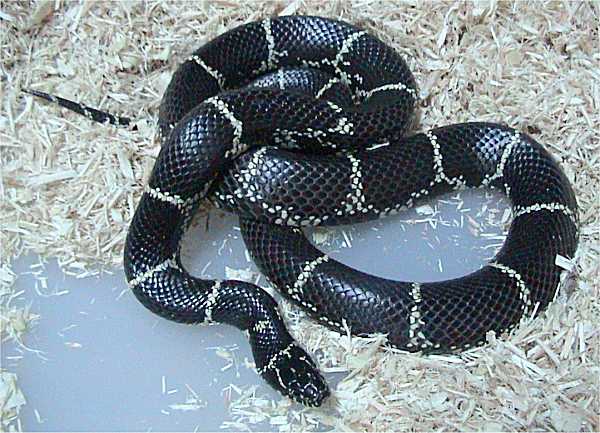 Common KingsnakeLampropeltis getula
-
 Speckled KingsnakeLampropeltis holbrooki
-
 California Mountain KingsnakeLampropeltis zonata
-
 Black KingsnakeLampropeltis nigra
-
 Prairie KingsnakeLampropeltis calligaster
Compare
Questions and answers
What is the scientific name of the Webb's Kingsnake?
The scientific name of the Webb's Kingsnake is Lampropeltis webbi. Written with its author, the full name is Lampropeltis webbi Bryson, Dixon & Lazcano, 2005.
Which family does the Webb's Kingsnake belong to?
Lampropeltis webbi belongs to the family Colubridae, in the order Squamata and the class Reptilia.
Where is the Webb's Kingsnake found?
Checklists and occurrence records place Lampropeltis webbi in 1 country: Mexico.
What is the conservation status of the Webb's Kingsnake?
The IUCN Red List category recorded for Lampropeltis webbi is Data Deficient (DD).
What other names does the Webb's Kingsnake have?
Lampropeltis webbi is also known in English as Webb’s Kingsnake.
What kind of habitat do king snakes need?
Webb's Kingsnake has been recorded in rugged montane pine–oak forest.[6]
Sources
Passages the profile rests on
- Known specimens have grey coloration with broad red saddles outlined by black stripes. Source passage: “Known specimens have a pattern of grey with broad red saddles bordered by black striping.” — English Wikipedia
- The head is slightly differentiated from the neck. Source passage: “The head is slightly distinct from the neck” — English Wikipedia
- The species has slightly protruding brown eyes. Source passage: “with brown eyes slightly protruding from the head.” — English Wikipedia
- Specimens have between 216 and 221 ventral scales. Source passage: “specimens having a ventral scale count ranging 216–221 ventral scales.” — English Wikipedia
- The largest known specimen measures 75 cm in length. Source passage: “The largest specimen has a length of 75 cm” — English Wikipedia
- The species has been recorded in rugged montane pine–oak forest. Source passage: “Lampropeltis webbi has been found in rugged montane pine–oak forest” — English Wikipedia
- Lampropeltis webbi is an egg-laying species. Source passage: “L. webbi is oviparous.” — English Wikipedia
- Only five specimens of Lampropeltis webbi are currently known, including one living specimen. Source passage: “Currently, there are only five known specimens, with one being a live snake.” — English Wikipedia
- Known records are restricted to a short section of a single highway in the species' documented region. Source passage: “It has been found only on a small stretch of a single highway in this region” — English Wikipedia
- Most recorded specimens were discovered dead on the road. Source passage: “with most of the specimens being found dead on the road.” — English Wikipedia
Data
- Catalogue of Life, 2026-10-16 XR cc by
- Global Biodiversity Information Facility CC BY 4.0
- Wikidata CC0
- GeoNames CC BY 4.0
- Within the Catalogue of Life, this name comes from The Reptile Database cc by
References
- New species of Lampropeltis (Serpentes: Colubridae) from the Sierra Madre Occidental, Mexico. (2005). Journal of Herpetology, 39(2), 207–214. https://doi.org/10.1670/85-04a Link where the name was published
- Bryson, R.W.; Dixon, J.R. & Lazcano, D. (2005). New species of Lampropeltis (Serpentes: Colubridae) from the Sierra Madre Occidental, México. Journal of Herpetology 39 (2): 207-214.
- Beolens, B., & Michael Watkins, a. M. G. (2011). The Eponym Dictionary of Reptiles. Johns Hopkins University Press, Baltimore, USA.
- Valdez-Lares, R.; R. Muñiz-Martínez; E.Gadsden; G. Aguirre-León; G. Castañeda-Gaytán; R. Gonzalez-Trápaga. (2013). Checklist of amphibians and reptiles of the state of Durango, México. Check List 9 (4):714-724.
- Wallach, Van; Kenneth L. Williams, Jeff Boundy. (2014). Snakes of the World: A Catalogue of Living and Extinct Species. [type catalogue]. Taylor and Francis, CRC Press, 1237 Pp.
- Heimes, P. (2016). Snakes of Mexico. Chimaira, Frankfurt, 572 Pp.
- Hansen, R. W., and G. T. Salmon. (2017). Distribution analysis, taxonomic updates, and conservation status for the Lampropeltis mexicana group (Serpentes: Colubridae). Mesoamerican Herpetology 4 (4): 700–758.
- Lemos-Espinal JA, Smith GR, Gadsden-Esparza H, Valdez-Lares R, & Woolrich-Piña GA. (2018). Amphibians and reptiles of the state of Durango, Mexico, with comparisons with adjoining states. ZooKeys 748: 65-87.
- Greenbaum, E & Zhuang, M V; (2019). Obituary: Robert Gravem Webb (1927-2018): Specialist on Trionychid turtles and Mexican herpetology. Herpetological Review 50 (3): 656-661.
- Lemos-Espinal JA, & Smith GR. (2020). A checklist of the amphibians and reptiles of Sinaloa, Mexico with a conservation status summary and comparisons with neighboring states. ZooKeys 931: 85-114.
This species in other databases
Page built on 27 November 2026. See how the catalog is made and all sources and licences.
Cite this page
ScientificNames.org. (2026). Lampropeltis webbi (Webb's Kingsnake). Retrieved November 27, 2026, from https://scientificnames.org/species/lampropeltis-webbi
“Lampropeltis webbi (Webb's Kingsnake).” ScientificNames.org, 2026, scientificnames.org/species/lampropeltis-webbi. Accessed 27 Nov. 2026.
ScientificNames.org. “Lampropeltis webbi (Webb's Kingsnake).” Accessed November 27, 2026. https://scientificnames.org/species/lampropeltis-webbi.
@misc{scientificnames_lampropeltis_webbi_webbs_kingsnake,
  author = {{ScientificNames.org}},
  title = {Lampropeltis webbi (Webb's Kingsnake)},
  year = {2026},
  url = {https://scientificnames.org/species/lampropeltis-webbi},
  note = {Accessed 2026-11-27}
}