Species · Flowering plants
Beach Pea Lathyrus japonicus
The scientific name of the Beach Pea is Lathyrus japonicus. It is a species of flowering plant in the family Fabaceae (bean), order Fabales.
- Scientific name
- Lathyrus japonicus Willd.
- Common name
- Beach Pea
- Genus
- Lathyrus
- Family
- Fabaceae (Bean)
- Order
- Fabales
- Class
- Magnoliopsida
- Red List category
- LC Least Concern
- Recorded in
- 31 countries
- Name status
- accepted in the Catalogue of Life

Overview
Beach pea (Lathyrus japonicus Willd.) is a herbaceous perennial flowering plant in the family Fabaceae. It typically grows on sandy and gravelly storm beaches and sandy and stony seashores. Its flowers have dark purple standard petals and paler purple wing and keel petals, becoming bluer as they age.
Written 26 November 2026 from the sources listed below. Each statement was checked against the passage it cites; statements that could not be supported were removed.
Appearance
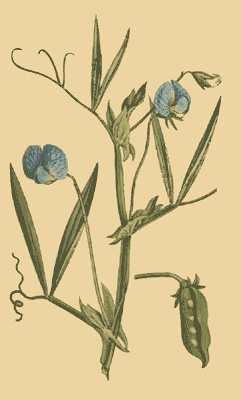
The plant has waxy, glaucous green leaves. The leaves are pinnate, with two to five pairs of leaflets, and the terminal leaflet is usually replaced by a twining tendril.[1][2][3]
The flowers have dark purple standard petals and paler purple wing and keel petals. They become bluer as they age.[4][5]
The plant produces brown seed pods that can reach 50 mm in length.[6][7]
Habitat
Beach pea typically grows on sandy and gravelly storm beaches. Its typical habitats include sandy and stony seashores, and it also occurs in other coastal locations.[8][9][10]
Behaviour
The plant has trailing stems that are limp and lack wings. The stems are often hairless.[11][12][13]
Reproduction and life cycle
The plant produces flower racemes containing up to twelve flowers. The inflorescence contains five to twelve purple flowers.[14][15]
Each flower has five sepals and five petals, with ten stamens and one carpel.[16][17]
The plant flowers in July and August in the Northern Hemisphere and in January and February in the Southern Hemisphere.[18][19]
The seeds can remain viable while floating in seawater for up to five years. Germination occurs after waves abrade the hard outer seed coat against sand or gravel.[20][21]
Uses
The plant's pods can be eaten. They contain β-oxalyl-L-α,β-diaminopropionic acid, a compound that can cause paralysis known as lathyrism.[22][23][24]
The plant's leaves are used in Chinese traditional medicine.[25]
Classification of the Beach Pea
| Kingdom | Plantae |
|---|---|
| Subkingdom | Pteridobiotina |
| Phylum | Tracheophyta |
| Class | Magnoliopsida |
| Order | Fabales |
| Family | Fabaceae (Bean) |
| Genus | Lathyrus (Pea) |
| Species | Lathyrus japonicus Willd. |
Where the Beach Pea is found
Checklists and occurrence records place Lathyrus japonicus in 31 countries across Asia, Europe, North America and South America. GBIF holds 49,233 georeferenced records of it.
Countries where it is native or its origin is not stated
- Afghanistan 104
- Aland Islands 27
- Belgium 6
- Canada 9,732
- China 80
- Denmark 5,200
- Estonia 747
- Faroe Islands 2
- Finland 2,275
- France 356
- Germany 1,223
- Greenland 220
- Iceland 493
- Ireland 50
- Italy 3
- Japan 1,639
- Latvia 104
- Lithuania 362
- North Korea 18
- Norway 2,272
- Poland 498
- Portugal 5
- Saint Pierre and Miquelon 21
- South Korea 907
- Spain 8
- Sweden 5,309
- The Netherlands 796
- United Kingdom 2,359
- United States 11,091
Countries where it has been introduced
Regions and cities with the most records
- British Columbia, Canada 2,661
- England, United Kingdom 1,400
- Nova Scotia, Canada 1,363
- Quebec, Canada 1,160
- Ontario, Canada 1,112
- Massachusetts, United States 1,048
- Skåne, Sweden 1,019
- Michigan, United States 993
- Washington, United States 993
- Maine, United States 989
- Oregon, United States 966
- Zealand, Denmark 808
- South Denmark, Denmark 789
- Colwood, Canada 716
- Langford, Canada 713
- Alaska, United States 690
- Saanich, Canada 652
- Oak Bay, Canada 637
- Esquimalt, Canada 633
- Victoria, Canada 632
- Central Saanich, Canada 599
- New Brunswick, Canada 590
- Central Jutland, Denmark 574
- Västra Götaland, Sweden 540
- Felixstowe, United Kingdom 516
- Richmond, Canada 500
- Capital Region, Denmark 494
- Harwich, United Kingdom 451
- Hillegom, The Netherlands 442
- Victoria-Fraserview, Canada 437
- Västernorrland, Sweden 434
- Newfoundland and Labrador, Canada 432
- Delta, Canada 427
- Castricum, The Netherlands 422
- Heiloo, The Netherlands 422
- Beverwijk, The Netherlands 419
2 more countries have a few records outside this range
These countries hold a few records of Lathyrus japonicus but lie outside the range the checklists give for it. Such records are often zoo or garden specimens, museum material or vagrants, so the species is not counted as occurring there.
A number beside a place is its count of GBIF occurrence records. A place without a number comes from a checklist alone. Records show where a species has been observed or collected, which can include escapes and vagrants.
Common names
English
- Beach Pea
- Beach Peavine
- Beach Vetchling
- Beach-pea
- Maritime Pea
- Sand Pea
- Sea Pea
- Sea Vetchling
- Sea-pea
- Seaside Pea
Names in 24 other languages
- Azerbaijani
- Yapon gülülcəsi
- Chinese
- 毛海滨山黧豆, 海滨山黧豆
- Czech
- hrachor přímořský
- Danish
- Klit-fladbælg, Strand-fladbælg, Strandært
- Dutch
- Zeelathyrus
- Estonian
- Rand-seahernes, jaapani seahernes
- Finnish
- merinätkelmä
- French
- Pois-de-mer, gesse de mer, gesse du Japon, gesse japonaise, gesse maritime, pois de mer
- German
- Japanische Platterbse, Strand-Platterbse, Strandplatterbse
- Icelandic
- Baunagras
- Japanese
- ハマエンドウ
- Korean
- 갯완두
- Latvian
- Jūrmalas dedestiņa
- Lithuanian
- Pajūrinis pelėžirnis
- Northern Sami
- riddosáhpal
- Norwegian Bokmål
- strandflatbelg
- Norwegian Nynorsk
- strandskolm
- Polish
- Groszek nadmorski
- Russian
- Чина японская
- Slovak
- hrachor japonský
- Swedish
- strandvial, strandärt
- Ukrainian
- Чина японська
- hsb
- Přimórski hróšik
- nuk
- ʕushʕuʔuqmapt
Synonyms
6 other scientific names have been used for this species and are now treated as synonyms of Lathyrus japonicus.
- Lathyrus japonicus f. japonicus
- Lathyrus japonicus subsp. japonicus
- Lathyrus japonicus var. pilosiusculus Pobed.
- Lathyrus japonicus var. typicus Fernald
- Lathyrus pisiformis Houtt.
- Orobus japonicus (Willd.) Alef.
Subspecies and varieties
- Lathyrus japonicus var. japonicus (Beach Peavine) variety
- Lathyrus japonicus var. maritimus (Beach Pea) variety
- Lathyrus japonicus var. parviflorus variety
- Lathyrus japonicus var. pellitus variety
Related species
-
 Sweet PeaLathyrus odoratus
-
 Indian PeaLathyrus sativus
-
 Perennial PeaLathyrus latifolius
-
 Tuberous PeaLathyrus tuberosus
-
 Yellow VetchlingLathyrus aphaca
-
 Bitter VetchLathyrus linifolius
-
 Spanish VetchlingLathyrus clymenum
-
 Meadow VetchlingLathyrus pratensis
Compare
Questions and answers
What is the scientific name of the Beach Pea?
The scientific name of the Beach Pea is Lathyrus japonicus. Written with its author, the full name is Lathyrus japonicus Willd..
Which family does the Beach Pea belong to?
Lathyrus japonicus belongs to the family Fabaceae, in the order Fabales and the class Magnoliopsida.
Where is the Beach Pea found?
Checklists and occurrence records place Lathyrus japonicus in 31 countries, including United States, Canada, Sweden, Denmark, United Kingdom and Finland.
What is the conservation status of the Beach Pea?
The IUCN Red List category recorded for Lathyrus japonicus is Least Concern (LC).
What other names does the Beach Pea have?
Lathyrus japonicus is also known in English as Beach Peavine, Beach Vetchling, Beach-pea, Maritime Pea, Sand Pea and Sea Pea.
What are sea peas?
Sea pea is an English name for beach pea (Lathyrus japonicus Willd.), a herbaceous perennial flowering plant.[26]
Is beach pea edible?
The plant's pods can be eaten, but they contain β-oxalyl-L-α,β-diaminopropionic acid, which can cause paralysis known as lathyrism.[22][23][24]
Sources
Passages the profile rests on
- The plant has waxy, glaucous green leaves. Source passage: “The leaves are waxy glaucous green” — English Wikipedia
- The leaves are pinnate and have two to five pairs of leaflets. Source passage: “pinnate, with 2-5 pairs of leaflets” — English Wikipedia
- The terminal leaflet is usually replaced by a twining tendril. Source passage: “the terminal leaflet usually replaced by a twining tendril.” — English Wikipedia
- The flowers have dark purple standard petals and paler purple wing and keel petals. Source passage: “with a dark purple standard petal and paler purple wing and keel petals” — English Wikipedia
- The flowers become bluer as they age. Source passage: “turning bluer as they age.” — English Wikipedia
- The plant produces brown seed pods. Source passage: “The fruit is a long brown pod” — English Wikipedia
- The seed pods can reach 50 mm in length. Source passage: “up to 50 mm (2.0 in) in length.” — English Wikipedia
- The plant typically grows on sandy and gravelly storm beaches. Source passage: “typically on sand and gravel storm beaches.” — English Wikipedia
- Its typical habitats include sandy and stony seashores. Source passage: “Its typical habitat is sandy or stony seashores” — English Wikipedia
- The species also occurs in other coastal locations. Source passage: “and other coastal locations.” — English Wikipedia
- The plant has trailing stems. Source passage: “trailing stems 50–80 cm (20–31 in) long” — English Wikipedia
- The stems are limp and lack wings. Source passage: “The stem grows to 15 to 30 cm (6 to 12 in) and is limp, has no wings” — English Wikipedia
- The stems are often hairless. Source passage: “and is often hairless.” — English Wikipedia
- The plant produces flower racemes containing up to twelve flowers. Source passage: “they are produced in racemes of up to twelve flowers.” — English Wikipedia
- The inflorescence contains five to twelve purple flowers. Source passage: “The inflorescence has a long stem and five to twelve purple flowers” — English Wikipedia
- The flowers have five sepals and five petals. Source passage: “These have five sepals and five petals” — English Wikipedia
- Each flower contains ten stamens and one carpel. Source passage: “There are ten stamens and a single carpel.” — English Wikipedia
- The plant flowers in July and August in the Northern Hemisphere. Source passage: “July and August in the Northern Hemisphere” — English Wikipedia
- The plant flowers in January and February in the Southern Hemisphere. Source passage: “January and February in the Southern Hemisphere” — English Wikipedia
- The plant's seeds can remain viable while floating in seawater for up to five years. Source passage: “the seeds to remain viable while floating in sea water for up to five years” — English Wikipedia
- Seed germination occurs after waves abrade the hard outer seed coat against sand or gravel. Source passage: “Germination occurs when waves abrade the hard outer seed coat on sand or gravel.” — English Wikipedia
- The plant's pods can be eaten. Source passage: “The pods can be eaten” — English Wikipedia
- The plant contains β-oxalyl-L-α,β-diaminopropionic acid in its pods. Source passage: “they contain β-oxalyl-L-α,β-diaminopropionic acid” — English Wikipedia
- The compound in the pods can cause paralysis known as lathyrism. Source passage: “which can cause paralysis called lathyrism.” — English Wikipedia
- The plant's leaves are used in Chinese traditional medicine. Source passage: “The leaves of the plant are used in Chinese traditional medicine.” — English Wikipedia
- The plant is a herbaceous perennial. Source passage: “It is a herbaceous perennial” — English Wikipedia
Data
- Catalogue of Life, 2026-10-16 XR cc by
- Global Biodiversity Information Facility CC BY 4.0
- Wikidata CC0
- GeoNames CC BY 4.0
- Wikimedia Commons per image; credit shown with each image
- Within the Catalogue of Life, this name comes from The World Checklist of Vascular Plants (WCVP): Fabaceae cc by
References
- Sp. Pl., ed. 4. 3: 1092 (1802) where the name was published
This species in other databases
Page built on 26 November 2026. See how the catalog is made and all sources and licences.
Cite this page
ScientificNames.org. (2026). Lathyrus japonicus (Beach Pea). Retrieved November 26, 2026, from https://scientificnames.org/species/lathyrus-japonicus
“Lathyrus japonicus (Beach Pea).” ScientificNames.org, 2026, scientificnames.org/species/lathyrus-japonicus. Accessed 26 Nov. 2026.
ScientificNames.org. “Lathyrus japonicus (Beach Pea).” Accessed November 26, 2026. https://scientificnames.org/species/lathyrus-japonicus.
@misc{scientificnames_lathyrus_japonicus_beach_pea,
  author = {{ScientificNames.org}},
  title = {Lathyrus japonicus (Beach Pea)},
  year = {2026},
  url = {https://scientificnames.org/species/lathyrus-japonicus},
  note = {Accessed 2026-11-26}
}