Species · Flowering plants
Heath-pea Lathyrus linifolius
The scientific name of the Heath-pea is Lathyrus linifolius. It is a species of flowering plant in the family Fabaceae (bean), order Fabales.
- Scientific name
- Lathyrus linifolius (Reichard) Bässler
- Common name
- Heath-pea
- Genus
- Lathyrus
- Family
- Fabaceae (Bean)
- Order
- Fabales
- Class
- Magnoliopsida
- Red List category
- LC Least Concern
- Recorded in
- 34 countries
- Name status
- accepted in the Catalogue of Life

Overview
Bitter Vetch is a perennial plant. It typically grows in rough grassy places and occurs in broad-leaved woodland. It has dark-coloured tubers attached to its roots.
Written 26 November 2026 from the sources listed below. Each statement was checked against the passage it cites; statements that could not be supported were removed.
Appearance
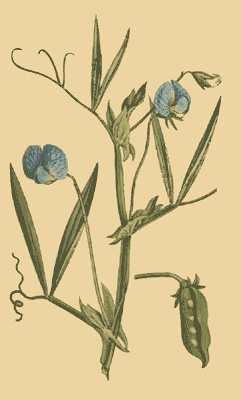
The plant has an erect stem that can grow to 50 centimetres tall. The stem is winged and nearly hairless.[1][2]
The leaves are arranged alternately and have short winged stalks and large stipules. Each leaf has two to four pairs of narrow lanceolate leaflets with blunt tips, entire margins and no tendrils.[3][4]
The inflorescence bears between two and six red flowers, each measuring between 10 and 16 millimetres in length. The flowers have five sepals and five irregular petals, and become bluer as they age.[5][6][7][8]
Each flower has ten stamens and a single carpel. The fruit is a long reddish-brown pod.[9][10]
The plant has dark-coloured tubers attached to its roots. These tubers can reach 3 centimetres in width.[11][12]
Habitat
Bitter Vetch typically grows in rough grassy places and occurs in broad-leaved woodland. The species is native to Europe.[13][14][15]
Reproduction and life cycle
Bitter Vetch flowers during May and June. Each fruit pod can contain up to ten seeds.[16][17]
Uses
The tubers can be eaten raw, but are better cooked and eaten like chestnuts. Small tubers were removed from the roots and dried for consumption.[18][19][20]
The plant was formerly used as an appetite suppressant in medieval Scotland. It was part of the Highland diet when food was scarce and remained an ingredient of that diet until the 18th century.[21][22][23]
Consumption of the tubers was associated with preventing thirst and hunger pangs. Medieval herbals claimed that the effects of eating the tubers could last for days or weeks.[24][25]
The proposed explanation for the effects of the tubers is the presence of transethanol. Attempts have been made to cultivate the species commercially.[26][27]
Classification of the Heath-pea
| Kingdom | Plantae |
|---|---|
| Subkingdom | Pteridobiotina |
| Phylum | Tracheophyta |
| Class | Magnoliopsida |
| Order | Fabales |
| Family | Fabaceae (Bean) |
| Genus | Lathyrus (Pea) |
| Species | Lathyrus linifolius (Reichard) Bässler |
Where the Heath-pea is found
Checklists and occurrence records place Lathyrus linifolius in 34 countries across Africa and Europe. GBIF holds 240,934 georeferenced records of it.
Countries where it is native or its origin is not stated
- Aland Islands 127
- Albania
- Algeria
- Andorra 38
- Austria 288
- Belarus 58
- Belgium 1,936
- Bulgaria 8
- Croatia 12
- Czechia 223
- Denmark 10,252
- Estonia 16
- Finland 3,787
- France 55,675
- Germany 14,115
- Greece 3
- Hungary 26
- Ireland 533
- Isle of Man 91
- Italy 862
- Latvia 13
- Luxembourg 1,170
- Norway 17,447
- Poland 1,081
- Portugal 146
- Romania 3
- Slovenia 113
- Spain 5,386
- Sweden 57,484
- Switzerland 4,535
- The Netherlands 1,013
- Ukraine 3
- United Kingdom 64,442
Countries where it has been introduced
Regions and cities with the most records
- England, United Kingdom 30,533
- Scotland, United Kingdom 23,934
- Auvergne-Rhône-Alpes, France 20,566
- Västra Götaland, Sweden 13,747
- Bourgogne-Franche-Comté, France 7,192
- Bavaria, Germany 6,538
- Södermanland, Sweden 6,300
- Occitanie, France 6,117
- Wales, United Kingdom 5,578
- Centre-Val de Loire, France 5,052
- Stockholm, Sweden 4,677
- Östergötland, Sweden 4,528
- Jönköping, Sweden 4,219
- Skåne, Sweden 4,082
- Grand Est, France 3,999
- Central Jutland, Denmark 3,537
- Kalmar, Sweden 3,389
- Uppsala, Sweden 2,478
- Akershus, Norway 2,438
- Västmanland, Sweden 2,312
- Catalonia, Spain 2,197
- Gävleborg, Sweden 2,086
- Kronoberg, Sweden 1,929
- Danderyd, Sweden 1,914
- Örebro, Sweden 1,880
- Huskvarna, Sweden 1,848
- Telemark, Norway 1,834
- Solna, Sweden 1,810
- Täby, Sweden 1,797
- Jönköping, Sweden 1,791
- Stockholm, Sweden 1,788
- Lidingö, Sweden 1,767
- Sundbyberg, Sweden 1,767
- Sollentuna, Sweden 1,719
- Oslo, Norway 1,691
- Rinkeby, Sweden 1,686
6 more countries have a few records outside this range
These countries hold a few records of Lathyrus linifolius but lie outside the range the checklists give for it. Such records are often zoo or garden specimens, museum material or vagrants, so the species is not counted as occurring there.
A number beside a place is its count of GBIF occurrence records. A place without a number comes from a checklist alone. Records show where a species has been observed or collected, which can include escapes and vagrants.
Common names
English
- Heath-pea
- Bitter Vetch
- Bitter Vetchling
- Bitter-Vetch
- Heath Pea
Names in 25 other languages
- Azerbaijani
- Kətanyarpaq gülülcə
- Belarusian
- Чына льналістая
- Bulgarian
- планинско секирче
- Catalan
- Guixó de muntanya, Guixó muntanyenc, Veça de muntanya
- Chinese
- 山地山黧豆, 苦山黧豆
- Czech
- hrachor horský
- Danish
- Krat-fladbælg
- Dutch
- Knollathyrus
- Estonian
- Lathyrus macrorhhizus, Lathyrus montanus, Orobus linifolius, mägi-seahernes
- Finnish
- soikkosyylälinnunherne, syylälinnunherne
- French
- Gesse aux tiges renflées, Gesse des Montagnes, Gesse à Feuilles de Lin
- German
- Berg Platterbse, Berg-Platterbse
- Hungarian
- hegyi lednek
- Italian
- Cicerchia montana
- Lithuanian
- Kalninis pelėžirnis
- Northern Sami
- giegasáhpal
- Norwegian Bokmål
- knollerteknapp
- Polish
- Groszek skrzydlasty, Groszek skrzydlaty
- Russian
- Чина льнолистная
- Scottish Gaelic
- cairmeal
- Slovak
- hrachor ľanolistý
- Slovenian
- gorski grahor
- Swedish
- Gökört, gökärt
- Welsh
- Pys y Coed, Pysen y Coed, Pysen y Coed Cnapwreiddiog, Ytbys y Coed, Ytbysen y Coed
- hsb
- Hórski hróšik
Synonyms
80 other scientific names have been used for this species and are now treated as synonyms of Lathyrus linifolius.
- Lathyrus linifolius f. emarginatus (Hertzsch) Bässler
- Lathyrus linifolius f. pubescens (Beck) Bässler
- Lathyrus linifolius f. pyrenaicus (L.) Bässler
- Lathyrus linifolius lusus albiflorus (Alef.) Bässler
- Lathyrus linifolius lusus variegatus (Rouy) Bässler
- Lathyrus linifolius var. montanus (Bernh.) Bässler
- Lathyrus linifolius var. varifolius (Martrin-Donos) P.D.Sell
- Lathyrus linnaei Rouy
- Lathyrus linnaei var. orientalis (Fisch. & C.A.Mey.) Simpson
- Lathyrus macrorrhizus Wimm.
- Lathyrus macrorrhizus (Dulac) St.-Lag.
- Lathyrus macrorrhizus prol. rothii Rouy
- Lathyrus macrorrhizus subvar. variegatus Rouy
- Lathyrus macrorrhizus var. angustissimus Godr.
- Lathyrus macrorrhizus var. divaricatus (Lapeyr.) Godr.
- Lathyrus macrorrhizus var. latifolius C.Schust.
- Lathyrus macrorrhizus var. pyrenaicus (L.) Godr.
- Lathyrus macrorrhizus var. varifolius Martrin-Donos
- Lathyrus macrorrhizus var. variifolius Martrin-Donos
- Lathyrus montanus Bernh.
- Lathyrus montanus f. albiflorus (Alef.) Beck
- Lathyrus montanus f. emarginatus Hertzsch
- Lathyrus montanus f. obtusifolius (Martrin-Donos) Gams
- Lathyrus montanus f. prostratus (Host) Asch. & Graebn.
- Lathyrus montanus f. pyrenaicus (L.) Asch. & Graebn.
- Lathyrus montanus f. unidentatus Werner Christ.
- Lathyrus montanus f. variegatus (Rouy) Beck
- Lathyrus montanus f. varifolius (Martrin-Donos) Asch. & Graebn.
- Lathyrus montanus lusus albiflorus (Alef.) Asch. & Graebn.
- Lathyrus montanus lusus variegatus (Rouy) Asch. & Graebn.
- Lathyrus montanus subsp. divaricatus (Lapeyr.) Arcang.
- Lathyrus montanus subsp. pyrenaicus (L.) Arcang.
- Lathyrus montanus var. angustissimus (Rouy) Asch. & Graebn.
- Lathyrus montanus var. divaricatus (Lapeyr.) Fiori
- Lathyrus montanus var. latifolius C.Schust.
- Lathyrus montanus var. linifolius (Reichard) Asch.
- Lathyrus montanus var. montanus
- Lathyrus montanus var. obtusifolius (Martrin-Donos) Beck
- Lathyrus montanus var. prostratus (Host) Wohlf.
- Lathyrus montanus var. pubescens Beck
Showing 40 of 80.
Subspecies and varieties
Related species
-
 Sweet PeaLathyrus odoratus
-
 Indian PeaLathyrus sativus
-
 Perennial PeaLathyrus latifolius
-
 Tuberous PeaLathyrus tuberosus
-
 Sea PeaLathyrus japonicus
-
 Yellow VetchLathyrus aphaca
-
 Spanish VetchlingLathyrus clymenum
-
 Yellow VetchlingLathyrus pratensis
Compare
Questions and answers
What is the scientific name of the Heath-pea?
The scientific name of the Heath-pea is Lathyrus linifolius. Written with its author, the full name is Lathyrus linifolius (Reichard) Bässler.
Which family does the Heath-pea belong to?
Lathyrus linifolius belongs to the family Fabaceae, in the order Fabales and the class Magnoliopsida.
Where is the Heath-pea found?
Checklists and occurrence records place Lathyrus linifolius in 34 countries, including United Kingdom, Sweden, France, Norway, Germany and Denmark.
What is the conservation status of the Heath-pea?
The IUCN Red List category recorded for Lathyrus linifolius is Least Concern (LC).
What other names does the Heath-pea have?
Lathyrus linifolius is also known in English as Bitter Vetch, Bitter Vetchling, Bitter-Vetch and Heath Pea.
Sources
Passages the profile rests on
- The plant's erect stem can grow to 50 centimetres tall. Source passage: “The stem grows to 50 cm (20 in) tall” — English Wikipedia
- The stem is erect, winged and nearly hairless. Source passage: “is erect, winged and nearly hairless.” — English Wikipedia
- The leaves are arranged alternately and have short winged stalks and large stipules. Source passage: “The leaves are alternate with short winged stalks and large stipules.” — English Wikipedia
- Each leaf has two to four pairs of narrow lanceolate leaflets with blunt tips, entire margins and no tendrils. Source passage: “two to four pairs of narrow lanceolate leaflets with blunt tips, entire margins and no tendrils.” — English Wikipedia
- The inflorescence bears between two and six red flowers. Source passage: “two to six red flowers” — English Wikipedia
- Individual flowers measure between 10 and 16 millimetres in length. Source passage: “each 10 to 16 mm (3⁄8 to 5⁄8 in) long” — English Wikipedia
- The flowers become bluer as they age. Source passage: “turning bluer as they age.” — English Wikipedia
- The flowers have five sepals and five irregular petals. Source passage: “These have five sepals and five petals and are irregular.” — English Wikipedia
- The ten stamens and single carpel are reproductive structures of the flower. Source passage: “There are ten stamens and a single carpel.” — English Wikipedia
- The fruit is a long reddish-brown pod. Source passage: “The fruit is a long reddish-brown pod” — English Wikipedia
- The plant has dark-coloured tubers attached to its roots. Source passage: “dark-coloured tubers up to 3 centimetres (1+1⁄4 in) wide attached to the roots.” — English Wikipedia
- The plant's tubers can reach 3 centimetres in width. Source passage: “tubers up to 3 centimetres (1+1⁄4 in) wide” — English Wikipedia
- The species typically grows in rough grassy places. Source passage: “Its typical habitat is rough grassy places” — English Wikipedia
- The species occurs in broad-leaved woodland. Source passage: “broad-leaved woodland” — English Wikipedia
- The species is native to Europe. Source passage: “Lathyrus linifolius is native to Europe” — English Wikipedia
- Each fruit pod can contain up to ten seeds. Source passage: “containing up to ten seeds.” — English Wikipedia
- The plant flowers during May and June. Source passage: “This plant flowers in May and June.” — English Wikipedia
- The plant's tubers can be eaten raw. Source passage: “The tubers can be eaten raw” — English Wikipedia
- The tubers are better cooked and eaten like chestnuts. Source passage: “but are better cooked and eaten like chestnuts.” — English Wikipedia
- The plant's small tubers were removed from the roots and dried for consumption. Source passage: “The small tubers were removed from the roots and dried.” — English Wikipedia
- The tubers were formerly used as an appetite suppressant in medieval Scotland. Source passage: “The tubers of L. linifolius were formerly used as an appetite suppressant in medieval Scotland” — English Wikipedia
- The plant was formerly part of the Highland diet when food was scarce. Source passage: “The plant was formerly an ingredient of the Highland diet when food was scarce” — English Wikipedia
- The plant remained an ingredient of the Highland diet until the 18th century. Source passage: “until the 18th century, when the potato became an important crop in the region.” — English Wikipedia
- Consumption of the tubers was associated with preventing thirst and hunger pangs. Source passage: “Once eaten, they prevented thirst and hunger pangs.” — English Wikipedia
- Medieval herbals claimed that the effects of eating the tubers could last for days or weeks. Source passage: “Certain medieval herbals claimed that this effect could last for days or even weeks.” — English Wikipedia
- The proposed explanation for the tubers' effects is the presence of transethanol. Source passage: “It is surmised that this effect derives from the presence in them of transethanol.” — English Wikipedia
- Attempts have been made to cultivate the species commercially. Source passage: “Attempts are being made to cultivate the plant on a commercial scale.” — English Wikipedia
- Lathyrus linifolius is a perennial plant. Source passage: “Lathyrus linifolius is a perennial plant” — English Wikipedia
Data
- Catalogue of Life, 2026-10-16 XR cc by
- Global Biodiversity Information Facility CC BY 4.0
- Wikidata CC0
- GeoNames CC BY 4.0
- Wikimedia Commons per image; credit shown with each image
- Within the Catalogue of Life, this name comes from The World Checklist of Vascular Plants (WCVP): Fabaceae cc by
References
- Feddes Repert. 82: 434 (1971) where the name was published
This species in other databases
- Catalogue of Life 3SKWT
- Wikidata Q158866
- iNaturalist 85072
- World Flora Online wfo-0000212690
- GRIN 314543
Page built on 26 November 2026. See how the catalog is made and all sources and licences.
Cite this page
ScientificNames.org. (2026). Lathyrus linifolius (Heath-pea). Retrieved November 26, 2026, from https://scientificnames.org/species/lathyrus-linifolius
“Lathyrus linifolius (Heath-pea).” ScientificNames.org, 2026, scientificnames.org/species/lathyrus-linifolius. Accessed 26 Nov. 2026.
ScientificNames.org. “Lathyrus linifolius (Heath-pea).” Accessed November 26, 2026. https://scientificnames.org/species/lathyrus-linifolius.
@misc{scientificnames_lathyrus_linifolius_heath_pea,
  author = {{ScientificNames.org}},
  title = {Lathyrus linifolius (Heath-pea)},
  year = {2026},
  url = {https://scientificnames.org/species/lathyrus-linifolius},
  note = {Accessed 2026-11-26}
}