Species · Flowering plants
Perennial Pea Lathyrus latifolius
The scientific name of the Perennial Pea is Lathyrus latifolius. It is a species of flowering plant in the family Fabaceae (bean), order Fabales.
- Scientific name
- Lathyrus latifolius L.
- Common name
- Perennial Pea
- Genus
- Lathyrus
- Family
- Fabaceae (Bean)
- Order
- Fabales
- Class
- Magnoliopsida
- Red List category
- LC Least Concern
- Recorded in
- 56 countries
- Name status
- accepted in the Catalogue of Life

Overview
Lathyrus latifolius is native to south and east-central Europe and northwest Africa and also occurs in North America and Australia. It has purplish-pink flowers that fade with age and flattened seedpods that split into curled segments to release their seeds.
Written 26 November 2026 from the sources listed below. Each statement was checked against the passage it cites; statements that could not be supported were removed.
Appearance
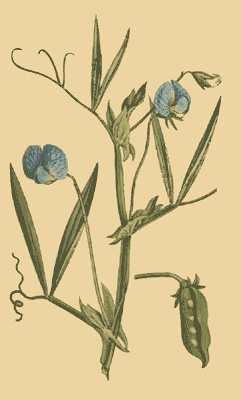
The perennial pea has winged, hairless stems. Its alternating compound leaves are blue-green and consist of a single pair of leaflets, with a branched tendril growing between each pair.[1][2][3]
Its leaf petioles are winged and approximately 51 mm long. The leaflets are narrowly ovate or oblong-ovate, have smooth margins and no hairs, and can reach 76 mm in length and 25 mm in width.[4][5][6]
Its flowers grow in short racemes containing four to eleven flowers. They are unscented, approximately 19–25 mm across, and have five purplish-pink petals that fade with age.[7][8][9]
The flowers have a green calyx with five often unequal teeth. The flattened, hairless seedpods are approximately 51 mm long and 13 mm wide, beginning green and turning brown as they mature.[10][11][12][13]
Its seeds are dark and oblong to kidney-shaped. The plant can grow to six feet or taller, and its foliage becomes ragged and yellowish toward the end of summer.[14][15][16]
Habitat
The perennial pea grows in partial to full sunlight. It grows in loam or clay-loam soils that are moist, mesic, or slightly dry.[17][18]
The species is native to south and east-central Europe and northwest Africa. It also occurs in North America and Australia.[19][20]
Behaviour
The perennial pea climbs using twining tendrils but sprawls in open areas. It spreads slowly.[21][22]
The species generally lacks floral fragrance. Its foliage becomes ragged and yellowish toward the end of summer.[16][23]
When cultivated in gardens, the species can become pervasive and difficult to remove. It is often considered a weed despite its attractive appearance.[24][25]
Reproduction and life cycle
The species can reproduce vegetatively from its taproot and rhizomes. Bumblebees pollinate its flowers.[26][27]
Its seedpods split into curled segments that fling out the seeds.[28]
Uses
The perennial pea is cultivated as a garden plant and grown as an ornamental plant for its flowers.[29][30]
Classification of the Perennial Pea
| Kingdom | Plantae |
|---|---|
| Subkingdom | Pteridobiotina |
| Phylum | Tracheophyta |
| Class | Magnoliopsida |
| Order | Fabales |
| Family | Fabaceae (Bean) |
| Genus | Lathyrus (Pea) |
| Species | Lathyrus latifolius L. |
Where the Perennial Pea is found
Checklists and occurrence records place Lathyrus latifolius in 56 countries across Africa, Asia, Europe, North America, Oceania and South America. GBIF holds 127,182 georeferenced records of it.
Countries where it is native or its origin is not stated
- Aland Islands 12
- Albania 13
- Algeria 19
- Andorra 4
- Austria 766
- Belarus 24
- Bosnia and Herzegovina 40
- Bulgaria 9
- Croatia 159
- Czechia 778
- Denmark 1,250
- Estonia 23
- France 32,052
- Greece 82
- Hungary 111
- Isle of Man 32
- Italy 1,503
- Latvia 5
- Liechtenstein 5
- Lithuania 4
- Luxembourg 61
- Montenegro 60
- Morocco 26
- North Macedonia 4
- Norway 149
- Poland 103
- Portugal 490
- Romania 30
- Serbia 18
- Slovakia 699
- Slovenia 83
- South Africa 50
- Spain 5,045
- Sweden 3,682
- Switzerland 3,002
- The Netherlands 9,329
- Tunisia 4
- Ukraine 44
Countries where it has been introduced
- Argentina 82
- Australia 325
- Belgium 15,232
- Canada 4,125
- China 7
- Cyprus 1
- Germany 8,277
- Guatemala 1
- India
- Ireland 45
- Kenya
- New Zealand 397
- Russia 31
- Sri Lanka
- United Kingdom 15,033
- United States 23,847
- Uruguay 5
- Uzbekistan 4
Regions and cities with the most records
- England, United Kingdom 13,382
- California, United States 6,056
- Provence-Alpes-Côte d'Azur, France 6,027
- Auvergne-Rhône-Alpes, France 4,952
- Île-de-France, France 3,940
- Occitanie, France 3,151
- Oregon, United States 2,550
- Hauts-de-France, France 2,465
- Kortenberg, Belgium 2,456
- Zaventem, Belgium 2,374
- Tervuren, Belgium 2,265
- Woluwe-Saint-Lambert, Belgium 2,142
- Herent, Belgium 2,102
- Washington, United States 2,102
- Centre-Val de Loire, France 2,087
- Vilvoorde, Belgium 2,081
- British Columbia, Canada 2,051
- Evere, Belgium 2,036
- Auderghem, Belgium 2,018
- Meise, Belgium 1,981
- Heverlee, Belgium 1,963
- Saint-Josse-ten-Noode, Belgium 1,950
- Jette, Belgium 1,947
- Schaerbeek, Belgium 1,947
- Leuven, Belgium 1,944
- Grimbergen, Belgium 1,937
- Overijse, Belgium 1,934
- Ganshoren, Belgium 1,932
- Koekelberg, Belgium 1,916
- Mechelen, Belgium 1,893
- Etterbeek, Belgium 1,889
- Ixelles, Belgium 1,880
- Brussels, Belgium 1,878
- Catalonia, Spain 1,854
- Molenbeek-Saint-Jean, Belgium 1,853
- Paris 13 Gobelins, France 1,853
11 more countries have a few records outside this range
These countries hold a few records of Lathyrus latifolius but lie outside the range the checklists give for it. Such records are often zoo or garden specimens, museum material or vagrants, so the species is not counted as occurring there.
A number beside a place is its count of GBIF occurrence records. A place without a number comes from a checklist alone. Records show where a species has been observed or collected, which can include escapes and vagrants.
Common names
English
- Perennial Pea
- Broad-Leaf Everlasting Pea
- Broad-Leaved Everlasting-Pea
- Garden Everlasting Pea
- Pharoah's Pea
- Broad-leaved Everlasting Pea
- Broad-leaved Peavine
- Broad-leaved Sweet Pea
- Broadleaf Everlasting-pea
- Everlasting Pea
- Everlasting Peavine
- Everlasting Sweet Pea
- Everlasting-pea
- Perennial Sweet Pea
- Perennial-pea
Names in 26 other languages
- Catalan
- Pèsol bord, Pèsol silvestre
- Chinese
- Kuan Ye Shan Li Dou, 宽叶山黧豆, 寬葉山黧豆
- Croatian
- Velecvjetna kukavičica
- Czech
- hrachor širolistý
- Danish
- Bredbladet Fladbælg, Flerårig Lathyrus, Flerårig fladbælg, Flerårig ærteblomst
- Dutch
- Brede lathyrus
- Estonian
- laialehine seahernes
- Finnish
- ruusunätkelmä
- French
- Gesse à Large Feuilles, gesse à feuilles larges, gesse à larges feuilles, pois de Chine, pois vivace
- German
- Breitblatt-Platterbse, Breitblättrige Platterbse
- Hungarian
- nagyvirágú lednek
- Italian
- Cicerchia a Foglie Larghe
- Japanese
- ヒロハノレンリソウ
- Lithuanian
- plačialapis pelėžirnis
- Norwegian Bokmål
- bredflatbelg, breiflatbelg
- Norwegian Nynorsk
- breiskolm
- Polish
- groszek szerokolistny
- Portuguese
- Cizirão-de-flor-grande
- Russian
- Чина широколистная
- Slovak
- hrachor širokolistý
- Slovenian
- širokolistni grahor
- Spanish
- Lenteja silvestre, albejana
- Swedish
- Rosenvial, rosenvial/vingvial
- Turkish
- Sonsuz Bezelye
- Ukrainian
- Чина широколиста
- Welsh
- Ytbys Fythol Llydanddail, Ytbysen Barbara Lydanddail, Ytbysen Barhaus, Ytbysen Fythol Lydanddail
Synonyms
10 other scientific names have been used for this species and are now treated as synonyms of Lathyrus latifolius.
- Lathyrus latifolius var. angustifolius Godr.
- Lathyrus latifolius var. angustifolius L.
- Lathyrus latifolius var. latifolius
- Lathyrus latifolius var. splendens Groenl. & Rümpler
- Lathyrus latifolius var. splendens L.
- Lathyrus sylvestris subsp. latifolius (L.) Arcang.
- Lathyrus sylvestris subsp. latifolius L.
- Lathyrus sylvestris var. latifolius (L.) Fiori
- Lathyrus sylvestris var. platyphyllos Wahlenb.
- Pisum latifolium (L.) E.H.L.Krause
Subspecies and varieties
- Lathyrus latifolius subsp. algericus subspecies
- Lathyrus latifolius subsp. latifolius subspecies
Related species
-
 Sweet PeaLathyrus odoratus
-
 Indian PeaLathyrus sativus
-
 Tuberous PeaLathyrus tuberosus
-
 Beach PeaLathyrus japonicus
-
 Yellow VetchlingLathyrus aphaca
-
 Bitter VetchLathyrus linifolius
-
 Spanish VetchlingLathyrus clymenum
-
 Meadow VetchlingLathyrus pratensis
Compare
Questions and answers
What is the scientific name of the Perennial Pea?
The scientific name of the Perennial Pea is Lathyrus latifolius. Written with its author, the full name is Lathyrus latifolius L..
Which family does the Perennial Pea belong to?
Lathyrus latifolius belongs to the family Fabaceae, in the order Fabales and the class Magnoliopsida.
Where is the Perennial Pea found?
Checklists and occurrence records place Lathyrus latifolius in 56 countries, including France, The Netherlands, Spain, Sweden, Switzerland and Italy.
What is the conservation status of the Perennial Pea?
The IUCN Red List category recorded for Lathyrus latifolius is Least Concern (LC).
What other names does the Perennial Pea have?
Lathyrus latifolius is also known in English as Broad-Leaf Everlasting Pea, Broad-Leaved Everlasting-Pea, Garden Everlasting Pea, Pharoah's Pea, Broad-leaved Everlasting Pea and Broad-leaved Peavine.
Sources
Passages the profile rests on
- Lathyrus latifolius has winged, hairless stems. Source passage: “Lathyrus latifolius has winged hairless stems” — English Wikipedia
- Its alternating compound leaves are blue-green and consist of a single pair of leaflets. Source passage: “alternating blue green compound leaves consisting of a single pair of leaflets” — English Wikipedia
- A branched tendril grows between each pair of leaflets. Source passage: “There is a branched tendril between the leaflets.” — English Wikipedia
- Its leaf petioles are winged and approximately 51 mm long. Source passage: “a winged petiole about 2 inches (51 mm) long” — English Wikipedia
- Its leaflets are narrowly ovate or oblong-ovate, with smooth margins and no hairs. Source passage: “The leaflets are narrowly ovate or oblong-ovate, smooth along the margins, hairless” — English Wikipedia
- Its leaflets can reach 76 mm in length and 25 mm in width. Source passage: “up to 3 in (76 mm) long and 1 in (25 mm) across.” — English Wikipedia
- Its flowers grow in short racemes containing four to eleven flowers. Source passage: “Short racemes of 4–11 flowers are produced from the axils of the leaves.” — English Wikipedia
- Its flowers are unscented and approximately 19–25 mm across. Source passage: “The flowers, which are unscented, are about 3⁄4–1 in (19–25 mm) across” — English Wikipedia
- Its flowers have five purplish-pink petals that fade with age. Source passage: “There are 5 petals, which are purplish pink, fading with age.” — English Wikipedia
- Its flowers have a green calyx with five often unequal teeth. Source passage: “There is a green calyx with 5 teeth, often unequal.” — English Wikipedia
- Its seedpods are flattened and hairless. Source passage: “The flowers are followed by hairless flattened seedpods” — English Wikipedia
- Its seedpods are approximately 51 mm long and 13 mm wide. Source passage: “about 2 in (51 mm) long and 1⁄2 in (13 mm) wide” — English Wikipedia
- Its seedpods begin green and turn brown as they mature. Source passage: “The seedpod, which is initially green, gradually turns brown” — English Wikipedia
- Its seeds are dark and oblong to kidney-shaped. Source passage: “The seeds are dark and oblong to reniform in shape.” — English Wikipedia
- The plant can grow to six feet or taller. Source passage: “which can reach 6 feet or more” — English Wikipedia
- Its foliage becomes ragged and yellowish toward the end of summer. Source passage: “The foliage becomes rather ragged and yellowish by the end of summer.” — English Wikipedia
- The species grows in partial to full sunlight. Source passage: “It requires partial to full sun” — English Wikipedia
- The species grows in loam or clay-loam soils that are moist, mesic, or slightly dry. Source passage: “loam or clay-loam soil that is moist, mesic, or slightly dry.” — English Wikipedia
- The species also occurs in North America and Australia. Source passage: “present on other continents, such as North America and Australia” — English Wikipedia
- The species is native to south and east-central Europe and northwest Africa. Source passage: “native to south and east-central Europe and northwest Africa” — misin.msu.edu
- The species climbs using twining tendrils but sprawls in open areas. Source passage: “by means of twining tendrils, but in open areas sprawls.” — English Wikipedia
- The species spreads slowly. Source passage: “It is frost-hardy, long-lived, and slowly spreading.” — English Wikipedia
- The species generally lacks floral fragrance. Source passage: “Perennial Lathyus are generally unscented” — rhs.org.uk
- The species can become pervasive and difficult to remove when cultivated in gardens. Source passage: “it may be pervasive and difficult to remove.” — English Wikipedia
- The species is often considered a weed despite its attractive appearance. Source passage: “this species is often considered to be a weed despite its attractive appearance.” — English Wikipedia
- The species can reproduce vegetatively from its taproot and rhizomes. Source passage: “Lathyrus latifolius can reproduce vegetatively from its taproot and rhizomes” — English Wikipedia
- Bumblebees pollinate the flowers. Source passage: “Bumblebees pollinate the flowers” — English Wikipedia
- Its seedpods split into curled segments that fling out the seeds. Source passage: “splitting open into curled segments, flinging out the seeds.” — English Wikipedia
- The species is cultivated as a garden plant. Source passage: “While grown as a garden plant” — English Wikipedia
- The species is grown as an ornamental plant for its flowers. Source passage: “Numerous cultivars have been selected as garden subjects” — English Wikipedia
- The species is a long-lived perennial. Source passage: “It is frost-hardy, long-lived, and slowly spreading.” — English Wikipedia
- The species returns year after year as a perennial plant. Source passage: “Perennial species such as Lathyrus latifolius come back year after year” — rhs.org.uk
Data
- Catalogue of Life, 2026-10-16 XR cc by
- Global Biodiversity Information Facility CC BY 4.0
- Wikidata CC0
- GeoNames CC BY 4.0
- Wikimedia Commons per image; credit shown with each image
- iNaturalist per image; credit shown with each image
- Within the Catalogue of Life, this name comes from The World Checklist of Vascular Plants (WCVP): Fabaceae cc by
References
- Sp. Pl.: 733 (1753) where the name was published
This species in other databases
Page built on 28 November 2026. See how the catalog is made and all sources and licences.
Cite this page
ScientificNames.org. (2026). Lathyrus latifolius (Perennial Pea). Retrieved November 28, 2026, from https://scientificnames.org/species/lathyrus-latifolius
“Lathyrus latifolius (Perennial Pea).” ScientificNames.org, 2026, scientificnames.org/species/lathyrus-latifolius. Accessed 28 Nov. 2026.
ScientificNames.org. “Lathyrus latifolius (Perennial Pea).” Accessed November 28, 2026. https://scientificnames.org/species/lathyrus-latifolius.
@misc{scientificnames_lathyrus_latifolius_perennial_pea,
  author = {{ScientificNames.org}},
  title = {Lathyrus latifolius (Perennial Pea)},
  year = {2026},
  url = {https://scientificnames.org/species/lathyrus-latifolius},
  note = {Accessed 2026-11-28}
}