Species · Flowering plants
Lavender Lavandula angustifolia
The scientific name of the Lavender is Lavandula angustifolia. It is a species of flowering plant in the family Lamiaceae (mint family), order Lamiales.
- Scientific name
- Lavandula angustifolia Mill.
- Common name
- Lavender
- Genus
- Lavandula
- Family
- Lamiaceae (Mint Family)
- Order
- Lamiales
- Class
- Magnoliopsida
- Red List category
- LC Least Concern
- Recorded in
- 56 countries
- Name status
- accepted in the Catalogue of Life
Overview
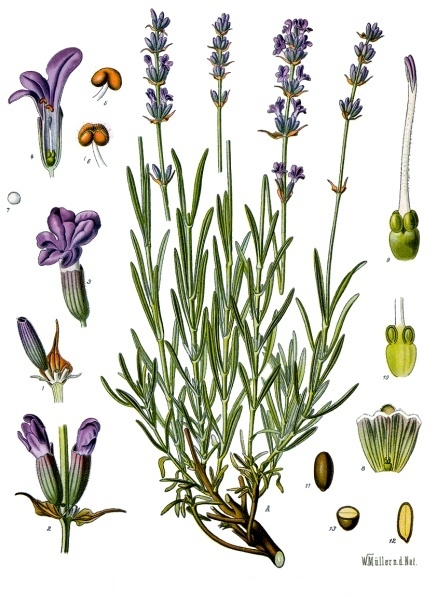
Lavandula angustifolia grows naturally in the Mediterranean basin and is native to France, Spain, Andorra and Italy. It is characterized by silver-green leaves and typically purple flowers arranged in spikes.
Written 26 November 2026 from the sources listed below. Each statement was checked against the passage it cites; statements that could not be supported were removed.
Appearance
Its flowers are typically purple and grow in spikes measuring 2–8 centimetres long. The spikes develop at the tops of slender, leafless stems.[1][2][3]
Its root system is highly branched and fibrous. The species is described as frost-resistant.[4][5]
Habitat
Lavender grows naturally in the Mediterranean basin. It is native to France, Spain, Andorra and Italy, and is also cultivated in Poland.[6][7][8]
It grows best in Mediterranean climates characterized by wet winters and dry summers. It does not grow well in continuously damp soil.[9][10]
Lavender tolerates acidic soils but prefers neutral to alkaline soils.[11]
Reproduction and life cycle
Lavender flowers are arranged in spikes, with 3–5 flowers in each ring. The rings form near the tops of the stems.[12][13]
Uses
Lavender is commonly cultivated as an ornamental plant. It is commercially cultivated for essential oil used in balms, salves, perfumes, cosmetics and topical products.[14][15]
Its flowers and leaves are used in herbal medicine. Its essential oil is used in massage therapy and aromatherapy when diluted with a carrier oil.[16][17]
Lavender flowers are used as a culinary herb, particularly in the North American version of herbes de Provence. Lavender has also been used as a food additive and a laxative.[18][19]
Lavender is included on the Tasmanian Fire Service list of plants with low flammability.[20]
Lavender was historically used as a bath additive by the Romans. During the Middle Ages, it was used to make perfumes and soaps.[21][22]
Similar species
Lavender was formerly known by the scientific name Lavandula officinalis. It has also been known by the scientific name Lavandula vera.[23][24]
Classification of the Lavender
| Kingdom | Plantae |
|---|---|
| Subkingdom | Pteridobiotina |
| Phylum | Tracheophyta |
| Class | Magnoliopsida |
| Order | Lamiales |
| Family | Lamiaceae (Mint Family) |
| Subfamily | Nepetoideae |
| Tribe | Ocimeae |
| Subtribe | Lavandulinae |
| Genus | Lavandula (Lavender) |
| Species | Lavandula angustifolia Mill. |
Where the Lavender is found
Checklists and occurrence records place Lavandula angustifolia in 56 countries across Africa, Asia, Europe, North America, Oceania and South America. GBIF holds 51,512 georeferenced records of it.
Countries where it is native or its origin is not stated
- Algeria 5
- Andorra 24
- Argentina 6
- Austria 455
- Belarus 7
- Belgium 1,207
- Bolivia 4
- Brazil 104
- Chile 5
- Colombia 5
- Czechia 20
- Denmark 117
- Estonia 19
- Finland 3
- India 4
- Iran 24
- Isle of Man 9
- Japan 10
- Jersey 10
- Lebanon 4
- Luxembourg 12
- Morocco 3
- Norway 56
- Pakistan 3
- Peru 3
- Poland 71
- Portugal 27
- Romania 6
- Russia 21
- South Korea 7
- Spain 4,574
- Sweden 1,197
- Switzerland 789
- The Netherlands 1,010
- Venezuela
Countries where it has been introduced
- Australia 21
- Bulgaria 12
- China 62
- Croatia 30
- France 36,826
- Germany 1,040
- Greece 10
- Guam
- Hungary 45
- Ireland 8
- Italy 492
- Kosovo
- Myanmar
- Serbia
- Slovakia 15
- Slovenia 3
- Taiwan 1
- Turkey 4
- Ukraine 179
- United Kingdom 2,562
- United States 381
Regions and cities with the most records
- Provence-Alpes-Côte d'Azur, France 23,873
- Auvergne-Rhône-Alpes, France 9,748
- Catalonia, Spain 2,919
- England, United Kingdom 2,190
- Gap, France 1,833
- Digne-les-Bains, France 1,805
- Occitanie, France 1,395
- Vence, France 985
- Nice, France 925
- Manosque, France 833
- Menton, France 830
- Grasse, France 814
- Pertuis, France 681
- Aragon, Spain 651
- Monaco, Monaco 638
- Saint-Maximin-la-Sainte-Baume, France 577
- Saint-Laurent-du-Var, France 535
- Cagnes-sur-Mer, France 513
- Ventimiglia, Italy 504
- Mougins, France 457
- Gardanne, France 437
- Berga, Spain 401
- Aubagne, France 389
- Valencia, Spain 373
- Draguignan, France 360
- Bavaria, Germany 348
- Aix-en-Provence, France 341
- Montélimar, France 337
- Skåne, Sweden 297
- Vaud, Switzerland 268
- Allauch, France 249
- Scotland, United Kingdom 244
- North Rhine-Westphalia, Germany 236
- Bromsgrove, United Kingdom 235
- Carpentras, France 234
- Droitwich, United Kingdom 234
4 more countries have a few records outside this range
These countries hold a few records of Lavandula angustifolia but lie outside the range the checklists give for it. Such records are often zoo or garden specimens, museum material or vagrants, so the species is not counted as occurring there.
A number beside a place is its count of GBIF occurrence records. A place without a number comes from a checklist alone. Records show where a species has been observed or collected, which can include escapes and vagrants.
Common names
English
- Lavender
- Garden Lavender
Names in 5 other languages
- Dutch
- Echte lavendel
- Finnish
- tähkälaventeli
- French
- lavande
- German
- Echter Lavendel
- Swedish
- lavendel
Synonyms
One other scientific name has been used for this species and is now treated as a synonym of Lavandula angustifolia.
- Lavandula angustfolia
Subspecies and varieties
- Lavandula angustifolia subsp. angustifolia (Lavender) subspecies
- Lavandula angustifolia subsp. pyrenaica (Pyrenean Lavender) subspecies
Related species
-
 French LavenderLavandula stoechas
-
 French LavenderLavandula dentata
-
 Broad-leaved LavenderLavandula latifolia
-
 Fern-leaf LavenderLavandula multifida
-
 Spanish LavenderLavandula pedunculata
-
 Woolly LavenderLavandula lanata
-
 Green LavenderLavandula viridis
-
 Canary Island LavenderLavandula canariensis
Compare
Questions and answers
What is the scientific name of the Lavender?
The scientific name of the Lavender is Lavandula angustifolia. Written with its author, the full name is Lavandula angustifolia Mill..
Which family does the Lavender belong to?
Lavandula angustifolia belongs to the family Lamiaceae, in the order Lamiales and the class Magnoliopsida.
Where is the Lavender found?
Checklists and occurrence records place Lavandula angustifolia in 56 countries, including Spain, Belgium, Sweden, The Netherlands, Switzerland and Austria.
What is the conservation status of the Lavender?
The IUCN Red List category recorded for Lavandula angustifolia is Least Concern (LC).
What other names does the Lavender have?
Lavandula angustifolia is also known in English as Garden Lavender.
What does angustifolia mean?
The specific epithet angustifolia derives from Latin and means narrow leaf.[25]
Sources
Passages the profile rests on
- Its flowers are typically purple. Source passage: “The flowers are typically purple (lavender-coloured)” — English Wikipedia
- Its flowers grow in spikes measuring 2–8 centimetres long. Source passage: “produced on spikes 2–8 cm (1–3 in) long” — English Wikipedia
- Its flower spikes grow at the tops of slender, leafless stems. Source passage: “at the top of slender, leafless stems 10–30 cm (4–12 in) long.” — English Wikipedia
- The species is described as frost-resistant. Source passage: “It is a frost-resistant species with a variety of attractive cultivars and a beautiful flower color” — pmc.ncbi.nlm.nih.gov
- Its root system is highly branched and fibrous. Source passage: “a highly branched fibrous root system.” — pmc.ncbi.nlm.nih.gov
- The species grows naturally in the Mediterranean basin. Source passage: “native to the Mediterranean basin.” — English Wikipedia
- The species is native to the Mediterranean region, including France, Spain, Andorra and Italy. Source passage: “Lavender is a Mediterranean plant native to France, Spain, Andorra, and Italy” — pmc.ncbi.nlm.nih.gov
- Lavandula angustifolia is also cultivated in Poland. Source passage: “although it is also grown in Poland” — pmc.ncbi.nlm.nih.gov
- It grows best in Mediterranean climates characterized by wet winters and dry summers. Source passage: “It does best in Mediterranean climates similar to its native habitat, characterised by wet winters and dry summers.” — English Wikipedia
- The species does not grow well in continuously damp soil. Source passage: “It does not grow well in continuously damp soil” — English Wikipedia
- The species tolerates acidic soils but prefers neutral to alkaline soils. Source passage: “It tolerates acid soils, but favours neutral to alkaline soils” — English Wikipedia
- Its flowers form rings near the tops of stems, with 3–5 flowers in each ring. Source passage: “Lavender flowers form a ring on the top of the stem and bloom in spikes (3–5 flowers per ring).” — pmc.ncbi.nlm.nih.gov
- Its flowers are arranged in spikes, with 3–5 flowers per ring. Source passage: “bloom in spikes (3–5 flowers per ring).” — pmc.ncbi.nlm.nih.gov
- The species is commercially cultivated for essential oil used in balms, salves, perfumes, cosmetics and topical products. Source passage: “Commercially, the plant is used to produce lavender essential oil used in balms, salves, perfumes, cosmetics, and topical applications.” — English Wikipedia
- The species is commonly cultivated as an ornamental plant. Source passage: “English lavender is commonly grown as an ornamental plant.” — English Wikipedia
- The flowers and leaves are used in herbal medicine. Source passage: “The flowers and leaves are applied in herbal medicine.” — English Wikipedia
- Its essential oil is used in massage therapy and aromatherapy when diluted with a carrier oil. Source passage: “Lavender essential oil, when diluted with a carrier oil, is commonly used for massage therapy or aromatherapy.” — English Wikipedia
- Its flowers are used as a culinary herb, particularly in the North American version of herbes de Provence. Source passage: “The flowers are also used as a culinary herb, most often as part of the North American version of the French herb blend called herbes de Provence.” — English Wikipedia
- Lavender has been used as a laxative and as a food additive. Source passage: “It is used both as a laxative and as a food additive.” — pmc.ncbi.nlm.nih.gov
- The species is included on the Tasmanian Fire Service list of plants with low flammability. Source passage: “Lavandula angustifolia is included in the Tasmanian Fire Service's list of low flammability plants” — English Wikipedia
- Lavender has historically been used as a bath additive by the Romans. Source passage: “The Romans used lavender as a bath additive” — pmc.ncbi.nlm.nih.gov
- During the Middle Ages, lavender was used to make perfumes and soaps. Source passage: “in the Middle Ages it was one of the most valuable essential oil plants used to make perfumes and soaps.” — pmc.ncbi.nlm.nih.gov
- Lavandula angustifolia was formerly known by the scientific name Lavandula officinalis. Source passage: “Lavandula angustifolia, formerly L. officinalis” — English Wikipedia
- Lavandula angustifolia has also been known by the scientific name Lavandula vera. Source passage: “formerly known as L. vera or L. officinalis” — pmc.ncbi.nlm.nih.gov
- The specific epithet angustifolia derives from Latin and means narrow leaf. Source passage: “The species name angustifolia is Latin for "narrow leaf".” — English Wikipedia
Data
- Catalogue of Life, 2026-10-16 XR cc by
- Global Biodiversity Information Facility CC BY 4.0
- Wikidata CC0
- GeoNames CC BY 4.0
- Wikimedia Commons per image; credit shown with each image
- Within the Catalogue of Life, this name comes from Synonymic Checklists of the Vascular Plants of the World cc by
References
- Mill. where the name was published
This species in other databases
Page built on 29 November 2026. See how the catalog is made and all sources and licences.
Cite this page
ScientificNames.org. (2026). Lavandula angustifolia (Lavender). Retrieved November 29, 2026, from https://scientificnames.org/species/lavandula-angustifolia
“Lavandula angustifolia (Lavender).” ScientificNames.org, 2026, scientificnames.org/species/lavandula-angustifolia. Accessed 29 Nov. 2026.
ScientificNames.org. “Lavandula angustifolia (Lavender).” Accessed November 29, 2026. https://scientificnames.org/species/lavandula-angustifolia.
@misc{scientificnames_lavandula_angustifolia_lavender,
  author = {{ScientificNames.org}},
  title = {Lavandula angustifolia (Lavender)},
  year = {2026},
  url = {https://scientificnames.org/species/lavandula-angustifolia},
  note = {Accessed 2026-11-29}
}