Species · Flowering plants
French Lavender Lavandula dentata
The scientific name of the French Lavender is Lavandula dentata. It is a species of flowering plant in the family Lamiaceae (mint family), order Lamiales.
- Scientific name
- Lavandula dentata L.
- Common name
- French Lavender
- Genus
- Lavandula
- Family
- Lamiaceae (Mint Family)
- Order
- Lamiales
- Class
- Magnoliopsida
- Recorded in
- 27 countries
- Name status
- accepted in the Catalogue of Life

Overview
Lavandula dentata is native to the Mediterranean basin, Eritrea, Ethiopia, Yemen, and the Arabian Peninsula, and is present on Madeira and the Canary Islands. It is distinguished by gray-green toothed leaves, purple flowers topped with pale violet bracts, and a strong aromatic scent.
Written 26 November 2026 from the sources listed below. Each statement was checked against the passage it cites; statements that could not be supported were removed.
Appearance
French lavender has gray-green, linear or lance-shaped leaves with toothed edges and a lightly woolly texture. It produces purple flowers in narrow spikes topped with pale violet bracts.[1][2]
The whole plant has a strong aromatic scent characteristic of lavender. It can grow to a height of 60 cm.[3][4]
Habitat
French lavender occurs naturally on low hills with limestone substrates among other shrubs. It is associated with dry, sunny conditions and well-drained alkaline soil.[5][6]
The species tolerates a range of growing conditions, although it may be short-lived. It requires some shelter in areas prone to frost.[7][8]
Uses
French lavender is commonly cultivated as an ornamental plant. Its essential oil is used in perfumes.[9][10]
Classification of the French Lavender
| Kingdom | Plantae |
|---|---|
| Subkingdom | Pteridobiotina |
| Phylum | Tracheophyta |
| Class | Magnoliopsida |
| Order | Lamiales |
| Family | Lamiaceae (Mint Family) |
| Subfamily | Nepetoideae |
| Tribe | Ocimeae |
| Subtribe | Lavandulinae |
| Genus | Lavandula (Lavender) |
| Species | Lavandula dentata L. |
Where the French Lavender is found
Checklists and occurrence records place Lavandula dentata in 27 countries across Africa, Asia, Europe and Oceania. GBIF holds 7,660 georeferenced records of it.
Countries where it is native or its origin is not stated
- Algeria 238
- Belgium 4
- Cabo Verde 27
- Eritrea 5
- Ethiopia 2
- France 101
- Germany 4
- Gibraltar 60
- Iran 3
- Israel 22
- Jordan 8
- Malta 8
- Morocco 557
- Palestinian Territory 8
- Saudi Arabia 81
- South Africa 15
- Spain 5,687
- Switzerland 6
- The Netherlands 3
- Turkey 5
- United Kingdom 7
- Yemen 9
Countries where it has been introduced
Regions and cities with the most records
- Valencia, Spain 1,508
- Huercal-Overa, Spain 896
- Calp, Spain 894
- Javea, Spain 714
- Altea, Spain 602
- la Nucia, Spain 589
- l'Alfàs del Pi, Spain 586
- Catalonia, Spain 573
- Balearic Islands, Spain 565
- Denia, Spain 524
- Benidorm, Spain 368
- Sant Agustí, Spain 342
- Calvià, Spain 331
- Son Rapinya, Spain 330
- Palma, Spain 317
- Montcada i Reixac, Spain 260
- Murcia, Spain 256
- Badalona, Spain 254
- Ripollet, Spain 251
- Santa Perpètua de Mogoda, Spain 249
- Santa Coloma de Gramenet, Spain 248
- Cerdanyola del Vallès, Spain 245
- Llefià, Spain 245
- Barberà del Vallès, Spain 242
- Sant Adrià de Besòs, Spain 241
- Mollet del Vallès, Spain 238
- Barcelona, Spain 236
- Villajoyosa, Spain 235
- Sant Cugat del Vallès, Spain 231
- Molins de Rei, Spain 229
- Esplugues de Llobregat, Spain 226
- Sant Feliu de Llobregat, Spain 226
- Rubí, Spain 225
- Sant Just Desvern, Spain 224
- Sabadell, Spain 217
- El Masnou, Spain 214
3 more countries have a few records outside this range
These countries hold a few records of Lavandula dentata but lie outside the range the checklists give for it. Such records are often zoo or garden specimens, museum material or vagrants, so the species is not counted as occurring there.
Range as the checklists state it
E- & S-Spain; Gibraltar; Baleares; Italy [I]; Sicily [I]; Greece [I]; Morocco; Algeria; Madeira [I] (Madeira Isl. [I]); Canary Isl. (Lanzarote, Gran Canaria, Tenerife, La Gomera, La Palma); Cape Verde Isl. (Santo Antao Isl., Fogo Isl., Ilha Brava); Ethiopia; Eritrea; Saudi Arabia (Hejaz, C-Saudi Arabia, Asir); Yemen (W-Yemen); Australia [I] (Western Australia [I], South Australia [I]); New Zealand [I]; Chatham Isl. [I]
A number beside a place is its count of GBIF occurrence records. A place without a number comes from a checklist alone. Records show where a species has been observed or collected, which can include escapes and vagrants.
Common names
English
- French Lavender
- Toothed Lavender
Names in 20 other languages
- Arabic
- الضُرُم
- Catalan
- espígol dentat
- Chinese
- 齒葉薰衣草
- Czech
- levandule zoubkatá
- Danish
- tandet lavendel
- Dutch
- Getande lavendel, Tandlavendel
- Estonian
- hambuline lavendel
- Finnish
- Nyhälaventeli
- French
- Lavande dentée
- German
- Französischer Lavendel, Gezähnter Lavendel
- Hebrew
- אזוביון משונן
- Italian
- Spigo-nardo
- Lithuanian
- Dantytoji levanda
- Portuguese
- Lavanda-dentada, Lavanda-francesa
- Russian
- Лаванда зубчатая
- Slovak
- levanduľa zúbkatá
- Slovenian
- nazobčana sivka
- Spanish
- alhucema rizada, cantueso dentado, cantueso rizado, espliego dentado, lavanda
- Swedish
- kamlavendel
- Turkish
- Fransız Lavantası, Saçaklı Lavanta
Synonyms
13 other scientific names have been used for this species and are now treated as synonyms of Lavandula dentata.
- Lavandula dentata f. albiflora Maire
- Lavandula dentata f. multibracteolata Sennen
- Lavandula dentata f. persicina Maire ex Upson & S.Andrews
- Lavandula dentata f. pinnatilobulata Sennen
- Lavandula dentata f. rosea Maire
- Lavandula dentata var. balearica Ging.
- Lavandula dentata var. candicans Batt.
- Lavandula dentata var. rendalliana Bolle
- Lavandula dentata var. vulgaris Ging.
- Lavandula santolinifolia Spach
- Lavandula spica var. vulgaris Ging.
- Stoechas dentata (L.) Mill.
- Lavandula pinnata Moench ambiguous synonym
Subspecies and varieties
- Lavandula dentata var. dentata (French Lavender) variety
Related species
-
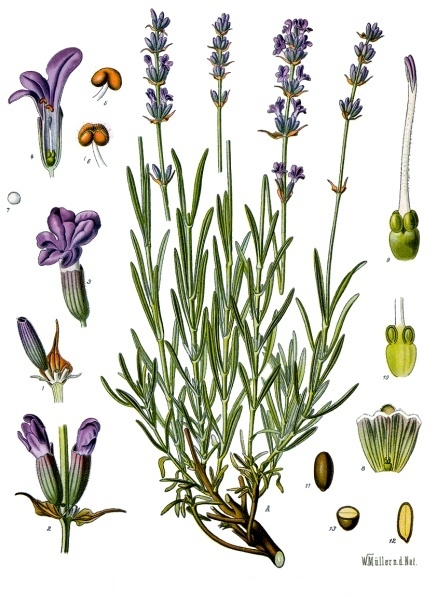 LavenderLavandula angustifolia
-
 French LavenderLavandula stoechas
-
 Broad-leaved LavenderLavandula latifolia
-
 Downy LavenderLavandula multifida
-
 Spanish LavenderLavandula pedunculata
-
 Woolly LavenderLavandula lanata
-
 Green LavenderLavandula viridis
-
 Canary Island LavenderLavandula canariensis
Compare
Questions and answers
What is the scientific name of the French Lavender?
The scientific name of the French Lavender is Lavandula dentata. Written with its author, the full name is Lavandula dentata L..
Which family does the French Lavender belong to?
Lavandula dentata belongs to the family Lamiaceae, in the order Lamiales and the class Magnoliopsida.
Where is the French Lavender found?
Checklists and occurrence records place Lavandula dentata in 27 countries, including Spain, Morocco, Algeria, France, Saudi Arabia and Gibraltar.
What other names does the French Lavender have?
Lavandula dentata is also known in English as Toothed Lavender.
Will French lavender come back every year?
French lavender may be short-lived, so it is not necessarily a long-lived plant.[7]
What is special about French lavender?
French lavender has toothed, gray-green leaves, purple flowers topped with pale violet bracts, and a strong aromatic scent. It can grow to 60 cm in height.[1][2][3][4]
Are there different types of French lavender?
The cultivar Lavandula dentata var. dentata 'Royal Crown' has received the Royal Horticultural Society's Award of Garden Merit.[11]
Sources
Passages the profile rests on
- The leaves are gray-green, linear or lance-shaped, and have toothed edges and a lightly woolly texture. Source passage: “it has gray-green, linear or lance-shaped leaves with toothed edges and a lightly woolly texture.” — English Wikipedia
- The plant produces purple flowers in narrow spikes topped with pale violet bracts. Source passage: “The long-lasting, narrow spikes of purple flowers, topped with pale violet bracts” — English Wikipedia
- The whole plant has a strong aromatic scent characteristic of lavender. Source passage: “The whole plant is strongly aromatic with the typical lavender fragrance.” — English Wikipedia
- The plant can grow to a height of 60 cm. Source passage: “Growing to 60 cm (24 in) tall” — English Wikipedia
- The species occurs naturally on low hills with limestone substrates among other shrubs. Source passage: “Its native habitat includes low hills with limestone substrates amidst other shrubs.” — English Wikipedia
- The species is associated with dry, sunny conditions and well-drained alkaline soil. Source passage: “it is particularly associated with dry, sunny, well-drained conditions in alkaline soil.” — English Wikipedia
- The species can tolerate a range of growing conditions, although it may be short-lived. Source passage: “But it will tolerate a range of conditions, though it may be short-lived.” — English Wikipedia
- The species requires some shelter in areas prone to frost. Source passage: “It requires some shelter in frost-prone areas.” — English Wikipedia
- The species is commonly cultivated as an ornamental plant. Source passage: “it is commonly grown as an ornamental plant” — English Wikipedia
- The essential oil of the species is used in perfumes. Source passage: “its essential oil is used in perfumes.” — English Wikipedia
- The cultivar Lavandula dentata var. dentata 'Royal Crown' has received the Royal Horticultural Society's Award of Garden Merit. Source passage: “The cultivar L. dentata var. dentata 'Royal Crown' has gained the Royal Horticultural Society's Award of Garden Merit.” — English Wikipedia
Data
- Catalogue of Life, 2026-10-16 XR cc by
- Global Biodiversity Information Facility CC BY 4.0
- Wikidata CC0
- GeoNames CC BY 4.0
- Wikimedia Commons per image; credit shown with each image
- Within the Catalogue of Life, this name comes from Synonymic Checklists of the Vascular Plants of the World cc by
References
- L. (1753). Sp. Pl. [Linnaeus] 2: 572 (1753). where the name was published
This species in other databases
- Catalogue of Life 3SNDP
- Wikidata Q1450735
- iNaturalist 71134
- World Flora Online wfo-0000224153
- GRIN 21678
Page built on 26 November 2026. See how the catalog is made and all sources and licences.
Cite this page
ScientificNames.org. (2026). Lavandula dentata (French Lavender). Retrieved November 26, 2026, from https://scientificnames.org/species/lavandula-dentata
“Lavandula dentata (French Lavender).” ScientificNames.org, 2026, scientificnames.org/species/lavandula-dentata. Accessed 26 Nov. 2026.
ScientificNames.org. “Lavandula dentata (French Lavender).” Accessed November 26, 2026. https://scientificnames.org/species/lavandula-dentata.
@misc{scientificnames_lavandula_dentata_french_lavender,
  author = {{ScientificNames.org}},
  title = {Lavandula dentata (French Lavender)},
  year = {2026},
  url = {https://scientificnames.org/species/lavandula-dentata},
  note = {Accessed 2026-11-26}
}