Species · Flowering plants
French Lavender Lavandula stoechas
The scientific name of the French Lavender is Lavandula stoechas. It is a species of flowering plant in the family Lamiaceae (mint family), order Lamiales.
- Scientific name
- Lavandula stoechas L.
- Common name
- French Lavender
- Genus
- Lavandula
- Family
- Lamiaceae (Mint Family)
- Order
- Lamiales
- Class
- Magnoliopsida
- Recorded in
- 26 countries
- Name status
- accepted in the Catalogue of Life

Overview
French lavender (Lavandula stoechas L.) is an evergreen flowering shrub in the family Lamiaceae. It is native to the Mediterranean Basin and grows in semi-arid conditions and relatively inhospitable soils.
Written 26 November 2026 from the sources listed below. Each statement was checked against the passage it cites; statements that could not be supported were removed.
Appearance
The plant usually reaches 30–100 centimetres in height, and its leaves measure 1–4 centimetres in length. The flower-bearing stems measure 10–30 centimetres in length.[1][2][3]
The upper part of each flower spike bears larger sterile bracts, usually bright lavender purple but occasionally white. These apical bracts measure 10–50 millimetres in length, and the flowers have a blackish-violet crown measuring up to 8 millimetres.[4][5][6]
Habitat
French lavender grows in semi-arid conditions and relatively inhospitable soils in the Mediterranean region. It is associated with hot, dry and sunny growing conditions in alkaline soils.[7][8]
Reproduction and life cycle
French lavender produces flowers in spring and early summer. Flowering can begin as early as March in its native habitat, depending on climate.[9]
Conservation
French lavender has become widely distributed across Australia following its introduction there. It has been classified as a noxious weed in Victoria, Australia, since 1920, and is regarded as a weed in parts of Spain.[10][11][12]
Uses
The flowers are used in aromatherapy to prepare infusions and essential oils. The essential oils contain d-camphor and d-fenchone ketones, as well as borneol and terpineol alcohols.[13][14]
Classification of the French Lavender
| Kingdom | Plantae |
|---|---|
| Subkingdom | Pteridobiotina |
| Phylum | Tracheophyta |
| Class | Magnoliopsida |
| Order | Lamiales |
| Family | Lamiaceae (Mint Family) |
| Subfamily | Nepetoideae |
| Tribe | Ocimeae |
| Subtribe | Lavandulinae |
| Genus | Lavandula (Lavender) |
| Species | Lavandula stoechas L. |
Where the French Lavender is found
Checklists and occurrence records place Lavandula stoechas in 26 countries across Africa, Asia, Europe, North America and Oceania. GBIF holds 228,145 georeferenced records of it.
Countries where it is native or its origin is not stated
- Algeria 292
- Australia 1,145
- Austria 3
- Belgium 26
- Croatia 3
- Cyprus 87
- France 18,374
- Germany 89
- Greece 696
- Israel 1,319
- Italy 2,031
- Lebanon 63
- Morocco 382
- Palestinian Territory 11
- Portugal 6,855
- South Africa 10
- Spain 196,008
- Switzerland 19
- Syria 25
- The Netherlands 47
- Tunisia 56
- Turkey 358
- United Kingdom 6
Countries where it has been introduced
Regions and cities with the most records
- Los Barrios, Spain 13,854
- La Carolina, Spain 10,871
- Algeciras, Spain 10,165
- San Roque, Spain 8,125
- Provence-Alpes-Côte d'Azur, France 7,636
- Adra, Spain 7,544
- Coín, Spain 6,839
- Estepona, Spain 6,224
- Marbella, Spain 6,176
- Málaga, Spain 6,019
- Catalonia, Spain 5,984
- La Línea de la Concepción, Spain 5,673
- Motril, Spain 5,130
- Gibraltar, Gibraltar 5,074
- Occitanie, France 4,972
- Alhaurín el Grande, Spain 4,566
- Ubrique, Spain 4,495
- San Pedro Alcántara, Spain 4,377
- Níjar, Spain 3,911
- Berja, Spain 3,801
- Corsica, France 3,577
- Cártama, Spain 3,291
- Ronda, Spain 3,205
- Fréjus, France 3,148
- Mijas, Spain 2,931
- Saint-Raphaël, France 2,910
- Fuengirola, Spain 2,862
- Mandelieu-la-Napoule, France 2,575
- Antequera, Spain 2,513
- Extremadura, Spain 2,359
- Faro, Portugal 2,313
- Cannes, France 2,277
- Benalmádena, Spain 2,231
- Alhaurín de la Torre, Spain 2,026
- Le Cannet, France 2,025
- Mougins, France 1,997
4 more countries have a few records outside this range
These countries hold a few records of Lavandula stoechas but lie outside the range the checklists give for it. Such records are often zoo or garden specimens, museum material or vagrants, so the species is not counted as occurring there.
A number beside a place is its count of GBIF occurrence records. A place without a number comes from a checklist alone. Records show where a species has been observed or collected, which can include escapes and vagrants.
Common names
English
- French Lavender
- Italian Lavender
- Spanish Lavender
- Topped Lavender
- Wild Lavender
Names in 24 other languages
- Arabic
- حلحال
- Catalan
- Cap d'ase
- Czech
- levandule smilovitá
- Danish
- Sommerfuglelavendel
- Dutch
- Franse lavendel, Kuiflavendel, Vlinderlavendel
- Estonian
- prantsuse lavendel
- Finnish
- tupsulaventeli
- French
- Lavande des îles d'Hyères, Lavande papillon, Lavande à toupet, lavande stéchade
- German
- Schopf-Lavendel, Schopflavendel
- Greek
- Αγριολεβάντα
- Hebrew
- אזוביון דגול
- Italian
- Lavanda selvatica
- Japanese
- フレンチラベンダー
- Lithuanian
- Italinė levanda
- Polish
- Lawenda francuska
- Portuguese
- Rosmaninho
- Russian
- Лаванда стэхадская
- Slovak
- levanduľa chochlatá
- Slovenian
- čopasta sivka
- Spanish
- almoraduz de cuello corto, cantahueso, cantihueso, cantueso
- Swedish
- skärmlavendel
- Turkish
- Karabaş Otu, Kelebek Lavanta
- mwl
- tomielho
- srd
- Ispìgula areste
Subspecies and varieties
- Lavandula stoechas subsp. luisieri subspecies
- Lavandula stoechas subsp. stoechas (Bush Lavender) subspecies
Related species
-
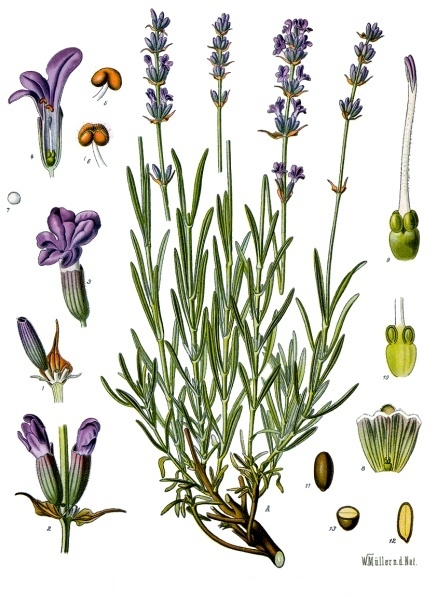 LavenderLavandula angustifolia
-
 French LavenderLavandula dentata
-
 Broad-leaved LavenderLavandula latifolia
-
 Fern-leaf LavenderLavandula multifida
-
 Spanish LavenderLavandula pedunculata
-
 Woolly LavenderLavandula lanata
-
 Green LavenderLavandula viridis
-
 Canary Island LavenderLavandula canariensis
Compare
Questions and answers
What is the scientific name of the French Lavender?
The scientific name of the French Lavender is Lavandula stoechas. Written with its author, the full name is Lavandula stoechas L..
Which family does the French Lavender belong to?
Lavandula stoechas belongs to the family Lamiaceae, in the order Lamiales and the class Magnoliopsida.
Where is the French Lavender found?
Checklists and occurrence records place Lavandula stoechas in 26 countries, including Spain, France, Portugal, Italy, Israel and Australia.
What other names does the French Lavender have?
Lavandula stoechas is also known in English as Italian Lavender, Spanish Lavender, Topped Lavender and Wild Lavender.
Sources
Passages the profile rests on
- The plant usually reaches a height of 30–100 centimetres. Source passage: “usually grows to between 30–100 centimetres (12–39 in) tall” — English Wikipedia
- The leaves measure 1–4 centimetres in length. Source passage: “Its leaves are 1–4 cm long, greyish and tomentose.” — English Wikipedia
- The flower-bearing stems measure 10–30 centimetres in length. Source passage: “stems 10–30 cm (4–12 in) long” — English Wikipedia
- The upper part of each flower spike bears larger sterile bracts that are usually bright lavender purple but occasionally white. Source passage: “At the top of the spike are a number of much larger, sterile bracts (no flowers between them), 10–50 mm long and bright lavender purple (rarely white).” — English Wikipedia
- The sterile apical bracts measure 10–50 millimetres in length. Source passage: “10–50 mm long and bright lavender purple” — English Wikipedia
- The flowers have a blackish-violet crown measuring up to 8 millimetres in length. Source passage: “The crown is blackish-violet, up to 8 mm long and indistinct two-lipped.” — English Wikipedia
- The species is associated with hot, dry and sunny growing conditions in alkaline soils. Source passage: “Like other lavenders, it is associated with hot, dry, sunny conditions in alkaline soils.” — English Wikipedia
- The species grows in semi-arid and relatively inhospitable soils in the Mediterranean region. Source passage: “These species grow in the semi-arid and rather inhospitable soils in this region” — pmc.ncbi.nlm.nih.gov
- The species produces flowers in spring and early summer, with flowering beginning as early as March in its native habitat depending on climate. Source passage: “It blooms in spring and early summer, from the month of March in its native habitat, depending on the climate in which it grows.” — English Wikipedia
- The species has become widely distributed across Australia following its introduction there. Source passage: “Since its introduction into Australia, it has become an invasive species, widely distributed within the continent.” — English Wikipedia
- Lavandula stoechas has been classified as a noxious weed in Victoria, Australia, since 1920. Source passage: “It has been declared a noxious weed in Victoria since 1920.” — English Wikipedia
- The species is regarded as a weed in parts of Spain. Source passage: “It also is regarded as a weed in parts of Spain.” — English Wikipedia
- The flowers are used in aromatherapy to prepare infusions and essential oils. Source passage: “The flowers are used in aromatherapy to prepare infusions and essential oils” — English Wikipedia
- The essential oils of the species contain d-camphor and d-fenchone ketones, as well as borneol and terpineol alcohols. Source passage: “contain ketones (d-camphor and d-fenchone) and alcohols (borneol and terpineol).” — English Wikipedia
Data
- Catalogue of Life, 2026-10-16 XR cc by
- Global Biodiversity Information Facility CC BY 4.0
- Wikidata CC0
- GeoNames CC BY 4.0
- Wikimedia Commons per image; credit shown with each image
- Within the Catalogue of Life, this name comes from Synonymic Checklists of the Vascular Plants of the World cc by
References
- L. where the name was published
This species in other databases
- Catalogue of Life 3SNFT
- Wikidata Q1342976
- iNaturalist 61904
- World Flora Online wfo-0000224244
- GRIN 21685
Page built on 28 November 2026. See how the catalog is made and all sources and licences.
Cite this page
ScientificNames.org. (2026). Lavandula stoechas (French Lavender). Retrieved November 28, 2026, from https://scientificnames.org/species/lavandula-stoechas
“Lavandula stoechas (French Lavender).” ScientificNames.org, 2026, scientificnames.org/species/lavandula-stoechas. Accessed 28 Nov. 2026.
ScientificNames.org. “Lavandula stoechas (French Lavender).” Accessed November 28, 2026. https://scientificnames.org/species/lavandula-stoechas.
@misc{scientificnames_lavandula_stoechas_french_lavender,
  author = {{ScientificNames.org}},
  title = {Lavandula stoechas (French Lavender)},
  year = {2026},
  url = {https://scientificnames.org/species/lavandula-stoechas},
  note = {Accessed 2026-11-28}
}