Species · Flowering plants
Downy Lavender Lavandula pubescens
The scientific name of the Downy Lavender is Lavandula pubescens. It is a species of flowering plant in the family Lamiaceae (mint family), order Lamiales.
- Scientific name
- Lavandula pubescens Decne.
- Common name
- Downy Lavender
- Genus
- Lavandula
- Family
- Lamiaceae (Mint Family)
- Order
- Lamiales
- Class
- Magnoliopsida
- Recorded in
- 11 countries
- Name status
- accepted in the Catalogue of Life

Overview
Downy Lavender is an erect, branching, fragrant perennial herb and an aromatic herbaceous shrub. It grows mainly in desert environments or dry shrubland, with a native distribution extending from the south-eastern Mediterranean to the western Arabian Peninsula. It is one of five Lavandula species growing wild in Yemen.
Written 27 November 2026 from the sources listed below. Each statement was checked against the passage it cites; statements that could not be supported were removed.
Appearance
Downy Lavender has slender, square-shaped, hairy stems. Its broad leaves are bipinnate, with linear segments.[1][2]
The flowering panicles are long and slender, with whorls bearing two flowers each. The bracts are ovate and approximately 1 mm long, and the calyx is approximately the same length as the bract.[3][4][5]
The calyx teeth are small and deltoid. The corolla tube is slightly longer than the calyx.[6][7]
Habitat
Downy Lavender grows mainly in desert environments or dry shrubland. Its native distribution extends from the south-eastern Mediterranean to the western Arabian Peninsula.[8][9]
Uses
Downy Lavender is used in traditional Yemeni medicine. The plant is believed to have sedative, antiseptic and anti-obesity properties.[10][11][12][13]
Classification of the Downy Lavender
| Kingdom | Plantae |
|---|---|
| Subkingdom | Pteridobiotina |
| Phylum | Tracheophyta |
| Class | Magnoliopsida |
| Order | Lamiales |
| Family | Lamiaceae (Mint Family) |
| Subfamily | Nepetoideae |
| Tribe | Ocimeae |
| Subtribe | Lavandulinae |
| Genus | Lavandula (Lavender) |
| Species | Lavandula pubescens Decne. |
Where the Downy Lavender is found
Checklists and occurrence records place Lavandula pubescens in 11 countries across Africa and Asia. GBIF holds 613 georeferenced records of it.
Countries
- Egypt 58
- Eritrea 5
- Ethiopia 3
- Iran 3
- Israel 319
- Jordan 18
- Palestinian Territory 22
- Saudi Arabia 63
- Sudan 54
- Syria 3
- Yemen 65
Regions and cities with the most records
- Southern District, Israel 224
- West Bank, Palestinian Territory 84
- Central Darfur, Sudan 51
- Arad, Israel 40
- Ma‘ale Adummim, Palestinian Territory 38
- Jericho, Palestinian Territory 37
- Safi, Jordan 36
- Al ‘Ayzarīyah, Palestinian Territory 35
- Ar Rām wa Ḑāḩiyat al Barīd, Palestinian Territory 28
- Bayt Ḩanīnā, Palestinian Territory 28
- Shu‘fāţ, Palestinian Territory 28
- Jerusalem, Israel 26
- Al Bīrah, Palestinian Territory 25
- ‘Aţārūt, Palestinian Territory 25
- Banī Na‘īm, Palestinian Territory 22
- Ramallah, Palestinian Territory 21
- Dimona, Israel 17
- Eilat, Israel 13
- Bethlehem, Palestinian Territory 11
- Mevasseret Tsiyyon, Israel 11
- Qiryat HaYovel, Israel 11
- Ta‘izz, Yemen 10
- Aqaba, Jordan 9
- Aqaba, Jordan 8
- 'Asir Region, Saudi Arabia 7
- Bayt Jālā, Palestinian Territory 7
- Sanaa Governorate, Yemen 7
- Mecca Region, Saudi Arabia 6
- Saḩar, Yemen 5
- Abha, Saudi Arabia 4
- Abyan Governorate, Yemen 3
- Kuseifa, Israel 3
- Northern Red Sea, Eritrea 3
- Sanaa, Yemen 3
- Taiz, Yemen 3
1 more country has a few records outside this range
These countries hold a few records of Lavandula pubescens but lie outside the range the checklists give for it. Such records are often zoo or garden specimens, museum material or vagrants, so the species is not counted as occurring there.
Range as the checklists state it
Egypt (Eastern Desert, NE-Egypt, SE-Egypt); Sudan (Jbel Marra); Eritrea; Israel (Rift Valley, Judean Desert); Sinai peninsula (C-Sinai, S-Sinai); Jordania (S-Jordania); Saudi Arabia (N-Saudi Arabia, Hejaz, Asir, Nejd Desert, Nafud Desert); Yemen (Aden Desert, N-Inner Yemen, SW-Yemen, W-Yemen)
A number beside a place is its count of GBIF occurrence records. A place without a number comes from a checklist alone. Records show where a species has been observed or collected, which can include escapes and vagrants.
Common names
English
- Downy Lavender
Names in 2 other languages
- Hebrew
- אזוביון שעיר
- Polish
- lawenda orzęsiona
Related species
-
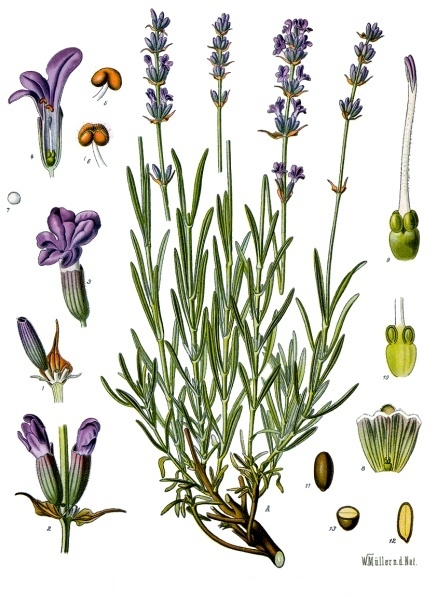 LavenderLavandula angustifolia
-
 French LavenderLavandula stoechas
-
 French LavenderLavandula dentata
-
 Broad-leaved LavenderLavandula latifolia
-
 Fern-leaf LavenderLavandula multifida
-
 Spanish LavenderLavandula pedunculata
-
 Woolly LavenderLavandula lanata
-
 Green LavenderLavandula viridis
Compare
Questions and answers
What is the scientific name of the Downy Lavender?
The scientific name of the Downy Lavender is Lavandula pubescens. Written with its author, the full name is Lavandula pubescens Decne..
Which family does the Downy Lavender belong to?
Lavandula pubescens belongs to the family Lamiaceae, in the order Lamiales and the class Magnoliopsida.
Where is the Downy Lavender found?
Checklists and occurrence records place Lavandula pubescens in 11 countries, including Israel, Yemen, Saudi Arabia, Egypt, Sudan and Palestinian Territory.
Is lavender a herb or a shrub?
Downy Lavender is described as an erect, branching, fragrant perennial herb and an aromatic herbaceous shrub.[14][15]
How would you describe lavender?
Downy Lavender is a fragrant perennial herb with slender, square-shaped, hairy stems and broad, bipinnate leaves with linear segments. Its flowering panicles are long and slender, with whorls bearing two flowers each.[14][1][2][3]
What is lavandula used for?
Downy Lavender is used in traditional Yemeni medicine.[10]
Sources
Passages the profile rests on
- The stems are slender, square-shaped and hairy. Source passage: “with slender, square, hairy stems.” — English Wikipedia
- The leaves are broad and bipinnate, with linear segments. Source passage: “Leaves are broad, bipinnate, with linear segments.” — English Wikipedia
- The flowering panicles are long and slender, with whorls bearing two flowers each. Source passage: “Panicles are long and slender, with 2-flowered whorls.” — English Wikipedia
- The bracts are ovate and approximately 1 mm long. Source passage: “Bracts are ovate, measuring about 1mm in length.” — English Wikipedia
- The calyx is approximately the same length as the bract. Source passage: “The calyx is the same length as the bract;” — English Wikipedia
- The calyx teeth are small and deltoid. Source passage: “teeth are small, deltoid.” — English Wikipedia
- The corolla tube is slightly longer than the calyx. Source passage: “The corolla-tube is a little longer than the calyx.” — English Wikipedia
- The species grows mainly in desert environments or dry shrubland. Source passage: “It grows mostly in desert or dry shrubland.” — English Wikipedia
- The native distribution of the species extends from the south-eastern Mediterranean to the western Arabian Peninsula. Source passage: “Its native range is from the SE. Mediterranean to the Western Arabian Peninsula.” — English Wikipedia
- The species is used in traditional Yemeni medicine. Source passage: “The plant is used in Yemeni traditional medicine,” — English Wikipedia
- In Yemeni traditional medicine, the plant is believed to have sedative properties. Source passage: “where it is believed to have sedative,” — English Wikipedia
- In Yemeni traditional medicine, the plant is believed to have antiseptic properties. Source passage: “anti-inflammatory, antiseptic,” — English Wikipedia
- In Yemeni traditional medicine, the plant is believed to have anti-obesity properties. Source passage: “anti-obesity properties.” — English Wikipedia
- Lavandula pubescens is an erect, branching, fragrant perennial herb. Source passage: “Lavandula pubescens is an erect, branching, fragrant perennial herb” — English Wikipedia
- Lavandula pubescens is an aromatic herbaceous shrub. Source passage: “is a species of flowering, aromatic herbaceous shrub” — English Wikipedia
Data
- Catalogue of Life, 2026-10-16 XR cc by
- Global Biodiversity Information Facility CC BY 4.0
- Wikidata CC0
- GeoNames CC BY 4.0
- Wikimedia Commons per image; credit shown with each image
- Within the Catalogue of Life, this name comes from Synonymic Checklists of the Vascular Plants of the World cc by
References
- Decne. (1834). Ann. Sci. Nat., Bot., Sér. 2, 2: 246 (1834). where the name was published
This species in other databases
- Catalogue of Life 3SNFB
- Wikidata Q3219774
- iNaturalist 919805
- World Flora Online wfo-0000224223
- GRIN 453687
Page built on 27 November 2026. See how the catalog is made and all sources and licences.
Cite this page
ScientificNames.org. (2026). Lavandula pubescens (Downy Lavender). Retrieved November 27, 2026, from https://scientificnames.org/species/lavandula-pubescens
“Lavandula pubescens (Downy Lavender).” ScientificNames.org, 2026, scientificnames.org/species/lavandula-pubescens. Accessed 27 Nov. 2026.
ScientificNames.org. “Lavandula pubescens (Downy Lavender).” Accessed November 27, 2026. https://scientificnames.org/species/lavandula-pubescens.
@misc{scientificnames_lavandula_pubescens_downy_lavender,
  author = {{ScientificNames.org}},
  title = {Lavandula pubescens (Downy Lavender)},
  year = {2026},
  url = {https://scientificnames.org/species/lavandula-pubescens},
  note = {Accessed 2026-11-27}
}