Species · Birds
Common Merganser Mergus merganser
The scientific name of the Common Merganser is Mergus merganser. It is a species of bird in the family Anatidae (ducks), order Anseriformes. The name dates from 1758.
- Scientific name
- Mergus merganser Linnaeus, 1758
- Common name
- Common Merganser
- Genus
- Mergus
- Family
- Anatidae (Ducks)
- Order
- Anseriformes
- Class
- Aves
- Red List category
- LC Least Concern
- Environment
- freshwater, marine, terrestrial
- Recorded in
- 76 countries
- Name status
- accepted in the Catalogue of Life

Overview
Mergus merganser inhabits rivers and lakes in forested areas of Europe, Asia, and North America. It is distinguished by its serrated bill edges, which help it grip prey, and a crest of longer head feathers that usually lies smoothly rounded behind the head.
Written 26 November 2026 from the sources listed below. Each statement was checked against the passage it cites; statements that could not be supported were removed.
Appearance
Adult males in breeding plumage have a white body with a variable salmon-pink tinge, an iridescent green-black head, a grey rump and tail, and predominantly white and black wings. Females and non-breeding males have predominantly grey bodies, reddish-brown heads, white chins, and white secondary wing feathers.[1][2]
Juveniles have a short black-edged white stripe between the eye and bill. The bill and legs range from red to brownish-red, with the brightest coloration in adult males and dullest in juveniles.[3][4]
Adults measure 58–72 cm in length, have a wingspan of 78 to 97 cm, and weigh between 0.9 and 2.1 kg. Males are slightly larger than females on average.[5][6][7][8]
Common mergansers are the largest mergansers and the largest North American inland ducks.[9]
Habitat
The species inhabits rivers and lakes in forested areas of Europe, Asia, and North America. It prefers wooded areas along streams and rivers or near small inland lakes.[10][11]
It also occurs along the shores of the Great Lakes and on coastal streams in British Columbia. It forages in clear waters less than 4 m deep, including estuaries, coastal bays, lakes, streams, and rivers.[12][13]
In winter, the species can dive into deeper water to capture schooling fish.[14]
Diet
Fish constitute the main component of the Common Merganser's diet. Its aquatic prey also includes molluscs, crustaceans, worms, insect larvae, and amphibians.[15][16]
The species occasionally eats small mammals and birds. Ducklings feed on freshwater invertebrates and small fish fry.[17][18]
Behaviour
Common mergansers locate prey by sight while diving. During group fishing, they sometimes form a semicircle to drive fish into shallow water.[19][20]
They can remain underwater for up to two minutes, although a typical dive lasts less than 30 seconds.[21][22]
Common mergansers are social birds that prefer groups of up to 75 individuals. Winter gatherings can include hundreds of individuals.[23][24]
They typically fly at approximately 70 km/h. The species is a partial migrant, with birds leaving areas where rivers and large lakes freeze during winter.[25][26]
Reproduction and life cycle
Common mergansers form monogamous mating pairs lasting at least one mating season. They generally nest in tree cavities and also use large nest boxes with entrance holes approximately 15 cm in diameter.[27][28][29]
In treeless areas of Central Asia, common mergansers nest in holes in cliffs and steep banks. Females typically lay clutches of 8–12 eggs, although the recorded range is 6–17.[30][31]
The species produces one brood per season. Eggs measure approximately 6–7.2 cm long and 4.3–5 cm wide, and females incubate them for 28–35 days.[32][33][34]
Young leave the nest within 24–48 hours of hatching. Ducklings become skilled divers within approximately eight days of leaving the nest.[35][36]
Females typically abandon their broods 30–50 days after hatching, before the young can fly. Common merganser ducklings fledge at approximately 60–70 days of age.[37][38]
Conservation
The species is not considered threatened overall. Illegal persecution by game-fishing interests is a problem in certain regions.[39][40]
Classification of the Common Merganser
| Kingdom | Animalia |
|---|---|
| Phylum | Chordata |
| Subphylum | Vertebrata |
| Infraphylum | Gnathostomata |
| Parvphylum | Osteichthyes |
| Megaclass | Tetrapoda |
| Class | Aves (Bird) |
| Order | Anseriformes (Ducks) |
| Family | Anatidae (Ducks) |
| Genus | Mergus (Greater Mergansers) |
| Species | Mergus merganser Linnaeus, 1758 |
Where the Common Merganser is found
Checklists and occurrence records place Mergus merganser in 76 countries across Asia, North America and Oceania. GBIF holds 5,554,719 georeferenced records of it.
Countries
- Afghanistan 3
- Aland Islands 2,262
- Albania 57
- Armenia 5
- Austria 19,275
- Azerbaijan 36
- Bangladesh 8
- Belarus 1,242
- Belgium 30,289
- Bermuda 137
- Bhutan 1,070
- Bosnia and Herzegovina 119
- Bulgaria 359
- Canada 991,481
- China 11,801
- Croatia 937
- Czechia 15,000
- Denmark 242,192
- Estonia 46,559
- Faroe Islands 84
- Finland 84,035
- France 43,253
- Georgia 25
- Germany 88,409
- Greece 215
- Greenland 5
- Guernsey 5
- Hungary 2,216
- Iceland 4,813
- India 3,677
- Iran 23
- Ireland 675
- Isle of Man 256
- Israel 4
- Italy 12,002
- Japan 15,338
- Jersey 10
- Kazakhstan 279
- Kosovo 18
- Kyrgyzstan 154
- Latvia 2,689
- Liechtenstein 30
- Lithuania 4,799
- Luxembourg 596
- Mexico 435
- Moldova 62
- Mongolia 1,307
- Montenegro 53
- Myanmar 79
- Nepal 1,423
- North Korea 39
- North Macedonia 225
- Norway 219,818
- Pakistan 6
- Poland 31,297
- Portugal 44
- Romania 1,148
- Russia 16,817
- Saint Pierre and Miquelon 89
- Serbia 525
- Slovakia 1,839
- Slovenia 1,753
- South Korea 10,358
- Spain 685
- Svalbard and Jan Mayen 10
- Sweden 865,750
- Switzerland 41,707
- Taiwan 245
- Tajikistan 64
- The Netherlands 228,315
- Turkey 81
- Ukraine 1,877
- United Kingdom 154,870
- United States 2,347,314
- United States Minor Outlying Islands 3
- Uzbekistan 39
Regions and cities with the most records
- Ontario, Canada 332,450
- New York, United States 250,540
- Quebec, Canada 241,713
- British Columbia, Canada 208,582
- Pennsylvania, United States 186,620
- Washington, United States 175,292
- California, United States 166,022
- Michigan, United States 155,330
- Colorado, United States 136,731
- Västra Götaland, Sweden 128,778
- Stockholm, Sweden 124,849
- Oregon, United States 122,254
- England, United Kingdom 106,672
- Massachusetts, United States 106,662
- Wisconsin, United States 100,537
- Alberta, Canada 87,515
- New Jersey, United States 76,580
- Illinois, United States 76,463
- Vermont, United States 63,907
- Minnesota, United States 62,397
- Solna, Sweden 61,318
- Ohio, United States 61,048
- Stockholm, Sweden 60,851
- Sundbyberg, Sweden 60,365
- Danderyd, Sweden 59,755
- Sollentuna, Sweden 58,572
- Lidingö, Sweden 58,034
- Rinkeby, Sweden 57,133
- Täby, Sweden 56,332
- Trångsund, Sweden 54,442
- Capital Region, Denmark 53,300
- Calgary, Canada 53,043
- Jakobsberg, Sweden 52,460
- Skåne, Sweden 52,417
- Nacka, Sweden 52,207
- Central Jutland, Denmark 51,954
3 more countries have a few records outside this range
These countries hold a few records of Mergus merganser but lie outside the range the checklists give for it. Such records are often zoo or garden specimens, museum material or vagrants, so the species is not counted as occurring there.
Range as the checklists state it
Europe & Northern Asia (excluding China)
North America
Southern Asia
Oceania
A number beside a place is its count of GBIF occurrence records. A place without a number comes from a checklist alone. Records show where a species has been observed or collected, which can include escapes and vagrants.
Common names
English
- Common Merganser
- Big Fish-duck
- Dun-Diver
- Goosander
- Big Pond-sheldrake
- Big Sawbill
- Big Sheldrake
Names in 64 other languages
- Albanian
- zhytësi i mesëm
- Arabic
- بط غواص شائع, بلقشة شائعة
- Armenian
- Բադ սղոցակտուց մեծ
- Asturian
- merguyu grande
- Azerbaijani
- Böyük pazdimdik
- Basque
- Zerra handi
- Belarusian
- Вялiкi савук, Вялікі савук, Крахаль вялікі
- Bengali
- সরুঠোঁট ডুবুরি হাঁস
- Breton
- Heskenneg bras
- Bulgarian
- Голям нирец
- Catalan
- bec de serra gros
- Chinese
- 川秋沙, 川秋沙〔普通秋沙〕, 普通秋沙鸭
- Czech
- morčák velký
- Danish
- stor skallesluger
- Dutch
- grote zaagbek
- Esperanto
- granda merĝo
- Estonian
- jääkoskel
- Faroese
- Tannont
- Finnish
- isokoskelo
- French
- Grand Harle, Grand bec-scie, harle bièvre
- German
- Gänsesäger
- Greek
- Χηνοπρίστης
- Hebrew
- מרגון גדול
- Hungarian
- nagy bukó
- Icelandic
- Gulönd
- Irish
- Síolta, Tumaire
- Italian
- smergo maggiore
- Japanese
- カワアイサ
- Kazakh
- Үлкен бейнарық
- Korean
- 비오리
- Latvian
- lielā gaura
- Lithuanian
- didysis dančiasnapis
- Luxembourgish
- Grousse Seeër
- Macedonian
- голем северен нуркач
- Mongolian
- Хумхин нугас
- Northern Sami
- Gussagoalsi, stuorragoalsi, suovragoalsi
- Norwegian Bokmål
- laksand
- Persian
- مرگوس بزرگ
- Polish
- nurogęś, tracz nurogęś
- Portuguese
- merganso-grande
- Romanian
- Ferestraș mare, ferestraş mare, ferestraşul mare
- Russian
- большой крохаль, или керкуль (устар.)
- Scottish Gaelic
- Lach fhiachailleach, Sìolta bheag, lach fhiacailleach, lachan-fiacailleach, síolta mhór
- Serbian
- Veliki ronac, Велики ронац, Велики ронац/Veliki ronac
- Slovak
- potápač veľký
- Slovenian
- srednji žagar, veliki žagar
- Spanish
- Mergo mayor, Serreta grande
- Swedish
- storskrake
- Turkish
- buyuk tarakdis, büyük tarakdiş
- Ukrainian
- Крех великий
- Welsh
- Hwyaid Danheddog, hwyaden ddanheddog
- arg
- Mergo gran
- bak
- Беле
- chv
- Пысӑк крохаль
- cor
- Hos dynsak
- fry
- Grutte Seachbek
- glv
- Thunnag eeacklagh
- lut
- sx̌ahus, sx̌aʔus
- mic
- Tma’qni
- oji
- Anzig
- pcd
- Gueufe
- pnb
- عام مرگانسر
- rue
- Великый крохаль
- sah
- Үрүҥ улун
Synonyms
4 other scientific names have been used for this species and are now treated as synonyms of Mergus merganser.
- Merganser raii Forster, T, 1817
- Mergus gulo Scopoli, GA, 1769
- Mergus rubricapilla Brünnich, MT, 1764
- Mergus variabilis S.D.W., 1836
Subspecies and varieties
- Mergus merganser americanus (American Goosander) subspecies
- Mergus merganser merganser (Goosander) subspecies
- Mergus merganser orientalis (Asian Goosander) subspecies
Related species
-
 Red-breasted MerganserMergus serrator
-
 Scaly-sided MerganserMergus squamatus
-
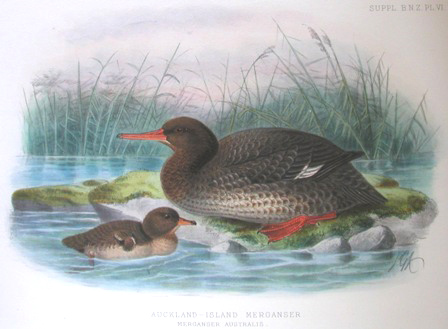 Auckland Island MerganserMergus australis
-
 Brazilian MerganserMergus octosetaceus
-
 Chatham Island MerganserMergus milleneri
-
 Canada GooseBranta canadensis
-
 MallardAnas platyrhynchos
-
 Muscovy DuckCairina moschata
Compare
Questions and answers
What is the scientific name of the Common Merganser?
The scientific name of the Common Merganser is Mergus merganser. Written with its author, the full name is Mergus merganser Linnaeus, 1758.
Which family does the Common Merganser belong to?
Mergus merganser belongs to the family Anatidae, in the order Anseriformes and the class Aves.
Where is the Common Merganser found?
Checklists and occurrence records place Mergus merganser in 76 countries, including United States, Canada, Sweden, Denmark, The Netherlands and Norway.
What is the conservation status of the Common Merganser?
The IUCN Red List category recorded for Mergus merganser is Least Concern (LC).
What other names does the Common Merganser have?
Mergus merganser is also known in English as Big Fish-duck, Dun-Diver, Goosander, Big Pond-sheldrake, Big Sawbill and Big Sheldrake.
Is a merganser technically a duck?
The Common Merganser belongs to the family Anatidae, order Anseriformes, and class Aves. It is also described as the largest North American inland duck.[9]
What is a group of common mergansers called?
Common mergansers are social birds that prefer groups of up to 75 individuals. Winter gatherings can include hundreds of individuals.[23][24]
What do the Common Merganser eat?
Fish make up the main component of their diet. They also eat molluscs, crustaceans, worms, insect larvae, amphibians, and occasionally small mammals and birds.[15][16][17]
Sources
Passages the profile rests on
- Adult males in breeding plumage have a white body with a variable salmon-pink tinge, an iridescent green-black head, a grey rump and tail, and predominantly white and black wings. Source passage: “Adult males in breeding plumage are easily distinguished, the body white with a variable salmon-pink tinge, the head black with an iridescent green sheen, the rump and tail grey, and the wings largely white on the inner half, black on the outer half.” — English Wikipedia
- Females and non-breeding males have predominantly grey bodies, reddish-brown heads, white chins, and white secondary wing feathers. Source passage: “Females and males in "eclipse" (non-breeding plumage, July to October) are largely grey, with a reddish-brown head, white chin, and white secondary feathers on the wing.” — English Wikipedia
- Juveniles have a short black-edged white stripe between the eye and bill. Source passage: “Juveniles (both sexes) are similar to adult females but also show a short black-edged white stripe between the eye and bill.” — English Wikipedia
- The bill and legs range from red to brownish-red, with the brightest coloration in adult males and dullest in juveniles. Source passage: “The bill and legs are red to brownish-red, brightest on adult males, dullest on juveniles.” — English Wikipedia
- Adults measure 58–72 cm in length. Source passage: “It is 58–72 cm (23–28+1⁄2 in) long” — English Wikipedia
- The wingspan ranges from 78 to 97 cm. Source passage: “with a 78–97 cm (30+1⁄2–38 in) wingspan” — English Wikipedia
- Adults weigh between 0.9 and 2.1 kg. Source passage: “and a weight of 0.9–2.1 kg (2 lb 0 oz – 4 lb 10 oz)” — English Wikipedia
- Males are slightly larger than females on average. Source passage: “males are on average slightly larger than females, but with some overlap.” — English Wikipedia
- Common mergansers are the largest mergansers and the largest North American inland ducks. Source passage: “Common mergansers are the largest mergansers and the largest North American inland ducks.” — animaldiversity.org
- The species inhabits rivers and lakes in forested areas of Europe, Asia, and North America. Source passage: “a large sea duck of rivers and lakes in forested areas of Europe, Asia, and North America.” — English Wikipedia
- Common mergansers prefer wooded areas along streams and rivers or near small inland lakes. Source passage: “Common mergansers prefer to live in wooded areas along streams and rivers or near small, inland lakes.” — animaldiversity.org
- The species also occurs along the shores of the Great Lakes and on coastal streams in British Columbia. Source passage: “They can also be found along the shores of the Great Lakes, as well as on coastal streams in British Columbia.” — animaldiversity.org
- Common mergansers forage in clear waters less than 4 m deep, including estuaries, coastal bays, lakes, streams, and rivers. Source passage: “tend to feed in clear waters, less than 4 m deep, including estuaries, coastal bays, lakes, streams, and rivers.” — animaldiversity.org
- In winter, the species can dive into deeper water to capture schooling fish. Source passage: “In the winter, common mergansers have been known to dive deeper in order to capture schooling fish.” — animaldiversity.org
- Fish constitute the main component of the common merganser's diet. Source passage: “The common merganser eats mainly fish.” — English Wikipedia
- Its aquatic prey also includes molluscs, crustaceans, worms, insect larvae, and amphibians. Source passage: “In addition to fish, they take a wide range of other aquatic prey, such as molluscs, crustaceans, worms, insect larvae, and amphibians” — English Wikipedia
- The species occasionally eats small mammals and birds. Source passage: “more rarely, small mammals and birds may be taken.” — English Wikipedia
- Ducklings feed on freshwater invertebrates and small fish fry. Source passage: “where they feed on freshwater invertebrates and small fish fry” — English Wikipedia
- Common mergansers locate prey by sight while diving. Source passage: “Common mergansers are diving predators who locate their prey by sight” — animaldiversity.org
- During group fishing, common mergansers sometimes form a semicircle to drive fish into shallow water. Source passage: “They often fish in a group by forming a semicircle and driving the fish into shallow water where they are easier to catch.” — English Wikipedia
- Common mergansers can remain underwater for up to two minutes. Source passage: “Common mergansers are capable of remaining underwater for up to 2 minutes” — animaldiversity.org
- A typical dive lasts less than 30 seconds. Source passage: “with the typical dive lasting less than 30 seconds.” — animaldiversity.org
- Common mergansers are social birds that prefer groups of up to 75 individuals. Source passage: “Mergus merganser is a social species, preferring to be in groups of up to 75 individuals.” — animaldiversity.org
- Winter gatherings can include hundreds of individuals. Source passage: “In the winter, huge gatherings of hundreds of individuals have been observed.” — animaldiversity.org
- Common mergansers typically fly at approximately 70 km/h. Source passage: “They typically fly at about 70 km/h” — animaldiversity.org
- The species is a partial migrant, with birds leaving areas where rivers and large lakes freeze during winter. Source passage: “The species is a partial migrant, with birds moving away from areas where rivers and large lakes freeze in the winter, but resident where waters remain open.” — English Wikipedia
- Common mergansers form monogamous mating pairs lasting at least one mating season. Source passage: “Common mergansers form monogamous mating pairs that last for at least one mating season.” — animaldiversity.org
- Common mergansers generally nest in tree cavities. Source passage: “Nesting is usually in a tree cavity” — English Wikipedia
- The species also uses large nest boxes with entrance holes approximately 15 cm in diameter. Source passage: “they also readily use large nest boxes where these are available, requiring an entrance hole 15 cm (6 in) in diameter.” — English Wikipedia
- In treeless areas of Central Asia, common mergansers nest in holes in cliffs and steep banks. Source passage: “In treeless areas such as the mountains of Central Asia, they use holes in cliffs and steep, high banks” — English Wikipedia
- Females typically lay clutches of 8–12 eggs, although the recorded range is 6–17. Source passage: “The female lays 6–17 (most often 8–12) white to yellowish eggs” — English Wikipedia
- The species produces one brood per season. Source passage: “and raises one brood per season.” — English Wikipedia
- Eggs measure approximately 6–7.2 cm long and 4.3–5 cm wide. Source passage: “Eggs measure 6–7.2 cm (2.4–2.8 in) in length and 4.3–5 cm (1.7–2.0 in) in width.” — English Wikipedia
- Females incubate the eggs for 28–35 days. Source passage: “female parents incubate the eggs for 28 to 35 days.” — animaldiversity.org
- Young leave the nest within 24–48 hours of hatching. Source passage: “Young are precocial, and leave the nest within 24 to 48 hours.” — animaldiversity.org
- Ducklings become skilled divers within approximately eight days of leaving the nest. Source passage: “They are skilled divers within 8 days of leaving the nest” — animaldiversity.org
- Females typically abandon their broods 30–50 days after hatching, before the young can fly. Source passage: “Mothers abandon their broods before the young develop the ability to fly, typically 30 to 50 days after hatching.” — animaldiversity.org
- Common merganser ducklings fledge at approximately 60–70 days of age. Source passage: “fledging at 60–70 days of age.” — English Wikipedia
- The species is not considered threatened overall. Source passage: “Overall, the species is not threatened” — English Wikipedia
- Illegal persecution by game-fishing interests is a problem in certain regions. Source passage: “although illegal persecution by game-fishing interests is a problem in certain regions.” — English Wikipedia
- Common mergansers occur in both the Nearctic and Palearctic regions. Source passage: “Mergus merganser (common mergansers or goosanders) occur in both the Nearctic and Palearctic regions.” — animaldiversity.org
Data
- Catalogue of Life, 2026-10-16 XR cc by
- Global Biodiversity Information Facility CC BY 4.0
- Wikidata CC0
- GeoNames CC BY 4.0
- Wikimedia Commons per image; credit shown with each image
- Within the Catalogue of Life, this name comes from The Integrated Taxonomic Information System cc0
References
- Linnaeus, C. (1758). Systema Naturae per regna tria naturae, secundum classes, ordines, genera, species, cum characteribus, differentiis, synonymis, locis. Tomus I. Editio decima, reformata. Laurentii Salvii. Holmiae [Stockholm]. [iii] + 824 pp. where the name was published
- Banks, R. C., R. W. McDiarmid, and A. L. Gardner. (1987). Checklist of Vertebrates of the United States, the U.S. Territories, and Canada. Resource Publication, No. 166.
- Gill, Frank, & and Minturn Wright. (2006). Birds of the World: Recommended English Names.
- Dickinson, E. C., and J. V. Remsen Jr., eds. (2013). The Howard and Moore Complete Checklist of the Birds of the World, 4th Edition, Vol. 1 Non-Passerines.
This species in other databases
- Catalogue of Life 3ZTRN
- Wikidata Q180991
- iNaturalist 7004
- WoRMS urn:lsid:marinespecies.org:taxname:159097
- Avibase commer
Page built on 26 November 2026. See how the catalog is made and all sources and licences.
Cite this page
ScientificNames.org. (2026). Mergus merganser (Common Merganser). Retrieved November 26, 2026, from https://scientificnames.org/species/mergus-merganser
“Mergus merganser (Common Merganser).” ScientificNames.org, 2026, scientificnames.org/species/mergus-merganser. Accessed 26 Nov. 2026.
ScientificNames.org. “Mergus merganser (Common Merganser).” Accessed November 26, 2026. https://scientificnames.org/species/mergus-merganser.
@misc{scientificnames_mergus_merganser_common_merganser,
  author = {{ScientificNames.org}},
  title = {Mergus merganser (Common Merganser)},
  year = {2026},
  url = {https://scientificnames.org/species/mergus-merganser},
  note = {Accessed 2026-11-26}
}