Species · Birds
Scaly-sided Merganser Mergus squamatus
The scientific name of the Scaly-sided Merganser is Mergus squamatus. It is a species of bird in the family Anatidae (ducks), order Anseriformes. The name dates from 1864.
- Scientific name
- Mergus squamatus Gould, 1864
- Common name
- Scaly-sided Merganser
- Genus
- Mergus
- Family
- Anatidae (Ducks)
- Order
- Anseriformes
- Class
- Aves
- Red List category
- EN Endangered
- Recorded in
- 6 countries
- Name status
- accepted in the Catalogue of Life

Overview
The breeding range extends across the southeastern Russian Far East, northeastern China, and northern North Korea, and its primary wintering range is in the Yangtze River basin in southern China. Its dark-edged white flank scales distinguish it from other merganser species.
Written 26 November 2026 from the sources listed below. Each statement was checked against the passage it cites; statements that could not be supported were removed.
Similar species
The Scaly-sided Merganser occurs in the same areas as Mandarin Ducks and may compete with them for nesting cavities. Common Mergansers and Common Goldeneyes are potential competitors in its wintering habitat.[1][2]
Appearance
Both sexes have a crest of elongated feathers, which is nearly shoulder-length in adult males and shorter in females and immature birds. Both sexes also have orange-red legs and dark brown irises.[3][4]
Adult males have a black head and neck, white breast and underparts, and predominantly blackish wings and mantle. Females have a buffish head and predominantly grey plumage instead of the male's black coloration.[5][6]
Both sexes have dark-edged white scales on their flanks that distinguish them from other merganser species. The species also has a thin red bill and scaled dark markings on its flanks and rump.[7][8]
Habitat
Its breeding habitat includes rivers flowing through primary forest in the southeastern Russian Far East. The species favors medium-sized rivers meandering through extensive mixed mountain forests at elevations of up to approximately 1,000 metres.[9][10]
A solitary male observed in northern China occupied river patches with dense riparian concealment and little human disturbance. The tracked male avoided open river sites experiencing high levels of human disturbance and strongly preferred sheltered river reaches that remained free of ice.[11][12][13]
Diet
Its diet includes aquatic arthropods, frogs, and small to medium-sized fish. Stonefly and giant caddisfly larvae can constitute most of its diet when available, while beetles and crustaceans are eaten less regularly.[14][15][16]
Fish become a more prominent component of its diet as aquatic insect larvae hatch during summer. Its preferred fish prey include dojo loaches and lenok.[17][18]
Behaviour
The species migrates between northern breeding grounds and southern wintering grounds. Individuals arrive at breeding grounds in March after winter ends and leave around mid-November when the first cold nights occur.[19][20][21]
Birds commonly move upstream during daylight when startled or while foraging. Individuals frequently dive repeatedly to capture prey, remaining submerged for approximately 15–30 seconds between short pauses.[22][23]
In shallow water, individuals submerge their heads without tipping their bodies upward. They spend most daylight hours foraging and rest, preen, and socialize around midday.[24][25]
The species is relatively unsocial during its breeding period but forms small groups during autumn and winter. Wintering groups containing more than twelve individuals are very uncommon.[26][27]
A solitary male observed over three winters in northern China associated exclusively with Common Mergansers. The tracked male did not form flocks with other sympatric waterbirds.[28][29]
Reproduction and life cycle
The species nests in trees. Preferred nesting trees include daimyo oak, Chozenia, linden, and Ussuri poplar.[30][31]
The species can breed successfully in artificial nest boxes installed along rivers where bank forests have been destroyed.[32]
Conservation
The Scaly-sided Merganser is classified as Endangered on the IUCN Red List. Its estimated population comprises fewer than 5,000 adult and first- and second-year birds.[33][34]
The species experienced population declines during the 1960s and 1970s because of primary forest loss within its restricted range. Approximately 85% of the breeding population occurs in the Russian Far East.[35][36]
Current threats include illegal hunting, entanglement in fishing nets, river pollution, and continued forest destruction.[37]
Recommended conservation measures include installing artificial nest boxes and protecting critical habitat. Small undisturbed ice-free river refuges are important for isolated wintering individuals in northern China.[38][39]
Classification of the Scaly-sided Merganser
| Kingdom | Animalia |
|---|---|
| Phylum | Chordata |
| Subphylum | Vertebrata |
| Infraphylum | Gnathostomata |
| Parvphylum | Osteichthyes |
| Megaclass | Tetrapoda |
| Class | Aves (Bird) |
| Order | Anseriformes (Ducks) |
| Family | Anatidae (Ducks) |
| Genus | Mergus (Greater Mergansers) |
| Species | Mergus squamatus Gould, 1864 |
Where the Scaly-sided Merganser is found
Checklists and occurrence records place Mergus squamatus in 6 countries across Asia. GBIF holds 2,711 georeferenced records of it.
Countries
Regions and cities with the most records
- Zhejiang, China 571
- Jiangxi, China 346
- Primorye, Russia 202
- Taichung, Taiwan 202
- Xizhou, Taiwan 202
- Lishui, China 157
- Taiwan, Taiwan 126
- Sham Tseng, Hong Kong 92
- Ting Kau, Hong Kong 92
- Tsing Yi Town, Hong Kong 92
- Discovery Park, Hong Kong 91
- Kwai Chung, Hong Kong 91
- Mei Foo, Hong Kong 91
- Mei Foo Sun Chuen, Hong Kong 91
- Shek Lei, Hong Kong 91
- Tai Wo Hau, Hong Kong 91
- Tsuen Wan, Hong Kong 91
- Hoi Lai Estate, Hong Kong 90
- Jordan, Hong Kong 90
- Keng Hau, Hong Kong 90
- Kennedy Town, Hong Kong 90
- Mid Levels, Hong Kong 90
- Mount Davis, Hong Kong 90
- Olympic, Hong Kong 90
- Pak Tin Estate, Hong Kong 90
- So Uk, Hong Kong 90
- So Uk Estate, Hong Kong 90
- Tai Wai, Hong Kong 90
- Tsim Sha Tsui, Hong Kong 90
- Un Chau Estate, Hong Kong 90
- Victoria, Hong Kong 90
- Wang Tau Hom, Hong Kong 90
- Wang Tau Hom Estate, Hong Kong 90
- Wong Tai Sin, Hong Kong 90
- Discovery Bay, Hong Kong 89
- Fu Cheong Estate, Hong Kong 89
Range as the checklists state it
Europe & Northern Asia (excluding China)
Southern Asia
A number beside a place is its count of GBIF occurrence records. A place without a number comes from a checklist alone. Records show where a species has been observed or collected, which can include escapes and vagrants.
Common names
English
- Scaly-sided Merganser
- Chinese Merganser
Names in 34 other languages
- Arabic
- بلقشة محرشفة الجوانب
- Breton
- Heskenneg Sina
- Catalan
- bec de serra de la Xina
- Chinese
- 中华秋沙鸭, 中華秋沙鴨, 唐秋沙, 唐秋沙〔中華秋沙,鱗脇秋沙〕
- Czech
- morčák šupinatý
- Danish
- Amur Skallesluger
- Dutch
- Chinese Zaagbek
- Esperanto
- Skvamomerĝo, ĉinia merĝo
- Estonian
- soomuskoskel
- Finnish
- amurinkoskelo
- French
- Harle de Chine
- German
- Schuppensäger
- Hebrew
- מרגון סיני
- Hungarian
- csuklyás bukó, pikkelyes bukó
- Italian
- Smergo cinese, Smergo dai fianchi scagliosi, Smergo della Cina, Smergo squamato
- Japanese
- コウライアイサ
- Korean
- 호사비오리
- Latvian
- zvīņotā gaura
- Lithuanian
- kininis dančiasnapis
- Norwegian
- skjellfiskand
- Persian
- اردک ماهیخوار پهلوپولکی
- Polish
- tracz chiński
- Portuguese
- merganso-chinês, merganso-de-flanco-escamoso, merganso-de-flancos-escamosos
- Russian
- Чешуйчатый крохаль
- Serbian
- Kineski ronac
- Slovak
- potápač šupinatý
- Spanish
- Serreta china
- Swedish
- amurskrake
- Thai
- เป็ดปากยาวข้างลาย
- Turkish
- Yazılı Tarakdiş
- Ukrainian
- крех китайський
- Vietnamese
- Vịt cát Trung Hoa
- Welsh
- hwyaden gribog Tsieina
- olo
- Amurankoskelo
Related species
-
 Common MerganserMergus merganser
-
 Red-breasted MerganserMergus serrator
-
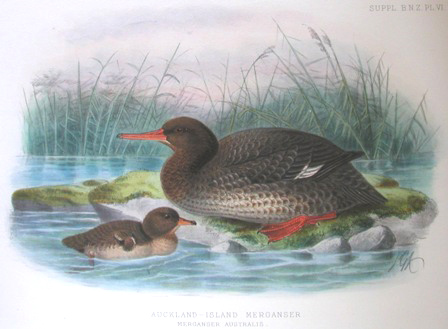 Auckland Island MerganserMergus australis
-
 Brazilian MerganserMergus octosetaceus
-
 Chatham Island MerganserMergus milleneri
-
 Canada GooseBranta canadensis
-
 MallardAnas platyrhynchos
-
 Muscovy DuckCairina moschata
Compare
Questions and answers
What is the scientific name of the Scaly-sided Merganser?
The scientific name of the Scaly-sided Merganser is Mergus squamatus. Written with its author, the full name is Mergus squamatus Gould, 1864.
Which family does the Scaly-sided Merganser belong to?
Mergus squamatus belongs to the family Anatidae, in the order Anseriformes and the class Aves.
Where is the Scaly-sided Merganser found?
Checklists and occurrence records place Mergus squamatus in 6 countries: China, Japan, Taiwan, Russia, South Korea and Hong Kong.
What is the conservation status of the Scaly-sided Merganser?
The IUCN Red List category recorded for Mergus squamatus is Endangered (EN).
What other names does the Scaly-sided Merganser have?
Mergus squamatus is also known in English as Chinese Merganser.
Sources
Passages the profile rests on
- The species occurs in the same areas as Mandarin Ducks and may compete with them for nesting cavities. Source passage: “They are sympatric with Mandarin ducks (Aix galericulata); perhaps competing for nesting holes” — English Wikipedia
- Common Mergansers and Common Goldeneyes are potential competitors in its wintering habitat. Source passage: “the scaly-sided merganser might compete with other Merginae with which it shares its habitat then, e.g. common mergansers (M. merganser) and common goldeneyes (Bucephala clangula).” — English Wikipedia
- Both sexes have a crest of elongated feathers, which is nearly shoulder-length in adult males and shorter in females and immature birds. Source passage: “Both sexes have a crest of wispy elongated feathers, reaching almost to the shoulders in adult males and being fairly short in females and immatures.” — English Wikipedia
- Both sexes have orange-red legs and dark brown irises. Source passage: “The legs are orange-red and the irides dark brown in both sexes.” — English Wikipedia
- Adult males have a black head and neck, white breast and underparts, and predominantly blackish wings and mantle. Source passage: “The adult male has a black head and neck, white breast and underparts, and blackish mantle and wings” — English Wikipedia
- Females have a buffish head and predominantly grey plumage instead of the male's black coloration. Source passage: “The female has a buffish head and otherwise replaces the male's black with grey colour.” — English Wikipedia
- Both sexes have dark-edged white scales on their flanks that distinguish them from other merganser species. Source passage: “Both sexes have prominent dark-edged white “scales” on the sides that distinguish them from other merganser species.” — ebird.org
- The species has a thin red bill and scaled dark markings on its flanks and rump. Source passage: “This striking sea duck has a thin red bill and a scaled dark pattern on the flanks and rump.” — English Wikipedia
- Its breeding habitat includes rivers flowing through primary forest in the southeastern Russian Far East. Source passage: “Their breeding habitat is rivers in primary forest in the southeastern Russian Far East” — English Wikipedia
- The species favors medium-sized rivers meandering through extensive mixed mountain forests at elevations of up to approximately 1,000 metres. Source passage: “This shy and easily startled bird favors mid-sized rivers which meander through wide expanses of mixed forest in the mountains, up to 1,000 meters (3,300 ft) ASL or less.” — English Wikipedia
- A solitary male observed in northern China occupied river patches with dense riparian concealment and little human disturbance. Source passage: “the focal bird only occupied two patches characterized by dense riparian concealment and low human disturbance” — pmc.ncbi.nlm.nih.gov
- The tracked solitary male avoided open river sites experiencing high levels of human disturbance. Source passage: “avoiding open, highly disturbed sites.” — pmc.ncbi.nlm.nih.gov
- The tracked male strongly preferred sheltered river reaches that remained free of ice. Source passage: “strongly preferred sheltered, ice-free reaches with little human disturbance.” — pmc.ncbi.nlm.nih.gov
- Its diet includes aquatic arthropods, frogs, and small to medium-sized fish. Source passage: “The food of M. squamatus consists of aquatic arthropods, frogs and small to medium-sized fish.” — English Wikipedia
- Stonefly and giant caddisfly larvae can constitute most of its diet when available. Source passage: “Stonefly (Plecoptera) and Phryganeidae giant caddisfly larvae may constitute the bulk of its diet when available.” — English Wikipedia
- Beetles and crustaceans are eaten less regularly than other prey. Source passage: “Beetles and crustaceans are eaten less regularly” — English Wikipedia
- Fish become a more prominent component of its diet as aquatic insect larvae hatch during summer. Source passage: “As aquatic insect larvae hatch in the course of the summer, fish become more prominent in the diet.” — English Wikipedia
- Its preferred fish prey include dojo loaches and lenok. Source passage: “Favorite fish species include the dojo loach (Misgurnus anguillicaudatus) and the lenok Brachymystax lenok.” — English Wikipedia
- The species migrates between northern breeding grounds and southern wintering grounds. Source passage: “M. squamatus are migratory, wintering in central and southern China” — English Wikipedia
- Individuals arrive at breeding grounds in March after winter ends. Source passage: “They arrive on the breeding grounds as soon as winter is over, in March” — English Wikipedia
- Individuals leave their breeding grounds around mid-November when the first cold nights occur. Source passage: “leave when the first cold nights come in mid November.” — English Wikipedia
- Birds commonly move upstream during daylight when startled or while foraging. Source passage: “Birds tend to move upriver during the day, both when startled and when foraging” — English Wikipedia
- Individuals frequently dive repeatedly to capture prey, remaining submerged for approximately 15–30 seconds between short pauses. Source passage: “repeatedly submerging for a quarter-to half-minute with only a few seconds pause between dives.” — English Wikipedia
- In shallow water, individuals submerge their heads without tipping their bodies upward. Source passage: “In shallow water, the birds submerge only the head; they do not upend.” — English Wikipedia
- Individuals spend most daylight hours foraging and rest, preen, and socialize around midday. Source passage: “They spend most of the daylight time foraging, except around noon when they take some time to rest, preen and socialize at the river banks” — English Wikipedia
- The species is relatively unsocial during its breeding period but forms small groups during autumn and winter. Source passage: “The birds are not very social during breeding period and they gather in small groups in autumn and winter.” — English Wikipedia
- Wintering groups containing more than twelve individuals are very uncommon. Source passage: “Even on the wintering grounds, groups of more than a dozen are very rare.” — English Wikipedia
- A solitary male observed over three winters in northern China associated exclusively with Common Mergansers. Source passage: “This solitary male associated only with Common Mergansers” — pmc.ncbi.nlm.nih.gov
- The tracked male did not form flocks with other sympatric waterbirds. Source passage: “and never aggregated with other sympatric waterbirds.” — pmc.ncbi.nlm.nih.gov
- The species nests in trees. Source passage: “Scaly-sided mergansers nest in trees, as typical for the merganser and goldeneye lineage of sea ducks.” — English Wikipedia
- Preferred nesting trees include daimyo oak, Chozenia, linden, and Ussuri poplar. Source passage: “Preferred nesting trees are such species as daimyo oak (Quercus dentata, Chinese: 柞栎), Chozenia, Linden and Ussuri poplar” — English Wikipedia
- The species can breed successfully in artificial nest boxes installed along rivers where bank forests have been destroyed. Source passage: “Easy breed in artificial nest boxes on the rivers with destroyed forests on banks.” — English Wikipedia
- The Scaly-sided Merganser is classified as Endangered on the IUCN Red List. Source passage: “is currently listed as Endangered (EN) on the IUCN Red List of Threatened Species” — pmc.ncbi.nlm.nih.gov
- The estimated population comprises fewer than 5,000 adult and first- and second-year birds. Source passage: “fewer than 5000 adult and first and second year old birds remain” — English Wikipedia
- The species experienced population declines during the 1960s and 1970s because of primary forest loss within its restricted range. Source passage: “Its numbers declined in the 1960s and 1970s due to loss of primary forests in its limited range” — English Wikipedia
- Approximately 85% of the breeding population occurs in the Russian Far East. Source passage: “The bulk of the species' population breed in Russian Far East (85%)” — English Wikipedia
- Illegal hunting, entanglement in fishing nets, river pollution, and continued forest destruction are identified as current threats. Source passage: “Current threats include illegal hunting, entanglement in (ghost) fishing nets and river pollution, as well as ongoing destruction of forest.” — English Wikipedia
- Recommended conservation measures include installing artificial nest boxes and protecting critical habitat. Source passage: “Recommended conservation measures include provision of artificial nest boxes, informing local residents of the merganser's status” — English Wikipedia
- Small undisturbed ice-free river refuges are important for isolated wintering individuals in northern China. Source passage: “This case study highlights the conservation importance of small, undisturbed riparian ice-free refugia” — pmc.ncbi.nlm.nih.gov
Data
- Catalogue of Life, 2026-10-16 XR cc by
- Global Biodiversity Information Facility CC BY 4.0
- Wikidata CC0
- GeoNames CC BY 4.0
- Wikimedia Commons per image; credit shown with each image
- Within the Catalogue of Life, this name comes from The Integrated Taxonomic Information System cc0
References
- Mayr, Ernst, and G. William Cottrell, eds. (1979). Check-List of Birds of the World, Vol. 1, Second Edition.
- Gill, Frank, & and Minturn Wright. (2006). Birds of the World: Recommended English Names.
- Dickinson, E. C., and J. V. Remsen Jr., eds. (2013). The Howard and Moore Complete Checklist of the Birds of the World, 4th Edition, Vol. 1 Non-Passerines.
This species in other databases
Page built on 27 November 2026. See how the catalog is made and all sources and licences.
Cite this page
ScientificNames.org. (2026). Mergus squamatus (Scaly-sided Merganser). Retrieved November 27, 2026, from https://scientificnames.org/species/mergus-squamatus
“Mergus squamatus (Scaly-sided Merganser).” ScientificNames.org, 2026, scientificnames.org/species/mergus-squamatus. Accessed 27 Nov. 2026.
ScientificNames.org. “Mergus squamatus (Scaly-sided Merganser).” Accessed November 27, 2026. https://scientificnames.org/species/mergus-squamatus.
@misc{scientificnames_mergus_squamatus_scaly_sided_merganser,
  author = {{ScientificNames.org}},
  title = {Mergus squamatus (Scaly-sided Merganser)},
  year = {2026},
  url = {https://scientificnames.org/species/mergus-squamatus},
  note = {Accessed 2026-11-27}
}