Species · Birds
Brazilian Merganser Mergus octosetaceus
The scientific name of the Brazilian Merganser is Mergus octosetaceus. It is a species of bird in the family Anatidae (ducks), order Anseriformes. The name dates from 1817.
- Scientific name
- Mergus octosetaceus Vieillot, 1817
- Common name
- Brazilian Merganser
- Genus
- Mergus
- Family
- Anatidae (Ducks)
- Order
- Anseriformes
- Class
- Aves
- Red List category
- CR Critically Endangered
- Recorded in
- 2 countries
- Name status
- accepted in the Catalogue of Life

Overview
The Brazilian Merganser is a bird belonging to the genus Mergus. It is distinguished by a shiny dark-green hood with a long crest, a jagged black bill and a noticeable white speculum visible during flight.
Written 26 November 2026 from the sources listed below. Each statement was checked against the passage it cites; statements that could not be supported were removed.
Appearance
Both sexes have similar coloration, although females have shorter crests and bills. Young Brazilian Mergansers are predominantly black with white throats and breasts.[1][2]
A particularly noticeable white speculum is visible during flight.[3]
Adult Brazilian Mergansers measure between 49 and 56 centimetres in length. Females are smaller than males.[4][5]
Diet
Fish constitute the principal food of the Brazilian Merganser. The species also consumes molluscs, insects and insect larvae.[6][7]
Behaviour
Brazilian Mergansers generally capture fish by diving in river rapids and backwaters. The species is territorial and defends extensive stretches of river and surrounding land.[8][9]
The species is generally silent but produces barking calls in certain situations. Four types of calls have been recorded, including a harsh krack-krack call that serves as an alarm signal during flight.[10][11][12]
Brazilian Mergansers are resident birds that remain in the watercourses where they establish territories. Adults are believed to remain in the same territory throughout the year.[13][14]
Reproduction and life cycle
The breeding season is thought to occur during the austral winter, although its timing may vary geographically. Brazilian Mergansers usually lay three to six eggs during June and July.[15][16]
Chicks generally hatch during July and August. Young birds become capable of flight by September or October.[17][18]
Only females incubate the eggs, while both parents participate in caring for the young.[19]
Conservation
The Brazilian Merganser is among the world's most threatened waterfowl species. The wild population is estimated to contain fewer than 250 birds.[20][21]
Tourism activities such as canoeing and rafting can disturb the species' habitat and interrupt breeding patterns. Hunting for food and collection for exhibition specimens contributed to its decline.[22][23]
A captive-breeding programme for the species is led by Itatiba Zooparque in São Paulo state, Brazil. The first Brazilian Merganser eggs collected for captive breeding hatched there in 2011.[24][25]
The first generation of Brazilian Mergansers bred entirely in captivity was successfully produced in 2017. The Prague Zoo received its first breeding group in autumn 2023.[26][27]
Classification of the Brazilian Merganser
| Kingdom | Animalia |
|---|---|
| Phylum | Chordata |
| Subphylum | Vertebrata |
| Infraphylum | Gnathostomata |
| Parvphylum | Osteichthyes |
| Megaclass | Tetrapoda |
| Class | Aves (Bird) |
| Order | Anseriformes (Ducks) |
| Family | Anatidae (Ducks) |
| Genus | Mergus (Greater Mergansers) |
| Species | Mergus octosetaceus Vieillot, 1817 |
Where the Brazilian Merganser is found
Checklists and occurrence records place Mergus octosetaceus in 2 countries across South America. GBIF holds 742 georeferenced records of it.
Countries
Regions and cities with the most records
- Minas Gerais, Brazil 575
- Tocantins, Brazil 90
- Goiás, Brazil 35
- Patrocínio, Brazil 20
- Misiones, Argentina 11
- Colonia Wanda, Argentina 3
- Puerto Esperanza, Argentina 3
- Sacramento, Brazil 3
Range as the checklists state it
South America
A number beside a place is its count of GBIF occurrence records. A place without a number comes from a checklist alone. Records show where a species has been observed or collected, which can include escapes and vagrants.
Common names
English
- Brazilian Merganser
Names in 28 other languages
- Arabic
- بلقشة برازيلية
- Catalan
- bec de serra sud-americà
- Chinese
- 褐秋沙鸭, 髮冠秋沙
- Czech
- morčák brazilský, morčák paranský
- Danish
- Brasiliansk Skallesluger
- Dutch
- Braziliaanse Zaagbek
- Esperanto
- brazila merĝo
- Estonian
- brasiilia koskel
- Finnish
- brasiliankoskelo
- French
- Harle huppard
- German
- Dunkelsäger
- Hungarian
- füstös bukó
- Italian
- Smergo brasiliano, Smergo del Brasile
- Japanese
- クロアイサ
- Lithuanian
- brazilinis dančiasnapis
- Norwegian
- brasilfiskand
- Polish
- tracz brazylijski
- Portuguese
- merganso-brasileiro, pato-mergulhão
- Russian
- Бразильский крохаль
- Serbian
- Brazilski ronac
- Slovak
- potápač tmavý
- Spanish
- Pato serrucho, Pato serrucho brasilero, Serreta brasileña
- Swedish
- cerradoskrake
- Thai
- เป็ดปากยาวบราซิล
- Turkish
- Yeşil Tarakdiş
- Ukrainian
- крех бразильський
- Welsh
- hwyaden gribog Brasil
- grn
- Chimbe
Synonyms
3 other scientific names have been used for this species and are now treated as synonyms of Mergus octosetaceus.
- Prionochilus brasiliensis Bertoni, AW, 1901
- Prionochilus braziliensis Bertoni, AW, 1901
- Prister brasilianus
Related species
-
 Common MerganserMergus merganser
-
 Red-breasted MerganserMergus serrator
-
 Scaly-sided MerganserMergus squamatus
-
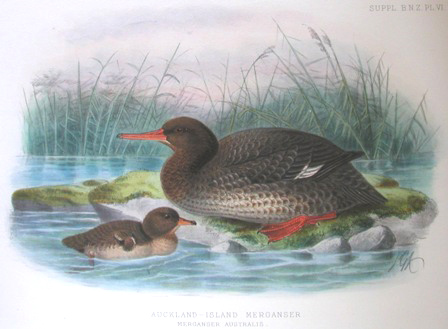 Auckland Island MerganserMergus australis
-
 Chatham Island MerganserMergus milleneri
-
 Canada GooseBranta canadensis
-
 MallardAnas platyrhynchos
-
 Muscovy DuckCairina moschata
Compare
Questions and answers
What is the scientific name of the Brazilian Merganser?
The scientific name of the Brazilian Merganser is Mergus octosetaceus. Written with its author, the full name is Mergus octosetaceus Vieillot, 1817.
Which family does the Brazilian Merganser belong to?
Mergus octosetaceus belongs to the family Anatidae, in the order Anseriformes and the class Aves.
Where is the Brazilian Merganser found?
Checklists and occurrence records place Mergus octosetaceus in 2 countries: Brazil and Argentina.
What is the conservation status of the Brazilian Merganser?
The IUCN Red List category recorded for Mergus octosetaceus is Critically Endangered (CR).
What do mergansers eat?
Fish constitute the principal food of the Brazilian Merganser. It also consumes molluscs, insects and insect larvae.[6][7]
Are merganser ducks rare?
The Brazilian Merganser is among the world's most threatened waterfowl species, with an estimated wild population of fewer than 250 birds.[20][21]
How many babies do mergansers usually have?
Brazilian Mergansers usually lay three to six eggs during June and July.[16]
Sources
Passages the profile rests on
- Both sexes have similar coloration, although females have shorter crests and bills. Source passage: “Although females are smaller with a shorter bill and crest, both sexes are alike in color.” — English Wikipedia
- Young Brazilian Mergansers are predominantly black with white throats and breasts. Source passage: “Young Brazilian mergansers are mainly black with white throat and breast.” — English Wikipedia
- The species has a particularly noticeable white speculum visible during flight. Source passage: “a white speculum is particularly noticeable in flight.” — English Wikipedia
- Adult Brazilian Mergansers measure between 49 and 56 centimetres in length. Source passage: “The slender ducks range in size from 49 to 56 centimetres (19 to 22 in) as an adult.” — English Wikipedia
- Females are smaller than males. Source passage: “Although females are smaller with a shorter bill and crest” — English Wikipedia
- Fish constitute the principal food of the Brazilian Merganser. Source passage: “Fish is the Brazilian merganser's main food” — English Wikipedia
- The species also consumes molluscs, insects and insect larvae. Source passage: “they also eat molluscs, insects and their larvae.” — English Wikipedia
- Brazilian Mergansers generally capture fish by diving in river rapids and backwaters. Source passage: “The birds, usually in pairs, capture fish by diving in river rapids and backwater.” — English Wikipedia
- The species is territorial and defends extensive stretches of river and surrounding land. Source passage: “Brazilian mergansers are very territorial birds defending large stretches of river and the land surrounding the fast-flowing water.” — English Wikipedia
- The species is generally silent but produces barking calls in certain situations. Source passage: “The Brazilian mergansers are generally silent birds, but may make barking calls in certain situations.” — English Wikipedia
- The species has four recorded types of calls. Source passage: “Four calls have been recorded.” — English Wikipedia
- A harsh krack-krack call serves as an alarm signal during flight. Source passage: “A harsh krack-krack acts as an alarm call emitted in flight.” — English Wikipedia
- Adult Brazilian Mergansers are believed to remain in the same territory throughout the year. Source passage: “Adult Brazilian mergansers are believed to remain on the same territory all year round” — English Wikipedia
- Brazilian Mergansers are resident birds that remain in the watercourses where they establish territories. Source passage: “They are recognized as a resident species that does not abandon the watercourses where it established its territory.” — English Wikipedia
- The breeding season is thought to occur during the austral winter, although its timing may vary geographically. Source passage: “It is thought the breeding season is during the austral winter, when rain is minimal and water levels are low, but it may vary geographically.” — English Wikipedia
- Brazilian Mergansers usually lay three to six eggs during June and July. Source passage: “The Brazilian merganser usually lays three to six eggs in June and July” — English Wikipedia
- Chicks generally hatch during July and August. Source passage: “with the chicks hatching during the following July and August.” — English Wikipedia
- Young birds become capable of flight by September or October. Source passage: “The young are capable of flight by September and/or October.” — English Wikipedia
- Only females incubate the eggs, while both parents participate in caring for the young. Source passage: “Only the female birds incubate the eggs, but both parents care for the young.” — English Wikipedia
- The Brazilian Merganser is among the world's most threatened waterfowl species. Source passage: “It is one of the most threatened waterfowl species in the world” — English Wikipedia
- The wild population is estimated to contain fewer than 250 birds. Source passage: “with possibly fewer than 250 birds in the wild” — English Wikipedia
- Tourism activities such as canoeing and rafting can disturb the species' habitat and interrupt breeding patterns. Source passage: “Activities such as canoeing and rafting disturb the natural habitats for the Brazilian mergansers that thrive on the rapid-rivers, interrupting breeding patterns.” — English Wikipedia
- Hunting for food and collection for exhibition specimens contributed to the species' decline. Source passage: “People hunting the birds for food and collecting them for exhibition specimens contributed to the decline of the species.” — English Wikipedia
- A captive-breeding programme for the species is led by Itatiba Zooparque in São Paulo state, Brazil. Source passage: “The Brazilian merganser captive-breeding program is led by Itatiba Zooparque, a zoo in Itatiba, São Paulo state, Brazil.” — English Wikipedia
- The first Brazilian Merganser eggs collected for captive breeding hatched at Itatiba Zooparque in 2011. Source passage: “The first collected eggs of Brazilian mergansers hatched in captivity in this zoo in 2011” — English Wikipedia
- The first generation of Brazilian Mergansers bred entirely in captivity was successfully produced in 2017. Source passage: “in 2017, Itatiba Zooparque announced the successful breeding of the first generation in captivity.” — English Wikipedia
- The Prague Zoo received its first breeding group of Brazilian Mergansers in autumn 2023. Source passage: “which received its first breeding group from Itatiba Zooparque in autumn 2023” — English Wikipedia
Data
- Catalogue of Life, 2026-10-16 XR cc by
- Global Biodiversity Information Facility CC BY 4.0
- Wikidata CC0
- GeoNames CC BY 4.0
- Wikimedia Commons per image; credit shown with each image
- Within the Catalogue of Life, this name comes from The Integrated Taxonomic Information System cc0
References
- Mayr, Ernst, and G. William Cottrell, eds. (1979). Check-List of Birds of the World, Vol. 1, Second Edition.
- Gill, Frank, & and Minturn Wright. (2006). Birds of the World: Recommended English Names.
- Dickinson, E. C., and J. V. Remsen Jr., eds. (2013). The Howard and Moore Complete Checklist of the Birds of the World, 4th Edition, Vol. 1 Non-Passerines.
This species in other databases
Page built on 29 November 2026. See how the catalog is made and all sources and licences.
Cite this page
ScientificNames.org. (2026). Mergus octosetaceus (Brazilian Merganser). Retrieved November 29, 2026, from https://scientificnames.org/species/mergus-octosetaceus
“Mergus octosetaceus (Brazilian Merganser).” ScientificNames.org, 2026, scientificnames.org/species/mergus-octosetaceus. Accessed 29 Nov. 2026.
ScientificNames.org. “Mergus octosetaceus (Brazilian Merganser).” Accessed November 29, 2026. https://scientificnames.org/species/mergus-octosetaceus.
@misc{scientificnames_mergus_octosetaceus_brazilian_merganser,
  author = {{ScientificNames.org}},
  title = {Mergus octosetaceus (Brazilian Merganser)},
  year = {2026},
  url = {https://scientificnames.org/species/mergus-octosetaceus},
  note = {Accessed 2026-11-29}
}