Species · Birds
Red-breasted Merganser Mergus serrator
The scientific name of the Red-breasted Merganser is Mergus serrator. It is a species of bird in the family Anatidae (ducks), order Anseriformes. The name dates from 1758.
- Scientific name
- Mergus serrator Linnaeus, 1758
- Common name
- Red-breasted Merganser
- Genus
- Mergus
- Family
- Anatidae (Ducks)
- Order
- Anseriformes
- Class
- Aves
- Red List category
- LC Least Concern
- Environment
- freshwater, marine, terrestrial
- Recorded in
- 86 countries
- Name status
- accepted in the Catalogue of Life

Overview
Mergus serrator breeds in freshwater lakes and rivers across northern North America, Greenland, Europe, and the Palearctic, and winters mainly in coastal waters. It is distinguished by a spiky crest and a long, thin red bill with serrated edges.
Written 26 November 2026 from the sources listed below. Each statement was checked against the passage it cites; statements that could not be supported were removed.
Appearance
Adult males have a dark green-sheened head, white neck, rusty breast, black back, and white underparts. Adult females have a rusty head and a greyish-brown body.[1][2]
The species has a spiky crest and a long, thin red bill with serrated edges. Juveniles resemble adult females but have shorter crests and slightly smaller white wing patches.[3][4]
Adults measure 51–64 cm in body length and have a wingspan of 66–74 cm. Adult males weigh approximately 950–1,350 g, while adult females weigh approximately 800–1,100 g.[5][6][7][8]
Habitat
The species breeds in freshwater lakes and rivers across northern North America, Greenland, Europe, and the Palearctic. It uses coasts, shorelines, forests, woodlands, lakes, ponds, and rivers.[9][10]
It nests in sheltered ground locations near water, frequently near estuaries or sea coasts.[11]
Diet
The Red-breasted Merganser mainly eats small fish. Its diet also includes aquatic insects, worms, crustaceans, and amphibians.[12][13]
The species is an important predator of small fish in wetland habitats.[14]
Behaviour
The species catches aquatic prey by diving from the surface and pursuing it underwater. It uses its serrated bill to capture slippery fish.[15][16]
The species is noted for its rapid flight. A male was recorded flying at 80 mph airspeed and 100 mph over land during an aircraft-induced flush.[17][18]
Males perform synchronized courtship displays while swimming, stretching, bending, and contracting their necks. These displays generally extend from mid-November through June.[19][20]
Females select preferred mates while watching male courtship displays and may chase or attack displaying males.[21]
The species is largely silent outside specific courtship and flight vocalizations. Females give a rasping prrak prrak call during courtship, while males produce a catlike meow.[22][23][24]
Outside the breeding season, the species forms flocks that are generally smaller during spring migration than in autumn and winter.[25]
Reproduction and life cycle
The species breeds in freshwater lakes and rivers throughout northern North America, Greenland, Europe, and the Palearctic.[26]
Its eggs measure approximately 5.8–6.8 cm long and 4.3–4.7 cm wide. Incubation lasts approximately 28–35 days.[27][28]
Hatchlings leave the nest within 24 hours of hatching.[29]
Conservation
The Red-breasted Merganser is classified as Least Concern by the IUCN. Its worldwide population is stable, although some populations may be declining.[30][31][32]
Threats include habitat loss through wetland destruction, exposure to pesticides and lead, and becoming bycatch in commercial fishing operations.[33][34][35]
The species is covered by the Agreement on the Conservation of African-Eurasian Migratory Waterbirds.[36]
Similar species
The Red-breasted Merganser has a broadly overlapping geographic range with the Common Merganser. The Red-breasted Merganser generally prefers saltwater habitats, whereas the Common Merganser generally prefers freshwater habitats.[37][38]
Classification of the Red-breasted Merganser
| Kingdom | Animalia |
|---|---|
| Phylum | Chordata |
| Subphylum | Vertebrata |
| Infraphylum | Gnathostomata |
| Parvphylum | Osteichthyes |
| Megaclass | Tetrapoda |
| Class | Aves (Bird) |
| Order | Anseriformes (Ducks) |
| Family | Anatidae (Ducks) |
| Genus | Mergus (Greater Mergansers) |
| Species | Mergus serrator Linnaeus, 1758 |
Where the Red-breasted Merganser is found
Checklists and occurrence records place Mergus serrator in 86 countries across Asia, North America and Oceania. GBIF holds 3,721,197 georeferenced records of it.
Countries
- Aland Islands 1,156
- Albania 39
- Armenia 3
- Austria 600
- Azerbaijan 159
- Bahamas 258
- Belarus 166
- Belgium 5,948
- Belize 81
- Bermuda 249
- Bosnia and Herzegovina 3
- Bulgaria 1,937
- Canada 521,487
- Cayman Islands 95
- China 1,528
- Costa Rica 25
- Croatia 846
- Cuba 1,529
- Cyprus 15
- Czechia 941
- Denmark 250,567
- Dominican Republic 4
- Estonia 23,463
- Faroe Islands 1,598
- Finland 30,361
- France 21,625
- Georgia 140
- Germany 13,383
- Greece 1,017
- Greenland 688
- Guernsey 8
- Honduras 37
- Hong Kong 74
- Hungary 211
- Iceland 34,747
- India 126
- Iran 41
- Ireland 7,354
- Isle of Man 257
- Israel 283
- Italy 4,785
- Japan 11,525
- Jersey 230
- Kazakhstan 176
- Kuwait 12
- Kyrgyzstan 22
- Latvia 439
- Lithuania 248
- Luxembourg 7
- Macao 6
- Mexico 6,979
- Moldova 13
- Mongolia 210
- Montenegro 7
- North Korea 34
- North Macedonia 3
- Norway 423,292
- Oman 4
- Panama 8
- Poland 4,273
- Portugal 1,407
- Puerto Rico 93
- Romania 293
- Russia 7,730
- Saint Pierre and Miquelon 702
- Serbia 81
- Sint Maarten 8
- Slovakia 172
- Slovenia 804
- South Korea 3,148
- Spain 4,867
- Svalbard and Jan Mayen 30
- Sweden 432,003
- Switzerland 2,302
- Taiwan 746
- Thailand 16
- The Netherlands 126,315
- Turkey 1,197
- Turkmenistan 4
- Turks and Caicos Islands 5
- Ukraine 1,270
- United Arab Emirates 14
- United Kingdom 83,752
- United States 1,678,908
- Uzbekistan 3
- Vietnam 5
Regions and cities with the most records
- Ontario, Canada 247,425
- New York, United States 168,766
- Massachusetts, United States 146,816
- Illinois, United States 113,137
- Ohio, United States 97,456
- Washington, United States 93,118
- Michigan, United States 87,959
- Wisconsin, United States 84,960
- California, United States 81,200
- Quebec, Canada 79,140
- Florida, United States 69,053
- New Jersey, United States 64,416
- British Columbia, Canada 64,128
- Chicago, United States 59,214
- Cicero, United States 56,067
- Berwyn, United States 55,155
- Toronto, Canada 54,143
- Västra Götaland, Sweden 52,171
- Maine, United States 51,987
- Etobicoke, Canada 51,856
- Skåne, Sweden 51,568
- Kalmar, Sweden 46,622
- Connecticut, United States 46,038
- Oak Park, United States 43,517
- Brooklyn, United States 43,290
- Zealand, Denmark 43,126
- Elmwood Park, United States 42,793
- New York City, United States 41,742
- Queens, United States 41,217
- Skokie, United States 41,199
- Gloucester, United States 41,167
- Evanston, United States 41,111
- Niles, United States 40,663
- Morton Grove, United States 40,621
- Park Ridge, United States 40,144
- Wilmette, United States 39,165
6 more countries have a few records outside this range
These countries hold a few records of Mergus serrator but lie outside the range the checklists give for it. Such records are often zoo or garden specimens, museum material or vagrants, so the species is not counted as occurring there.
Range as the checklists state it
Europe & Northern Asia (excluding China)
Middle America
North America
Southern Asia
A number beside a place is its count of GBIF occurrence records. A place without a number comes from a checklist alone. Records show where a species has been observed or collected, which can include escapes and vagrants.
Common names
English
- Red-breasted Merganser
- Fishing Duck
- Red-breast Merganser
Names in 74 other languages
- Albanian
- Zhytësi i mesëm me callme, zhytësi i mesëm me çallmë
- Arabic
- بطة غواصة حمراء الصدر, بلقشة حمراء الصدر
- Armenian
- Բադ սղոցակտուց
- Asturian
- Coríu Sierra, merguyu
- Azerbaijani
- Uzunburun pazdimdik
- Basque
- Zerra ertain, Zerra ertaina
- Belarusian
- Даўгадзюбы крахаль, Даўганосы савук, Крахаль даўгадзюбы
- Bengali
- লালবুক ডুবুরি হাঁস
- Breton
- Heskenneg kuch
- Bulgarian
- Среден нирец
- Catalan
- bec de serra mitjà
- Chinese
- 海秋沙, 紅胸秋沙, 红胸秋沙鸭
- Croatian
- mali ronac
- Czech
- morčák prostřední
- Danish
- toppet skallesluger
- Dutch
- middelste zaagbek
- Esperanto
- mezgranda merĝo
- Estonian
- rohukoskel
- Faroese
- Toppont
- Finnish
- tukkakoskelo
- French
- Harle huppé, bec-scie à poitrine rousse
- Galician
- Mergo cristado
- Georgian
- გრძელნისკარტა
- German
- Mittelsäger
- Greek
- Θαλασσοβουττηκτής, Θαλασσοπρίστης
- Hebrew
- מרגון בינוני
- Hungarian
- örvös bukó
- Icelandic
- Toppönd
- Irish
- Gairg
- Italian
- smergo minore
- Japanese
- ウミアイサ
- Kazakh
- Секпілтєс бейнарық, Секпілтөс бейнарық
- Korean
- 바다비오리
- Latvian
- garknābja gaura
- Lithuanian
- vidutinis dančiasnapis
- Luxembourgish
- Mëttelseeër
- Macedonian
- Среден потопник, среден северен нуркач
- Maltese
- Serra
- Mongolian
- Сэвгэр бохио
- Nepali
- कुमथोप्ले मणितुण्डक
- Northern Sami
- goalsi, unnagoalssáš, vuoktagoalsi, čievragoalsi
- Norwegian
- siland
- Persian
- اردک ماهیخوار کاکلی, مرگوس کاکلی
- Polish
- szlachar, tracz długodzioby
- Portuguese
- merganso-de-poupa
- Romanian
- ferestraş moţat, ferestraşul moţat
- Russian
- Длинноносый крохаль, Средний крохаль, длинноносый, или морской крохаль
- Scottish Gaelic
- sìolta dhearg, sìoltaidhean dearga, síolta rua
- Serbian
- Srednji ronac, Средњи ронац
- Slovak
- potápač prostredný
- Slovenian
- Srednja žagarica, srednji žagar, veliki žagar
- Spanish
- Mergansa Pechiroja, Mergansa piquilarga, Mergo copetón, Serreta mediana
- Swedish
- småskrake
- Thai
- เป็ดปากยาวอกแดง
- Turkish
- tarakdis, tarakdiş
- Ukrainian
- Крех довгоносий, Крех середній, Крех середній (Крех довгоносий), Середній крех
- Welsh
- Hwyaid Brongoch, hwyaden frongoch
- arg
- Mergo meyano
- bak
- Ҡушы
- chv
- Вӑтам крохаль
- cor
- Sedhor brongough
- csb
- Mùcnica
- fry
- Bûnte Seachbek
- glv
- Sheeltey yiarg, Thunnag Cleeau Yiarg
- hat
- Kanna fal wouj
- kal
- Miteq siorartooq, nujalik, paaq
- kjn
- Орта сус
- oji
- Gaawanzig, ᑲᐊᐧᓯ`
- pcd
- Hurlard
- pnb
- رتی چھاتی آلی مرگانسر
- roh
- Marel mesaun
- rue
- Середнїй крохаль
- sah
- Улун
- tyv
- Узун думчуктуг даргат
Synonyms
7 other scientific names have been used for this species and are now treated as synonyms of Mergus serrator.
- Merganser serrator Linnaeus, C, 1758
- Mergus castor Linnaeus, C, 1766
- Mergus epaumopherus de Sélys Longchamps, ME, 1831
- Mergus rubecula Palmer, S, 1836
- Mergus serrator major Schiøler, EL, 1925
- Mergus serrator schioleri Salomonsen, 1949
- Mergus serrator serrator Linnaeus, 1758
Related species
-
 Common MerganserMergus merganser
-
 Scaly-sided MerganserMergus squamatus
-
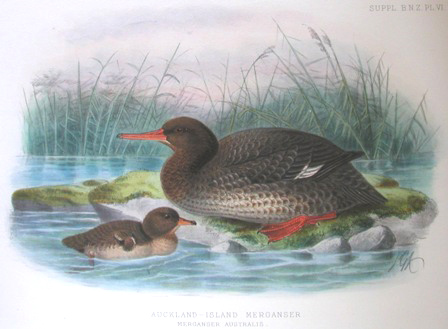 Auckland Island MerganserMergus australis
-
 Brazilian MerganserMergus octosetaceus
-
 Chatham Island MerganserMergus milleneri
-
 Canada GooseBranta canadensis
-
 MallardAnas platyrhynchos
-
 Muscovy DuckCairina moschata
Compare
Questions and answers
What is the scientific name of the Red-breasted Merganser?
The scientific name of the Red-breasted Merganser is Mergus serrator. Written with its author, the full name is Mergus serrator Linnaeus, 1758.
Which family does the Red-breasted Merganser belong to?
Mergus serrator belongs to the family Anatidae, in the order Anseriformes and the class Aves.
Where is the Red-breasted Merganser found?
Checklists and occurrence records place Mergus serrator in 86 countries, including United States, Canada, Sweden, Norway, Denmark and The Netherlands.
What is the conservation status of the Red-breasted Merganser?
The IUCN Red List category recorded for Mergus serrator is Least Concern (LC).
What other names does the Red-breasted Merganser have?
Mergus serrator is also known in English as Fishing Duck and Red-breast Merganser.
How rare are Red-breasted Merganser?
The Red-breasted Merganser is classified as Least Concern by the IUCN, and its worldwide population is stable. Some populations may be declining.[30][31][32]
What are the differences between a Common Merganser and a Red-breasted Merganser?
The two species have broadly overlapping geographic ranges. The Red-breasted Merganser generally prefers saltwater habitats, whereas the Common Merganser generally prefers freshwater habitats.[37][38]
What do red-breasted merganser eat?
They mainly eat small fish, with aquatic insects, worms, crustaceans, and amphibians also included in their diet.[12][13]
Sources
Passages the profile rests on
- Adult males have a dark green-sheened head, white neck, rusty breast, black back, and white underparts. Source passage: “The male has a dark head with a green sheen, a white neck with a rusty breast, a black back, and white underparts.” — English Wikipedia
- Adult females have a rusty head and a greyish-brown body. Source passage: “Adult females have a rusty head and a greyish-brown body.” — English Wikipedia
- The species has a spiky crest and a long, thin red bill with serrated edges. Source passage: “It has a spiky crest and long thin red bill with serrated edges.” — English Wikipedia
- Juveniles resemble adult females but have shorter crests and slightly smaller white wing patches. Source passage: “Juveniles look similar to females, but have a shorter crest, and marginally smaller white wing patches.” — English Wikipedia
- Adults measure 51–64 cm in body length. Source passage: “The adult red-breasted merganser is 51–64 cm (20–25 in) long” — English Wikipedia
- Adults have a wingspan of 66–74 cm. Source passage: “has a wingspan of 66–74 cm (26–29 in).” — English Wikipedia
- Adult males weigh approximately 950–1,350 g. Source passage: “Males average slightly larger, weighing 950–1,350 g (34–48 oz)” — English Wikipedia
- Adult females weigh approximately 800–1,100 g. Source passage: “compared to female weight of 800–1,100 g (28–39 oz).” — English Wikipedia
- The species breeds in freshwater lakes and rivers across northern North America, Greenland, Europe, and the Palearctic. Source passage: “Its breeding habitat is freshwater lakes and rivers across northern North America, Greenland, Europe, and the Palearctic.” — English Wikipedia
- The species uses coasts, shorelines, forests, woodlands, lakes, ponds, and rivers. Source passage: “Habitat. Coasts and Shorelines, Forests and Woodlands, Lakes, Ponds, and Rivers” — audubon.org
- The species nests in sheltered ground locations near water, frequently near estuaries or sea coasts. Source passage: “It nests in sheltered locations on the ground near water, often, but far from always, close to estuaries or sea coasts.” — English Wikipedia
- The species mainly eats small fish. Source passage: “It mainly eats small fish” — English Wikipedia
- Its diet also includes aquatic insects, worms, crustaceans, and amphibians. Source passage: “but also consumes aquatic insects, worms, crustaceans, and amphibians.” — English Wikipedia
- The species is an important predator of small fish in wetland habitats. Source passage: “Red-breasted mergansers are important predators of small fish in their wetland habitats.” — animaldiversity.org
- The species catches aquatic prey by diving from the surface and pursuing it underwater. Source passage: “feed by diving from the surface to pursue aquatic animals underwater” — English Wikipedia
- The species uses its serrated bill to capture slippery fish. Source passage: “using serrated bills to capture slippery fish.” — English Wikipedia
- The species is noted for its rapid flight. Source passage: “The red-breasted merganser has been noted for its fast flight speed.” — English Wikipedia
- A male was recorded flying at 80 mph airspeed and 100 mph over land during an aircraft-induced flush. Source passage: “a male was clocked at 80 mph (130 km/h) airspeed, 100 mph (160 km/h) over land.” — English Wikipedia
- Males perform synchronized courtship displays involving stretching, bending, and contracting their necks. Source passage: “in which they stretch, bend and contract their necks, often in synchrony by several males together” — English Wikipedia
- Courtship displays take place while swimming and generally extend from mid-November through June. Source passage: “Display, which takes place while swimming, starts in mid November, and continues until June or rarely July.” — English Wikipedia
- Females select preferred mates while watching male courtship displays and may chase or attack displaying males. Source passage: “females watch from nearby to select their preferred mate, and often chase or even attack the males.” — English Wikipedia
- The species is largely silent outside specific courtship and flight vocalizations. Source passage: “At other times this species is largely silent.” — English Wikipedia
- Females give a rasping prrak prrak call during courtship. Source passage: “During courtship, the female gives a rasping prrak prrak” — English Wikipedia
- Males produce a catlike meow during courtship. Source passage: “while the male gives a catlike meow.” — English Wikipedia
- Outside the breeding season, the species forms flocks that are generally smaller during spring migration than in autumn and winter. Source passage: “Outside of the breeding season, it forms flocks, which tend to be smaller during spring migration than they are in autumn migration and in winter.” — English Wikipedia
- The species breeds in freshwater lakes and rivers throughout northern North America, Greenland, Europe, and the Palearctic. Source passage: “Its breeding habitat is freshwater lakes and rivers across northern North America, Greenland, Europe, and the Palearctic.” — English Wikipedia
- Eggs measure approximately 5.8–6.8 cm long and 4.3–4.7 cm wide. Source passage: “The eggs measure 5.8–6.8 cm (2.3–2.7 in) in length and 4.3–4.7 cm (1.7–1.9 in) in width.” — English Wikipedia
- Incubation lasts approximately 28–35 days. Source passage: “Incubation takes 28 to 35 days.” — English Wikipedia
- Hatchlings leave the nest within 24 hours of hatching. Source passage: “After hatching, young leave the nest within 24 hours.” — English Wikipedia
- The species is classified as Least Concern by the IUCN. Source passage: “The species is widespread and common enough to be given conservation status of least concern by the IUCN” — English Wikipedia
- The worldwide population of the species is stable. Source passage: “The worldwide population of this species is stable” — English Wikipedia
- Some populations may be declining. Source passage: “though populations in some areas may be declining.” — English Wikipedia
- Habitat loss through wetland destruction is identified as a threat to the species. Source passage: “Threats include habitat loss through wetland destruction” — English Wikipedia
- Exposure to pesticides and lead is identified as a threat to the species. Source passage: “exposure to toxins such as pesticides and lead” — English Wikipedia
- The species is threatened by becoming bycatch in commercial fishing operations. Source passage: “and becoming bycatch of commercial fishing operations.” — English Wikipedia
- The species is covered by the Agreement on the Conservation of African-Eurasian Migratory Waterbirds. Source passage: “The red-breasted merganser is one of the species to which the Agreement on the Conservation of African-Eurasian Migratory Waterbirds (AEWA) applies.” — English Wikipedia
- The species has a broadly overlapping geographic range with the common merganser. Source passage: “The range of the red-breasted merganser broadly overlaps with that of the similar and closely related common merganser.” — English Wikipedia
- The red-breasted merganser generally prefers saltwater habitats, whereas the common merganser generally prefers freshwater habitats. Source passage: “red-breasted prefers saltwater, common prefers freshwater, but overlap is frequent” — English Wikipedia
- The species is mostly migratory, with northern breeding populations wintering farther south in coastal waters. Source passage: “It is mostly migratory and northern breeders winter in coastal waters further south.” — English Wikipedia
Data
- Catalogue of Life, 2026-10-16 XR cc by
- Global Biodiversity Information Facility CC BY 4.0
- Wikidata CC0
- GeoNames CC BY 4.0
- Wikimedia Commons per image; credit shown with each image
- Within the Catalogue of Life, this name comes from The Integrated Taxonomic Information System cc0
References
- Linnaeus, C. (1758). Systema Naturae per regna tria naturae, secundum classes, ordines, genera, species, cum characteribus, differentiis, synonymis, locis. Tomus I. Editio decima, reformata. Laurentii Salvii. Holmiae [Stockholm]. [iii] + 824 pp. where the name was published
- Mayr, Ernst, and G. William Cottrell, eds. (1979). Check-List of Birds of the World, Vol. 1, Second Edition.
- Banks, R. C., R. W. McDiarmid, and A. L. Gardner. (1987). Checklist of Vertebrates of the United States, the U.S. Territories, and Canada. Resource Publication, No. 166.
- Gill, Frank, & and Minturn Wright. (2006). Birds of the World: Recommended English Names.
- Dickinson, E. C., and J. V. Remsen Jr., eds. (2013). The Howard and Moore Complete Checklist of the Birds of the World, 4th Edition, Vol. 1 Non-Passerines.
This species in other databases
- Catalogue of Life 3ZTRQ
- Wikidata Q189609
- iNaturalist 6996
- WoRMS urn:lsid:marinespecies.org:taxname:159098
- Avibase rebmer
Page built on 26 November 2026. See how the catalog is made and all sources and licences.
Cite this page
ScientificNames.org. (2026). Mergus serrator (Red-breasted Merganser). Retrieved November 26, 2026, from https://scientificnames.org/species/mergus-serrator
“Mergus serrator (Red-breasted Merganser).” ScientificNames.org, 2026, scientificnames.org/species/mergus-serrator. Accessed 26 Nov. 2026.
ScientificNames.org. “Mergus serrator (Red-breasted Merganser).” Accessed November 26, 2026. https://scientificnames.org/species/mergus-serrator.
@misc{scientificnames_mergus_serrator_red_breasted_merganser,
  author = {{ScientificNames.org}},
  title = {Mergus serrator (Red-breasted Merganser)},
  year = {2026},
  url = {https://scientificnames.org/species/mergus-serrator},
  note = {Accessed 2026-11-26}
}