Species · Fishes
Suwannee Bass Micropterus notius
The scientific name of the Suwannee Bass is Micropterus notius. It is a species of fish in the family Centrarchidae (sunfishes), order Centrarchiformes. The name dates from 1949.
- Scientific name
- Micropterus notius Bailey & Hubbs, 1949
- Common name
- Suwannee Bass
- Genus
- Micropterus
- Family
- Centrarchidae (Sunfishes)
- Order
- Centrarchiformes
- Class
- Teleostei
- Red List category
- NT Near Threatened
- Environment
- freshwater
- Recorded in
- 1 country
- Name status
- accepted in the Catalogue of Life

Overview
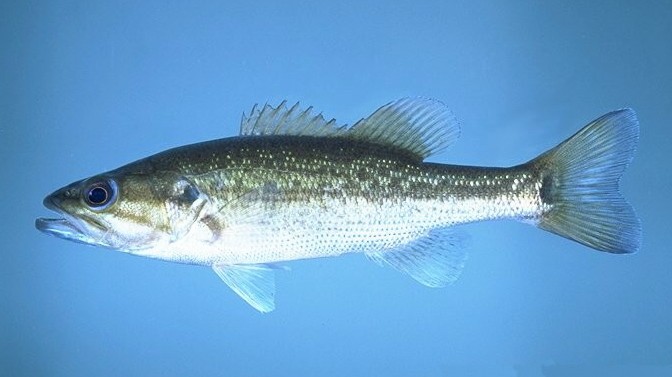
The native range includes the lower Suwannee River system in Florida, the Ochlockonee River system in Florida and a small part of Georgia. It has a deep body, a large mouth and approximately twelve olive blotches along its mostly brown flanks.
Written 26 November 2026 from the sources listed below. Each statement was checked against the passage it cites; statements that could not be supported were removed.
Appearance
The Suwannee Bass has a deep body and a large mouth, with the maxilla positioned beneath the eye. It has a circular patch of teeth on its tongue, and the bases of its soft dorsal and anal fins are scaled.[1][2][3]
The fish is mostly brown, with approximately twelve olive blotches along its flanks. These blotches merge toward the tail to form a horizontal band near the caudal peduncle, and a large, pale-margined blotch occurs at the base of the caudal fin.[4][5][6]
Young individuals have conspicuous mottling on their soft dorsal, anal and caudal fins. Breeding adults develop turquoise coloration on their cheeks, breasts and bellies.[7][8]
Habitat
The Suwannee Bass inhabits shallow, fast-flowing river shoals over limestone, often with sand covering the limestone. It generally prefers neutral or basic waters supplied by springs emerging from limestone aquifers.[9][10]
The species is uncommon in the tidal lower reaches of the Suwannee River. It is absent from the upper Suwannee River, where acidic waters drain from the Okefenokee Swamp.[11][12]
Diet
The Suwannee Bass consumes other invertebrates and fishes. In the tidal lower reaches of the Suwannee River, its diet includes blue crabs.[13][14]
Reproduction and life cycle
The spawning season extends from February through May, with activity peaking in April and May. Spawning occurs when water temperatures reach approximately 18–19 °C.[15][16][17]
Females lay eggs in circular depressions excavated near stream edges. Males fertilize the eggs and subsequently guard them until hatching.[18][19]
Uses
The Suwannee Bass is targeted by recreational sport fishing.[20]
Classification of the Suwannee Bass
| Kingdom | Animalia |
|---|---|
| Phylum | Chordata |
| Subphylum | Vertebrata |
| Infraphylum | Gnathostomata |
| Parvphylum | Osteichthyes |
| Gigaclass | Actinopterygii |
| Superclass | Actinopteri |
| Class | Teleostei (Teleost) |
| Order | Centrarchiformes |
| Family | Centrarchidae (Sunfishes) |
| Genus | Micropterus (Black Basses) |
| Species | Micropterus notius Bailey & Hubbs, 1949 |
Where the Suwannee Bass is found
Checklists and occurrence records place Micropterus notius in 1 country. GBIF holds 682 georeferenced records of it.
Countries
Regions and cities with the most records
- Florida, United States 583
- Tallahassee, United States 15
- Georgia, United States 10
- Valdosta, United States 7
- Alabama, United States 3
- Auburn, United States 3
- Opelika, United States 3
A number beside a place is its count of GBIF occurrence records. A place without a number comes from a checklist alone. Records show where a species has been observed or collected, which can include escapes and vagrants.
Common names
English
- Suwannee Bass
- Bass
Names in 5 other languages
- Czech
- okounek suwanneeský
- Danish
- Suwannee-ørredaborre
- Mandarin Chinese
- 南方黑鱸, 南方黑鲈
- Portuguese
- Achigã-de-Suwannee
- Russian
- Чёрный окунь
Related species
-
 Largemouth BassMicropterus salmoides
-
 Smallmouth BassMicropterus dolomieu
-
 Guadalupe BassMicropterus treculii
-
 Spotted BassMicropterus punctulatus
-
 Florida BassMicropterus floridanus
-
 Redeye BassMicropterus coosae
-
 Shoal BassMicropterus cataractae
- Alabama BassMicropterus henshalli
Compare
Questions and answers
What is the scientific name of the Suwannee Bass?
The scientific name of the Suwannee Bass is Micropterus notius. Written with its author, the full name is Micropterus notius Bailey & Hubbs, 1949.
Which family does the Suwannee Bass belong to?
Micropterus notius belongs to the family Centrarchidae, in the order Centrarchiformes and the class Teleostei.
Where is the Suwannee Bass found?
Checklists and occurrence records place Micropterus notius in 1 country: United States.
What is the conservation status of the Suwannee Bass?
The IUCN Red List category recorded for Micropterus notius is Near Threatened (NT).
What other names does the Suwannee Bass have?
Micropterus notius is also known in English as Bass.
How big do Suwannee bass get?
The maximum reported total length is 40 cm, while the usual total length is approximately 21 cm. The maximum published weight is 1.8 kg. Males rarely exceed 33 cm, and females grow faster and reach larger sizes than males.[21][22][23][24][25]
What is the world record for the Suwannee bass?
The IGFA all-tackle world record weight is 1.75 kg, recorded from the Suwannee River in 1985. A length record of 17 inches was reported from the Withlacoochee River in 2025.[26][27]
Where does Suwannee bass live?
The species is native to the southeastern United States. Its native range includes the lower Suwannee River system in Florida, the Ochlockonee River system in Florida and a small part of Georgia. It has also been introduced into Florida's St. Marks River and Wacissa River.[28][29][30][31][32][33]
Sources
Passages the profile rests on
- The Suwannee bass has a deep body and a large mouth, with the maxilla positioned beneath the eye. Source passage: “has a deep body with a large mouth in which the maxilla is placed beneath the eye” — English Wikipedia
- The species has a circular patch of teeth on its tongue. Source passage: “there is a circular patch of teeth on the tongue.” — English Wikipedia
- The bases of the soft dorsal fin and anal fin are scaled. Source passage: “The base of the soft part of the dorsal fin and the anal fin are scaled.” — English Wikipedia
- The fish is mostly brown, with approximately twelve olive blotches along its flanks. Source passage: “They are mostly brown in color marked with a dozen olive blotches on the flanks.” — English Wikipedia
- The flank blotches merge toward the tail to form a horizontal band near the caudal peduncle. Source passage: “they merge towards the tail eventually creating a horizontal band near the caudal peduncle.” — English Wikipedia
- A large, pale-margined blotch occurs at the base of the caudal fin. Source passage: “There is a large blotch at the base of the caudal fin which has a pale margin” — English Wikipedia
- Young individuals have conspicuous mottling on the soft dorsal, anal, and caudal fins. Source passage: “young fish which also show bold mottling on the soft part of the dorsal fin, the anal fin and the caudal fin.” — English Wikipedia
- Breeding adults develop turquoise coloration on their cheeks, breasts, and bellies. Source passage: “In the breeding season, the adults show a turquoise coloration on the cheek, breast and belly.” — English Wikipedia
- The species inhabits shallow, fast-flowing river shoals over limestone, often with sand covering the limestone. Source passage: “found in fast-moving shallow areas of rivers, known as shoals, over limestone, this is frequently covered in sand.” — English Wikipedia
- Suwannee bass generally prefer neutral or basic waters supplied by springs emerging from limestone aquifers. Source passage: “They usually prefer neutral or basic waters, originating in springs emerging from aquifers in the limestone.” — English Wikipedia
- The species is uncommon in the tidal lower reaches of the Suwannee River. Source passage: “They are uncommon in the lower parts of the Suwannee River where there is a tidal influence” — English Wikipedia
- The species is absent from the upper Suwannee River, where acidic waters drain from the Okefenokee Swamp. Source passage: “but are absent from the upper reaches which are dominated by acidic waters draining from the Okefenokee Swamp.” — English Wikipedia
- The species also consumes other invertebrates and fishes. Source passage: “although they will eat other invertebrates and fishes.” — English Wikipedia
- Blue crabs are consumed by Suwannee bass in the tidal lower reaches of the Suwannee River. Source passage: “In the lower, tidal reaches of the Suwannee River, the blue crab is taken by this species.” — English Wikipedia
- The spawning season extends from February through May. Source passage: “The spawning season runs from February to May” — English Wikipedia
- Spawning activity peaks in April and May. Source passage: “peaking in April and May” — English Wikipedia
- Spawning occurs when water temperatures reach approximately 18–19 °C. Source passage: “when the water temperature reaches 18–19 °C (64–66 °F)” — English Wikipedia
- Females lay eggs in circular depressions excavated near stream edges. Source passage: “The eggs are laid in circular depressions excavated near the edges of the streams” — English Wikipedia
- Males fertilize the eggs and subsequently guard them until hatching. Source passage: “where they are fertilized by the male. The male then guards the eggs up to the point of hatching.” — English Wikipedia
- The Suwannee bass is targeted by recreational sport fishing. Source passage: “M. notius is also fished for sport.” — English Wikipedia
- The maximum reported total length of the Suwannee bass is 40 cm. Source passage: “This species attains a maximum total length of 40 centimeters (16 in)” — English Wikipedia
- The usual total length of the species is approximately 21 cm. Source passage: “a more usual total length would be around 21 centimeters (8.3 in)” — English Wikipedia
- The maximum published weight for the species is 1.8 kg. Source passage: “the maximum published weight is 1.8 kilograms (4.0 lb).” — English Wikipedia
- Males rarely exceed 33 cm in length. Source passage: “the males rarely attain lengths greater than 13 inches (33 cm).” — English Wikipedia
- Females grow faster and reach larger sizes than males. Source passage: “Females have a faster growth rate and attain larger sizes than the males;” — English Wikipedia
- The IGFA all-tackle world record weight for the species is 1.75 kg, recorded from the Suwannee River in 1985. Source passage: “The IGFA all-tackle world record for the species stands at 1.75 kg (3 lb 14 oz) caught from the Suwannee River in 1985” — English Wikipedia
- A length record of 17 inches was reported from the Withlacoochee River in 2025. Source passage: “the length record is 17 inches (43 cm) from the Withlacoochee River in 2025.” — English Wikipedia
- The species is native to the southeastern United States. Source passage: “The Suwannee bass is endemic to the southeastern United States” — English Wikipedia
- Its native range includes the lower Suwannee River system in Florida. Source passage: “native to the lower Suwannee and Ochlockonee River systems in Florida” — English Wikipedia
- Its native range includes the Ochlockonee River system in Florida. Source passage: “native to the lower Suwannee and Ochlockonee River systems in Florida” — English Wikipedia
- The species' native range extends into a small part of Georgia. Source passage: “and a small part of Georgia.” — English Wikipedia
- The species has been introduced into Florida's St. Marks River. Source passage: “It has been introduced into the St. Marks River” — English Wikipedia
- The species has also been introduced into Florida's Wacissa River. Source passage: “and the Wacissa River in Florida.” — English Wikipedia
Data
- Catalogue of Life, 2026-10-16 XR cc by
- Global Biodiversity Information Facility CC BY 4.0
- Wikidata CC0
- GeoNames CC BY 4.0
- Wikimedia Commons per image; credit shown with each image
- Within the Catalogue of Life, this name comes from World Register of Marine Species cc by
References
- Bailey, R. M., & Dimick, M. F. (1949). The black basses (Micropterus) of Florida, with description of a new species. Occasional Papers of the Museum of Zoology University of Michigan, 516: 1–40, Pls. 1–2. where the name was published
This species in other databases
- Catalogue of Life 6RHTM
- Wikidata Q3756613
- iNaturalist 105820
- WoRMS urn:lsid:marinespecies.org:taxname:1014262
- ITIS 168164
Page built on 26 November 2026. See how the catalog is made and all sources and licences.
Cite this page
ScientificNames.org. (2026). Micropterus notius (Suwannee Bass). Retrieved November 26, 2026, from https://scientificnames.org/species/micropterus-notius
“Micropterus notius (Suwannee Bass).” ScientificNames.org, 2026, scientificnames.org/species/micropterus-notius. Accessed 26 Nov. 2026.
ScientificNames.org. “Micropterus notius (Suwannee Bass).” Accessed November 26, 2026. https://scientificnames.org/species/micropterus-notius.
@misc{scientificnames_micropterus_notius_suwannee_bass,
  author = {{ScientificNames.org}},
  title = {Micropterus notius (Suwannee Bass)},
  year = {2026},
  url = {https://scientificnames.org/species/micropterus-notius},
  note = {Accessed 2026-11-26}
}