Species · Fishes
Guadalupe Bass Micropterus treculii
The scientific name of the Guadalupe Bass is Micropterus treculii. It is a species of fish in the family Centrarchidae (sunfishes), order Centrarchiformes. The name dates from 1874.
- Scientific name
- Micropterus treculii (Vaillant & Bocourt, 1874)
- Common name
- Guadalupe Bass
- Genus
- Micropterus
- Family
- Centrarchidae (Sunfishes)
- Order
- Centrarchiformes
- Class
- Teleostei
- Red List category
- NT Near Threatened
- Environment
- freshwater
- Recorded in
- 1 country
- Name status
- accepted in the Catalogue of Life

Overview
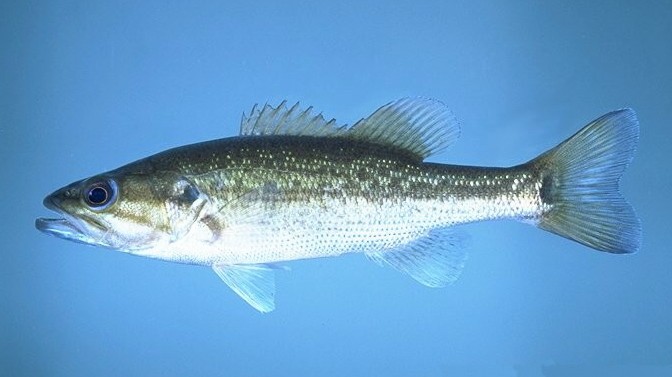
The species is endemic to Texas in the United States and occurs in the Edwards Plateau of central Texas. It is generally lime green to olive green and has mostly separate diamond-shaped or circular spots along its lateral line.
Written 26 November 2026 from the sources listed below. Each statement was checked against the passage it cites; statements that could not be supported were removed.
Appearance
The Guadalupe Bass is generally lime green to olive green in coloration. River-dwelling specimens are usually lighter in coloration.[1][2]
Its lateral line bears mostly separate diamond-shaped or circular spots that fade from black to olive as the fish ages. The back has additional small diamond-shaped markings.[3][4]
The species has a rectangular tooth patch on its tongue. Its green coloration extends below the lateral line farther than in its relatives.[5][6]
Habitat
Guadalupe Bass inhabit streams and reservoirs but are absent from extreme headwaters. They typically inhabit flowing water and prefer flowing stream water within their native range.[7][8][9]
The species occurs in the Edwards Plateau of central Texas. Its principal river habitats include the San Marcos, Colorado, Llano, and Guadalupe Rivers.[10][11]
It also occurs in Barton Creek, Onion Creek, the San Gabriel River, and the Comal River.[12]
Guadalupe Bass use large rocks, cypress trees, and stumps as refuges. Juveniles typically inhabit fast-moving water and begin moving into deeper water with moderate currents by the end of their first year.[13][14][15]
Diet
Newly hatched fry feed on invertebrates. Juvenile and very old Guadalupe Bass show an inclination toward eating insects.[16][17]
At their predatory peak, Guadalupe Bass prefer larger baitfish, including shad, small bass, and bluegills.[18]
Behaviour
The Guadalupe Bass is known to hybridize with other bass. It has very few natural predators.[19][20]
Reproduction and life cycle
Both sexes reach adulthood and sexual maturity at one year of age. Spawning can begin in March and continue through June, depending on location and water conditions.[21][22]
A secondary spawning period can occur in late summer or early fall. Males construct and select gravel nests in shallow water with high flow rates outside the fastest currents.[23][24]
Females lay between 400 and 9,000 eggs per spawning event. Males chase females away immediately after egg laying.[25][26]
Males guard their nests against predators after spawning and may strike fishing lures to defend their territory. They continue guarding the fry after hatching.[27][28][29]
Conservation
The Guadalupe Bass is classified as near threatened. Hybridization with introduced smallmouth bass is identified as its principal threat.[30][31]
In some rivers, hybrids account for almost half of the Guadalupe Bass population. Hybridization with smallmouth bass has caused pure Guadalupe Bass to disappear from parts of its native range.[32][33]
Guadalupe Bass have been intentionally stocked outside their native range for conservation purposes. Introduced populations have become established in the Nueces River basin.[34][35]
The ecological risk assessment classifies the species' history of invasiveness as data deficient. Its overall ecological risk assessment category in the contiguous United States is uncertain.[36][37]
Uses
The Guadalupe Bass is a popular sport fish in Texas and is popular among fishermen in Central Texas. Anglers value the species for its prolonged and strenuous fights.[38][39][40]
Its preference for strong currents and insect-rich diet have earned it the nickname Texas brook trout. Catch-and-release fishing is commonly practiced to help improve Guadalupe Bass populations.[41][42]
Similar species
The Guadalupe Bass can be difficult to distinguish from the smallmouth bass and spotted bass. Its physical characteristics closely resemble those of the spotted bass.[43][44]
Classification of the Guadalupe Bass
| Kingdom | Animalia |
|---|---|
| Phylum | Chordata |
| Subphylum | Vertebrata |
| Infraphylum | Gnathostomata |
| Parvphylum | Osteichthyes |
| Gigaclass | Actinopterygii |
| Superclass | Actinopteri |
| Class | Teleostei (Teleost) |
| Order | Centrarchiformes |
| Family | Centrarchidae (Sunfishes) |
| Genus | Micropterus (Black Basses) |
| Species | Micropterus treculii (Vaillant & Bocourt, 1874) |
Where the Guadalupe Bass is found
Checklists and occurrence records place Micropterus treculii in 1 country. GBIF holds 3,018 georeferenced records of it.
Countries
Regions and cities with the most records
- Texas, United States 2,826
- Austin, United States 200
- Kerrville, United States 183
- San Marcos, United States 116
- Round Rock, United States 113
- Brushy Creek, United States 108
- Georgetown, United States 107
- Hutto, United States 106
- Belton, United States 100
- Kyle, United States 98
- Cedar Park, United States 92
- Pflugerville, United States 91
- Leander, United States 90
- Canyon Lake, United States 73
- Harker Heights, United States 69
- San Antonio, United States 50
- New Braunfels, United States 48
- Copperas Cove, United States 46
- Temple, United States 46
- Taylor, United States 45
- Seguin, United States 40
- Fort Cavazos, United States 34
- Killeen, United States 32
- Uvalde, United States 15
- Cibolo, United States 12
- Alabama, United States 6
- Auburn, United States 6
- Opelika, United States 6
- Schertz, United States 4
- Universal City, United States 4
- Victoria, United States 4
- Converse, United States 3
- Live Oak, United States 3
- Stephenville, United States 3
- Waco, United States 3
A number beside a place is its count of GBIF occurrence records. A place without a number comes from a checklist alone. Records show where a species has been observed or collected, which can include escapes and vagrants.
Common names
English
- Guadalupe Bass
- Bass
- Guadaloupe Bass
Names in 5 other languages
- Czech
- okounek guadalupský
- Danish
- Guadalupe-ørredaborre
- Mandarin Chinese
- 特氏黑鱸, 特氏黑鲈
- Portuguese
- Achigã-de-Guadalupe
- Spanish
- Lobina del río Guadalupe
Synonyms
2 other scientific names have been used for this species and are now treated as synonyms of Micropterus treculii.
- Dioplites nuecensis treculii Vaillant & Bocourt, 1874
- Micropterus treculi (Vaillant & Bocourt, 1874)
Related species
-
 Largemouth BassMicropterus salmoides
-
 Smallmouth BassMicropterus dolomieu
-
 Spotted BassMicropterus punctulatus
-
 Florida BassMicropterus floridanus
-
 Redeye BassMicropterus coosae
-
 Shoal BassMicropterus cataractae
- Alabama BassMicropterus henshalli
-
 Suwannee BassMicropterus notius
Compare
Questions and answers
What is the scientific name of the Guadalupe Bass?
The scientific name of the Guadalupe Bass is Micropterus treculii. Written with its author, the full name is Micropterus treculii (Vaillant & Bocourt, 1874).
Which family does the Guadalupe Bass belong to?
Micropterus treculii belongs to the family Centrarchidae, in the order Centrarchiformes and the class Teleostei.
Where is the Guadalupe Bass found?
Checklists and occurrence records place Micropterus treculii in 1 country: United States.
What is the conservation status of the Guadalupe Bass?
The IUCN Red List category recorded for Micropterus treculii is Near Threatened (NT).
What other names does the Guadalupe Bass have?
Micropterus treculii is also known in English as Bass and Guadaloupe Bass.
How rare are Guadalupe bass?
The Guadalupe Bass is classified as near threatened. Hybridization with introduced smallmouth bass is its principal threat, and pure Guadalupe Bass have disappeared from parts of their native range.[30][31][33]
What's the difference between a largemouth bass and a Guadalupe bass?
The Guadalupe Bass is generally lime green to olive green, has mostly separate diamond-shaped or circular spots along its lateral line, and has a rectangular tooth patch on its tongue. No distinguishing characteristics of the largemouth bass are provided.[1][3][5]
What is the biggest Guadalupe bass ever caught?
The documented record catch weighed 3.71 pounds.[45]
Sources
Passages the profile rests on
- The species is generally lime green to olive green in coloration. Source passage: “Guadalupe bass, like most black bass, are lime to olive green in color” — English Wikipedia
- River-dwelling specimens are usually lighter in coloration. Source passage: “this particular species being lighter in shade usually in river specimens.” — English Wikipedia
- Its lateral line bears mostly separate diamond-shaped or circular spots that fade from black to olive as the fish ages. Source passage: “They have a lateral line covered in mostly separate diamond-shaped or circular spots, which with age fade from black to olive.” — English Wikipedia
- The back bears additional small diamond-shaped markings. Source passage: “Also, many smaller diamond marks are scattered on the back” — English Wikipedia
- The species has a rectangular tooth patch on its tongue. Source passage: “They have a rectangular tooth patch on the tongue.” — English Wikipedia
- Its green coloration extends below the lateral line farther than in its relatives. Source passage: “the green coloring tends to extend lower on the body past the lateral line than their relatives.” — English Wikipedia
- Guadalupe bass inhabit streams and reservoirs but are absent from extreme headwaters. Source passage: “Typically, Guadalupe bass are found in streams and reservoirs; they are absent from extreme headwaters.” — English Wikipedia
- The species prefers flowing stream water within its native range. Source passage: “They prefer flowing waters of streams within native variety” — English Wikipedia
- Guadalupe bass typically inhabit flowing water. Source passage: “Typically, Guadalupe bass are found in flowing water” — tpwd.texas.gov
- The species occurs in the Edwards Plateau of central Texas. Source passage: “The fish is only found in the Edwards Plateau in central Texas.” — English Wikipedia
- Its principal river habitats include the San Marcos, Colorado, Llano, and Guadalupe Rivers. Source passage: “Its main habitats are the San Marcos, Colorado, Llano, and Guadalupe Rivers” — English Wikipedia
- The species also occurs in Barton Creek, Onion Creek, the San Gabriel River, and the Comal River. Source passage: “but can also be found in smaller streams such as Barton Creek, Onion Creek, San Gabriel River and the Comal River.” — English Wikipedia
- Guadalupe bass use large rocks, cypress trees, and stumps as refuges. Source passage: “use covers such as large rocks, cypress trees, or stumps for refuge.” — English Wikipedia
- Juveniles typically inhabit fast-moving water. Source passage: “Juvenile fish are often found in fast-moving water” — English Wikipedia
- By the end of their first year, juveniles begin moving into deeper water with moderate currents. Source passage: “but begin transitioning to deeper, moderate current towards the end of their first year.” — English Wikipedia
- Juvenile and very old Guadalupe bass show an inclination toward eating insects. Source passage: “The fish (especially juveniles and very old fish), unlike other bass, have an inclination towards insects.” — English Wikipedia
- Newly hatched fry feed on invertebrates. Source passage: “After hatching, the fry feed on invertebrates.” — English Wikipedia
- At their predatory peak, Guadalupe bass prefer larger baitfish, including shad, small bass, and bluegills. Source passage: “Guadalupe bass at their predatory peak prefer larger bait fish such as shad and small bass or bluegills.” — English Wikipedia
- The species is known to hybridize with other bass. Source passage: “and the fish is known to hybridize.” — English Wikipedia
- Guadalupe bass have very few natural predators. Source passage: “The Guadalupe bass has almost no predators.” — English Wikipedia
- Both sexes reach adulthood and sexual maturity at one year of age. Source passage: “Both male and female Guadalupe Bass reach adulthood and sexually maturity at one year of age.” — English Wikipedia
- Spawning can begin in March and continue through June, depending on location and water conditions. Source passage: “Their spawning begins as early as March and continues into June depending on the locale and water conditions.” — English Wikipedia
- A secondary spawning period can occur in late summer or early fall. Source passage: “a secondary spawn is possible in late summer or early fall.” — English Wikipedia
- Males construct and select gravel nests in shallow water with high flow rates outside the fastest currents. Source passage: “The male Guadalupe Bass builds and picks out a gravel nest for spawning in shallow water where there is a high flow rate but out of the way of fast moving water.” — English Wikipedia
- Females lay between 400 and 9,000 eggs per spawning event. Source passage: “The female lays between 400 and 9000 eggs” — English Wikipedia
- Males chase females away immediately after egg laying. Source passage: “but is chased away by the male immediately after she lays the eggs.” — English Wikipedia
- Males guard their nests against predators after spawning. Source passage: “the male guards the nest from predators” — English Wikipedia
- Males remain on nest-guarding duty and may strike fishing lures to defend their territory. Source passage: “and will not eat, but may strike a lure in order to defend its territory.” — English Wikipedia
- Males continue guarding the fry after hatching. Source passage: “The male Guadalupe stays guard over the fry as they hatch.” — English Wikipedia
- The Guadalupe bass is classified as near threatened. Source passage: “and is listed as near threatened.” — English Wikipedia
- Hybridization with introduced smallmouth bass is identified as the species' principal threat. Source passage: “Its main threat is not predation, but hybridization with the introduced smallmouth bass.” — English Wikipedia
- In some rivers, hybrids account for almost half of the Guadalupe bass population. Source passage: “in some rivers almost half the Guadalupe bass are hybrids.” — English Wikipedia
- Hybridization with smallmouth bass has caused pure Guadalupe bass to disappear from parts of its native range. Source passage: “Hybridization with Smallmouth Bass (Micropterus dolomieu) has resulted in disappearance of pure M. treculii from parts of its native range.” — fws.gov
- Guadalupe bass have been intentionally stocked outside their native range for conservation purposes. Source passage: “has been intentionally stocked beyond its native range for conservation purposes.” — fws.gov
- Introduced Guadalupe bass populations have become established in the Nueces River basin. Source passage: “introductions have resulted in established populations in the Nueces River basin” — fws.gov
- The ecological risk assessment classifies the species' history of invasiveness as data deficient. Source passage: “The History of Invasiveness for M. treculii is classified as Data Deficient.” — fws.gov
- The overall ecological risk assessment category for the species in the contiguous United States is uncertain. Source passage: “The Overall Risk Assessment Category for M. treculii in the contiguous United States is Uncertain.” — fws.gov
- The Guadalupe bass is a popular sport fish in Texas. Source passage: “M. treculii is a popular sportfish in Texas” — fws.gov
- The species is popular among fishermen in Central Texas. Source passage: “the Guadalupe bass is very popular among fishermen in Central Texas.” — English Wikipedia
- The species is valued by anglers for its prolonged and strenuous fights. Source passage: “It is prized for its long, tough fights” — English Wikipedia
- Its preference for strong currents and insect-rich diet have earned it the nickname Texas brook trout. Source passage: “Its preference for strong current and its large diet of insects earned it the name "Texas brook trout"” — English Wikipedia
- Catch-and-release fishing is commonly practiced to help improve Guadalupe bass populations. Source passage: “Today, most fly fishermen and anglers practice catch-and-release techniques to improve fish populations.” — English Wikipedia
- The Guadalupe bass can be difficult to distinguish from the smallmouth bass and spotted bass. Source passage: “The Guadalupe bass is often difficult to distinguish from the smallmouth bass or spotted bass” — English Wikipedia
- Its physical characteristics closely resemble those of the spotted bass. Source passage: “Its physical traits are very similar to the spotted bass” — English Wikipedia
- The documented record catch weighed 3.71 pounds. Source passage: “So far, the record catch is 3.71 lb (3 lb 11.4 oz)” — English Wikipedia
Data
- Catalogue of Life, 2026-10-16 XR cc by
- Global Biodiversity Information Facility CC BY 4.0
- Wikidata CC0
- GeoNames CC BY 4.0
- Wikimedia Commons per image; credit shown with each image
- Within the Catalogue of Life, this name comes from World Register of Marine Species cc by
This species in other databases
- Catalogue of Life 4353K
- Wikidata Q11435863
- iNaturalist 105822
- WoRMS urn:lsid:marinespecies.org:taxname:1463308
- ITIS 168162
Page built on 28 November 2026. See how the catalog is made and all sources and licences.
Cite this page
ScientificNames.org. (2026). Micropterus treculii (Guadalupe Bass). Retrieved November 28, 2026, from https://scientificnames.org/species/micropterus-treculii
“Micropterus treculii (Guadalupe Bass).” ScientificNames.org, 2026, scientificnames.org/species/micropterus-treculii. Accessed 28 Nov. 2026.
ScientificNames.org. “Micropterus treculii (Guadalupe Bass).” Accessed November 28, 2026. https://scientificnames.org/species/micropterus-treculii.
@misc{scientificnames_micropterus_treculii_guadalupe_bass,
  author = {{ScientificNames.org}},
  title = {Micropterus treculii (Guadalupe Bass)},
  year = {2026},
  url = {https://scientificnames.org/species/micropterus-treculii},
  note = {Accessed 2026-11-28}
}