Species · Mammals
Prehensile-tailed Hutia Mysateles prehensilis
The scientific name of the Prehensile-tailed Hutia is Mysateles prehensilis. It is a species of mammal in the family Echimyidae (coypu), order Rodentia. The name dates from 1824.
- Scientific name
- Mysateles prehensilis (Poeppig, 1824)
- Common name
- Prehensile-tailed Hutia
- Genus
- Mysateles
- Family
- Echimyidae (Coypu)
- Order
- Rodentia
- Class
- Mammalia
- Red List category
- NT Near Threatened
- Recorded in
- 1 country
- Name status
- accepted in the Catalogue of Life

Overview
Mysateles prehensilis inhabits primary and secondary forests, wooded areas, and mangrove areas of tropical Cuba. It has a partially prehensile tail and an arboreal lifestyle.
Written 26 November 2026 from the sources listed below. Each statement was checked against the passage it cites; statements that could not be supported were removed.
Uses
People in Cuba use the Prehensile-tailed Hutia as a food source.[1]
Similar species
The genus Mesocapromys is identified as the closest relative of Mysateles. Capromys is the sister group to Mysateles and Mesocapromys.[2][3]
The Prehensile-tailed Hutia is the only extant member of the genus Mysateles.[4]
Appearance
The Prehensile-tailed Hutia has a small, furry, rat-like body. Its dorsal fur ranges from black to grey, while its ventral fur often starts white and becomes brown toward the rear.[5][6][7]
Its tail is partially prehensile and can reach 80% of its body length.[8][9]
Habitat
The Prehensile-tailed Hutia inhabits both primary and secondary forests. It also occurs in wooded areas and mangrove areas of tropical Cuba.[10][11][12]
The species is endemic to Cuba and is primarily distributed across the western half of Cuba.[13][14]
Diet
The Prehensile-tailed Hutia primarily eats fruits, leaves, and bark.[15]
Its consumption of fruits may contribute to seed dispersal.[16]
Behaviour
The Prehensile-tailed Hutia has an arboreal lifestyle. Its claws and semi-prehensile tail enable it to climb exceptionally well.[17][18]
Reproduction and life cycle
The species has separate male and female sexes. Its mating system remains poorly understood.[19][20]
Conservation
The Prehensile-tailed Hutia is classified as near threatened on the IUCN Red List. Its population is declining despite being locally common in some areas.[21][22]
Deforestation and habitat fragmentation threaten the species.[23][24]
Classification of the Prehensile-tailed Hutia
| Kingdom | Animalia |
|---|---|
| Phylum | Chordata |
| Subphylum | Vertebrata |
| Infraphylum | Gnathostomata |
| Parvphylum | Osteichthyes |
| Megaclass | Tetrapoda |
| Class | Mammalia (Mammal) |
| Subclass | Theria |
| Infraclass | Eutheria |
| Order | Rodentia (Rodent) |
| Suborder | Hystricomorpha |
| Infraorder | Hystricognathi (Hystricognath Rodents) |
| Family | Echimyidae (Coypu) |
| Subfamily | Capromyinae |
| Tribe | Capromyini |
| Genus | Mysateles (Prehensile-tailed Hutia) |
| Species | Mysateles prehensilis (Poeppig, 1824) |
Where the Prehensile-tailed Hutia is found
Checklists and occurrence records place Mysateles prehensilis in 1 country across North America. GBIF holds 230 georeferenced records of it.
Countries
Regions and cities with the most records
- Pinar del Río, Cuba 76
- Isla de la Juventud, Cuba 39
- Sancti Spíritus Province, Cuba 34
- Los Palacios, Cuba 21
- Yaguajay, Cuba 18
- Nueva Gerona, Cuba 16
- Matanzas Province, Cuba 11
- Abreus, Cuba 7
- Cienfuegos, Cuba 7
- Cienfuegos Province, Cuba 7
- Minas de Matahambre, Cuba 7
- Palmira, Cuba 7
- Rodas, Cuba 7
- Sancti Spíritus, Cuba 7
- Viñales, Cuba 7
- Guane, Cuba 6
- Consolación del Sur, Cuba 5
- Florencia, Cuba 5
- Jatibonico, Cuba 5
- Alquízar, Cuba 4
- Bauta, Cuba 4
- Bejucal, Cuba 4
- Cabaiguán, Cuba 4
- Condado, Cuba 4
- Fontanar, Cuba 4
- Guanajay, Cuba 4
- Güira de Melena, Cuba 4
- La Salud, Cuba 4
- San Antonio de los Baños, Cuba 4
- Santiago de las Vegas, Cuba 4
- Trinidad, Cuba 4
- Arroyo Naranjo, Cuba 3
- Calimete, Cuba 3
- Ciego de Ávila Province, Cuba 3
- Jagüey Grande, Cuba 3
- Primero de Enero, Cuba 3
Range as the checklists state it
Caribbean
A number beside a place is its count of GBIF occurrence records. A place without a number comes from a checklist alone. Records show where a species has been observed or collected, which can include escapes and vagrants.
Common names
English
- Prehensile-tailed Hutia
Names in 6 other languages
- Dutch
- Hutiacarabali
- Finnish
- camagueynhutia
- Japanese
- オマキフチア
- Polish
- kubohutia rudawa
- Portuguese
- Hutia-de-cauda-preênsil
- Spanish
- Jutía Carabalí
Synonyms
2 other scientific names have been used for this species and are now treated as synonyms of Mysateles prehensilis.
- Capromys prehensilis Poeppig, 1824
- Mysateles poeyi Guérin-Méneville, 1834
Subspecies and varieties
- Mysateles prehensilis gundlachi (Chapman's Prehensile-tailed Hutia) subspecies
- Mysateles prehensilis meridionalis (Southern Hutia) subspecies
- Mysateles prehensilis prehensilis subspecies
Related species
- Garrido's HutiaMysateles garridoi
-
 NutriaMyocastor coypus
-
 Red-crested Tree-ratSantamartamys rufodorsalis
-
 Desmarest's HutiaCapromys pilorides
-
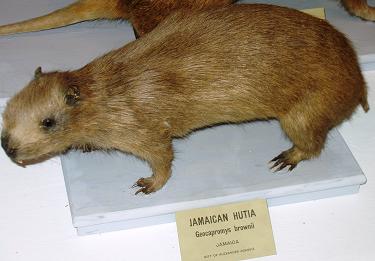 Jamaican ConeyGeocapromys brownii
-
 Hispaniolan HutiaPlagiodontia aedium
-
 Armored RatHoplomys gymnurus
-
 Bahamian HutiaGeocapromys ingrahami
Compare
Questions and answers
What is the scientific name of the Prehensile-tailed Hutia?
The scientific name of the Prehensile-tailed Hutia is Mysateles prehensilis. Written with its author, the full name is Mysateles prehensilis (Poeppig, 1824).
Which family does the Prehensile-tailed Hutia belong to?
Mysateles prehensilis belongs to the family Echimyidae, in the order Rodentia and the class Mammalia.
Where is the Prehensile-tailed Hutia found?
Checklists and occurrence records place Mysateles prehensilis in 1 country: Cuba.
What is the conservation status of the Prehensile-tailed Hutia?
The IUCN Red List category recorded for Mysateles prehensilis is Near Threatened (NT).
Sources
Passages the profile rests on
- People in Cuba use the species as a food source. Source passage: “Prehensile-tailed hutias are used as a food source by the people of Cuba.” — animaldiversity.org
- The genus Mesocapromys is identified as the closest relative of Mysateles. Source passage: “the closest relative of Mysateles is the genus Mesocapromys.” — English Wikipedia
- The genus Capromys is the sister group to Mysateles and Mesocapromys. Source passage: “Both genera are the sister group to Capromys” — English Wikipedia
- The species is the only extant member of the genus Mysateles according to the source. Source passage: “It is the only member of the genus Mysateles.” — English Wikipedia
- The species has a small, furry, rat-like body. Source passage: “a small, furry, rat-like mammal” — English Wikipedia
- Its dorsal fur ranges in color from black to grey. Source passage: “The dorsal fur ranges in color from black to grey” — animaldiversity.org
- Its ventral fur often starts white and becomes brown toward the rear. Source passage: “the ventral pelage often begins as white and then changes posteriorly to brown.” — animaldiversity.org
- Its tail is partially prehensile. Source passage: “The tail of M. prehensilis is partially prehensile” — animaldiversity.org
- Its tail can reach 80% of its body length. Source passage: “can be equal to 80% of the body's length.” — animaldiversity.org
- The species inhabits both primary and secondary forests. Source passage: “The species is found in both primary and secondary forest.” — English Wikipedia
- It occurs in wooded areas of tropical Cuba. Source passage: “Prehensile-tailed hutias occur in the woods” — animaldiversity.org
- It occurs in mangrove areas of tropical Cuba. Source passage: “and mangrove areas of tropical Cuba.” — animaldiversity.org
- The species is endemic to Cuba. Source passage: “Prehensile-tailed hutias ( Mysateles prehensilis ) are endemic to Cuba” — animaldiversity.org
- It is primarily distributed across the western half of Cuba. Source passage: “and are primarily found on the western half of the island.” — animaldiversity.org
- Its diet primarily includes fruits, leaves, and bark. Source passage: “The diet of prehensile-tailed hutias primarily consists of fruit, leaves, and bark.” — animaldiversity.org
- The species may contribute to seed dispersal through fruit consumption. Source passage: “They may help to disperse seeds through their frugivory.” — animaldiversity.org
- The species has an arboreal lifestyle. Source passage: “they exhibit an arboreal lifestyle.” — animaldiversity.org
- Its claws and semi-prehensile tail enable it to climb exceptionally well. Source passage: “Their claws and semi-prehensile tail make them exceptional climbers” — animaldiversity.org
- The species has separate male and female sexes. Source passage: “gonochoric/gonochoristic/dioecious (sexes separate)” — animaldiversity.org
- The mating system of this species remains poorly understood. Source passage: “Little is known about the mating system of prehensile-tailed hutias” — animaldiversity.org
- The species is classified as near threatened on the IUCN Red List. Source passage: “It is listed as near threatened on the IUCN Red List.” — English Wikipedia
- The species is declining despite being locally common in some areas. Source passage: “Although locally common in some areas, it is in decline” — English Wikipedia
- Deforestation threatens the species. Source passage: “is threatened by deforestation” — English Wikipedia
- Habitat fragmentation is a threat to the species. Source passage: “and habitat fragmentation.” — English Wikipedia
Data
- Catalogue of Life, 2026-10-16 XR cc by
- Global Biodiversity Information Facility CC BY 4.0
- Wikidata CC0
- GeoNames CC BY 4.0
- Wikimedia Commons per image; credit shown with each image
- Within the Catalogue of Life, this name comes from The Integrated Taxonomic Information System cc0
References
- Jour. Acad. Nat. Sci. Philadelphia vol.4 p.11 where the name was published
- Wilson, Don E., and DeeAnn M. Reeder, eds. (1993). Mammal Species of the World: A Taxonomic and Geographic Reference, 2nd Ed., 3rd Printing.
- Woods, Charles A., and C. William Kilpatrick / Wilson, Don E., and DeeAnn M. Reeder, eds. (2005). Infraorder Hystricognathi Brandt, 1855. Mammal Species of the World: A Taxonomic and Geographic Reference, 3rd Ed., Vol. 2.
- Wilson, Don E., T. E. Lacher Jr., and R. A. Mittermeier, eds. (2016). Handbook of the Mammals of the World. Vol. 6: Lagomorphs and Rodents I.
This species in other databases
Page built on 27 November 2026. See how the catalog is made and all sources and licences.
Cite this page
ScientificNames.org. (2026). Mysateles prehensilis (Prehensile-tailed Hutia). Retrieved November 27, 2026, from https://scientificnames.org/species/mysateles-prehensilis
“Mysateles prehensilis (Prehensile-tailed Hutia).” ScientificNames.org, 2026, scientificnames.org/species/mysateles-prehensilis. Accessed 27 Nov. 2026.
ScientificNames.org. “Mysateles prehensilis (Prehensile-tailed Hutia).” Accessed November 27, 2026. https://scientificnames.org/species/mysateles-prehensilis.
@misc{scientificnames_mysateles_prehensilis_prehensile_tailed_hutia,
  author = {{ScientificNames.org}},
  title = {Mysateles prehensilis (Prehensile-tailed Hutia)},
  year = {2026},
  url = {https://scientificnames.org/species/mysateles-prehensilis},
  note = {Accessed 2026-11-27}
}