Species · Birds
Denham's Bustard Neotis denhami
The scientific name of the Denham's Bustard is Neotis denhami. It is a species of bird in the family Otididae (bustard), order Otidiformes. The name dates from 1826.
- Scientific name
- Neotis denhami (Children & Vigors, 1826)
- Common name
- Denham's Bustard
- Genus
- Neotis
- Family
- Otididae (Bustard)
- Order
- Otidiformes
- Class
- Aves
- Red List category
- NT Near Threatened
- Environment
- terrestrial
- Recorded in
- 30 countries
- Name status
- accepted in the Catalogue of Life

Overview
Denham's Bustard (Neotis denhami) is a bird in the family Otididae, order Otidiformes and class Aves. It inhabits savanna, grassland and other open habitats across much of Sub-Saharan Africa. It is the largest species in the genus Neotis, with adult males weighing between 9 and 10 kg and adult females between 3 and 4 kg.
Written 26 November 2026 from the sources listed below. Each statement was checked against the passage it cites; statements that could not be supported were removed.
Appearance
The wings have brown, white and black patterns. Adult males show more white on their wings in flight than females and young birds.[1][2]
The male has a darker and plainer brown back than the female. The legs are long and pale yellow, and the bill is whitish horn in colour.[3][4][5]
Habitat
Denham's Bustard inhabits open ground, including agricultural land, grassland, floodplains and burnt fynbos. It primarily occupies savanna and grassland habitats.[6][7]
It also occurs in secondary habitats, including dense shrubland, light woodland, farmland, dried marshes and arid plains. It occurs at elevations up to 3,000 metres.[8][9]
Diet
Denham's Bustard is omnivorous. Its recorded animal foods include insects, small snakes, rodents and nestlings of other birds, and it also eats various green plant materials.[10][11][12]
It sometimes follows ungulates to collect dung beetles from their droppings.[13]
Behaviour
Denham's Bustards are usually solitary outside the mating season. Individuals congregate at large food sources and temporarily group together during migratory movements.[14][15][16]
Migration is generally associated with searching for food and follows rainfall patterns. Inland populations sometimes move to lower elevations during winter.[17][18]
The species is usually silent. Males perform courtship displays at leks to attract females.[19][20]
During courtship displays, males inflate their heads and chests and spread their tails to appear larger. They inflate their throats to reveal a conspicuous balloon of white feathers and call loudly while strutting.[21][22][23]
Reproduction and life cycle
Breeding occurs at varying times of the year, with particularly variable timing in East Africa. Rainfall may trigger breeding.[24][25][26]
The nest consists of a shallow scrape, and females lay one or two eggs. Females raise surviving offspring alone.[27][28][29]
Conservation
Denham's Bustard has experienced population declines across much or all of its range. South Africa, Kenya and Nigeria have experienced sharp population decreases.[30][31]
Hunting is the primary cause of population declines in the Sahel and West Africa. Conversion of grassland to agriculture is a major threat in eastern and southern Africa.[32][33]
Conversion of grassland into commercially logged forest also threatens the species in some areas.[34]
Classification of the Denham's Bustard
| Kingdom | Animalia |
|---|---|
| Phylum | Chordata |
| Subphylum | Vertebrata |
| Infraphylum | Gnathostomata |
| Parvphylum | Osteichthyes |
| Megaclass | Tetrapoda |
| Class | Aves (Bird) |
| Order | Otidiformes (Bustards) |
| Family | Otididae (Bustard) |
| Genus | Neotis (Neotis Bustards) |
| Species | Neotis denhami (Children & Vigors, 1826) |
Where the Denham's Bustard is found
Checklists and occurrence records place Neotis denhami in 30 countries across Africa. GBIF holds 18,930 georeferenced records of it.
Countries
- Angola 7
- Benin 219
- Botswana 48
- Burkina Faso 12
- Burundi 4
- Cameroon 8
- Central African Republic 85
- Chad 71
- Democratic Republic of the Congo 16
- Eswatini 72
- Gambia 3
- Ghana 114
- Guinea-Bissau 3
- Ivory Coast 15
- Kenya 115
- Lesotho 9
- Malawi 166
- Mozambique 19
- Namibia 15
- Niger 19
- Nigeria 54
- Republic of the Congo 4
- Rwanda 11
- Senegal 16
- South Africa 16,886
- Sudan 3
- Tanzania 22
- Uganda 610
- Zambia 285
- Zimbabwe 19
Regions and cities with the most records
- Western Cape, South Africa 6,568
- Eastern Cape, South Africa 5,048
- KwaZulu-Natal, South Africa 2,734
- Kruisfontein, South Africa 1,987
- Humansdorp, South Africa 1,922
- Mpumalanga, South Africa 1,605
- Jeffreys Bay, South Africa 1,544
- Bredasdorp, South Africa 774
- Swellendam, South Africa 674
- Pakwach, Uganda 299
- Riversdale, South Africa 275
- Plettenberg Bay, South Africa 272
- Mossel Bay, South Africa 263
- Hermanus, South Africa 259
- Howick, South Africa 252
- Mpophomeni, South Africa 252
- Groot-Brakrivier, South Africa 238
- Daggakraal, South Africa 223
- Free State, South Africa 199
- Limpopo, South Africa 195
- Atakora, Benin 166
- Port Alfred, South Africa 154
- Caledon, South Africa 152
- Western Province, Zambia 141
- Verena, South Africa 132
- Savannah, Ghana 110
- George, South Africa 91
- Motherwell, South Africa 82
- Kwaggafontein, South Africa 79
- Despatch, South Africa 67
- Newcastle, South Africa 67
- Pietermaritzburg, South Africa 67
- Hhohho Region, Eswatini 64
- Dundee, South Africa 62
- Wembesi, South Africa 61
- Mbomou, Central African Republic 60
Range as the checklists state it
Africa
A number beside a place is its count of GBIF occurrence records. A place without a number comes from a checklist alone. Records show where a species has been observed or collected, which can include escapes and vagrants.
Common names
English
- Denham's Bustard
- Stanley Bustard
Names in 35 other languages
- Afrikaans
- Veldpou
- Arabic
- الحبارى الدنهام, حبارى دينهام
- Breton
- Otiz Denham
- Catalan
- pioc de Denham
- Chinese
- 黑冠非洲鴇, 黑冠鴇, 黑冠鸨
- Croatian
- prugastoglava droplja
- Czech
- drop Denhamův
- Danish
- Brunhalset Trappe
- Dutch
- Denhams Trap
- Esperanto
- makulflugila otido
- Estonian
- pugaltiib-trapp
- Finnish
- sinikaulatrappi
- French
- Outarde de Denham
- German
- Kaffern-Trappe, Kafferntrappe, Savannentrappe
- Hungarian
- Denham-túzok
- Icelandic
- Steppudoðra
- Irish
- Bústard deinim
- Italian
- Otarda di Denham, Otarda di Stanley
- Japanese
- アフリカチュウノガン
- Latvian
- melnspārnu sīga
- Lithuanian
- tamsianugaris einis
- Northern Sami
- Ruostanisketráhppe
- Norwegian
- rustnakketrappe
- Polish
- drop białoskrzydły
- Portuguese
- abetarda-de-denham, abetarda-real
- Russian
- Кафрская африканская дрофа, Кафрская дрофа
- Serbian
- Denhamova droplja
- Slovak
- drop škvrnitokrídly
- Slovenian
- kafrska droplja
- Spanish
- Avutarda cafre
- Swedish
- denhamtrapp, rostnackad trapp
- Turkish
- Kızıl Enseli Toy
- Ukrainian
- дрохва кафрська
- Welsh
- ceiliog gwaun Denham
- bam
- Kolonkɔnɔ
Synonyms
6 other scientific names have been used for this species and are now treated as synonyms of Neotis denhami.
- Ardeotis denhami (Children & Vigors, 1826)
- Eupodotis cafra Lichtenstein, AAH, 1793
- Neotis cafra A.A.H.Lichtenstein, 1793
- Neotis cafra denhami
- Otis collei Temminck, CJ, 1836
- Otis denhami Children & Vigors, 1826
Subspecies and varieties
- Neotis denhami denhami (Denham's Bustard) subspecies
- Neotis denhami jacksoni (Jackson's Bustard) subspecies
- Neotis denhami stanleyi (Stanley's Bustard) subspecies
Related species
-
 Ludwig's BustardNeotis ludwigii
-
 Nubian BustardNeotis nuba
-
 Heuglin's BustardNeotis heuglinii
-
 Great Indian BustardArdeotis nigriceps
-
 Kori BustardArdeotis kori
-
 Great BustardOtis tarda
-
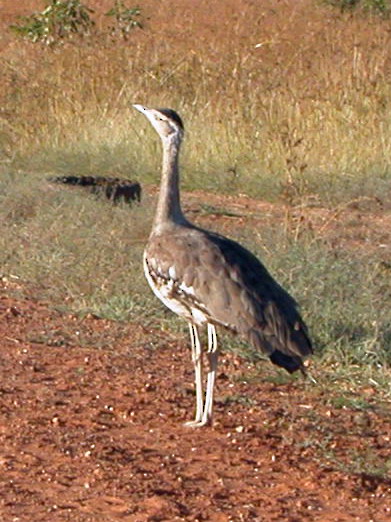 Australian BustardArdeotis australis
-
 Little BustardTetrax tetrax
Compare
Questions and answers
What is the scientific name of the Denham's Bustard?
The scientific name of the Denham's Bustard is Neotis denhami. Written with its author, the full name is Neotis denhami (Children & Vigors, 1826).
Which family does the Denham's Bustard belong to?
Neotis denhami belongs to the family Otididae, in the order Otidiformes and the class Aves.
Where is the Denham's Bustard found?
Checklists and occurrence records place Neotis denhami in 30 countries, including South Africa, Uganda, Zambia, Benin, Malawi and Kenya.
What is the conservation status of the Denham's Bustard?
The IUCN Red List category recorded for Neotis denhami is Near Threatened (NT).
What other names does the Denham's Bustard have?
Neotis denhami is also known in English as Stanley Bustard.
Sources
Passages the profile rests on
- The wings have brown, white and black patterns. Source passage: “The wings are strikingly patterned in brown, white and black” — English Wikipedia
- Adult males show more white on their wings in flight than females and young birds. Source passage: “the male showing more white in flight than the female or young birds.” — English Wikipedia
- The male has a darker and plainer brown back than the female. Source passage: “The back is brown, darker and plainer in the male” — English Wikipedia
- The legs are long and pale yellow. Source passage: “The long legs are pale yellow.” — English Wikipedia
- The bill is whitish horn in colour. Source passage: “the bill is whitish horn in color.” — English Wikipedia
- The species inhabits open ground, including agricultural land, grassland, floodplains and burnt fynbos. Source passage: “It is a species of open ground, including agricultural land, grassland, flood-plains and burnt fynbos.” — English Wikipedia
- The species primarily occupies savanna and grassland habitats. Source passage: “The Denham's bustard occupies grassland habitats. Mainly they are distributed in savanna” — English Wikipedia
- The species occurs in secondary habitats including dense shrubland, light woodland, farmland, dried marshes and arid plains. Source passage: “including dense shrubland, light woodland, farmland, dried marsh and arid plains.” — English Wikipedia
- The species occurs at elevations up to 3,000 metres. Source passage: “may be found at any elevation up to 3,000 m (9,800 ft).” — English Wikipedia
- Denham's bustard is omnivorous. Source passage: “This species is omnivorous” — English Wikipedia
- Its recorded animal foods include insects, small snakes, rodents and nestlings of other birds. Source passage: “insects, small snakes, rodents, the nestlings of other birds” — English Wikipedia
- The species also eats various green plant materials. Source passage: “and various green plant life.” — English Wikipedia
- The species sometimes follows ungulates to collect dung beetles from their droppings. Source passage: “They will sometimes follow ungulate species in order to pick dung beetles out of their droppings.” — English Wikipedia
- Denham's bustards are usually solitary outside the mating season. Source passage: “Denham's bustard are often solitary outside of the mating season” — English Wikipedia
- Individuals congregate at large food sources. Source passage: “although they congregate at large food sources” — English Wikipedia
- Individuals temporarily group together during migratory movements. Source passage: “temporarily band together for migratory movements.” — English Wikipedia
- Inland populations sometimes move to lower elevations during winter. Source passage: “some inland populations move to lower altitudes in winter.” — English Wikipedia
- Migration is generally associated with searching for food and follows rainfall patterns. Source passage: “Migration is usually in search of food sources and follows passages of rain.” — English Wikipedia
- The species is usually silent. Source passage: “This species is usually silent.” — English Wikipedia
- Males perform courtship displays at leks to attract females. Source passage: “the male Denham's bustard performs a courtship display to attract the attention on females, on what is called a lek.” — English Wikipedia
- During courtship displays, males inflate their heads and chests and spread their tails to appear larger. Source passage: “the male puffs up his head and chest and flairs his tail, thus appearing larger” — English Wikipedia
- Displaying males call loudly while strutting. Source passage: “calls loudly while he struts about.” — English Wikipedia
- Males inflate their throats during displays to reveal a conspicuous balloon of white feathers. Source passage: “The male inflates his throat when displaying to show a conspicuous balloon of white feathers.” — English Wikipedia
- Breeding occurs at varying times of the year. Source passage: “Breeding occurs over varied times of the year” — English Wikipedia
- Breeding timing is particularly variable in East Africa. Source passage: “being especially undefined in East Africa.” — English Wikipedia
- Rainfall may trigger breeding. Source passage: “Breeding may brought on by presence of rainfall.” — English Wikipedia
- The nest consists of a shallow scrape. Source passage: “The nest consists of a shallow scrape” — English Wikipedia
- Females lay one or two eggs. Source passage: “in which the female lays one or two eggs” — English Wikipedia
- Females raise surviving offspring alone. Source passage: “which (if they survive) she will raise alone.” — English Wikipedia
- The species has experienced population declines across much or all of its range. Source passage: “It has suffered population declines through much, if not all, of its range.” — English Wikipedia
- South Africa, Kenya and Nigeria have experienced sharp population decreases. Source passage: “Countries including South Africa, Kenya and Nigeria have had a sharp decrease in population.” — English Wikipedia
- Hunting is the primary cause of population declines in the Sahel and West Africa. Source passage: “Hunting is the primary cause of declines across the Sahel and West Africa” — English Wikipedia
- Conversion of grassland to agriculture is a major threat in eastern and southern Africa. Source passage: “in eastern and southern Africa, conversion of grassland to agriculture is a greater threat.” — English Wikipedia
- Conversion of grassland into commercially logged forest threatens the species in some areas. Source passage: “In some areas, the conversion of grassland into commercially logged forest has become a threat for the species.” — English Wikipedia
Data
- Catalogue of Life, 2026-10-16 XR cc by
- Global Biodiversity Information Facility CC BY 4.0
- Wikidata CC0
- GeoNames CC BY 4.0
- Wikimedia Commons per image; credit shown with each image
- Within the Catalogue of Life, this name comes from The Integrated Taxonomic Information System cc0
References
- Gill, Frank, & and Minturn Wright. (2006). Birds of the World: Recommended English Names.
This species in other databases
- Catalogue of Life 46VB9
- Wikidata Q773787
- iNaturalist 85
- WoRMS urn:lsid:marinespecies.org:taxname:1657364
- Avibase stabus1
Page built on 27 November 2026. See how the catalog is made and all sources and licences.
Cite this page
ScientificNames.org. (2026). Neotis denhami (Denham's Bustard). Retrieved November 27, 2026, from https://scientificnames.org/species/neotis-denhami
“Neotis denhami (Denham's Bustard).” ScientificNames.org, 2026, scientificnames.org/species/neotis-denhami. Accessed 27 Nov. 2026.
ScientificNames.org. “Neotis denhami (Denham's Bustard).” Accessed November 27, 2026. https://scientificnames.org/species/neotis-denhami.
@misc{scientificnames_neotis_denhami_denhams_bustard,
  author = {{ScientificNames.org}},
  title = {Neotis denhami (Denham's Bustard)},
  year = {2026},
  url = {https://scientificnames.org/species/neotis-denhami},
  note = {Accessed 2026-11-27}
}