Species · Birds
Nubian Bustard Neotis nuba
The scientific name of the Nubian Bustard is Neotis nuba. It is a species of bird in the family Otididae (bustard), order Otidiformes. The name dates from 1826.
- Scientific name
- Neotis nuba (Cretzschmar, 1826)
- Common name
- Nubian Bustard
- Genus
- Neotis
- Family
- Otididae (Bustard)
- Order
- Otidiformes
- Class
- Aves
- Red List category
- VU Vulnerable
- Recorded in
- 3 countries
- Name status
- accepted in the Catalogue of Life

Overview
Neotis nuba inhabits sparsely vegetated areas between the southern Sahara and northern Sahel. Adults have rufous and sandy plumage with a distinctive broad sandy-rufous crown stripe.
Written 26 November 2026 from the sources listed below. Each statement was checked against the passage it cites; statements that could not be supported were removed.
Habitat
The Nubian Bustard inhabits dry savanna and subtropical or tropical dry shrubland. It occupies sparsely vegetated areas between the southern Sahara and northern Sahel.[1][2][3]
Its preferred habitats include desert fringes, semi-arid scrub, and dry savannah with scattered vegetation.[4]
Diet
The Nubian Bustard is omnivorous. Its animal prey includes beetles and grasshoppers, while its plant foods include grass seeds, leaves, and fruits.[5][6][7]
Behaviour
Males perform a display by walking with their tails held vertically in a forked position and their wing tips resting between the fork. They maintain a retracted neck during the display, which is performed alone without nearby individuals of the same species.[8][9][10]
Recorded vocalizations consist of relatively quiet, low booming or hooting sounds.[11]
Reproduction and life cycle
The breeding season extends from July to October and coincides with the regional rainy season.[12][13]
Nubian Bustards construct nests by scraping shallow depressions into the ground. Young birds and eggs are threatened by mammalian carnivores and reptiles.[14][15]
Conservation
The Nubian Bustard is classified as Vulnerable on the IUCN Red List. It has become very rare and its populations are declining.[16][17]
Important remaining populations occur in protected reserves in Niger and Chad.[18]
Uses
The Nubian Bustard is used as a source of meat by local nomadic communities. It is also targeted by falconers from the Arabian Peninsula.[19][20]
Similar species
The Nubian Bustard is smaller than the sympatric Arabian bustard.[21]
Appearance
Juveniles have paler and less contrasting plumage than adults. Males and females have similar coloration.[22][23]
The face has black throat and eyebrow patches, which are less distinct in females. The outer tail feathers are longer, stiffer, and more sharply pointed than the central tail feathers.[24][25]
Adult males average approximately 70 cm in length and approximately 5.4 kg in weight. Their average wingspan is approximately 180 cm.[26][27][28]
Females measure approximately 50 cm in length and have an average wingspan of approximately 140 cm.[29][30]
Classification of the Nubian Bustard
| Kingdom | Animalia |
|---|---|
| Phylum | Chordata |
| Subphylum | Vertebrata |
| Infraphylum | Gnathostomata |
| Parvphylum | Osteichthyes |
| Megaclass | Tetrapoda |
| Class | Aves (Bird) |
| Order | Otidiformes (Bustards) |
| Family | Otididae (Bustard) |
| Genus | Neotis (Neotis Bustards) |
| Species | Neotis nuba (Cretzschmar, 1826) |
Where the Nubian Bustard is found
Checklists and occurrence records place Neotis nuba in 3 countries across Africa. GBIF holds 54 georeferenced records of it.
Countries
Regions and cities with the most records
Range as the checklists state it
Africa
A number beside a place is its count of GBIF occurrence records. A place without a number comes from a checklist alone. Records show where a species has been observed or collected, which can include escapes and vagrants.
Common names
English
- Nubian Bustard
- NUBU
Names in 32 other languages
- Arabic
- حبارى نوبية
- Breton
- Otiz Nubia
- Catalan
- pioc núbic
- Chinese
- 棕頂鴇, 棕顶鸨, 黑喉非洲鴇
- Croatian
- sahelska droplja
- Czech
- drop núbijský
- Danish
- Nubisk Trappe
- Dutch
- Nubische Trap
- Esperanto
- nubia otido
- Estonian
- kõrbetrapp
- Finnish
- saharantrappi
- French
- Outarde de Nubie, Outarde nubienne
- German
- Nubientrappe, Nubier-Trappe, Nubiertrappe
- Hungarian
- száheltúzok
- Icelandic
- Valldoðra
- Irish
- Bústard núbiach
- Italian
- Otarda nubiana
- Japanese
- ヌビアチュウノガン
- Latvian
- Nūbijas sīga
- Lithuanian
- nubinis einis
- Northern Sami
- Sahalatráhppe
- Norwegian
- saheltrappe
- Polish
- drop nubijski
- Portuguese
- abetarda-de-barrete-ruivo, abetarda-núbia
- Russian
- Нубийская африканская дрофа, Нубийская дрофа
- Serbian
- Nubijska droplja
- Slovak
- drop čiernobradý
- Spanish
- Avutarda núbica
- Swedish
- nubisk trapp
- Turkish
- Nübye Toyu
- Ukrainian
- дрохва нубійська
- Welsh
- ceiliog gwaun Nwbia
Synonyms
3 other scientific names have been used for this species and are now treated as synonyms of Neotis nuba.
- Ardeotis nuba (Cretzschmar, 1826)
- Ardeotis nuba nuba Cretzschmar, PJ, 1826
- Otis nuba Cretzschmar, 1826
Related species
-
 Denham's BustardNeotis denhami
-
 Ludwig's BustardNeotis ludwigii
-
 Heuglin's BustardNeotis heuglinii
-
 Great Indian BustardArdeotis nigriceps
-
 Kori BustardArdeotis kori
-
 Great BustardOtis tarda
-
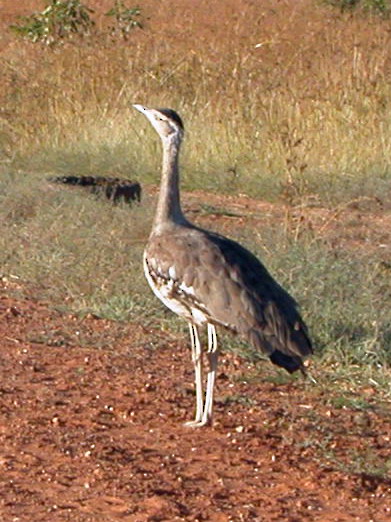 Australian BustardArdeotis australis
-
 Little BustardTetrax tetrax
Compare
Questions and answers
What is the scientific name of the Nubian Bustard?
The scientific name of the Nubian Bustard is Neotis nuba. Written with its author, the full name is Neotis nuba (Cretzschmar, 1826).
Which family does the Nubian Bustard belong to?
Neotis nuba belongs to the family Otididae, in the order Otidiformes and the class Aves.
Where is the Nubian Bustard found?
Checklists and occurrence records place Neotis nuba in 3 countries: Chad, Niger and Sudan.
What is the conservation status of the Nubian Bustard?
The IUCN Red List category recorded for Neotis nuba is Vulnerable (VU).
What other names does the Nubian Bustard have?
Neotis nuba is also known in English as NUBU.
Can you eat a bustard bird?
The Nubian Bustard is used as a source of meat by local nomadic communities.[19]
Sources
Passages the profile rests on
- The species inhabits dry savanna. Source passage: “Its natural habitats are dry savanna” — English Wikipedia
- The species inhabits subtropical or tropical dry shrubland. Source passage: “subtropical or tropical dry shrubland.” — English Wikipedia
- The species occupies sparsely vegetated areas between the southern Sahara and northern Sahel. Source passage: “found in the sparsely vegetated interface between the southern margins of the Sahara desert and the northern part of the Sahel.” — English Wikipedia
- Its preferred habitats include desert fringes, semi-arid scrub, and dry savannah with scattered vegetation. Source passage: “Preferred habitats include desert fringes, semi-arid scrub, and dry savannah with scattered vegetation.” — English Wikipedia
- The Nubian bustard is omnivorous. Source passage: “Nubian bustards are omnivorous” — English Wikipedia
- Its animal prey includes beetles and grasshoppers. Source passage: “large insects (beetles, grasshoppers)” — English Wikipedia
- Its plant foods include grass seeds, leaves, and fruits. Source passage: “grass seeds, leaves and fruits.” — English Wikipedia
- Males perform a display by walking with their tails held vertically in a forked position and their wing tips resting between the fork. Source passage: “Males perform a unique forked-tail display, walking with tail held vertically and wing-tips resting between the fork.” — English Wikipedia
- Males maintain a retracted neck during their display. Source passage: “The Nubian bustard maintains a retracted neck during display.” — English Wikipedia
- The male display is performed alone without nearby individuals of the same species. Source passage: “The display is performed solitarily with no nearby conspecifics” — English Wikipedia
- Recorded vocalizations consist of relatively quiet, low booming or hooting sounds. Source passage: “The calls that have been recorded are reported to be relatively quiet compared to the loud vocalizations characteristic of some other bustard species. and consist of low booming or hooting.” — English Wikipedia
- The breeding season extends from July to October. Source passage: “Breeding occurs from July to October” — English Wikipedia
- Breeding coincides with the regional rainy season. Source passage: “coinciding with the region's rainy season.” — English Wikipedia
- Nubian bustards construct nests by scraping shallow depressions into the ground. Source passage: “Nubian bustards create scape nests by scraping shallow depressions in the ground.” — English Wikipedia
- Young birds and eggs are threatened by mammalian carnivores and reptiles. Source passage: “Young birds and eggs are threatened by a wider range of predators, including mammalian carnivores (jackals, foxes and possibly honey badgers) and reptiles (monitor lizards and possibly large snakes).” — English Wikipedia
- The species is classified as Vulnerable on the IUCN Red List according to the document. Source passage: “Currently classified as Vulnerable by the IUCN” — English Wikipedia
- The species has become very rare and its populations are declining. Source passage: “Formerly common in this region, it is now very rare, with populations declining due to hunting and habitat degradation.” — English Wikipedia
- Important remaining populations occur in protected reserves in Niger and Chad. Source passage: “important populations do exist in federally protected areas such as the Aïr and Ténéré National Nature Reserve (RNNAT) and the Termit and Tin-Toumma National Nature Reserve (RNNTT) in Niger, and the Ouadi Rimé-Ouadi Achim Faunal Reserve (RFOROA) in Chad.” — English Wikipedia
- The species is used as a source of meat by local nomadic communities. Source passage: “it is known to local nomadic peoples as a source of meat.” — English Wikipedia
- The species is targeted by falconers from the Arabian Peninsula. Source passage: “The species has gained unfortunate notoriety as a prized quarry for falconers from the Arabian Peninsula” — English Wikipedia
- The Nubian bustard is smaller than the sympatric Arabian bustard. Source passage: “It is smaller than the sympatric Arabian bustard” — English Wikipedia
- Juveniles have paler and less contrasting plumage than adults. Source passage: “Immature plumage in juveniles are paler and less contrasted than adults.” — English Wikipedia
- Males and females have similar coloration. Source passage: “Both sexes are similar in coloration.” — English Wikipedia
- The outer tail feathers are longer, stiffer, and more sharply pointed than the central tail feathers. Source passage: “the outer rectrices being longer, stiffer, and more sharply pointed than the central tail feathers.” — English Wikipedia
- The face has black throat and eyebrow patches, which are less distinct in females. Source passage: “The face is boldly marked, with black throat and eyebrow patches and a rufous crown. These markings are fainter on females.” — ebird.org
- Adult males average approximately 70 cm in length. Source passage: “males average around 5.4 kg (12 lb) weight and around 70 cm (28 in) length” — English Wikipedia
- Adult males average approximately 5.4 kg in weight. Source passage: “males average around 5.4 kg (12 lb) weight” — English Wikipedia
- Adult males have an average wingspan of approximately 180 cm. Source passage: “180 cm (71 in) wingspan.” — English Wikipedia
- Females measure approximately 50 cm in length. Source passage: “Females are much smaller at around 50 cm (20 in) in length” — English Wikipedia
- Females have an average wingspan of approximately 140 cm. Source passage: “and 140 cm (55 in) wingspan” — English Wikipedia
Data
- Catalogue of Life, 2026-10-16 XR cc by
- Global Biodiversity Information Facility CC BY 4.0
- Wikidata CC0
- GeoNames CC BY 4.0
- Wikimedia Commons per image; credit shown with each image
- Within the Catalogue of Life, this name comes from The Integrated Taxonomic Information System cc0
References
- Gill, Frank, & and Minturn Wright. (2006). Birds of the World: Recommended English Names.
This species in other databases
Page built on 28 November 2026. See how the catalog is made and all sources and licences.
Cite this page
ScientificNames.org. (2026). Neotis nuba (Nubian Bustard). Retrieved November 28, 2026, from https://scientificnames.org/species/neotis-nuba
“Neotis nuba (Nubian Bustard).” ScientificNames.org, 2026, scientificnames.org/species/neotis-nuba. Accessed 28 Nov. 2026.
ScientificNames.org. “Neotis nuba (Nubian Bustard).” Accessed November 28, 2026. https://scientificnames.org/species/neotis-nuba.
@misc{scientificnames_neotis_nuba_nubian_bustard,
  author = {{ScientificNames.org}},
  title = {Neotis nuba (Nubian Bustard)},
  year = {2026},
  url = {https://scientificnames.org/species/neotis-nuba},
  note = {Accessed 2026-11-28}
}