Species · Birds
Raja Ampat Pitohui Pitohui cerviniventris
The scientific name of the Raja Ampat Pitohui is Pitohui cerviniventris. It is a species of bird in the family Oriolidae (old world oriole), order Passeriformes. The name dates from 1862.
- Scientific name
- Pitohui cerviniventris (G. R. Gray, 1862)
- Common name
- Raja Ampat Pitohui
- Genus
- Pitohui
- Family
- Oriolidae (Old World Oriole)
- Order
- Passeriformes
- Class
- Aves
- Red List category
- LC Least Concern
- Recorded in
- 1 country
- Name status
- accepted in the Catalogue of Life

Overview
Pitohui cerviniventris is found on the western Papuan Islands of New Guinea. It is among the few known poisonous birds.
Written 26 November 2026 from the sources listed below. Each statement was checked against the passage it cites; statements that could not be supported were removed.
Appearance
The Raja Ampat Pitohui is medium-sized. It has a rusty underside, a gray head, chest and back, and brown wings.[1][2]
Habitat
The Raja Ampat Pitohui inhabits subtropical or tropical moist lowland forests. It occurs in lowland forest on the northwest islands.[3][4]
Conservation
The Raja Ampat Pitohui is among the few known poisonous birds.[5]
Similar species
The Raja Ampat Pitohui was separated taxonomically from the northern variable pitohui in 2013. Two subspecies are recognized within the species.[6][7]
The subspecies P. c. pallidus occurs on Sagewin and Batanta Islands. The subspecies P. c. cerviniventris occurs on Waigeo and Gemien Islands.[8][9]
Classification of the Raja Ampat Pitohui
| Kingdom | Animalia |
|---|---|
| Phylum | Chordata |
| Subphylum | Vertebrata |
| Infraphylum | Gnathostomata |
| Parvphylum | Osteichthyes |
| Megaclass | Tetrapoda |
| Class | Aves (Bird) |
| Order | Passeriformes (Passerine) |
| Family | Oriolidae (Old World Oriole) |
| Genus | Pitohui (Morning Birds) |
| Species | Pitohui cerviniventris (G. R. Gray, 1862) |
Where the Raja Ampat Pitohui is found
Checklists and occurrence records place Pitohui cerviniventris in 1 country. GBIF holds 51 georeferenced records of it.
Countries
A number beside a place is its count of GBIF occurrence records. A place without a number comes from a checklist alone. Records show where a species has been observed or collected, which can include escapes and vagrants.
Common names
English
- Raja Ampat Pitohui
Names in 15 other languages
- Chinese
- 安帕特林鵙鶲, 褐头林鵙鹟
- Croatian
- riđotrba vuga
- Danish
- Waigeo Pitohui
- Dutch
- Raja-Ampatpitohui
- Esperanto
- grizkapa oriolo
- French
- Pitohui de Waigeo, Pitohui des Raja Ampat
- German
- Graukopfpirol
- Polish
- fletowiec płowy
- Portuguese
- pitoui-das-raja-ampat, pitouí-de-waigeo
- Russian
- Рыжебрюхий питоху
- Serbian
- Vaigeo pitohui
- Slovak
- pitohui ostrovný
- Spanish
- Pitohuí de Waigeo
- Turkish
- Raja Ampat Pitohuyisi
- Ukrainian
- пітогу острівний
Synonyms
4 other scientific names have been used for this species and are now treated as synonyms of Pitohui cerviniventris.
- Pitohui cervineiventris Gray, GR, 1862
- Pitohui kirhocephalus cervineiventris Gray, GR, 1862
- Pitohui kirhocephalus cerviniventris Gray, GR, 1862
- Rectes cerviniventris Gray, GR, 1862
Subspecies and varieties
- Pitohui cerviniventris cerviniventris subspecies
- Pitohui cerviniventris pallidus subspecies
Related species
-
 Hooded PitohuiPitohui dichrous
-
 Northern Variable PitohuiPitohui kirhocephalus
-
 Southern Variable PitohuiPitohui uropygialis
-
 Eurasian Golden OrioleOriolus oriolus
-
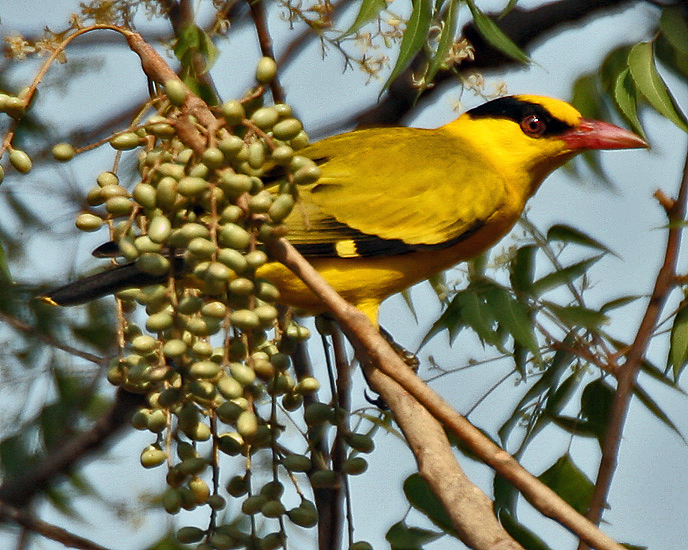 Black-naped OrioleOriolus chinensis
-
 Australasian FigbirdSphecotheres vieilloti
-
 Black-hooded OrioleOriolus xanthornus
-
 Indian Golden OrioleOriolus kundoo
Compare
Questions and answers
What is the scientific name of the Raja Ampat Pitohui?
The scientific name of the Raja Ampat Pitohui is Pitohui cerviniventris. Written with its author, the full name is Pitohui cerviniventris (G. R. Gray, 1862).
Which family does the Raja Ampat Pitohui belong to?
Pitohui cerviniventris belongs to the family Oriolidae, in the order Passeriformes and the class Aves.
Where is the Raja Ampat Pitohui found?
Checklists and occurrence records place Pitohui cerviniventris in 1 country: Indonesia.
What is the conservation status of the Raja Ampat Pitohui?
The IUCN Red List category recorded for Pitohui cerviniventris is Least Concern (LC).
Sources
Passages the profile rests on
- The species has a rusty underside, a gray head, chest and back, and brown wings. Source passage: “Rusty below, gray head, chest and back with brown wings.” — ebird.org
- The species is medium-sized. Source passage: “A medium-sized bird of lowland forest on the northwest islands.” — ebird.org
- The species inhabits subtropical or tropical moist lowland forests. Source passage: “Its natural habitat is subtropical or tropical moist lowland forests.” — English Wikipedia
- The species occurs in lowland forest on the northwest islands. Source passage: “A medium-sized bird of lowland forest on the northwest islands.” — ebird.org
- The species is among the few known poisonous birds. Source passage: “It is also one of the few known poisonous birds.” — English Wikipedia
- The species was separated taxonomically from the northern variable pitohui in 2013. Source passage: “This species was split from the northern variable pitohui in 2013.” — English Wikipedia
- Two subspecies are recognized within the species. Source passage: “Two subspecies are recognized:” — English Wikipedia
- The subspecies P. c. pallidus occurs on Sagewin and Batanta Islands. Source passage: “P. c. pallidus - van Oort, 1907: Found on Sagewin and Batanta Islands (western Papuan Islands)” — English Wikipedia
- The subspecies P. c. cerviniventris occurs on Waigeo and Gemien Islands. Source passage: “P. c. cerviniventris - (Gray, GR, 1862): Found on Waigeo and Gemien Islands (western Papuan Islands)” — English Wikipedia
- The species is found on the western Papuan Islands of New Guinea. Source passage: “found on the western Papuan Islands of New Guinea.” — English Wikipedia
Data
- Catalogue of Life, 2026-10-16 XR cc by
- Global Biodiversity Information Facility CC BY 4.0
- Wikidata CC0
- GeoNames CC BY 4.0
- Wikimedia Commons per image; credit shown with each image
- Within the Catalogue of Life, this name comes from The Integrated Taxonomic Information System cc0
References
- Dumbacher, John P., Kristy Deiner, Lindsey Thompson, and Robert C. Fleischer. (2008). Phylogeny of the avian genus Pitohui and the evolution of toxicity in birds. Molecular Phylogenetics and Evolution, Vol. 49, No. 3.
This species in other databases
Page built on 28 November 2026. See how the catalog is made and all sources and licences.
Cite this page
ScientificNames.org. (2026). Pitohui cerviniventris (Raja Ampat Pitohui). Retrieved November 28, 2026, from https://scientificnames.org/species/pitohui-cerviniventris
“Pitohui cerviniventris (Raja Ampat Pitohui).” ScientificNames.org, 2026, scientificnames.org/species/pitohui-cerviniventris. Accessed 28 Nov. 2026.
ScientificNames.org. “Pitohui cerviniventris (Raja Ampat Pitohui).” Accessed November 28, 2026. https://scientificnames.org/species/pitohui-cerviniventris.
@misc{scientificnames_pitohui_cerviniventris_raja_ampat_pitohui,
  author = {{ScientificNames.org}},
  title = {Pitohui cerviniventris (Raja Ampat Pitohui)},
  year = {2026},
  url = {https://scientificnames.org/species/pitohui-cerviniventris},
  note = {Accessed 2026-11-28}
}