Species · Flowering plants
White-fringed Orchid Platanthera blephariglottis
The scientific name of the White-fringed Orchid is Platanthera blephariglottis. It is a species of flowering plant in the family Orchidaceae (orchid), order Asparagales.
- Scientific name
- Platanthera blephariglottis (Willd.) Lindl.
- Common name
- White-fringed Orchid
- Genus
- Platanthera
- Family
- Orchidaceae (Orchid)
- Order
- Asparagales
- Class
- Liliopsida
- Red List category
- LC Least Concern
- Recorded in
- 3 countries
- Name status
- accepted in the Catalogue of Life

Overview
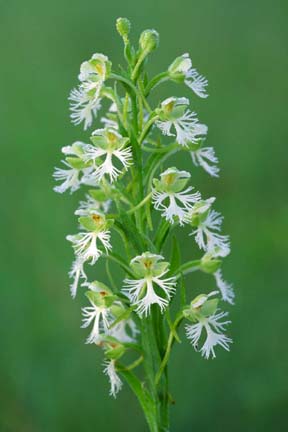
Platanthera blephariglottis grows in bogs, moist banks beside lakes and rivers, boggy lake shores, and open wet meadows. It is distinguished by showy white flowers arranged in spikes, fringed petals, and lateral sepals that bend downward and outward.
Written 27 November 2026 from the sources listed below. Each statement was checked against the passage it cites; statements that could not be supported were removed.
Appearance
The White-fringed Orchid produces showy white flowers arranged in dense to lax spikes. Its lateral sepals bend downward and outward at angles exceeding 90 degrees, while its petals are nearly entire, fringed, linear, and narrower toward their attachment points.[1][2][3]
Its spreading to ascending leaves are distributed along the stem and can be linear-lanceolate, ovate-lanceolate, or elliptic-lanceolate. The plant reaches heights of 8 to 110 centimeters and is described as a herbaceous perennial measuring 1–9 decimeters.[4][5][6][7]
Habitat
The species grows in bogs and on moist banks beside lakes and rivers. It is frequently associated with sphagnum and other acidic mosses.[8][9]
It occurs in open wet areas within black spruce and tamarack bogs. Other habitats include boggy lake shores and open wet meadows.[10][11]
Reproduction and life cycle
The White-fringed Orchid flowers from late spring through summer.[12]
Conservation
The species is classified as endangered in Connecticut and Ohio. It is classified as threatened in Florida, Maryland, and Rhode Island.[13][14]
New York classifies the species as exploitably vulnerable. In Quebec, it is considered susceptible to becoming threatened.[15][16]
Similar species
Platanthera ciliaris is an important counterpart in many hybrid zones involving the White-fringed Orchid. The species has numerous hybrid zones along the eastern coast of the United States.[17][18]
Classification of the White-fringed Orchid
| Kingdom | Plantae |
|---|---|
| Subkingdom | Pteridobiotina |
| Phylum | Tracheophyta |
| Class | Liliopsida |
| Order | Asparagales |
| Family | Orchidaceae (Orchid) |
| Genus | Platanthera (Bog Orchid) |
| Species | Platanthera blephariglottis (Willd.) Lindl. |
Where the White-fringed Orchid is found
Checklists and occurrence records place Platanthera blephariglottis in 3 countries across North America. GBIF holds 5,901 georeferenced records of it.
Countries
Regions and cities with the most records
- Nova Scotia, Canada 623
- Quebec, Canada 415
- New York, United States 291
- Ontario, Canada 271
- New Jersey, United States 262
- Maine, United States 245
- New Hampshire, United States 175
- North Carolina, United States 152
- New Brunswick, Canada 151
- Massachusetts, United States 146
- Michigan, United States 146
- Newfoundland and Labrador, Canada 141
- Pennsylvania, United States 140
- Bangor, United States 139
- Florida, United States 126
- Lévis, Canada 102
- Québec, Canada 99
- Vermont, United States 81
- L'Ancienne-Lorette, Canada 71
- Hazleton, United States 67
- Prince Edward Island, Canada 61
- Saint-Augustin-de-Desmaures, Canada 59
- Neufchâtel-Est–Lebourgneuf, Canada 55
- South Carolina, United States 50
- Ocean Acres, United States 49
- Maryland, United States 45
- Jackson, United States 44
- Sherbrooke, Canada 43
- Virginia, United States 40
- Conception Bay South, Canada 38
- Mississippi, United States 37
- Biddeford, United States 34
- Paradise, Canada 34
- Saco, United States 34
- Bracebridge, Canada 33
- Salisbury, United States 33
A number beside a place is its count of GBIF occurrence records. A place without a number comes from a checklist alone. Records show where a species has been observed or collected, which can include escapes and vagrants.
Common names
English
- White-fringed Orchid
- Northern White Fringed Orchid
- White Fringed Orchid
Names in 1 other language
- French
- habénaire frangée blanche, habénaire à gorge frangée, platanthère à gorge frangée
Synonyms
3 other scientific names have been used for this species and are now treated as synonyms of Platanthera blephariglottis.
- Blephariglottis alba House
- Orchis blephariglottis Willd.
- Platanthera ciliaris var. blephariglottis (Willd.) Chapm.
Subspecies and varieties
- Platanthera blephariglottis var. blephariglottis (White Fringed Orchid) variety
- Platanthera blephariglottis var. conspicua (Southern White Fringed Orchid) variety
Related species
-
 Blunt-leaved OrchidPlatanthera obtusata
-
 Lesser Butterfly OrchidPlatanthera bifolia
-
 Greater Butterfly-OrchidPlatanthera chlorantha
-
 Western Prairie Fringed OrchidPlatanthera praeclara
-
 Yellow Fringed OrchidPlatanthera ciliaris
-
 Eastern Prairie Fringed OrchidPlatanthera leucophaea
-
 Tall White Bog OrchidPlatanthera dilatata
-
 Northern Green OrchidPlatanthera hyperborea
Compare
Questions and answers
What is the scientific name of the White-fringed Orchid?
The scientific name of the White-fringed Orchid is Platanthera blephariglottis. Written with its author, the full name is Platanthera blephariglottis (Willd.) Lindl..
Which family does the White-fringed Orchid belong to?
Platanthera blephariglottis belongs to the family Orchidaceae, in the order Asparagales and the class Liliopsida.
Where is the White-fringed Orchid found?
Checklists and occurrence records place Platanthera blephariglottis in 3 countries: United States, Canada and Saint Pierre and Miquelon.
What is the conservation status of the White-fringed Orchid?
The IUCN Red List category recorded for Platanthera blephariglottis is Least Concern (LC).
What other names does the White-fringed Orchid have?
Platanthera blephariglottis is also known in English as Northern White Fringed Orchid and White Fringed Orchid.
Sources
Passages the profile rests on
- The species produces showy white flowers arranged in dense to lax spikes. Source passage: “Dense to lax spikes of showy white flowers.” — English Wikipedia
- Its lateral sepals bend downward and outward at angles exceeding 90 degrees. Source passage: “Lateral sepals bent downward and outward more than 90 degrees.” — English Wikipedia
- Its petals are nearly entire, fringed, linear in shape, and narrower toward their attachment points. Source passage: “Petals are near entire fringed and the shape is linear and narrows toward the point of attachment.” — English Wikipedia
- The plant has spreading to ascending leaves distributed along its stem. Source passage: “At least 2 and often several spreading to ascending leaves scattered along the stem.” — English Wikipedia
- Its leaves can be linear-lanceolate, ovate-lanceolate, or elliptic-lanceolate. Source passage: “Leaf shapes from linear-lanceolate, ovate-lanceolate and elliptic-lanceolate.” — English Wikipedia
- The plant reaches heights of 8 to 110 centimeters. Source passage: “8 to 110 centimeters (3 to 43 inches) tall plant” — English Wikipedia
- The species is described as a herbaceous perennial measuring 1–9 decimeters. Source passage: “Herbaceous perennial, 1-9 dm” — ohiodnr.gov
- The species grows in bogs and on moist banks beside lakes and rivers. Source passage: “growing in bogs and on the moist banks of lakes and rivers” — English Wikipedia
- The species is frequently associated with sphagnum and other acidic mosses. Source passage: “Often found growing in sphagnum and other acidic moss” — English Wikipedia
- The species occurs in open wet areas within black spruce and tamarack bogs. Source passage: “in open wet areas in black spruce and/or tamarack bogs” — English Wikipedia
- The species also inhabits boggy lake shores and open wet meadows. Source passage: “on the boggy shores of lakes and in open wet meadows.” — English Wikipedia
- The species flowers from late spring through summer. Source passage: “Flowering from late spring until summer” — English Wikipedia
- The species is classified as endangered in Connecticut and Ohio. Source passage: “endangered species in Connecticut and Ohio” — English Wikipedia
- The species is classified as threatened in Florida, Maryland, and Rhode Island. Source passage: “a threatened species in Florida, Maryland and Rhode Island” — English Wikipedia
- New York classifies the species as exploitably vulnerable. Source passage: “exploitably vulnerable in New York” — English Wikipedia
- The species is considered susceptible to becoming threatened in Quebec. Source passage: “susceptible to be threatened in Québec.” — English Wikipedia
- The species has numerous hybrid zones along the eastern coast of the United States. Source passage: “P. blephariglottis has many hybrid zones along the Eastern Coast of the United States” — English Wikipedia
- Platanthera ciliaris is identified as an important counterpart in many hybrid zones involving this species. Source passage: “with Platanthera ciliaris as a key species serving as the counterpart for many of these hybrid zones.” — English Wikipedia
Data
- Catalogue of Life, 2026-10-16 XR cc by
- Global Biodiversity Information Facility CC BY 4.0
- Wikidata CC0
- GeoNames CC BY 4.0
- Wikimedia Commons per image; credit shown with each image
- Within the Catalogue of Life, this name comes from The World Checklist of Vascular Plants (WCVP) cc by
References
- Gen. Sp. Orchid. Pl.: 291 (1835) where the name was published
This species in other databases
- Catalogue of Life 4JMVL
- Wikidata Q7202171
- iNaturalist 52499
- World Flora Online wfo-0000274346
- GRIN 481586
Page built on 29 November 2026. See how the catalog is made and all sources and licences.
Cite this page
ScientificNames.org. (2026). Platanthera blephariglottis (White-fringed Orchid). Retrieved November 29, 2026, from https://scientificnames.org/species/platanthera-blephariglottis
“Platanthera blephariglottis (White-fringed Orchid).” ScientificNames.org, 2026, scientificnames.org/species/platanthera-blephariglottis. Accessed 29 Nov. 2026.
ScientificNames.org. “Platanthera blephariglottis (White-fringed Orchid).” Accessed November 29, 2026. https://scientificnames.org/species/platanthera-blephariglottis.
@misc{scientificnames_platanthera_blephariglottis_white_fringed_orchid,
  author = {{ScientificNames.org}},
  title = {Platanthera blephariglottis (White-fringed Orchid)},
  year = {2026},
  url = {https://scientificnames.org/species/platanthera-blephariglottis},
  note = {Accessed 2026-11-29}
}