Species · Flowering plants
White Fringeless Orchid Platanthera integrilabia
The scientific name of the White Fringeless Orchid is Platanthera integrilabia. It is a species of flowering plant in the family Orchidaceae (orchid), order Asparagales.
- Scientific name
- Platanthera integrilabia (Correll) Luer
- Common name
- White Fringeless Orchid
- Genus
- Platanthera
- Family
- Orchidaceae (Orchid)
- Order
- Asparagales
- Class
- Liliopsida
- Red List category
- NT Near Threatened
- Recorded in
- 1 country
- Name status
- accepted in the Catalogue of Life

Overview
Platanthera integrilabia is native to Kentucky, Mississippi, Tennessee, Alabama, Georgia, North Carolina, and South Carolina. It produces ghost-white flowers with long, forward-curving spurs and a distinctive round labellum.
Written 27 November 2026 from the sources listed below. Each statement was checked against the passage it cites; statements that could not be supported were removed.
Appearance
The White Fringeless Orchid produces large, ghost-white flowers with conspicuous long spurs arranged in loose racemes. Its flowers have elongated, nectar-containing spurs that curve forward from the back of each flower.[1][2]
The species has two leaves at the base of its stem. Its round labellum distinguishes it from other members of its genus, and its flowers have a sweet scent.[3][4][5]
The plant can reach a height of two feet, and an individual plant can produce up to 20 flowers.[6][7]
Habitat
The White Fringeless Orchid typically grows in partially shaded, flat, boggy areas near stream heads or on seepage slopes. It occurs in boggy acidic seeps and flats, growing in acidic muck or sand.[8][9][10]
The species is often associated with Sphagnum species, Osmunda cinnamonea, Woodwardia areolata, and Thelyptris novaboracensis. It is usually found in partially open sunlight and is associated with higher soil moisture and shaded, humid climates.[11][12][13][14]
Diet
The White Fringeless Orchid obtains nutrients and water through a symbiotic relationship with mycorrhizal fungi. It relies on these fungi for resources needed for growth after seed germination and has a mycotrophic symbiotic relationship with the fungus Epulorhiza inquilina.[15][16][17]
Behaviour
The White Fringeless Orchid typically flowers from late July through early September. In the southern portion of its range, it can flower as early as June.[18][19]
Reproduction and life cycle
The species reproduces primarily through outcrossing. Eastern tiger swallowtails and silver-spotted skippers pollinate its flowers, reaching the nectar inside the spurs with their elongated tongues.[20][21][22]
Many individuals also reproduce clonally through tubers. The species produces several thousand dust-like seeds annually, which depend on wind for dispersal.[23][24][25]
Approximately 3% of wind-dispersed seeds germinate. Mycorrhizal fungi assist the species in seed germination.[26][27]
Conservation
Approximately 50–60 extant populations of the White Fringeless Orchid are known, with most known populations concentrated in Tennessee and Kentucky on the Cumberland Plateau. Most populations contain fewer than 100 individuals, although some contain as many as 1,000.[28][29][30][31]
The species was listed as threatened under the Endangered Species Act in 2016. Fire suppression has contributed to population declines by creating dense forest canopies.[32][33]
Wetland destruction through agricultural drainage and farm pond construction has eliminated much of the species' former bog and seep habitat. Habitat alteration, particularly changes to hydrology, threatens the species.[34][35]
The species is considered highly vulnerable to climate change, with population size likely to decrease by 2050.[36]
Classification of the White Fringeless Orchid
| Kingdom | Plantae |
|---|---|
| Subkingdom | Pteridobiotina |
| Phylum | Tracheophyta |
| Class | Liliopsida |
| Order | Asparagales |
| Family | Orchidaceae (Orchid) |
| Genus | Platanthera (Bog Orchid) |
| Species | Platanthera integrilabia (Correll) Luer |
Where the White Fringeless Orchid is found
Checklists and occurrence records place Platanthera integrilabia in 1 country across North America. GBIF holds 543 georeferenced records of it.
Countries
Regions and cities with the most records
- Tennessee, United States 119
- Alabama, United States 33
- Kentucky, United States 26
- Oxford, United States 4
- Anniston, United States 3
- Georgia, United States 3
- Mississippi, United States 1
- North Carolina, United States
- South Carolina, United States
A number beside a place is its count of GBIF occurrence records. A place without a number comes from a checklist alone. Records show where a species has been observed or collected, which can include escapes and vagrants.
Common names
English
- White Fringeless Orchid
- Monkey-face
Synonyms
3 other scientific names have been used for this species and are now treated as synonyms of Platanthera integrilabia.
- Blephariglottis integrilabia (Correll) W.J.Schrenk
- Habenaria blephariglottis var. integrilabia Correll
- Habenaria correlliana Cronquist
Related species
-
 Blunt-leaved OrchidPlatanthera obtusata
-
 Lesser Butterfly OrchidPlatanthera bifolia
-
 Greater Butterfly-OrchidPlatanthera chlorantha
-
 Western Prairie Fringed OrchidPlatanthera praeclara
-
 Yellow Fringed OrchidPlatanthera ciliaris
-
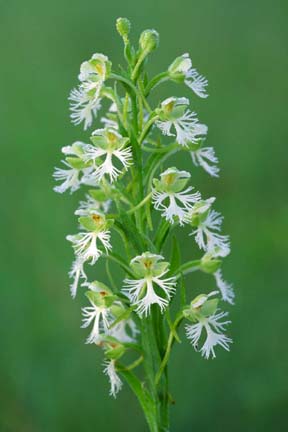 Eastern Prairie Fringed OrchidPlatanthera leucophaea
-
 Tall White Bog OrchidPlatanthera dilatata
-
 Northern Green OrchidPlatanthera hyperborea
Compare
Questions and answers
What is the scientific name of the White Fringeless Orchid?
The scientific name of the White Fringeless Orchid is Platanthera integrilabia. Written with its author, the full name is Platanthera integrilabia (Correll) Luer.
Which family does the White Fringeless Orchid belong to?
Platanthera integrilabia belongs to the family Orchidaceae, in the order Asparagales and the class Liliopsida.
Where is the White Fringeless Orchid found?
Checklists and occurrence records place Platanthera integrilabia in 1 country: United States.
What is the conservation status of the White Fringeless Orchid?
The IUCN Red List category recorded for Platanthera integrilabia is Near Threatened (NT).
What other names does the White Fringeless Orchid have?
Platanthera integrilabia is also known in English as Monkey-face.
What is the White Fringeless orchid?
The White Fringeless Orchid (Platanthera integrilabia) is a flowering plant in the family Orchidaceae, order Asparagales, and class Liliopsida. It produces large, ghost-white flowers with long spurs and a distinctive round labellum.[1][4]
What are some types of white orchids?
The White Fringeless Orchid is a flowering plant that produces large, ghost-white flowers.[1]
Sources
Passages the profile rests on
- The species produces large, ghost-white flowers with conspicuous long spurs arranged in loose racemes. Source passage: “The inflorescence is showy, with large, ghost-white flowers with conspicuous long spurs, clustered in loose racemes.” — fs.usda.gov
- The flowers have elongated nectar-containing spurs that curve forward from the back of each flower. Source passage: “conspicuous elongated nectar-containing spurs that come from the back of the flower and curve forward in front.” — English Wikipedia
- The species has two leaves located at the base of its stem. Source passage: “It has two leaves restricted to the base of the stem” — English Wikipedia
- The species has a round labellum that distinguishes it from other members of its genus. Source passage: “The white fringeless orchid differs from other Platanthera species by its round labellum.” — English Wikipedia
- The flowers have a sweet scent. Source passage: “containing up to 20 sweetly scented white flowers” — English Wikipedia
- The plant can reach a height of two feet. Source passage: “reaching up to 2-feet tall.” — English Wikipedia
- An individual plant can produce up to 20 flowers. Source passage: “containing up to 20 sweetly scented white flowers” — English Wikipedia
- The species typically grows in partially shaded, flat, boggy areas near stream heads or on seepage slopes. Source passage: “This plant is typically found in partially shaded, flat, boggy areas at the head of streams or seepage slopes.” — fs.usda.gov
- The species grows in acidic muck or sand. Source passage: “in acidic muck or sand.” — fs.usda.gov
- The species occurs in boggy acidic seeps and flats. Source passage: “Its natural habitat is in boggy acidic seeps and flats” — inaturalist.org
- The species is often associated with Sphagnum species. Source passage: “The species is often found in association with Sphagnum species” — fs.usda.gov
- The species is often associated with Osmunda cinnamonea, Woodwardia areolata, and Thelyptris novaboracensis. Source passage: “Osmunda cinnamonea, Woodwardia areolata, and Thelyptris novaboracensis” — fs.usda.gov
- The species is usually found in partially open sunlight. Source passage: “usually in partial open sunlight.” — English Wikipedia
- The species is associated with higher soil moisture and shaded, humid climates. Source passage: “better performance and growth within higher soil moisture and shaded, humid climates.” — English Wikipedia
- The species obtains nutrients and water through a symbiotic relationship with mycorrhizal fungi. Source passage: “providing access to a large amount of water and nutrients” — English Wikipedia
- The species relies on mycorrhizal fungi for resources needed for growth after seed germination. Source passage: “relies heavily on mycorrhizal fungi to provide necessary resources for growth after its germination.” — English Wikipedia
- The species has a mycotrophic symbiotic relationship with the fungus Epulorhiza inquilina. Source passage: “lives in a mycotrophic symbiotic relationship with the mycorrhizal fungus Epulorhiza inquilina” — English Wikipedia
- The species typically flowers from late July through early September. Source passage: “blooms from late July to early September.” — fs.usda.gov
- The species can flower as early as June in the southern portion of its range. Source passage: “but can flower as early as June in the southern part of its range.” — English Wikipedia
- The species reproduces primarily through outcrossing. Source passage: “The white fringeless orchid reproduces primarily through outcrossing” — English Wikipedia
- Eastern tiger swallowtails and silver-spotted skippers pollinate the species. Source passage: “pollinated by butterflies such as the eastern tiger swallowtail and silver-spotted skippers.” — English Wikipedia
- Pollinating butterflies reach the nectar inside the flowers' spurs using their elongated tongues. Source passage: “These butterflies have the ability to reach the nectar within the spurs with their lengthened tongues.” — English Wikipedia
- Many individuals reproduce clonally through tubers. Source passage: “with many individuals reproducing clonally through tubers.” — English Wikipedia
- The species produces several thousand dust-like seeds annually. Source passage: “produce several thousand dust-like seeds each year” — English Wikipedia
- The seeds depend on wind for dispersal. Source passage: “These seeds are dependent on wind dispersal” — English Wikipedia
- Approximately 3% of wind-dispersed seeds germinate. Source passage: “only around 3% of wind-dispersed seeds will germinate.” — English Wikipedia
- Mycorrhizal fungi assist the species in seed germination. Source passage: “symbiotic relationship with mycorrhizal fungi that aids in seed germination and growth.” — English Wikipedia
- Most known populations are concentrated in Tennessee and Kentucky on the Cumberland Plateau. Source passage: “primarily concentrated in Tennessee and Kentucky on the Cumberland Plateau.” — English Wikipedia
- Approximately 50–60 extant populations of the species are known. Source passage: “There are roughly 50-60 known extant populations” — English Wikipedia
- Most known populations contain fewer than 100 individuals. Source passage: “most of which consist of less than 100 individuals” — English Wikipedia
- Some populations contain as many as 1,000 individuals. Source passage: “although some populations have up to 1,000” — English Wikipedia
- The species was listed as threatened under the Endangered Species Act in 2016. Source passage: “In 2016, Platanthera integrilabia was listed as Threatened by the Endangered Species Act” — English Wikipedia
- Fire suppression has contributed to population declines by creating dense forest canopies. Source passage: “Populations have declined greatly due to fire suppression, which has created an unfavorably dense canopy throughout much of its range.” — English Wikipedia
- Wetland destruction through agricultural drainage and farm pond construction has eliminated much of the species' former bog and seep habitat. Source passage: “wetland destruction in the form of draining for agriculture and the creation of farm ponds has eliminated much of its former bog and seep habitat.” — English Wikipedia
- Habitat alteration, particularly changes to hydrology, threatens the species. Source passage: “Threats to this species include alteration of the habitat primarily through alteration of hydrology.” — fs.usda.gov
- The species is considered highly vulnerable to climate change, with population size likely to decrease by 2050. Source passage: “highly vulnerable" to climate change, meaning a likely decrease in population size by 2050.” — English Wikipedia
Data
- Catalogue of Life, 2026-10-16 XR cc by
- Global Biodiversity Information Facility CC BY 4.0
- Wikidata CC0
- GeoNames CC BY 4.0
- Wikimedia Commons per image; credit shown with each image
- Within the Catalogue of Life, this name comes from The World Checklist of Vascular Plants (WCVP) cc by
References
- Native Orchids U.S. & Canada excluding Florida: 186 (1975) where the name was published
This species in other databases
- Catalogue of Life 4JMXT
- Wikidata Q15436242
- iNaturalist 167022
- World Flora Online wfo-0000274521
- GRIN 481587
Page built on 29 November 2026. See how the catalog is made and all sources and licences.
Cite this page
ScientificNames.org. (2026). Platanthera integrilabia (White Fringeless Orchid). Retrieved November 29, 2026, from https://scientificnames.org/species/platanthera-integrilabia
“Platanthera integrilabia (White Fringeless Orchid).” ScientificNames.org, 2026, scientificnames.org/species/platanthera-integrilabia. Accessed 29 Nov. 2026.
ScientificNames.org. “Platanthera integrilabia (White Fringeless Orchid).” Accessed November 29, 2026. https://scientificnames.org/species/platanthera-integrilabia.
@misc{scientificnames_platanthera_integrilabia_white_fringeless_orchid,
  author = {{ScientificNames.org}},
  title = {Platanthera integrilabia (White Fringeless Orchid)},
  year = {2026},
  url = {https://scientificnames.org/species/platanthera-integrilabia},
  note = {Accessed 2026-11-29}
}