Species · Flowering plants
Large Round-leaved Orchis Platanthera orbiculata
The scientific name of the Large Round-leaved Orchis is Platanthera orbiculata. It is a species of flowering plant in the family Orchidaceae (orchid), order Asparagales.
- Scientific name
- Platanthera orbiculata (Pursh) Lindl.
- Common name
- Large Round-leaved Orchis
- Genus
- Platanthera
- Family
- Orchidaceae (Orchid)
- Order
- Asparagales
- Class
- Liliopsida
- Recorded in
- 3 countries
- Name status
- accepted in the Catalogue of Life

Overview
Large Round-leaved Orchis is a perennial herb. It is native to forested regions of North America and occurs across most of Canada and several regions of the United States. It has two large, nearly circular leaves close to the ground and produces a vertical flowering stalk bearing small white flowers.
Written 27 November 2026 from the sources listed below. Each statement was checked against the passage it cites; statements that could not be supported were removed.
Appearance
The Large Round-leaved Orchis has two large, nearly circular leaves positioned close to the ground. Its leaves are glossy and leathery.[1][2]
The plant produces a vertical flowering stalk bearing a spike of tiny white flowers. The flowers are diminutive and require magnification to appreciate their complex structure fully.[3][4][5]
Habitat
The Large Round-leaved Orchis grows in moist to moderately moist, shaded forest locations. Its habitats include southeastern Alaskan rainforests and the Black Hills of South Dakota and Wyoming.[6][7]
Behaviour
The leaves emerge from an underground rhizome in late spring. The plant produces a flowering spike later in summer.[8][9]
The species can remain dormant for more than one year when growing conditions are unsuitable.[10]
Reproduction and life cycle
The Large Round-leaved Orchis produces capsules containing tiny seeds in late summer. Its seeds are among the smallest in the plant kingdom and can be dispersed over long distances by wind.[11][12][13]
Conservation
The Large Round-leaved Orchis is considered endangered in several states. It has been extirpated from Connecticut and Indiana, although its survival is secure in some portions of its geographic range.[14][15][16]
Classification of the Large Round-leaved Orchis
| Kingdom | Plantae |
|---|---|
| Subkingdom | Pteridobiotina |
| Phylum | Tracheophyta |
| Class | Liliopsida |
| Order | Asparagales |
| Family | Orchidaceae (Orchid) |
| Genus | Platanthera (Bog Orchid) |
| Species | Platanthera orbiculata (Pursh) Lindl. |
Where the Large Round-leaved Orchis is found
Checklists and occurrence records place Platanthera orbiculata in 3 countries across North America. GBIF holds 5,951 georeferenced records of it.
Countries
Regions and cities with the most records
- British Columbia, Canada 683
- Quebec, Canada 440
- Ontario, Canada 402
- Pennsylvania, United States 280
- Michigan, United States 216
- New York, United States 150
- Alberta, Canada 137
- Montana, United States 108
- Washington, United States 94
- Saskatchewan, Canada 90
- Ohio, United States 86
- West Virginia, United States 86
- Manitoba, Canada 82
- Newfoundland and Labrador, Canada 80
- Wisconsin, United States 75
- North Carolina, United States 70
- New Hampshire, United States 62
- Nova Scotia, Canada 62
- Vermont, United States 61
- Idaho, United States 58
- Minnesota, United States 49
- Virginia, United States 42
- Maine, United States 40
- Boone, United States 38
- Maryland, United States 36
- New Brunswick, Canada 34
- Yukon, Canada 34
- Terrace, Canada 30
- L'Ancienne-Lorette, Canada 25
- Neufchâtel-Est–Lebourgneuf, Canada 25
- Hudson, United States 23
- Magog, Canada 23
- Squamish, Canada 23
- Saint-Augustin-de-Desmaures, Canada 22
- Lévis, Canada 20
- Stow, United States 20
A number beside a place is its count of GBIF occurrence records. A place without a number comes from a checklist alone. Records show where a species has been observed or collected, which can include escapes and vagrants.
Common names
English
- Large Round-leaved Orchis
- Round-leaved Bog Orchid
- Large Round-leaved Rein Orchid
- Large Roundleaf Orchid
- Lesser Round-leaved Orchid
- Pad-leaved Orchid
Names in 1 other language
- French
- habénaire orbiculaire, habénaire à feuilles orbiculaires, platanthère à feuilles orbiculaires
Synonyms
5 other scientific names have been used for this species and are now treated as synonyms of Platanthera orbiculata.
- Habenaria orbiculata (Pursh) Hook.
- Habenaria orbiculata (Pursh) Torr.
- Habenaria orbiculata var. orbiculata
- Lysias orbiculata (Pursh) Rydb.
- Orchis orbiculata Pursh
Subspecies and varieties
Related species
-
 Blunt-leaved OrchidPlatanthera obtusata
-
 Lesser Butterfly OrchidPlatanthera bifolia
-
 Greater Butterfly-OrchidPlatanthera chlorantha
-
 Western Prairie Fringed OrchidPlatanthera praeclara
-
 Yellow Fringed OrchidPlatanthera ciliaris
-
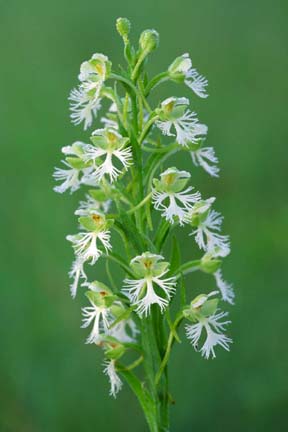 Eastern Prairie Fringed OrchidPlatanthera leucophaea
-
 Tall White Bog OrchidPlatanthera dilatata
-
 Northern Green OrchidPlatanthera hyperborea
Compare
Questions and answers
What is the scientific name of the Large Round-leaved Orchis?
The scientific name of the Large Round-leaved Orchis is Platanthera orbiculata. Written with its author, the full name is Platanthera orbiculata (Pursh) Lindl..
Which family does the Large Round-leaved Orchis belong to?
Platanthera orbiculata belongs to the family Orchidaceae, in the order Asparagales and the class Liliopsida.
Where is the Large Round-leaved Orchis found?
Checklists and occurrence records place Platanthera orbiculata in 3 countries: United States, Canada and Saint Pierre and Miquelon.
What other names does the Large Round-leaved Orchis have?
Platanthera orbiculata is also known in English as Round-leaved Bog Orchid, Large Round-leaved Rein Orchid, Large Roundleaf Orchid, Lesser Round-leaved Orchid and Pad-leaved Orchid.
Sources
Passages the profile rests on
- The species has two large, nearly circular leaves positioned close to the ground. Source passage: “Each plant has two large, nearly round leaves that lie close to the ground” — English Wikipedia
- Its leaves are glossy and leathery. Source passage: “a pair of glossy leathery leaves” — fs.usda.gov
- The plant produces a vertical flowering stalk bearing a spike of small white flowers. Source passage: “a vertical flowering stalk bearing a spike of small, white flowers.” — English Wikipedia
- Its white flowers are tiny and require magnification to appreciate their complex structure fully. Source passage: “The flowers are a brilliant white, but unlike the better-known lady’s slipper orchids, they require a magnifying lens to fully appreciate their complex beauty.” — fs.usda.gov
- The species produces flowers described as diminutive. Source passage: “With its diminutive flowers” — fs.usda.gov
- The species grows in moist to moderately moist, shaded forest locations. Source passage: “moist to mesic shaded locations in forests.” — English Wikipedia
- The species occurs in a variety of habitats, including southeastern Alaskan rainforests and the Black Hills of South Dakota and Wyoming. Source passage: “It can be found in a variety of habitats as varied as the rainforests of southeastern Alaska and the Black Hills of South Dakota and Wyoming.” — fs.usda.gov
- Its leaves emerge from an underground rhizome in late spring. Source passage: “leaves that emerge in late spring from a thick underground stem (rhizome).” — fs.usda.gov
- The species produces a flowering spike later in summer. Source passage: “Later in summer it sends up a spike of complex, tiny flowers” — fs.usda.gov
- The species can remain dormant for more than one year when growing conditions are unsuitable. Source passage: “It has the curious habit of being able to go dormant for more than a year at a time” — fs.usda.gov
- The species produces capsules containing tiny seeds in late summer. Source passage: “that mature into capsules full of tiny seeds in late summer.” — fs.usda.gov
- The species produces seeds that are among the smallest in the plant kingdom. Source passage: “Orchid seeds are the smallest in the plant kingdom.” — fs.usda.gov
- Its seeds can be dispersed over long distances by wind. Source passage: “These seeds are barely larger than a speck of dust and can be blown far and wide by winds.” — fs.usda.gov
- The species is considered endangered in several states. Source passage: “it is considered endangered in several states” — fs.usda.gov
- The species has been extirpated from Connecticut and Indiana. Source passage: “has been extirpated from Connecticut and Indiana.” — fs.usda.gov
- The species has secure survival in some portions of its geographic range. Source passage: “While its survival is secure in parts of its range” — fs.usda.gov
Data
- Catalogue of Life, 2026-10-16 XR cc by
- Global Biodiversity Information Facility CC BY 4.0
- Wikidata CC0
- GeoNames CC BY 4.0
- Wikimedia Commons per image; credit shown with each image
- Within the Catalogue of Life, this name comes from The World Checklist of Vascular Plants (WCVP) cc by
References
- Gen. Sp. Orchid. Pl.: 286 (1835) where the name was published
This species in other databases
- Catalogue of Life 4JMZ4
- Wikidata Q15437280
- iNaturalist 131218
- World Flora Online wfo-0000274633
- GRIN 456503
Page built on 27 November 2026. See how the catalog is made and all sources and licences.
Cite this page
ScientificNames.org. (2026). Platanthera orbiculata (Large Round-leaved Orchis). Retrieved November 27, 2026, from https://scientificnames.org/species/platanthera-orbiculata
“Platanthera orbiculata (Large Round-leaved Orchis).” ScientificNames.org, 2026, scientificnames.org/species/platanthera-orbiculata. Accessed 27 Nov. 2026.
ScientificNames.org. “Platanthera orbiculata (Large Round-leaved Orchis).” Accessed November 27, 2026. https://scientificnames.org/species/platanthera-orbiculata.
@misc{scientificnames_platanthera_orbiculata_large_round_leaved_orchis,
  author = {{ScientificNames.org}},
  title = {Platanthera orbiculata (Large Round-leaved Orchis)},
  year = {2026},
  url = {https://scientificnames.org/species/platanthera-orbiculata},
  note = {Accessed 2026-11-27}
}