Species · Flowering plants
Annual Bluegrass Poa annua
The scientific name of the Annual Bluegrass is Poa annua. It is a species of flowering plant in the family Poaceae (turf), order Poales.
- Scientific name
- Poa annua L.
- Common name
- Annual Bluegrass
- Genus
- Poa
- Family
- Poaceae (Turf)
- Order
- Poales
- Class
- Liliopsida
- Red List category
- LC Least Concern
- Recorded in
- 145 countries
- Name status
- accepted in the Catalogue of Life
Overview
Poa annua occurs in temperate and subarctic climates, cultivated areas, lawns and waste ground.
Written 26 November 2026 from the sources listed below. Each statement was checked against the passage it cites; statements that could not be supported were removed.
Appearance
Annual bluegrass is a clump-forming grass with yellow-green coloration. Mature plants form highly tillered clumps that may grow upright or prostrate, with stems ranging from 2.5 to 30.5 cm in height.[1][2][3]
The stems are slightly flattened because they are folded rather than rolled. The root system is shallow, fibrous and mat-forming, while the rootstock is slightly creeping.[4][5][6]
The leaf sheaths are long and clasp the stem. The ligule is pointed and silvery.[7][8]
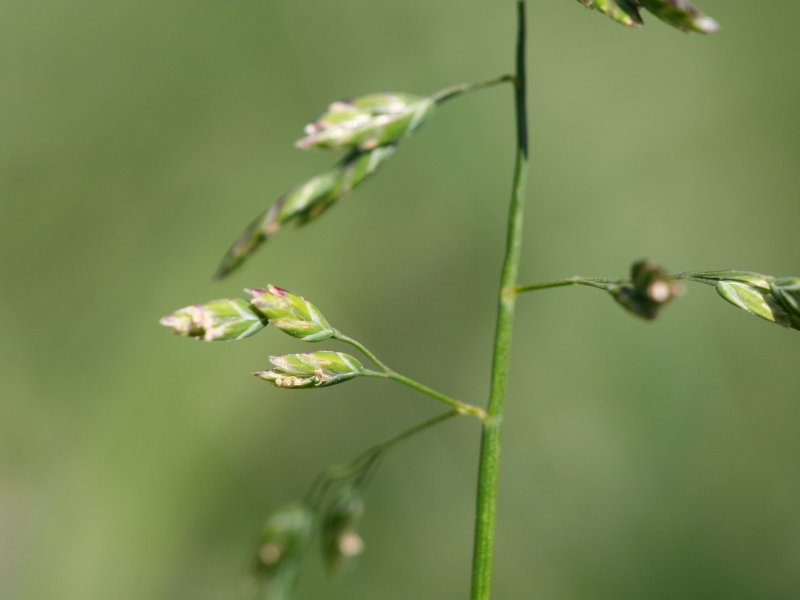
The inflorescence is an open, triangular, pyramid-shaped panicle measuring 5–7.5 cm long. It has a distinctive whitish flower head.[9][10][11]
The spikelets are stalked, lack awns and measure 1–2 cm when flowering. They are loosely arranged on delicate paired or spreading branches, may have a purple tinge and contain two to six flowers.[12][13][14][15]
The seeds are yellow-gray, elliptical and approximately 0.25 cm long. Seed weight has been reported in the range of 0.19–0.48 mg.[16][17]
Habitat
Annual bluegrass commonly occurs in cultivated areas as a weed, in lawns and on waste ground. It preferentially grows in moist, shady locations.[18][19][20][21]
The species grows in a wide variety of soil types, including clay, loam and sandy soils. In pastures, it is commonly associated with overgrazing or excessive trampling.[22][23][24]
Behaviour
The species typically emerges between fall and spring, flowers and dies when warm weather begins. It tolerates trampling, mowing and frozen conditions.[25][26]
Annual bluegrass tends to colonize locations where other grasses have died or been damaged. It can outcompete other plants and crops.[27][28]
The creeping perennial form becomes more prevalent in grassy areas subjected to close mowing.[29]
Reproduction and life cycle
Annual bluegrass flowers throughout the year except during severe winters. Seeds ripen and are deposited during eight months of the year.[30][31]
Plants can grow from seed and reach flowering within six weeks. Each plant can produce several hundred seeds in one season.[32][33]
The species produces both dormant and non-dormant seeds. Seed dormancy varies among populations, is influenced by conditions during seed formation and decreases over a period of several months.[34][35][36]
Seeds can remain dormant for years before germinating.[37]
The pollen of annual bluegrass is a known allergen associated with hay fever.[38]
The species originated through hybridization between Poa supina and Poa infirma.[39]
Classification of the Annual Bluegrass
| Kingdom | Plantae |
|---|---|
| Subkingdom | Pteridobiotina |
| Phylum | Tracheophyta |
| Class | Liliopsida |
| Order | Poales |
| Family | Poaceae (Turf) |
| Genus | Poa (Bluegrass) |
| Species | Poa annua L. |
Where the Annual Bluegrass is found
Checklists and occurrence records place Poa annua in 145 countries across Africa, Antarctica, Asia, Europe, North America, Oceania and South America. GBIF holds 973,382 georeferenced records of it.
Countries where it is native or its origin is not stated
- Afghanistan 39
- Aland Islands 1,099
- Albania 4
- Algeria 30
- Andorra 14
- Armenia 13
- Austria 8,963
- Azerbaijan 4
- Belarus 156
- Belgium 38,326
- Bhutan 9
- Bosnia and Herzegovina 11
- Bulgaria 22
- Burundi 11
- Cameroon 40
- China 1,022
- Croatia 68
- Cyprus 13
- Czechia 6,659
- Democratic Republic of the Congo 63
- Denmark 12,677
- Egypt 45
- Equatorial Guinea 25
- Eritrea 2
- Estonia 2,624
- Ethiopia 120
- Faroe Islands 113
- Finland 25,278
- France 214,651
- Georgia 39
- Germany 40,735
- Greece 490
- Guernsey 8
- Hong Kong 7
- Hungary 117
- Iceland 1,348
- India 275
- Iran 33
- Iraq 20
- Ireland 1,655
- Isle of Man 2,241
- Israel 150
- Italy 1,845
- Jersey 6
- Jordan 7
- Kazakhstan 68
- Kenya 26
- Kuwait 7
- Kyrgyzstan 8
- Latvia 121
- Lebanon 11
- Libya 6
- Liechtenstein 35
- Lithuania 72
- Luxembourg 1,914
- Malaysia 15
- Malta 6
- Moldova 5
- Mongolia 5
- Montenegro 3
- Morocco 113
- Myanmar 3
- Namibia 10
- Nepal 60
- Norway 18,079
- Pakistan 126
- Palestinian Territory 3
- Poland 13,643
- Portugal 3,337
- Qatar 4
- Romania 37
- Russia 6,662
- Rwanda 19
- Saudi Arabia 26
- Serbia 8
- Slovakia 3,295
- Slovenia 146
- South Korea 1,122
- Spain 11,538
- Sri Lanka 67
- Svalbard and Jan Mayen 5
- Sweden 35,989
- Switzerland 24,519
- Syria 7
- Taiwan 631
- Tajikistan 5
- Tanzania 40
- Thailand 7
- The Netherlands 123,990
- Tunisia 18
- Turkey 92
- Turkmenistan 2
- Uganda 66
- Ukraine 965
- United Kingdom 330,543
- Uzbekistan 25
- Vietnam 5
- Yemen 5
Countries where it has been introduced
- Antarctica 18
- Argentina 524
- Australia 8,345
- Bangladesh
- Bermuda 15
- Bolivia 210
- Brazil 740
- Canada 1,462
- Chile 170
- Colombia 565
- Costa Rica 178
- Cuba 2
- Dominican Republic 11
- Ecuador 211
- El Salvador 27
- Eswatini 2
- Falkland Islands 11
- French Southern Territories 91
- Greenland 145
- Guatemala 89
- Haiti 16
- Heard Island and McDonald Islands 15
- Honduras 19
- Indonesia 71
- Jamaica 43
- Japan 3,120
- Lesotho 35
- Madagascar 27
- Mauritius 9
- Mexico 1,410
- New Caledonia 4
- New Zealand 1,066
- Nicaragua 12
- Panama 13
- Paraguay 9
- Peru 211
- Philippines 31
- Puerto Rico 7
- Reunion 396
- Saint Helena 64
- South Africa 628
- South Georgia and the South Sandwich Islands 70
- United States 14,517
- Uruguay 75
- Venezuela 81
- Zambia 2
- Zimbabwe 24
Regions and cities with the most records
- England, United Kingdom 240,158
- Scotland, United Kingdom 56,835
- Île-de-France, France 35,882
- Auvergne-Rhône-Alpes, France 30,647
- Hauts-de-France, France 25,314
- Centre-Val de Loire, France 24,595
- Bavaria, Germany 21,297
- Bourgogne-Franche-Comté, France 21,283
- Grand Est, France 17,519
- Gelderland, The Netherlands 16,636
- Benthuizen, The Netherlands 15,245
- Wales, United Kingdom 15,197
- Salpêtrière, France 15,060
- Paris 13 Gobelins, France 15,052
- Gare, France 15,007
- Quinze-Vingts, France 15,007
- Paris 05 Panthéon, France 14,930
- Paris, France 14,891
- Paris 06 Luxembourg, France 14,875
- Paris 04 Hôtel-de-Ville, France 14,823
- Waddinxveen, The Netherlands 14,815
- Paris 01 Louvre, France 14,811
- Paris 07 Palais-Bourbon, France 14,793
- Paris 03 Temple, France 14,785
- Paris 02 Bourse, France 14,784
- Gentilly, France 14,752
- Paris 09 Opéra, France 14,741
- Maison Blanche, France 14,734
- Montrouge, France 14,721
- Le Kremlin-Bicêtre, France 14,697
- Paris 14 Observatoire, France 14,676
- Croulebarbe, France 14,672
- Paris 12 Reuilly, France 14,666
- Paris 11 Popincourt, France 14,630
- Ivry-sur-Seine, France 14,585
- Paris 08 Élysée, France 14,537
5 more countries have a few records outside this range
These countries hold a few records of Poa annua but lie outside the range the checklists give for it. Such records are often zoo or garden specimens, museum material or vagrants, so the species is not counted as occurring there.
A number beside a place is its count of GBIF occurrence records. A place without a number comes from a checklist alone. Records show where a species has been observed or collected, which can include escapes and vagrants.
Common names
English
- Annual Bluegrass
- Annual Meadow-Grass
- Annual Meadowgrass
- Annual Poa
- Dwarf Meadowgrass
- Winter Grass
Names in 14 other languages
- Chinese
- zao shu he
- Danish
- Enårig rapgræs
- Dutch
- Straatgras
- Finnish
- kylänurmikka
- French
- pâturin annuel
- German
- einjähriges Rispengras
- Japanese
- suzume-no-katabira
- Korean
- saepoapul
- Northern Sami
- šilljosuoidni
- Norwegian Bokmål
- tunrapp
- Russian
- mjatlik odnoletnij
- Spanish
- espiguilla, hierba de punta
- Swedish
- vitgröe
- Welsh
- Gwellt y Gweunydd, Gweunwellt Blynyddol, Gweunwellt Unflwydd
Synonyms
74 other scientific names have been used for this species and are now treated as synonyms of Poa annua.
- Catabrosa pumila (Pursh) Roem. & Schult.
- Deschampsia cespitosa var. triflora Schur
- Festuca tenuiculmis Tovar
- Lolium annuum Linnaeus, 1754
- Ochlopoa annua (L.) H.Scholz
- Ochlopoa annua subsp. annua
- Ochlopoa annua subsp. notabilis (Chrtek & V.Jirásek) H.Scholz & Valdés
- Ochlopoa annua subsp. pilantha (Ronniger) H.Scholz & Valdés
- Ochlopoa annua subsp. raniglumis (S.E.Fröhner) H.Scholz & Valdés
- Ochlopoa notabilis (Chrtek & V.Jirásek) Tzvelev
- Ochlopoa pilantha (Ronniger) Tzvelev
- Ochlopoa raniglumis (S.E.Fröhner) Bomble
- Poa aestivalis J.Presl
- Poa annua f. annua
- Poa annua f. aquatica (Asch.) Werner Christ.
- Poa annua f. aquatica (Asch.) Neuman
- Poa annua f. lanuginosa Sennen
- Poa annua f. latisquamea Lindm.
- Poa annua f. longiglumis Lindm.
- Poa annua f. ovalis (Tineo) Trab.
- Poa annua f. picta (Beck) Maire
- Poa annua f. purpurea Mike L.Grant
- Poa annua f. reptans (Hausskn.) T.Koyama
- Poa annua f. sericea Lindm.
- Poa annua subsp. annua
- Poa annua subsp. mutabilis Chrtek & V.Jirásek
- Poa annua subsp. notabilis Chrtek & V.Jirásek
- Poa annua subsp. ovalis (Tineo) Nyman
- Poa annua subsp. pilantha (Ronniger) H.Scholz
- Poa annua subsp. raniglumis (S.E.Fröhner) Chrtek
- Poa annua var. alpestris Schur
- Poa annua var. annua
- Poa annua var. aquatica Asch.
- Poa annua var. arenosa Schur
- Poa annua var. brevifolia Lagr.-Foss.
- Poa annua var. caespitosa N.Terracc.
- Poa annua var. campana Seguin
- Poa annua var. crispa Gray
- Poa annua var. elatior Chevall.
- Poa annua var. eriolepis É.Desv.
Showing 40 of 74.
Related species
-
 Kentucky BluegrassPoa pratensis
-
 Rough BluegrassPoa trivialis
-
 Common Tussock-grassPoa labillardierei
-
 Bulbous BluegrassPoa bulbosa
-
 Alpine Meadow GrassPoa alpina
-
 Tussac GrassPoa flabellata
-
 Sandberg BluegrassPoa secunda
-
 Snow GrassPoa sieberiana
Compare
Questions and answers
What is the scientific name of the Annual Bluegrass?
The scientific name of the Annual Bluegrass is Poa annua. Written with its author, the full name is Poa annua L..
Which family does the Annual Bluegrass belong to?
Poa annua belongs to the family Poaceae, in the order Poales and the class Liliopsida.
Where is the Annual Bluegrass found?
Checklists and occurrence records place Poa annua in 145 countries, including United Kingdom, France, The Netherlands, Germany, Belgium and Sweden.
What is the conservation status of the Annual Bluegrass?
The IUCN Red List category recorded for Poa annua is Least Concern (LC).
What other names does the Annual Bluegrass have?
Poa annua is also known in English as Annual Meadow-Grass, Annual Meadowgrass, Annual Poa, Dwarf Meadowgrass and Winter Grass.
Sources
Passages the profile rests on
- Annual bluegrass is a clump-forming grass with a yellow-green coloration. Source passage: “annual bluegrass is a winter annual, clump-forming grass with a yellow-green color” — plants.ces.ncsu.edu
- Mature plants form highly tillered clumps that can grow upright or prostrate. Source passage: “Mature plants grow into 1-12” (2.5-30.5 cm) tall, highly tillering, upright or prostrate clumps.” — cals.cornell.edu
- Mature plants range from 2.5 to 30.5 cm in height. Source passage: “Mature plants grow into 1-12” (2.5-30.5 cm) tall” — cals.cornell.edu
- The plant has a slightly creeping, fibrous rootstock. Source passage: “It has a slightly creeping, fibrous rootstock.” — English Wikipedia
- The stems are slightly flattened because they are folded rather than rolled. Source passage: “It is slightly flattened, due to being folded rather than rolled.” — English Wikipedia
- The mature root system is shallow, fibrous, and mat-forming. Source passage: “The root system is shallow, fibrous and matting.” — cals.cornell.edu
- The leaf sheaths are long and clasp the stem. Source passage: “Long sheaths clasp the stem.” — English Wikipedia
- The ligule is pointed and silvery. Source passage: “The ligule is pointed and silvery” — English Wikipedia
- The inflorescence is an open, triangular panicle measuring 5–7.5 cm long. Source passage: “The panicle is open and triangular shaped, 5–7.5 cm (2–3 in) long.” — English Wikipedia
- The species has prow-shaped leaf tips and a distinctive whitish flower head. Source passage: “prow-shaped leaf tips, and a distinctive whitish flower head.” — plants.ces.ncsu.edu
- The inflorescences are pyramid-shaped and measure 2.5–7.6 cm in height. Source passage: “Numerous 1-3” (2.5-7.6 cm) tall, pyramid-shaped inflorescences develop.” — cals.cornell.edu
- The spikelets are stalked, lack awns, and measure 1–2 cm when flowering. Source passage: “The spikelets are stalked, awnless, 1–2 cm (0.4–0.8 in) long when flowering” — English Wikipedia
- The spikelets are loosely arranged on delicate paired or spreading branches and may have a purple tinge. Source passage: “loosely arranged on delicate paired or spreading branches. Sometimes they are tinged purple.” — English Wikipedia
- Individual spikelets contain between two and six flowers. Source passage: “Individual spikelets are 0.2” (0.5 cm) long and contain 2-6 flowers.” — cals.cornell.edu
- Individual spikelets contain two to six flowers. Source passage: “Individual spikelets are 0.2” (0.5 cm) long and contain 2-6 flowers.” — cals.cornell.edu
- The seeds are yellow-gray, elliptical, and approximately 0.25 cm long. Source passage: “Yellow-gray seeds are 0.1” (0.25 cm) long, elliptical” — cals.cornell.edu
- The seed weight has been reported in the range of 0.19–0.48 mg. Source passage: “Seed weight: 0.19-0.48 mg” — cals.cornell.edu
- The species commonly occurs in cultivated areas as a weed. Source passage: “It is a common weed of cultivation” — English Wikipedia
- The species commonly grows in lawns, where it is frequently treated as a weed. Source passage: “It occurs as a common constituent of lawns, where it is also often treated as a weed” — English Wikipedia
- The species also grows on waste ground. Source passage: “and grows on waste ground.” — English Wikipedia
- The species preferentially grows in moist, shady locations. Source passage: “Preferring moist, shady areas” — plants.ces.ncsu.edu
- The species grows in a wide variety of soil types. Source passage: “It grows in a wide variety of soils” — plants.ces.ncsu.edu
- The species can grow in clay, loam, and sandy soils. Source passage: “Soil Texture: Clay Loam (Silt) Sand” — plants.ces.ncsu.edu
- In pastures, the species is commonly associated with overgrazing or excessive trampling. Source passage: “In pastures, annual bluegrass usually indicates over grazing or excessive trampling” — cals.cornell.edu
- The species typically emerges between fall and spring, flowers, and dies when warm weather begins. Source passage: “it emerges from fall through spring, flowers, and then dies with the onset of warm weather.” — plants.ces.ncsu.edu
- The species tolerates trampling, mowing, and frozen conditions. Source passage: “tolerates trampling, mowing, and frozen conditions” — plants.ces.ncsu.edu
- The species can outcompete other plants and crops. Source passage: “This species has the potential to outcompete other plants and crops.” — plants.ces.ncsu.edu
- The species tends to colonize locations where other grasses have died or been damaged. Source passage: “It tends to invade where other grasses have died or been damaged” — cals.cornell.edu
- The creeping perennial form becomes more prevalent in grassy areas subjected to close mowing. Source passage: “Close mowing shifts the population in grassy areas to the creeping perennial form” — cals.cornell.edu
- The plant flowers throughout the year except during severe winters. Source passage: “It is in flower all year around except for severe winters.” — English Wikipedia
- Seeds ripen and are deposited during eight months of the year. Source passage: “The seeds ripen and are deposited 8 months of the year.” — English Wikipedia
- Plants can grow from seed and reach flowering within six weeks. Source passage: “The plant grows rapidly from seed, flowering within 6 weeks” — English Wikipedia
- Each plant can produce several hundred seeds in one season. Source passage: “each plant produces several hundred seeds in a season” — plants.ces.ncsu.edu
- The species produces both dormant and non-dormant seeds. Source passage: “Annual bluegrass produces both dormant and non-dormant seeds” — cals.cornell.edu
- Seed dormancy varies among populations and is influenced by conditions during seed formation. Source passage: “The proportion of dormant seeds varies between populations and is affected by conditions during seed set.” — cals.cornell.edu
- Seed dormancy decreases over a period of several months. Source passage: “Dormancy declines over a period of months” — cals.cornell.edu
- The seeds can remain dormant for years before germinating. Source passage: “that can lay dormant years before sprouting.” — plants.ces.ncsu.edu
- The pollen of the species is a known allergen associated with hay fever. Source passage: “The pollen is a known allergen and contributes to hay fever.” — plants.ces.ncsu.edu
- The species originated through hybridization between Poa supina and Poa infirma. Source passage: “It originated as an allopolyploid hybrid between Poa supina and Poa infirma.” — English Wikipedia
Data
- Catalogue of Life, 2026-10-16 XR cc by
- Global Biodiversity Information Facility CC BY 4.0
- Wikidata CC0
- GeoNames CC BY 4.0
- Wikimedia Commons per image; credit shown with each image
- Within the Catalogue of Life, this name comes from The World Checklist of Vascular Plants (WCVP) cc by
References
- Sp. Pl. 1: 68. 1753 [1 May 1753] Link where the name was published
This species in other databases
Page built on 28 November 2026. See how the catalog is made and all sources and licences.
Cite this page
ScientificNames.org. (2026). Poa annua (Annual Bluegrass). Retrieved November 28, 2026, from https://scientificnames.org/species/poa-annua
“Poa annua (Annual Bluegrass).” ScientificNames.org, 2026, scientificnames.org/species/poa-annua. Accessed 28 Nov. 2026.
ScientificNames.org. “Poa annua (Annual Bluegrass).” Accessed November 28, 2026. https://scientificnames.org/species/poa-annua.
@misc{scientificnames_poa_annua_annual_bluegrass,
  author = {{ScientificNames.org}},
  title = {Poa annua (Annual Bluegrass)},
  year = {2026},
  url = {https://scientificnames.org/species/poa-annua},
  note = {Accessed 2026-11-28}
}