Species · Flowering plants
Bulbous Bluegrass Poa bulbosa
The scientific name of the Bulbous Bluegrass is Poa bulbosa. It is a species of flowering plant in the family Poaceae (turf), order Poales.
- Scientific name
- Poa bulbosa L.
- Common name
- Bulbous Bluegrass
- Genus
- Poa
- Family
- Poaceae (Turf)
- Order
- Poales
- Class
- Liliopsida
- Recorded in
- 77 countries
- Name status
- accepted in the Catalogue of Life

Overview
Poa bulbosa inhabits disturbed sites, grasslands, woodlands, riparian communities, sagebrush-steppe vegetation, and openings in coniferous forests.
Written 26 November 2026 from the sources listed below. Each statement was checked against the passage it cites; statements that could not be supported were removed.
Appearance
Its basal leaves are flat to involute and measure 1–3 mm wide and 5–15 cm long. Its stems measure approximately 15–70 cm in height, and its roots measure approximately 1–10 cm in length.[1][2][3]
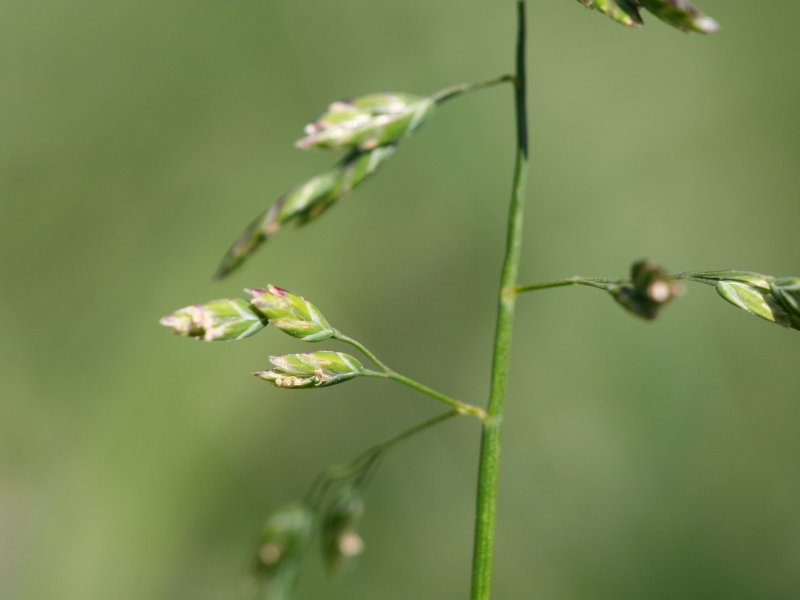
Its inflorescence is a one-sided panicle measuring 3–12 cm long. The panicles contain normal florets and vegetative bulbils, which measure 5–15 mm in length.[4][5][6]
Habitat
Bulbous bluegrass commonly inhabits disturbed sites, roadsides, and abandoned fields. In the western United States, it occurs in perennial and annual grasslands, chaparral, pinyon-juniper woodlands, riparian communities, sagebrush-steppe vegetation, and openings in coniferous forests.[7][8][9][10][11]
Basal bulbs are more commonly produced in habitats with periodic dry seasons than in moist habitats.[12]
Behaviour
Bulbous bluegrass can become dominant in disturbed habitats, including overgrazed fields.[13]
Reproduction and life cycle
Some populations reproduce primarily through seeds, while others rely mainly on basal bulb growth or bulbil production. Its normal florets are wind-pollinated.[14][15]
Plants grown under high temperatures and long-day conditions produce normal florets, while plants exposed to temperatures below 20 °C and short-day conditions produce bulbils. Long days with low temperatures or short days with high temperatures can result in panicles containing both florets and bulbils.[16][17][18]
Small mammals cache and disperse its bulbils.[19]
Diet
Wild and domesticated ruminants, small mammals, and birds consume bulbous bluegrass. Animals particularly consume its inflorescence bulbils, which contain starches and fats.[20][21][22]
Conservation
Bulbous bluegrass is classified as a noxious weed in some areas. It has no special federal legal status in the United States.[23][24]
Uses
Bulbous bluegrass has been intentionally planted to control weeds and prevent erosion. It has also been used to seed disturbed sites throughout the United States.[25][26]
It is used as fodder and pasture grass in parts of its native range.[27]
Classification of the Bulbous Bluegrass
| Kingdom | Plantae |
|---|---|
| Subkingdom | Pteridobiotina |
| Phylum | Tracheophyta |
| Class | Liliopsida |
| Order | Poales |
| Family | Poaceae (Turf) |
| Genus | Poa (Bluegrass) |
| Species | Poa bulbosa L. |
Where the Bulbous Bluegrass is found
Checklists and occurrence records place Poa bulbosa in 77 countries across Africa, Asia, Europe, North America, Oceania and South America. GBIF holds 110,146 georeferenced records of it.
Countries where it is native or its origin is not stated
- Afghanistan 164
- Albania 27
- Algeria 79
- Andorra 7
- Armenia 116
- Austria 752
- Azerbaijan 47
- Belarus 7
- Belgium 474
- Bosnia and Herzegovina 24
- Bulgaria 232
- China 41
- Croatia 111
- Cyprus 101
- Czechia 953
- Denmark 267
- Egypt 13
- Estonia 12
- Finland 59
- France 53,113
- Georgia 68
- Germany 2,423
- Greece 672
- Hungary 337
- India 40
- Iran 316
- Iraq 101
- Ireland
- Israel 2,380
- Italy 1,698
- Japan 43
- Jordan 80
- Kazakhstan 714
- Kosovo 5
- Kyrgyzstan 45
- Lebanon 75
- Libya 9
- Lithuania 4
- Luxembourg 45
- Moldova 29
- Montenegro 15
- Morocco 114
- Nepal 6
- North Macedonia 25
- Norway 41
- Oman 1
- Pakistan 58
- Palestinian Territory 172
- Poland 196
- Portugal 954
- Romania 68
- Russia 2,958
- Saudi Arabia 9
- Serbia 22
- Slovakia 792
- Slovenia 29
- South Africa 114
- South Korea 14
- Spain 9,719
- Sudan 15
- Sweden 3,227
- Switzerland 4,594
- Syria 78
- Tajikistan 27
- The Netherlands 1,647
- Tunisia 27
- Turkey 583
- Turkmenistan 52
- Ukraine 4,530
- United Kingdom 2,174
- Uzbekistan 264
Countries where it has been introduced
Regions and cities with the most records
- Auvergne-Rhône-Alpes, France 19,944
- Provence-Alpes-Côte d'Azur, France 13,063
- Occitanie, France 7,244
- Bourgogne-Franche-Comté, France 2,459
- Centre-Val de Loire, France 2,225
- Île-de-France, France 2,068
- Valais, Switzerland 1,969
- Catalonia, Spain 1,931
- Kherson, Ukraine 1,823
- California, United States 1,670
- England, United Kingdom 1,403
- Valencia, Spain 1,295
- Kalmar, Sweden 1,272
- British Columbia, Canada 1,174
- Corsica, France 1,077
- Victoria, Australia 1,010
- Étampes, France 934
- Vaud, Switzerland 926
- Valence, France 905
- South Australia, Australia 888
- Manosque, France 860
- Hauts-de-France, France 858
- Miramas, France 852
- Washington, United States 842
- Romans-sur-Isère, France 820
- Bourg-lès-Valence, France 798
- Istres, France 798
- Montélimar, France 788
- Échirolles, France 763
- Fos-sur-Mer, France 726
- Annonay, France 720
- Vénissieux, France 696
- Grenoble, France 684
- Madrid, Spain 681
- Carpentras, France 680
- Nice, France 672
2 more countries have a few records outside this range
These countries hold a few records of Poa bulbosa but lie outside the range the checklists give for it. Such records are often zoo or garden specimens, museum material or vagrants, so the species is not counted as occurring there.
A number beside a place is its count of GBIF occurrence records. A place without a number comes from a checklist alone. Records show where a species has been observed or collected, which can include escapes and vagrants.
Common names
English
- Bulbous Bluegrass
- Bulbous Meadow-Grass
- Bulbous Meadowgrass
- Bulbous Poa
- Bulbous Speargrass
Names in 12 other languages
- Chinese
- lin jing zao shu he
- Danish
- Løg-rapgræs, Løgrodet rapgræs
- Dutch
- Knolbeemdgras, Knolbeemdgras var. bulbosa, Knolbeemdgras var. vivipara
- Finnish
- sipulinurmikka
- French
- pâturin bulbeux
- German
- Artengruppe Knolliges Rispengras, Zwiebel-Rispengras, knolliges Rispengras
- Norwegian Bokmål
- løkrapp
- Norwegian Nynorsk
- laukrapp
- Russian
- mjatlik lukovičnyj
- Spanish
- grama cebollera
- Swedish
- knölgröe
- Welsh
- Gweunwellt Oddfog
Synonyms
58 other scientific names have been used for this species and are now treated as synonyms of Poa bulbosa.
- Paneion bulbosum (L.) Lundell
- Paneion bulbosum var. viviparum (Koeler) Lunell
- Poa attenuata var. desertorum (Trin.) Griseb.
- Poa briziformis Trab.
- Poa bulbillifera Chrtek & Hadac
- Poa bulbosa
- Poa bulbosa f. briziformis (Trab.) Maire
- Poa bulbosa f. patens Roshev.
- Poa bulbosa f. pubescens Neuman
- Poa bulbosa f. vivipara (Borkh.) Wirtg.
- Poa bulbosa f. vivipara (Koeler) Maire
- Poa bulbosa prol. pseudoconcinna (Schur) Asch. & Graebn.
- Poa bulbosa subsp. bulbosa
- Poa bulbosa subsp. crispa (Thuill.) Tzvelev
- Poa bulbosa subsp. crispa (Thuill.) Dumort.
- Poa bulbosa subsp. eu-bulbosa
- Poa bulbosa subsp. leucoglossa Velen.
- Poa bulbosa subsp. nevskii (Roshev. ex Ovcz.) Tzvelev
- Poa bulbosa subsp. perligulata H.Scholz
- Poa bulbosa subsp. praecox (Borbás) Nyman
- Poa bulbosa subsp. pseudoconcinna (Schur) Asch. & Graebn.
- Poa bulbosa subsp. pseudoconcinna (Schur) Domin
- Poa bulbosa subsp. vivipara (Koeler) Arcang.
- Poa bulbosa var. briziformis Trab.
- Poa bulbosa var. bulbosa
- Poa bulbosa var. crispa (Thuill.) Asch.
- Poa bulbosa var. crispa (Thuill.) Mérat
- Poa bulbosa var. elanata Stapf
- Poa bulbosa var. psammophila (Schur) Asch. & Graebn.
- Poa bulbosa var. pseudoconcinna (Schur) Hegi
- Poa bulbosa var. verticillata Coss. & Germ.
- Poa bulbosa var. vivipara Koeler
- Poa bulbosa var. vivipara Roth
- Poa bulbosa vivipara Koch
- Poa bulbosa vivipara (Koeler) Asch. & Graebn.
- Poa cephalonica H.Scholz
- Poa compressa d'Urv.
- Poa crassipes Domin
- Poa desertorum Trin.
- Poa eigii Feinbrun
Showing 40 of 58.
Related species
-
 Kentucky BluegrassPoa pratensis
-
 Annual BluegrassPoa annua
-
 Rough BluegrassPoa trivialis
-
 Common Tussock-grassPoa labillardierei
-
 Alpine Meadow GrassPoa alpina
-
 Tussac GrassPoa flabellata
-
 Sandberg BluegrassPoa secunda
-
 Snow GrassPoa sieberiana
Compare
Questions and answers
What is the scientific name of the Bulbous Bluegrass?
The scientific name of the Bulbous Bluegrass is Poa bulbosa. Written with its author, the full name is Poa bulbosa L..
Which family does the Bulbous Bluegrass belong to?
Poa bulbosa belongs to the family Poaceae, in the order Poales and the class Liliopsida.
Where is the Bulbous Bluegrass found?
Checklists and occurrence records place Poa bulbosa in 77 countries, including France, Spain, Switzerland, Ukraine, Sweden and Russia.
What other names does the Bulbous Bluegrass have?
Poa bulbosa is also known in English as Bulbous Meadow-Grass, Bulbous Meadowgrass, Bulbous Poa and Bulbous Speargrass.
Sources
Passages the profile rests on
- Its basal leaves are flat to involute and measure 1–3 mm wide and 5–15 cm long. Source passage: “Basal leaves are flat to involute, 1 to 3 mm wide, and 2 to 6 inches (5-15 cm) long” — fs.usda.gov
- Its stems measure approximately 15–70 cm in height. Source passage: “measure 6 to 28 inches (15-70 cm) tall” — fs.usda.gov
- Its roots measure approximately 1–10 cm in length. Source passage: “These roots range from 0.4 to 4 inches (1-10 cm) long” — fs.usda.gov
- Its inflorescence is a one-sided panicle measuring 3–12 cm long. Source passage: “On its 1- to 4.5-inch (3-12 cm) long, one-sided panicle” — fs.usda.gov
- Its panicles contain both normal florets and vegetative bulbils. Source passage: “bulbous bluegrass produces 2 types of spikelets: one typically has 3 to 6 normal florets; the other is a viviparous bulbil or bulblet without pistils or stamens” — fs.usda.gov
- Its bulbils measure 5–15 mm in length. Source passage: “measure 5 to 15 mm long” — fs.usda.gov
- It commonly inhabits disturbed sites, roadsides, and abandoned fields. Source passage: “Disturbed sites, roadsides, and abandoned fields are common bulbous bluegrass habitats.” — fs.usda.gov
- In the western United States, it occurs in perennial and annual grasslands. Source passage: “In the western United States, it occurs in perennial and annual grasslands” — fs.usda.gov
- It occurs in chaparral and pinyon-juniper woodlands in the western United States. Source passage: “chaparral, pinyon-juniper (Pinus-Juniperus spp.) woodlands” — fs.usda.gov
- It occurs in riparian communities and sagebrush-steppe vegetation. Source passage: “riparian communities, sagebrush (Artemisia spp.)- steppe vegetation” — fs.usda.gov
- It also inhabits openings in coniferous forests. Source passage: “and openings in coniferous forests.” — fs.usda.gov
- Its basal bulbs are more commonly produced in habitats with periodic dry seasons than in moist habitats. Source passage: “Studies of bulbous bluegrass in its native habitats showed that bulbs were common in regions that experienced a periodic dry season but not in moist areas.” — fs.usda.gov
- It can become dominant in disturbed habitats, including overgrazed fields. Source passage: “becomes the dominant species in disturbed habitat types, such as overgrazed fields.” — English Wikipedia
- Some populations reproduce primarily through seeds, while others rely mainly on basal bulb growth or bulbil production. Source passage: “Some bulbous bluegrass populations reproduce primarily by seed, while in others reproduction is dominated by basal bulb growth and/or bulbil production.” — fs.usda.gov
- Its normal florets are wind-pollinated. Source passage: “When true florets are produced, they are wind pollinated” — fs.usda.gov
- Plants grown under high temperatures and long-day conditions produce normal florets. Source passage: “Plants grown under high temperature (70-81 °F (21-27 °C)) and long day (16 hours of light) conditions produced normal florets.” — fs.usda.gov
- Plants exposed to temperatures below 20 °C and short-day conditions produce bulbils. Source passage: “Plants produced bulbils when grown at lower temperatures (68 °F (<20 °C)) and exposed to shorter days (8 hours of light).” — fs.usda.gov
- Plants exposed to long days with low temperatures or short days with high temperatures can produce panicles containing both florets and bulbils. Source passage: “Plants exposed to long day and low temperature or short day and high temperature conditions produced panicles with both florets and bulbils.” — fs.usda.gov
- Small mammals cache and disperse its bulbils. Source passage: “Small mammals cache and disperse bulbous bluegrass bulbils” — fs.usda.gov
- Wild and domesticated ruminants, small mammals, and birds consume this grass. Source passage: “Many types of animals, including wild and domesticated ruminants, small mammals, and birds, readily consume this grass” — English Wikipedia
- Animals particularly consume its inflorescence bulbils. Source passage: “especially the bulbils in the inflorescences” — English Wikipedia
- Its bulbils contain starches and fats. Source passage: “which contain some starches and fats.” — English Wikipedia
- It is classified as a noxious weed in some areas. Source passage: “and is a noxious weed in some areas.” — English Wikipedia
- It has no special federal legal status in the United States. Source passage: “FEDERAL LEGAL STATUS: No special status” — fs.usda.gov
- It has been intentionally planted to control weeds and prevent erosion. Source passage: “It was intentionally planted on both the east and west coasts to control weeds and prevent erosion.” — English Wikipedia
- It has been used to seed disturbed sites throughout the United States. Source passage: “Bulbous bluegrass has been used to seed disturbed sites throughout the United States” — fs.usda.gov
- It is used as fodder and pasture grass in parts of its native range. Source passage: “The grass is used as a fodder and a pasture grass in parts of its native region.” — English Wikipedia
Data
- Catalogue of Life, 2026-10-16 XR cc by
- Global Biodiversity Information Facility CC BY 4.0
- Wikidata CC0
- GeoNames CC BY 4.0
- Wikimedia Commons per image; credit shown with each image
- Within the Catalogue of Life, this name comes from The World Checklist of Vascular Plants (WCVP) cc by
References
- Sp. Pl. 1: 70. 1753 [1 May 1753] Link where the name was published
This species in other databases
Page built on 28 November 2026. See how the catalog is made and all sources and licences.
Cite this page
ScientificNames.org. (2026). Poa bulbosa (Bulbous Bluegrass). Retrieved November 28, 2026, from https://scientificnames.org/species/poa-bulbosa
“Poa bulbosa (Bulbous Bluegrass).” ScientificNames.org, 2026, scientificnames.org/species/poa-bulbosa. Accessed 28 Nov. 2026.
ScientificNames.org. “Poa bulbosa (Bulbous Bluegrass).” Accessed November 28, 2026. https://scientificnames.org/species/poa-bulbosa.
@misc{scientificnames_poa_bulbosa_bulbous_bluegrass,
  author = {{ScientificNames.org}},
  title = {Poa bulbosa (Bulbous Bluegrass)},
  year = {2026},
  url = {https://scientificnames.org/species/poa-bulbosa},
  note = {Accessed 2026-11-28}
}